2000 YAMAHA XVZ1300TF wheel
[x] Cancel search: wheelPage 57 of 121

5-1
5
EAU01114
5-PRE-OPERATION CHECKSOwners are personally responsible for their vehicle’s condition. Your motorcycle’s vital functions can start to deteriorate
quickly and unexpectedly, even if it remains unused (for instance, if it is exposed to the elements). Any damage, fluid leak or
loss of tire pressure could have serious consequences. Therefore, it is very important that, in addition to a thorough visual in-
spection, you check the following points before each ride.
EAU00340
PRE-OPERATION CHECK LIST
ITEM CHECKS PAGE
Front brake• Check operation, fluid level and vehicle for fluid leakage.
• Fill with DOT 4 brake fluid if necessary.
7-23 ~ 7-26
Rear brake• Check operation, fluid level and vehicle for fluid leakage.
• Fill with DOT 4 brake fluid if necessary.
Clutch• Check operation, fluid level and vehicle for fluid leakage.
• Fill with DOT 4 brake fluid if necessary.7-22
Throttle grip and housing• Check for smooth operation.
• Lubricate if necessary.7-18
Engine oil• Check oil level.
• Fill with oil if necessary.7-11 ~ 7-13
Coolant reservoir tank• Check coolant level.
• Fill with coolant if necessary.7-14
Final gear oil• Check vehicle for leakage. 7-13
Wheels and tires• Check tire pressure, wear and for damage. 7-19 ~ 7-22
Brake and shift pedal
shafts• Check for smooth operation.
• Lubricate if necessary.7-27
Brake and clutch lever
pivots• Check for smooth operation.
• Lubricate if necessary.7-27
Sidestand pivot• Check for smooth operation.
• Lubricate if necessary.7-28
E_5jc_Preop.fm Page 1 Saturday, October 16, 1999 1:10 PM
Page 66 of 121

7
PERIODIC MAINTENANCE AND MINOR REPAIR
Tool kit................................................................... 7-1
Periodic maintenance and lubrication ................... 7-3
Cowling and panel removal and installation.......... 7-6
Cowling A.............................................................. 7-6
Cowling B.............................................................. 7-7
Panel C ................................................................. 7-8
Panel D ................................................................. 7-8
Panel E ................................................................. 7-9
Spark plug inspection ......................................... 7-10
Engine oil ............................................................ 7-11
Final gear oil ....................................................... 7-13
Coolant ............................................................... 7-14
Air filters .............................................................. 7-15
Carburetor adjustment ........................................ 7-17
Idle speed adjustment ........................................ 7-17
Throttle cable free play inspection ...................... 7-18
Valve clearance adjustment ................................ 7-18
Tires .................................................................... 7-19
Wheels ................................................................ 7-21
Clutch lever free play adjustment........................ 7-22Front brake lever free play adjustment ............... 7-23
Rear brake pedal height adjustment .................. 7-23
Brake light switch adjustment ............................. 7-24
Checking the front and rear brake pads ............. 7-25
Inspecting the brake fluid level ........................... 7-25
Brake fluid replacement ..................................... 7-26
Brake and shift pedal lubrication ........................ 7-27
Brake and clutch lever lubrication ...................... 7-27
Sidestand lubrication.......................................... 7-28
Front fork inspection ........................................... 7-28
Steering inspection ............................................ 7-29
Battery................................................................ 7-29
Fuse replacement .............................................. 7-31
Headlight bulb replacement ............................... 7-32
Turn signal and tail/brake light bulb
replacement ..................................................... 7-33
License light bulb replacement........................... 7-34
Troubleshooting .................................................. 7-34
Troubleshooting charts ....................................... 7-35
E_5jc_PeriodicTOC.fm Page 1 Saturday, October 16, 1999 1:10 PM
Page 69 of 121
PERIODIC MAINTENANCE AND MINOR REPAIR
7-3
7
EAU00473
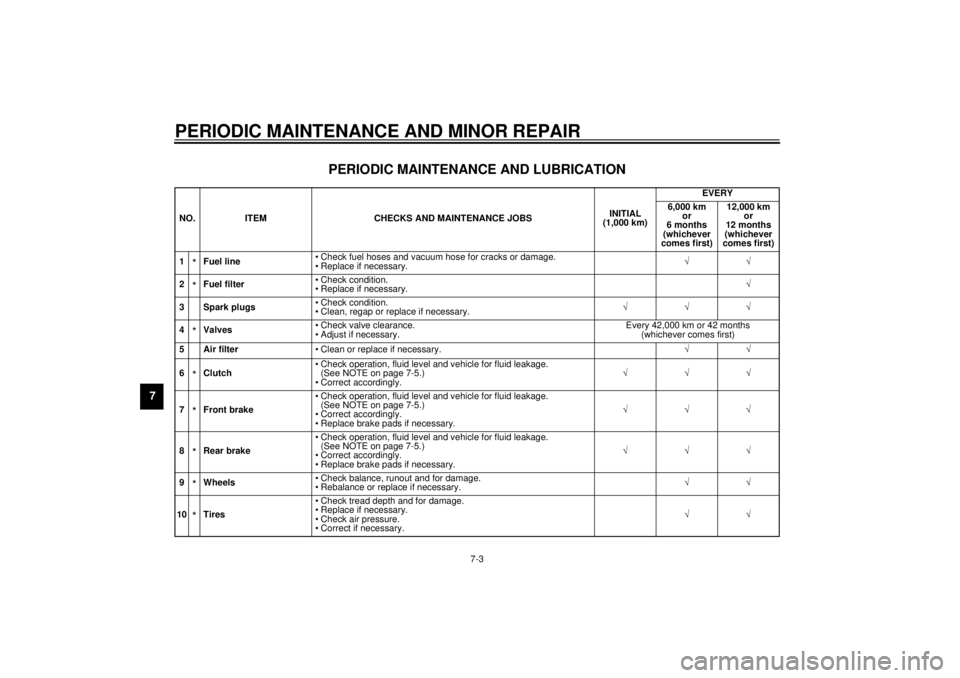
PERIODIC MAINTENANCE AND LUBRICATION
CP-01ENO. ITEM CHECKS AND MAINTENANCE JOBSINITIAL
(1,000 km)EVERY
6,000 km
or
6 months
(whichever
comes first)12,000 km
or
12 months
(whichever
comes first)
1
*Fuel line• Check fuel hoses and vacuum hose for cracks or damage.
• Replace if necessary.ÖÖ
2*Fuel filter• Check condition.
• Replace if necessary.Ö
3 Spark plugs• Check condition.
• Clean, regap or replace if necessary.ÖÖÖ
4*Valves• Check valve clearance.
• Adjust if necessary.Every 42,000 km or 42 months
(whichever comes first)
5 Air filter• Clean or replace if necessary.ÖÖ
6*Clutch• Check operation, fluid level and vehicle for fluid leakage.
(See NOTE on page 7-5.)
• Correct accordingly. ÖÖÖ
7*Front brake• Check operation, fluid level and vehicle for fluid leakage.
(See NOTE on page 7-5.)
• Correct accordingly.
• Replace brake pads if necessary.ÖÖÖ
8*Rear brake• Check operation, fluid level and vehicle for fluid leakage.
(See NOTE on page 7-5.)
• Correct accordingly.
• Replace brake pads if necessary.ÖÖÖ
9*Wheels• Check balance, runout and for damage.
• Rebalance or replace if necessary.ÖÖ
10*Tires• Check tread depth and for damage.
• Replace if necessary.
• Check air pressure.
• Correct if necessary.ÖÖ
E_5jc_Periodic.fm Page 3 Saturday, October 16, 1999 1:10 PM
Page 70 of 121

PERIODIC MAINTENANCE AND MINOR REPAIR
7-4
7
11
*Wheel bearings• Check bearing for looseness or damage.
• Replace if necessary. ÖÖ
12*Swingarm• Check swingarm pivoting point for play.
• Correct if necessary.
• Lubricate with molybdenum disulfide grease every 24,000 km or
24 months (whichever comes first).ÖÖ
13*Steering bearings• Check bearing play and steering for roughness.
• Correct accordingly.
• Lubricate with lithium soap base grease every 24,000 km
or 24 months (whichever comes first).ÖÖ
14*Chassis fasteners• Make sure that all nuts, bolts and screws are properly tightened.
• Tighten if necessary.ÖÖ
15 Sidestand• Check operation.
• Lubricate and repair if necessary.ÖÖ
16*Sidestand switch• Check operation.
• Replace if necessary.ÖÖÖ
17*Front fork• Check operation and for oil leakage.
• Correct accordingly.ÖÖ
18*Rear shock absorber
assembly• Check operation and shock absorber for oil leakage.
• Replace shock absorber assembly if necessary. ÖÖ
19*Rear suspension relay
arm and connecting arm
pivoting points• Check operation.
• Lubricate with molybdenum disulfide grease every 24,000 km or
24 months (whichever comes first).ÖÖ
20*Carburetors• Check engine idling speed, synchronization and starter operation.
• Adjust if necessary.ÖÖÖ
21 Engine oil• Check oil level and vehicle for oil leakage.
• Correct if necessary.
• Change. (Warm engine before draining.)ÖÖÖ
22 Engine oil filter cartridge• Replace.ÖÖ NO. ITEM CHECKS AND MAINTENANCE JOBSINITIAL
(1,000 km)EVERY
6,000 km
or
6 months
(whichever
comes first)12,000 km
or
12 months
(whichever
comes first)
E_5jc_Periodic.fm Page 4 Saturday, October 16, 1999 1:10 PM
Page 86 of 121
PERIODIC MAINTENANCE AND MINOR REPAIR
7-20
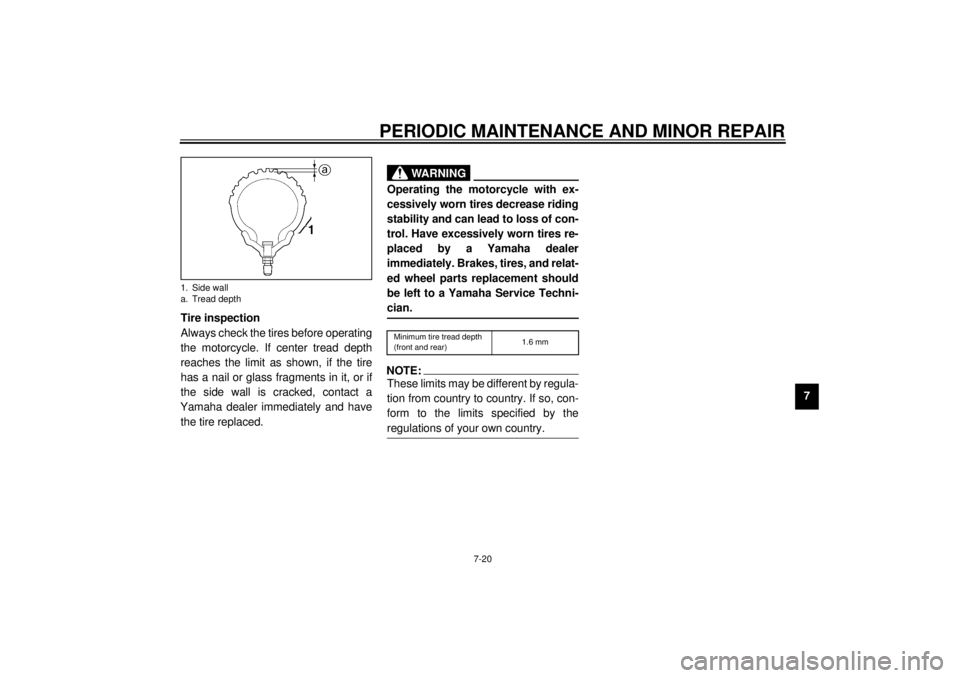
7 Tire inspection
Always check the tires before operating
the motorcycle. If center tread depth
reaches the limit as shown, if the tire
has a nail or glass fragments in it, or if
the side wall is cracked, contact a
Yamaha dealer immediately and have
the tire replaced.
EW000079
WARNING
@ Operating the motorcycle with ex-
cessively worn tires decrease riding
stability and can lead to loss of con-
trol. Have excessively worn tires re-
placed by a Yamaha dealer
immediately. Brakes, tires, and relat-
ed wheel parts replacement should
be left to a Yamaha Service Techni-
cian. @CE-26ENOTE:@ These limits may be different by regula-
tion from country to country. If so, con-
form to the limits specified by the
regulations of your own country. @
1. Side wall
a. Tread depth
Minimum tire tread depth
(front and rear)1.6 mm
E_5jc_Periodic.fm Page 20 Saturday, October 16, 1999 1:10 PM
Page 87 of 121
PERIODIC MAINTENANCE AND MINOR REPAIR
7-21
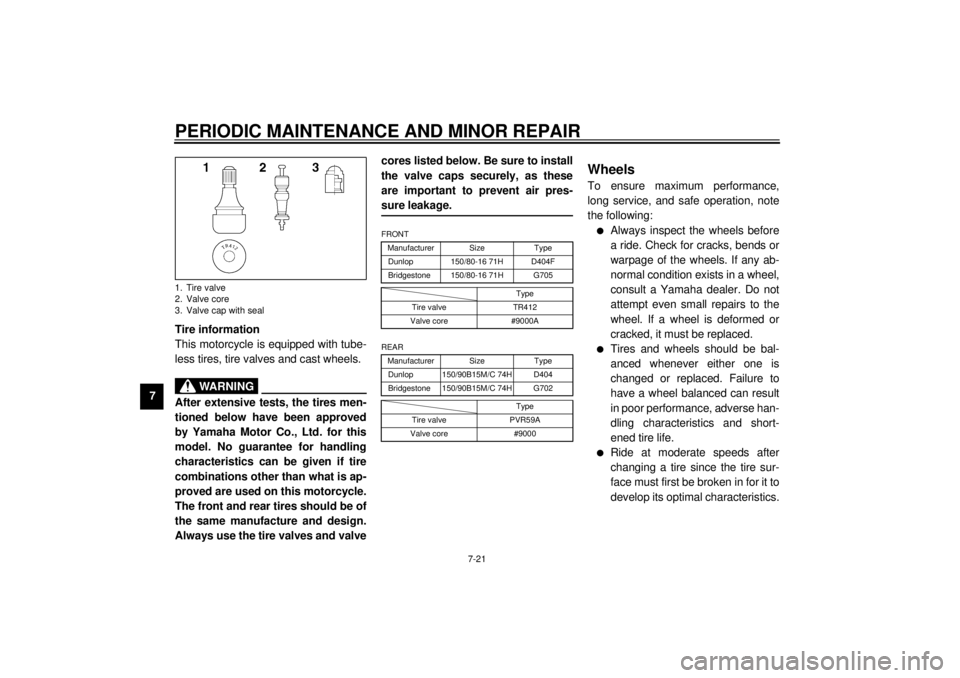
7Tire information
This motorcycle is equipped with tube-
less tires, tire valves and cast wheels.
EW000132
WARNING
@ After extensive tests, the tires men-
tioned below have been approved
by Yamaha Motor Co., Ltd. for this
model. No guarantee for handling
characteristics can be given if tire
combinations other than what is ap-
proved are used on this motorcycle.
The front and rear tires should be of
the same manufacture and design.
Always use the tire valves and valvecores listed below. Be sure to install
the valve caps securely, as these
are important to prevent air pres-
sure leakage.
@CE-41E
CE-42EEAU01230
WheelsTo ensure maximum performance,
long service, and safe operation, note
the following:l
Always inspect the wheels before
a ride. Check for cracks, bends or
warpage of the wheels. If any ab-
normal condition exists in a wheel,
consult a Yamaha dealer. Do not
attempt even small repairs to the
wheel. If a wheel is deformed or
cracked, it must be replaced.
l
Tires and wheels should be bal-
anced whenever either one is
changed or replaced. Failure to
have a wheel balanced can result
in poor performance, adverse han-
dling characteristics and short-
ened tire life.
l
Ride at moderate speeds after
changing a tire since the tire sur-
face must first be broken in for it to
develop its optimal characteristics.
1. Tire valve
2. Valve core
3. Valve cap with seal
FRONT
Manufacturer Size Type
Dunlop 150/80-16 71H D404F
Bridgestone 150/80-16 71H G705
Type
Tire valve TR412
Valve core #9000A
REAR
Manufacturer Size Type
Dunlop 150/90B15M/C 74H D404
Bridgestone 150/90B15M/C 74H G702
Type
Tire valve PVR59A
Valve core #9000
E_5jc_Periodic.fm Page 21 Saturday, October 16, 1999 1:10 PM
Page 95 of 121
PERIODIC MAINTENANCE AND MINOR REPAIR
7-29
7
EAU00794
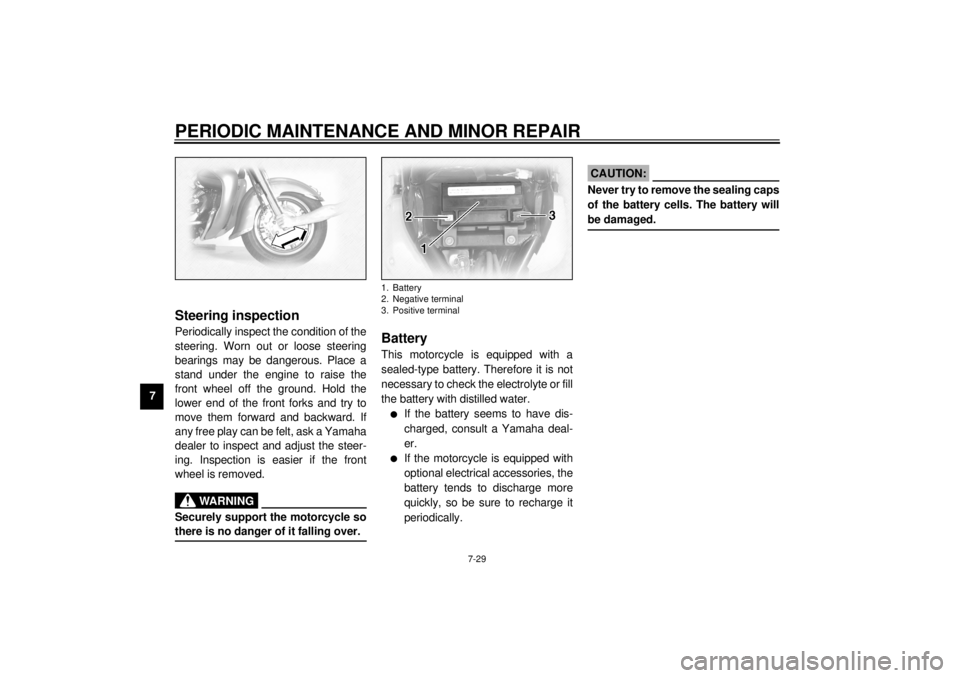
Steering inspectionPeriodically inspect the condition of the
steering. Worn out or loose steering
bearings may be dangerous. Place a
stand under the engine to raise the
front wheel off the ground. Hold the
lower end of the front forks and try to
move them forward and backward. If
any free play can be felt, ask a Yamaha
dealer to inspect and adjust the steer-
ing. Inspection is easier if the front
wheel is removed.
EW000115
WARNING
@ Securely support the motorcycle so
there is no danger of it falling over. @
EAU00800
BatteryThis motorcycle is equipped with a
sealed-type battery. Therefore it is not
necessary to check the electrolyte or fill
the battery with distilled water.l
If the battery seems to have dis-
charged, consult a Yamaha deal-
er.
l
If the motorcycle is equipped with
optional electrical accessories, the
battery tends to discharge more
quickly, so be sure to recharge it
periodically.
EC000101
CAUTION:@ Never try to remove the sealing caps
of the battery cells. The battery will
be damaged. @
1. Battery
2. Negative terminal
3. Positive terminal
E_5jc_Periodic.fm Page 29 Saturday, October 16, 1999 1:10 PM
Page 105 of 121
8-1
8
EAU01845
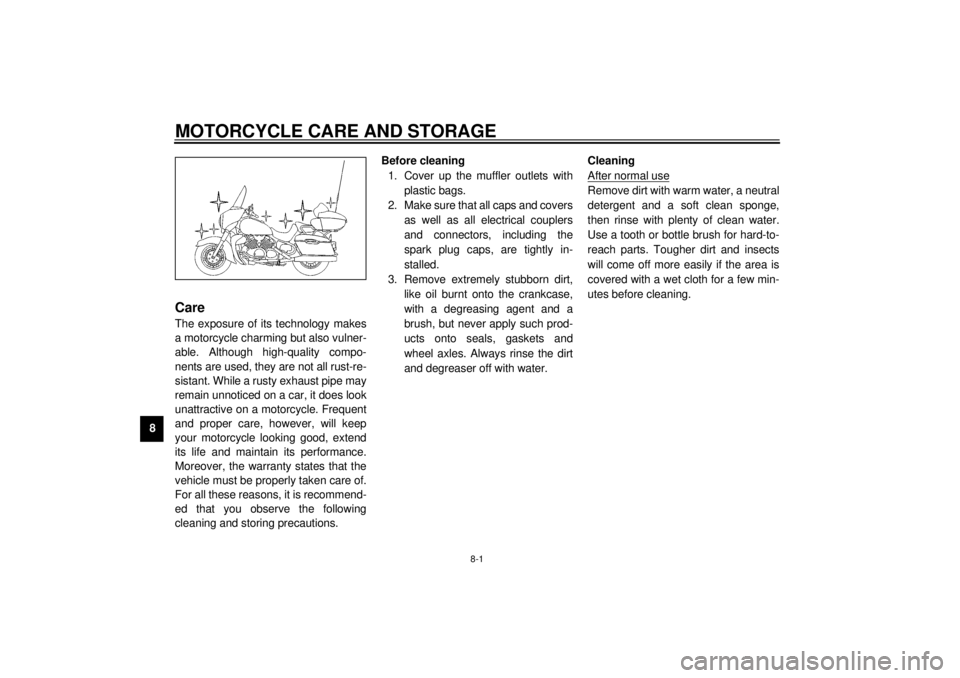
8-MOTORCYCLE CARE AND STORAGECareThe exposure of its technology makes
a motorcycle charming but also vulner-
able. Although high-quality compo-
nents are used, they are not all rust-re-
sistant. While a rusty exhaust pipe may
remain unnoticed on a car, it does look
unattractive on a motorcycle. Frequent
and proper care, however, will keep
your motorcycle looking good, extend
its life and maintain its performance.
Moreover, the warranty states that the
vehicle must be properly taken care of.
For all these reasons, it is recommend-
ed that you observe the following
cleaning and storing precautions.Before cleaning
1. Cover up the muffler outlets with
plastic bags.
2. Make sure that all caps and covers
as well as all electrical couplers
and connectors, including the
spark plug caps, are tightly in-
stalled.
3. Remove extremely stubborn dirt,
like oil burnt onto the crankcase,
with a degreasing agent and a
brush, but never apply such prod-
ucts onto seals, gaskets and
wheel axles. Always rinse the dirt
and degreaser off with water.Cleaning
After normal use
Remove dirt with warm water, a neutral
detergent and a soft clean sponge,
then rinse with plenty of clean water.
Use a tooth or bottle brush for hard-to-
reach parts. Tougher dirt and insects
will come off more easily if the area is
covered with a wet cloth for a few min-
utes before cleaning.
E_5jc_Cleaning.fm Page 1 Saturday, October 16, 1999 1:12 PM