Page 32 of 96
OPERATION AND IMPORTANT RIDING POINTS
Starting the engine.............................................................................5-1
Starting a warm engine.......................................................................5-3
Shifting................................................................................................5-4
Recommended shift point (for Switzerland only)................................5-4
Tips for reducing fuel consumption.....................................................5-5
Engine break-in..................................................................................5-5
Parking...............................................................................................5-6
5
4PT-9-E6 (ENG) 1~5 12/27/00 1:28 PM Page 31
Page 35 of 96

5-3
1.Turn the fuel cock to ÒONÓ.
2.Turn the main switch to ÒONÓ and
the engine stop switch to Ò#Ó.
3.Shift the transmission into neu-
tral.NOTE:
When the transmission is in neutral,
the neutral indicator light should be
on. If the light does not come on, ask
a Yamaha dealer to inspect it.4.Turn on the starter (choke) and
completely close the throttle grip.
5.Start the engine by pushing the
start switch.
NOTE:
If the engine fails to start, release the
start switch, wait a few seconds, then
try again. Each attempt should be as
short as possible to preserve the bat-
tery. Do not crank the engine more
than 10 seconds on any one attempt.6.After starting the engine, move
the starter (choke) to the halfway
position.NOTE:
For maximum engine life, never
accelerate hard with a cold engine!7.After warming up the engine,
turn off the starter (choke) com-
pletely.NOTE:
The engine is warm when it responds
normally to the throttle with the starter
(choke) turned off.
EAU01258
Starting a warm engineThe starter (choke) is not required
when the engine is warm.
EC000046
cCSee the ÒEngine break-inÓ section
prior to operating the motorcycle
for the first time.
OPERATION AND IMPORTANT RIDING POINTS
1
2
3
45
6
7
8
94PT-9-E6 (ENG) 1~5 12/27/00 1:28 PM Page 34
Page 37 of 96

5-5
EAU00436
Engine break-inThere is never a more important peri-
od in the life of your motorcycle than
the period between zero and 1,000
km. For this reason we ask that you
carefully read the following material.
Because the engine is brand new,
you must not put an excessive load
on it for the first 1,000 km. The vari-
ous parts in the engine wear and pol-
ish themselves to the correct operat-
ing clearances. During this period,
prolonged full throttle operation, or
any condition which might result in
excessive heating of the engine,
must be avoided.
EAU00440
0 ~ 150 km
Avoid operation above 4,000 r/min.
Stop the engine and let it cool for 5 to
10 minutes after every hour of opera-
tion. Vary the speed of the motorcy-
cle from time to time. Do not operate
it at one set throttle position.
150 ~ 500 km
Avoid prolonged operation above
5,000 r/min. Rev the motorcycle
freely through the gears, but do not
use full throttle at any time.
500 ~ 1,000 km
Avoid prolonged full throttle opera-
tion. Avoid cruising speeds in excess
of 6,000 r/min.
OPERATION AND IMPORTANT RIDING POINTS
1
2
3
45
6
7
8
9
EAU00424
Tips for reducing fuel
consumptionYour motorcycleÕs fuel consumption
depends to a large extent on your rid-
ing style. The following tips can help
reduce fuel consumption:
8Warm up the engine before rid-
ing.
8Turn off the starter (choke) as
soon as possible.
8Shift up swiftly and avoid high
engine speeds during accelera-
tion.
8Do not double-clutch or rev the
engine while shifting down and
avoid high engine speeds with
no load on the engine.
8Turn off the engine instead of let-
ting it idle for an extended length
of time, i.e. in traffic jams, at traf-
fic lights or railroad crossings.
4PT-9-E6 (ENG) 1~5 12/27/00 1:28 PM Page 36
Page 38 of 96
5-6
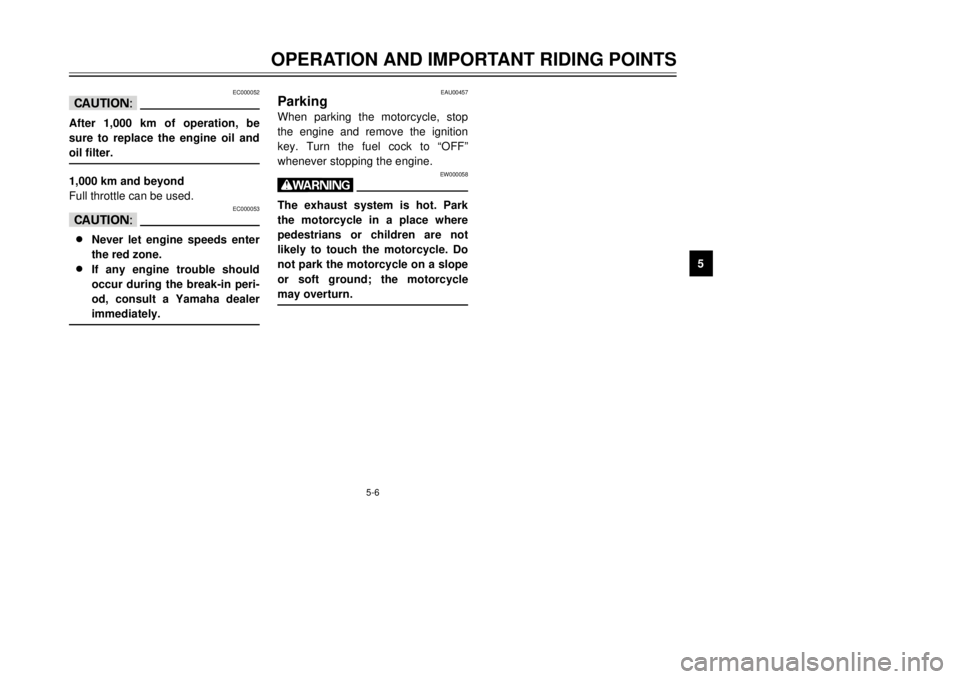
EC000052
cCAfter 1,000 km of operation, be
sure to replace the engine oil and
oil filter.1,000 km and beyond
Full throttle can be used.
EC000053
cC8
8
Never let engine speeds enter
the red zone.
8 8
If any engine trouble should
occur during the break-in peri-
od, consult a Yamaha dealer
immediately.
EAU00457
ParkingWhen parking the motorcycle, stop
the engine and remove the ignition
key. Turn the fuel cock to ÒOFFÓ
whenever stopping the engine.
EW000058
wThe exhaust system is hot. Park
the motorcycle in a place where
pedestrians or children are not
likely to touch the motorcycle. Do
not park the motorcycle on a slope
or soft ground; the motorcycle
may overturn.OPERATION AND IMPORTANT RIDING POINTS
1
2
3
45
6
7
8
9
4PT-9-E6 (ENG) 1~5 12/27/00 1:28 PM Page 37
Page 43 of 96

6-3
PERIODIC MAINTENANCE AND MINOR REPAIR
1
2
3
4
56
7
8
9
EAU03685
Periodic maintenance and lubrication chart
NOTE:
8The annual checks must be performed every year, except if a kilometer-based maintenance is performed instead.
8From 50,000 km, repeat the maintenance intervals starting from 10,000 km.
8Items marked with an asterisk should be performed by a Yamaha dealer as they require special tools, data and
technical skills.NO.ITEMCHECK OR MAINTENANCE JOBODOMETER READING (´ 1,000 km)
ANNUAL
CHECK
110203040
1
*Fuel line¥Check fuel hoses for cracks or damage.ÖÖÖÖÖ
2Spark plug¥Check condition.
¥Clean and regap.ÖÖ
¥Replace.ÖÖ
3*Valves¥Check valve clearance.
¥Adjust.ÖÖÖÖ
4Air filter element¥Clean.ÖÖ
¥Replace.ÖÖ
5Clutch¥Check operation.
¥Adjust.ÖÖÖÖÖ
6*Front brake¥Check operation, fluid level and vehicle for fluid leakage.
(See NOTE on page 6-5.)ÖÖÖÖÖÖ
¥Replace brake pads.Whenever worn to the limit
7*Rear brake¥Check operation, fluid level and vehicle for fluid leakage.
(See NOTE on page 6-5.)ÖÖÖÖÖÖ
¥Replace brake pads.Whenever worn to the limit
8*Brake hoses¥Check for cracks or damage.ÖÖÖÖÖ
¥Replace. (See NOTE on page 6-5.)Every 4 years
4PT-9-E6 (ENG) 6 12/27/00 1:29 PM Page 4
Page 55 of 96

6-15
PERIODIC MAINTENANCE AND MINOR REPAIR
1
2
3
4
56
7
8
9
* Load is the total weight of cargo, rider, passenger
and accessories.Maximum load*176 kg (XT500E)
180 kg (XT600E)
Cold tire pressure:FrontRear
150 kPa150 kPa
Up to 90 kg(1.5 kg/cm
2, (1.5 kg/cm
2,
1.5 bar)1.5 bar)
90 kg load ~150 kPa225 kPa
Maximum load*(1.5 kg/cm
2, (2.25 kg/cm
2,
1.5 bar) 2.25 bar)
125 kPa125 kPa
Off-road riding(1.25 kg/cm
2, (1.25 kg/cm
2,
1.25 bar) 1.25 bar)
150 kPa150 kPa
High speed riding(1.5 kg/cm
2, (1.5 kg/cm
2,
1.5 bar) 1.5 bar)
EAU00652
TiresTo ensure maximum performance,
long service and safe operation, note
the following:
Tire air pressure
Always check and adjust the tire
pressure before operating the motor-
cycle.
EW000082
wTire inflation pressure should be
checked and adjusted when the
temperature of the tire equals the
ambient air temperature. Tire infla-
tion pressure must be adjusted
according to total weight of cargo,
rider, passenger, and accessories
(fairing, saddlebags, etc. if
approved for this model), and vehi-
cle speed.
EAU00637
Valve clearance adjustmentThe correct valve clearance changes
with use, resulting in improper fuel/air
supply or engine noise. To prevent
this, the valve clearance must be
adjusted regularly. This adjustment
however, should be left to a profes-
sional Yamaha service technician.
4PT-9-E6 (ENG) 6 12/27/00 1:29 PM Page 16
Page 76 of 96

6-36
INSTRUMENT AND CONTROL FUNCTIONS
1
2
4
56
7
8
9
EAU01008
TroubleshootingAlthough Yamaha motorcycles
receive a rigid inspection before ship-
ment from the factory, trouble may
occur during operation.
Any problem in the fuel, compres-
sion, or ignition systems can cause
poor starting and loss of power. The
troubleshooting chart describes a
quick, easy procedure for making
checks.
If your motorcycle requires any
repair, bring it to a Yamaha dealer.
The skilled technicians at a Yamaha
dealership have the tools, experi-
ence, and know-how to properly ser-
vice your motorcycle. Use only gen-
uine Yamaha parts on your
motorcycle. Imitation parts may look
like Yamaha parts, but they are often
inferior. Conse-quently, they have a
shorter service life and can lead to
expensive repair bills.
5.Push the wheel forward and
remove the drive chain.
6.Pull out the wheel axle, then
remove the wheel assembly by
pulling backwards.NOTE:
8Do not depress the brake pedal
when the disc and caliper are
separated.
8You do not have to disassemble
the chain in order to remove or
install the rear wheel.
EAU01136*
Rear wheel installation1.Install the rear wheel and chain.
Guide the brake disc between
the brake pads. Make sure there
is enough gap between the
brake pads before inserting the
brake disc.
2.Make sure the wheel axle is
inserted from the left-hand side
and that the chain adjusting
plates are installed with the
punched side outward.
3.Install the swingarm end bolts.
4.Adjust the drive chain.
5.Tighten the following parts to the
specified torque.
Tightening torque:
Axle nut:
105 Nm (10.5 m
0kg)
Caliper bracket bolt:
48 Nm (4.8 m
0kg)
Swingarm end bolt:
2.5 Nm (0.25 m0kg)
4PT-9-E6 (ENG) 6 12/27/00 1:29 PM Page 37
Page 77 of 96
6-37
PERIODIC MAINTENANCE AND MINOR REPAIR
1
2
3
4
56
7
8
9
EAU01397
Troubleshooting chart
EW000125
wNever check the fuel system while smoking or in the vicinity of an open flame.1. Fuel
2. Compression
3. Ignition
4. Battery
Use the electric starter.
There is compression.
Go to ignition check.
No compression.
Ask a Yamaha dealer to inspect.Wet.
Dry.Wipe clean with dry cloth and
Ask a Yamaha dealer to inspect.
Check if there is fuel
Enough fuel.
No fuel.
Go to compression check.Supply fuel.
in the fuel tank.
Remove sparkelectrodes. plug and checkOpen throttle half-way and start the
Engine doesn’t start, go to batterycheck. engine. correct spark gap or replace spark plug.
Engine turns over
Engine turns overBattery good.
Check connections
quickly.
slowly.or recharge.Engine doesn’t start, ask a Yamaha
dealer to inspect.
Engine doesn’t start, go to compression check.
Use the electric
starter.
4PT-9-E6 (ENG) 6 12/27/00 1:29 PM Page 38