Page 28 of 104
1
a
b1
RES
This indicates reserve. If you run out
of fuel while riding, move the lever to
this position. Fill the tank at the first
opportunity. Be sure to set the lever
back to “ON” after refueling!EAU02976
Starter (choke) “1”
Starting a cold engine requires a rich-
er air-fuel mixture. A separate starter
circuit supplies this mixture.
Move in direction ato turn on the
starter (choke).
Move in direction bto turn off the
starter (choke).
EAU01619Seat
To remove
Insert the key into the lock and turn it
clockwise.
1. Starter(choke) “1” 1. Unlock
3-13
INSTRUMENT AND CONTROL FUNCTIONS
1
2
3
4
5
6
7
8
9
1
RES
1. Arrow mark pointing to “RES”
RES: reserve position
5AE-9-E3 (ENG) 4/11/0 11:06 AM Page 26
Page 35 of 104
4-2
PRE-OPERATION CHECKS
1
2
3
4
5
6
7
8
9
ITEM CHECKS PAGE
Brake and shift pedal shafts9Check for smooth operation.
6-28 9Lubricate if necessary.
Brake and clutch lever pivots9Check for smooth operation.
9Lubricate if necessary.
Sidestand pivot9Check for smooth operation.
6-28
9Lubricate if necessary.
Chassis fasteners9Make sure that all nuts, bolts, and screws are properly tightened.
—
9Tighten if necessary.
Fuel tank9Check fuel level.
3-9 ~ 3-10
9Fill with fuel if necessary.
Lights, signals and
9Check for proper operation. 6-32 ~ 6-34
switches
NOTE:
Pre-operation checks should be made each time the motorcycle is used. Such an inspection can be accomplished in a
very short time; and the added safety it assures is more than worth the time involved.
w
If any item in the Pre-Operation Check is not working properly, have it inspected and repaired before operating
the motorcycle.
5AE-9-E3 (ENG) 4/11/0 11:06 AM Page 33
Page 37 of 104
OPERATION AND IMPORTANT RIDING POINTS
Starting the engine .............................................................................5-1
Starting a warm engine.......................................................................5-4
Shifting................................................................................................5-4
Recommended shift points (for Switzerland only) ..............................5-5
Tips for reducing fuel consumption.....................................................5-5
Engine break-in ..................................................................................5-5
Parking ...............................................................................................5-6
5
5AE-9-E3 (ENG) 4/11/0 11:06 AM Page 35
Page 40 of 104

5-3
1. Turn the fuel cock to “ON”.
2. Turn the main switch to “ON” and
the engine stop switch to “#“.
3. Shift transmission into neutral.
NOTE:
When the transmission is in neutral,
the neutral indicator light should be
on. If the light does not come on, ask
a Yamaha dealer to inspect it.
4. Turn on the starter (choke) and
completely close the throttle grip.
5. Start the engine by pushing the
start switch.
NOTE:
If the engine fails to start, release the
start switch, wait a few seconds, then
try again. Each attempt should be as
short as possible to preserve the bat-
tery. Do not crank the engine more
than 10 seconds on any one attempt.
EC000034
cC
The oil level indicator light should
come on when the start switch is
pushed and should go off when
the start switch is released. If the
indicator light flickers or remains
on, immediately stop the engine
and check the engine oil level and
for oil leakage. If necessary, fill the
engine with oil and check to see
that the oil level indicator light
goes off. If the light does not go off
even with sufficient oil in the
crankcase or the light does not
come on when pushing the start
switch, consult a Yamaha dealer.
6. After starting the engine, move
the starter (choke) halfway back.
NOTE:
For maximum engine life, never
accelerate hard with a cold engine!
7. After the engine is warm, turn off
the starter (choke) completely.
NOTE:
The engine is warm when it responds
normally to the throttle with the starter
(choke) turned off.
OPERATION AND IMPORTANT RIDING POINTS
1
2
3
4
5
6
7
8
9
5AE-9-E3 (ENG) 4/11/0 11:06 AM Page 38
Page 42 of 104
5-5
EAU00424
Tips for reducing fuel
consumption
Your motorcycle’s fuel consumption
depends to a large extent on your rid-
ing style. The following tips can help
reduce fuel consumption:
8Warm up the engine before rid-
ing.
8Turn off the starter (choke) as
soon as possible.
8Shift up swiftly and avoid high
engine speeds during accelera-
tion.
8Do not double-clutch or rev the
engine while shifting down and
avoid high engine speeds with
no load on the engine.
8Turn off the engine instead of let-
ting it idle for an extended length
of time, i.e. in traffic jams, at traf-
fic lights or railroad crossings.
EAU00436Engine break-in
There is never a more important peri-
od in the life of your motorcycle than
the period between zero and 1,000
km. For this reason we ask that you
carefully read the following material.
Because the engine is brand new,
you must not put an excessive load
on it for the first 1,000 km. The vari-
ous parts in the engine wear and pol-
ish themselves to the correct operat-
ing clearances. During this period,
prolonged full throttle operation, or
any condition which might result in
excessive heating of the engine,
must be avoided.
OPERATION AND IMPORTANT RIDING POINTS
1
2
3
4
5
6
7
8
9
EAU02937
Recommended shift points
(for Switzerland only)
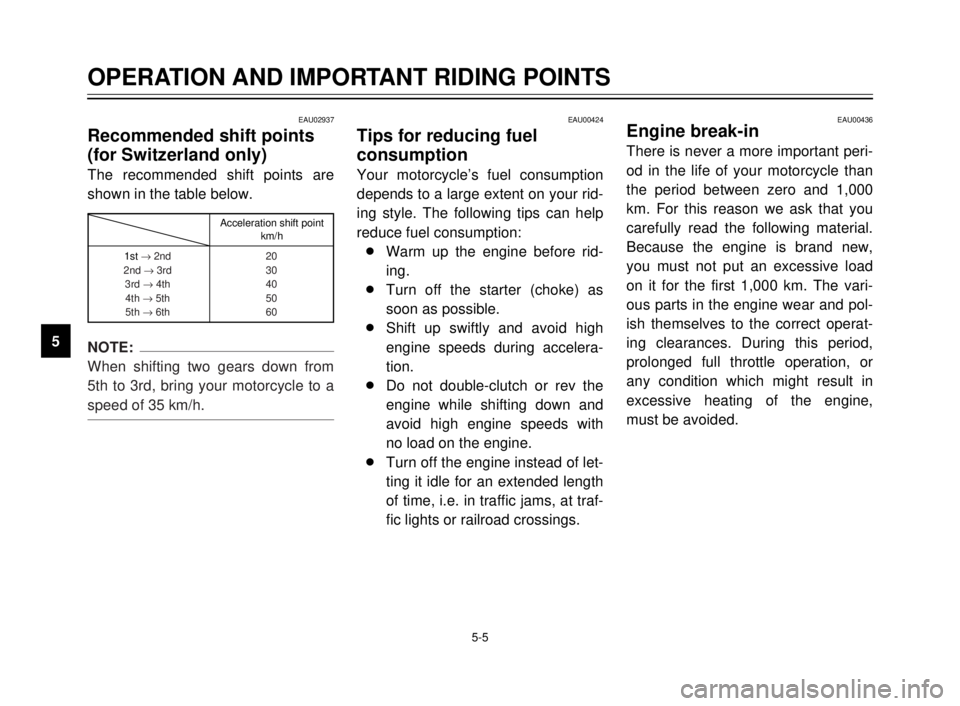
The recommended shift points are
shown in the table below.
Acceleration shift point
km/h
1st ®2nd 20
2nd ®3rd 30
3rd ®4th 40
4th ®5th 50
5th ®6th 60
NOTE:
When shifting two gears down from
5th to 3rd, bring your motorcycle to a
speed of 35 km/h.
5AE-9-E3 (ENG) 4/11/0 11:06 AM Page 40
Page 43 of 104

5-6
EAU00453
0 ~ 500 km
Avoid operation above 6,000 r/min.
Stop the engine and let it cool for 5 to
10 minutes after every hour of opera-
tion. Vary the speed of the motorcy-
cle from time to time. Do not operate
it at one set throttle position.
500 ~ 1,000 km
Avoid prolonged operation above
7,000 r/min. Rev the motorcycle
freely through the gears, but do not
use full throttle at any time.
EC000060
cC
After 1,000 km of operation, be
sure to replace the transmission
oil.
1,000 km and beyond
Full throttle can be used.
EC000053
cC
8
8
Never let engine speeds enter
the red zone.
8 8
If any engine trouble should
occur during the break-in peri-
od, consult a Yamaha dealer
immediately.
EAU00458
Parking
When parking the motorcycle, stop
the engine and remove the ignition
key. Turn the fuel cock to “OFF”
whenever stopping the engine.
EW000058
w
The exhaust system is hot. Park
the motorcycle in a place where
pedestrians or children are not
likely to touch the motorcycle. Do
not park the motorcycle on a slope
or soft ground; the motorcycle
may overturn.
EC000062
cC
Never park this motorcycle in an
area that would cause a fire hazard
such as grass or other materials
that may easily burn.
OPERATION AND IMPORTANT RIDING POINTS
1
2
3
4
5
6
7
8
9
5AE-9-E3 (ENG) 4/11/0 11:06 AM Page 41
Page 48 of 104

EVERY
6,000 km 12,000 km
No.
ITEM CHECKS AND MAINTENANCE JOBS
Initialor or
(1,000 km)6 months 12 months
(Whichever (Whichever
comes first) comes first)
1 * Fuel line 9Check fuel hoses for cracks or damage.
ÖÖ
9Replace if necessary.
2 Spark plug9Check condition.
ÖÖÖ
9Clean, regap or replace if necessary.
3 Air filter9Clean or replace if necessary.ÖÖ
4 Clutch9Check operation.
ÖÖÖ
9Adjust or replace cable.
9Check operation, fluid level and vehicle for fluid leakage.
(See NOTE on page 6-5.)
Ö
5 * Front brake
9Correct accordingly.ÖÖ
9Replace brake pads if necessary.
9Check operation, fluid level and vehicle for fluid leakage.
(See NOTE on page 6-5.)
6 * Rear brake
9Correct accordingly.ÖÖÖ
9Replace brake pads if necessary.
7 * Wheels9Check balance, runout and for damage.
ÖÖ
9Rebalance or replace if necessary.
9Check tread depth and for damage.
8 * Tires9Replace if necessary.
ÖÖ
9Check air pressure.
9Correct if necessary.
9 * Wheel bearings9Check bearing for looseness or damage.
ÖÖ
9Replace if necessary.
6-3
PERIODIC MAINTENANCE AND MINOR REPAIR
1
2
3
4
5
6
7
8
9
EAU00473
PERIODIC MAINTENANCE AND LUBRICATION
5AE-9-E3 (ENG) 4/11/0 11:06 AM Page 46
Page 58 of 104
6-13
PERIODIC MAINTENANCE AND MINOR REPAIR
1
2
3
4
5
6
7
8
9
2
1
4
5
3
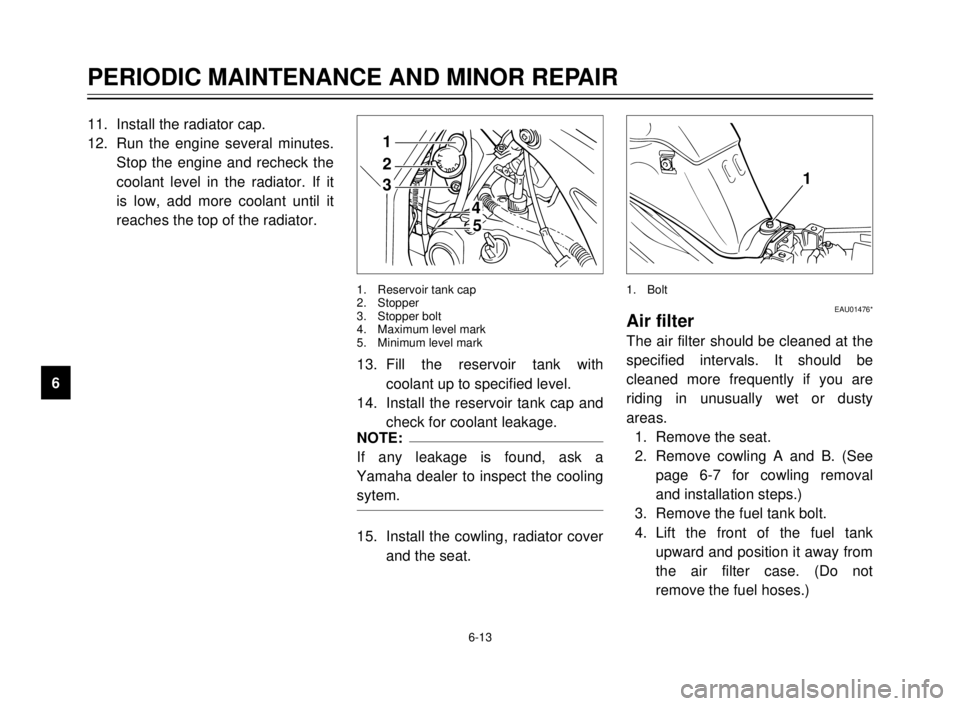
1. Reservoir tank cap
2. Stopper
3. Stopper bolt
4. Maximum level mark
5. Minimum level mark
11. Install the radiator cap.
12. Run the engine several minutes.
Stop the engine and recheck the
coolant level in the radiator. If it
is low, add more coolant until it
reaches the top of the radiator.
13. Fill the reservoir tank with
coolant up to specified level.
14. Install the reservoir tank cap and
check for coolant leakage.
NOTE:
If any leakage is found, ask a
Yamaha dealer to inspect the cooling
sytem.
15. Install the cowling, radiator cover
and the seat.
1
EAU01476*Air filter
The air filter should be cleaned at the
specified intervals. It should be
cleaned more frequently if you are
riding in unusually wet or dusty
areas.
1. Remove the seat.
2. Remove cowling A and B. (See
page 6-7 for cowling removal
and installation steps.)
3. Remove the fuel tank bolt.
4. Lift the front of the fuel tank
upward and position it away from
the air filter case. (Do not
remove the fuel hoses.)
1. Bolt
5AE-9-E3 (ENG) 4/11/0 11:06 AM Page 56