Page 251 of 283
TUNDRA (34413U)
251
Battery recharging precautions
During recharging, the battery is pro-
ducing hydrogen gas.
Therefore, before recharging:1. If recharging with the battery installed on the vehicle, be sure to disconnect
the ground cable.
2. Be sure the power switch on the re- charger is off when connecting the
charger cables to the battery and when
disconnecting them.
CAUTION
�Always charge the battery in an un-
confined area. Do not charge the
battery in a garage or closed room
where there is not sufficient ventila-
tion.
�Only do a slow charge (5 A or
less). Charging at a quicker rate is
dangerous. The battery may ex-
plode, causing personal injuries.
NOTICE
Never recharge the battery while the
engine is running. Also, be sure allaccessories are turned off.
Checking and replacing fuses
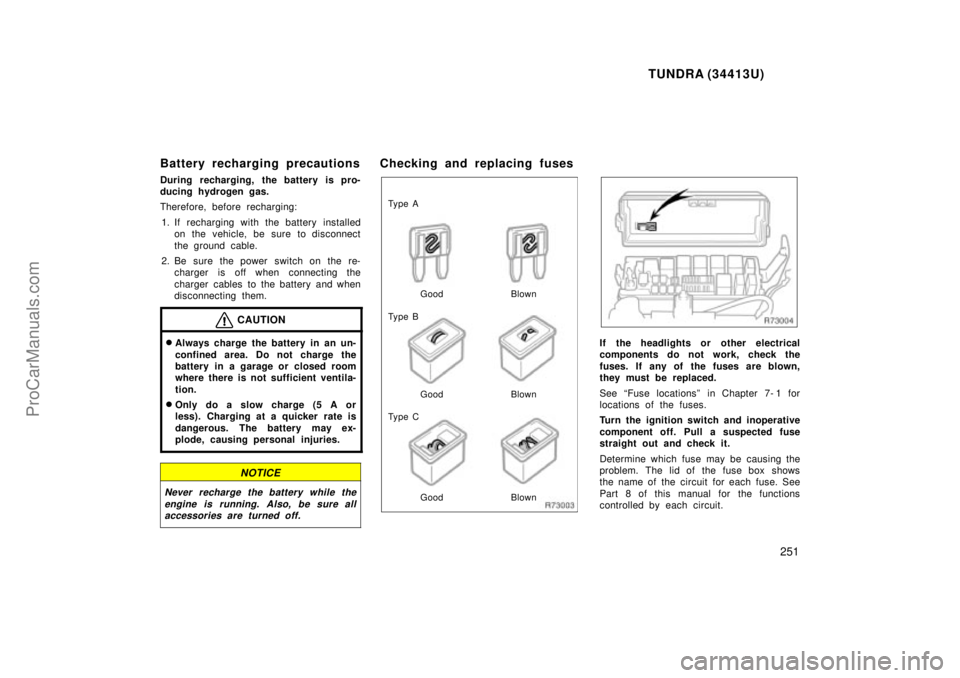
Ty p e A
Good Blown
Ty p e B
Ty p e C Good Blown
Good Blown
If the headlights or other electrical
components do not work, check the
fuses. If any of the fuses are blown,
they must be replaced.
See Fuse locationsº in Chapter 7- 1 for
locations of the fuses.
Turn the ignition switch and inoperative
component off. Pull a suspected fuse
straight out and check it.
Determine which fuse may be causing the
problem. The lid of the fuse box shows
the name of the circuit for each fuse. See
Part 8 of this manual for the functions
controlled by each circuit.
ProCarManuals.com
Page 252 of 283

TUNDRA (34413U)
252
Type A fuses can be pulled out by the
pull- out tool. The location of the pull- out
tool is shown in the illustration.
If you are not sure whether the fuse has
blown, try replacing the suspected fuse
with one that you know is good.
If the fuse has blown, push a new fuse
into the clip.
Only install a fuse with the amperage rat-
ing designated on the fuse box lid.
If you do not have a spare fuse, in an
emergency you can pull out the DOMEº,
A/Cº or HTRº fuse, which may be dis-
pensable for normal driving, and use it if
its amperage rating is the same.
If you cannot use one of the same amper-
age, use one that is lower, but as close
as possible to the rating. If the amperage
is lower than that specified, the fuse
might blow out again but this does not
indicate anything wrong. Be sure to get
the correct fuse as soon as possible and
return the substitute to its original clip.
It is a good idea to purchase a set of
spare fuses and keep them in your ve-
hicle for emergencies.If the new fuse immediately blows out,
there is a problem with the electrical sys-
tem. Have your Toyota dealer correct it as
soon as possible.
CAUTION
Never use a fuse with a higher am-
perage rating, or any other object, in
place of a fuse. This may cause ex-
tensive damage and possibly a fire.
Adding washer fluid
If any washer does not work or low
windshield washer fluid level warning
light comes on, the washer tank may be
empty. Add washer fluid.
You may use plain water as washer fluid.
However, in cold areas where tempera-
tures range below freezing point, use
washer fluid containing antifreeze. This
product is available at your Toyota dealer
and most auto parts stores. Follow the
manufacturer 's directions for how much to
mix with water.
NOTICE
Do not use engine antifreeze or any
other substitute because it may dam-age your vehicle's paint.
ProCarManuals.com
Page 271 of 283
TUNDRA (34413U)
271
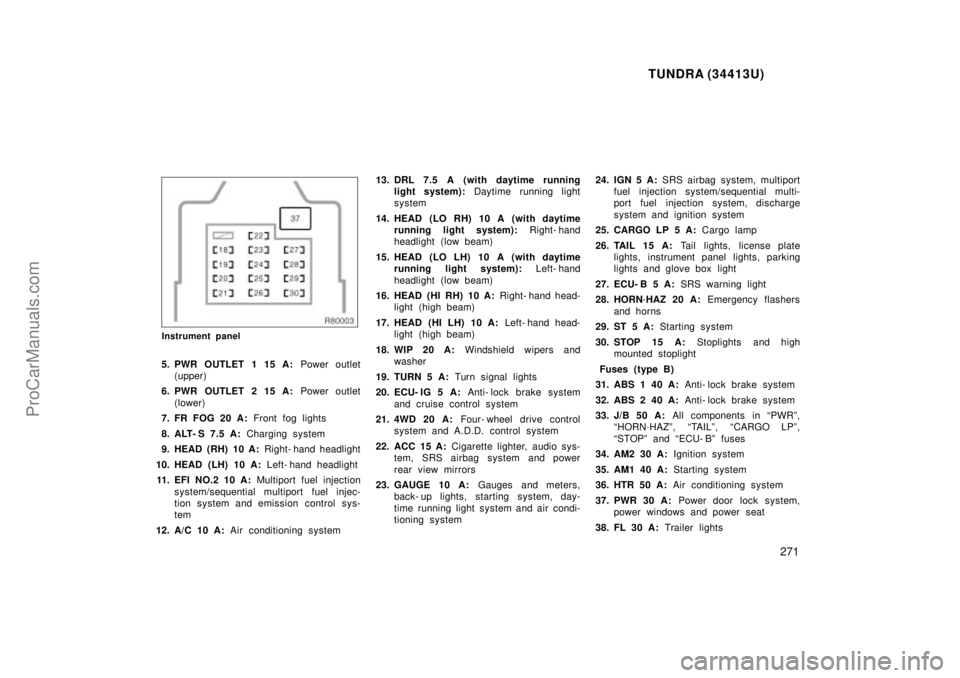
Instrument panel
5. PWR OUTLET 1 15 A: Power outlet
(upper)
6. PWR OUTLET 2 15 A: Power outlet
(lower)
7. FR FOG 20 A: Front fog lights
8. ALT- S 7.5 A: Charging system
9. HEAD (RH) 10 A: Right- hand headlight
10. HEAD (LH) 10 A: Left- hand headlight
11. EFI NO.2 10 A: Multiport fuel injection
system/s equential multiport fuel injec-
tion system and emission control sys-
tem
12. A/C 10 A: Air conditioning system 13. DRL 7.5 A (with daytime running
light system): Daytime running light
system
14. HEAD (LO RH) 10 A (with daytime running light system): Right- hand
headlight (low beam)
15. HEAD (LO LH) 10 A (with daytime running light system): Left- hand
headlight (low beam)
16. HEAD (HI RH) 10 A: Right- hand head- light (high beam)
17. HEAD (HI LH) 10 A: Left- hand head- light (high beam)
18. WIP 20 A: Windshield wipers and
washer
19. TURN 5 A: Turn signal lights
20. ECU- IG 5 A: Anti- lock brake system
and cruise control system
21. 4WD 20 A: Four- wheel drive control
system and A.D.D. control system
22. ACC 15 A: Cigarette lighter, audio sys-
tem, SRS airbag system and power
rear view mirrors
23. GAUGE 10 A: Gauges and meters,
back- up lights, starting system, day-
time running light system and air condi-
tioning system 24. IGN 5 A:
SRS airbag system, multiport
fuel injection system/sequential multi-
port fuel injection system, discharge
system and ignition system
25. CARGO LP 5 A: Cargo lamp
26. TAIL 15 A: Tail lights, license plate
lights, instrument panel lights, parking
lights and glove box light
27. ECU- B 5 A: SRS warning light
28. HORN´HAZ 20 A: Emergency flashers
and horns
29. ST 5 A: Starting system
30. STOP 15 A: Stoplights and high
mounted stoplight
Fuses (type B)
31. ABS 1 40 A: Anti- lock brake system
32. ABS 2 40 A: Anti- lock brake system
33. J/B 50 A: All components in PWRº,
HORN´HAZº, TAILº, CARGO LPº,
STOPº and ECU- Bº fuses
34. AM2 30 A: Ignition system
35. AM1 40 A: Starting system
36. HTR 50 A: Air conditioning system
37. PWR 30 A: Power door lock system,
power windows and power seat
38. FL 30 A: Trailer lights
ProCarManuals.com