Page 230 of 282
00 SIENNA(U)
224
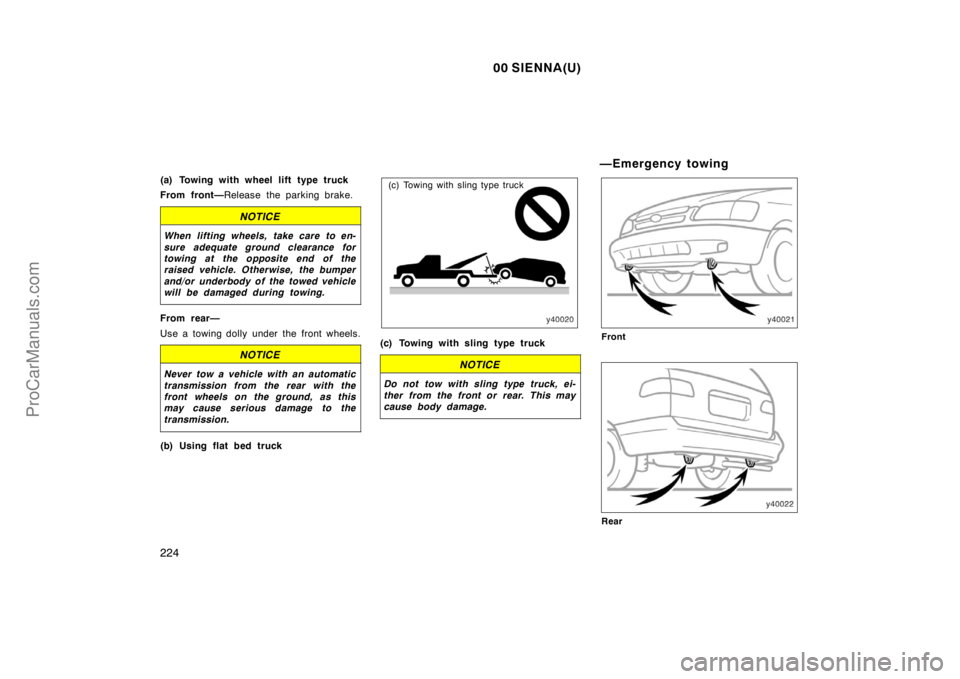
(a) Towing with wheel lift type truck
From front—Release the parking brake.
NOTICE
When lifting wheels, take care to en-
sure adequate ground clearance for
towing at the opposite end of the
raised vehicle. Otherwise, the bumper
and/or underbody of the towed vehicle
will be damaged during towing.
From rear—
Use a towing dolly under the front wheels.
NOTICE
Never tow a vehicle with an automatic
transmission from the rear with the
front wheels on the ground, as this
may cause serious damage to the
transmission.
(b) Using flat bed truck
(c) Towing with sling type truck
(c) Towing with sling type truck
NOTICE
Do not tow with sling type truck, ei-
ther from the front or rear. This may
cause body damage.
—Emergency towing
Front
Rear
ProCarManuals.com
Page 231 of 282
00 SIENNA(U)
225
If towing is necessary, we recommend
you to have it done by your Toyota
dealer or a commercial tow truck ser-
vice.
If towing service is not available in an
emergency, your vehicle may be tempo-
rarily towed by a cable or chain se-
cured to one of the emergency towing
eyelets under the vehicle. Use extreme
caution when towing vehicles.
NOTICE
Only use specified towing eyelet;
otherwise your vehicle may be dam-
aged.
A driver must be in the vehicle to steer
it and operate the brakes.
Towing in this manner may be done only
on hard−surfaced roads for a short dis-
tance and at low speeds. Also, the
wheels, axles, drive train, steering and
brakes must all be in good condition.
CAUTION
Use extreme caution when towing ve-
hicles. Avoid sudden starts or erratic
driving maneuvers which would place
excessive stress on the emergency
towing eyelets and towing cable or
chain. The eyelets and towing cable
or chain may break and cause serious
injury or damage.
NOTICE
Use only a cable or chain specifically
intended for use in towing vehicles.
Securely fasten the cable or chain to
the towing eyelets provided.
Before towing, release the parking brake
and put the transmission in “N”. The key
must be in “ACC” (engine off) or “ON”
(engine running).
CAUTION
If the engine is not running, the pow-
er assist for the brakes and steering
will not work so steering and braking
will be much harder than usual.
If you lose your keys
Please contact your nearest Toyota
dealer and ask for duplicating key. You
must inform them of the key number
and, in case of making the immobiliser
key, one of the master keys must be
presented.
See the suggestion given in “Keys” in
Section 1−2.
If your keys are locked in the vehicle and
you cannot get a duplicate, many Toyota
dealers can still open the door for you,
using their special tools. If you must
break a window to get in, we suggest
breaking the smallest side window be-
cause it is the least expensive to replace.
Be extremely cautious to avoid cuts from
the glass.
Vehicles with engine immobiliser system—
Even if you lose only one key, contact
your Toyota dealer to make a new key.
However, if you lose all your master keys,
the dealer cannot duplicate key but only
replace the whole system.
ProCarManuals.com
Page 236 of 282
00 SIENNA(U)
230
4. To prevent water spots, dry the vehicle
using a clean soft cotton towel. Do not
rub or press hard—you might scratch
the paint.
Automatic car wash
Your vehicle may be washed in an auto-
matic car wash, but remember that the
paint can be scratched by some type of
brushes, unfiltered washing water, or the
washing process itself. Scratching reduces
paint durability and gloss, especially on
darker colors. The manager of the car
wash should be able to advise you wheth-
er the process is safe for the paint on
your vehicle.
NOTICE
�With mast type antenna:
To prevent damage to the antenna,
make sure it is removed before
driving your Toyota through an au-
tomatic car wash.
�When your vehicle goes through an
automatic car wash, make sure the
power sliding door system is off.
Waxing your Toyota
Polishing and waxing is recommended
to maintain the original beauty of your
Toyota’s finish.
Once a month or if the vehicle does not
repel water well, apply wax.
1. Always wash and dry the vehicle be-
fore you begin waxing, even if you are
using a combined cleaner and wax.
2. Use a good quality polish and wax. If
the finish has become extremely weath-
ered, use a car−cleaning polish, fol-
lowed by a separate wax. Carefully fol-
low the manufacturer’s instructions and
precautions. Be sure to polish and wax
the chrome trim as well as the paint.
3. Wax the vehicle again when water
does not bead but remains on the sur-
face in large patches.
NOTICE
Always remove the plastic bumpers if
your vehicle is re−painted and placed
in a high heat paint waxing booth.
High temperatures could damage the
bumpers.
Cleaning the interior
CAUTION
Do not wash the vehicle floor with
water, or allow water to get onto the
floor when cleaning the vehicle interi-
or or exterior. Water may get into
audio components or other electrical
components above or under the floor
carpet (or mat) and cause a malfunc-
tion; and it may cause body corro-
sion.
Vinyl interior
The vinyl upholstery may be easily
cleaned with a mild soap or detergent
and water.
First vacuum over the upholstery to re-
move loose dirt. Then, using a sponge or
soft cloth, apply the soap solution to the
vinyl. After allowing it to soak in for a few
minutes to loosen the dirt, remove the dirt
and wipe off the soap with a clean damp
cloth. If all the dirt do not come off, re-
peat the procedure. Commercial foaming−
type vinyl cleaners are also available
which work well. Follow the manufacturer ’s
instructions.
ProCarManuals.com
Page 250 of 282

00 SIENNA(U)
244
Parts and tools
Here is a list of parts and tools you will
need on performing do−it−yourself mainte-
nance. Remember all Toyota parts are de-
signed in metric sizes, so your tools must
be metric.
Checking the engine oil level
Parts (if level is low):
�Engine oil API grade SJ,
“Energy−Conserving” or ILSAC multi-
grade having viscosity proper for your
climate
Tools:
�Rag or paper towel
�Funnel (only for adding oil)
Checking the engine coolant level
Parts (if level is low):
�“TOYOTA Long Life Coolant” or equiva-
lent
See Section 7−2 for details about cool-
ant type selection.
�Demineralized or distilled water
Tools:
�Funnel (only for adding coolant)Checking brake fluid
Parts (if level is low):
�SAE J1703 or FMVSS No.116 DOT 3
brake fluid
Tools:
�Rag or paper towel
�Funnel (only for adding fluid)
Checking power steering fluid
Parts (if level is low):
�Automatic transmission fluid
DEXRON®II or III
Tools:
�Rag or paper towel
�Funnel (only for adding fluid)
Checking battery condition
Tools:
�Warm water
�Baking soda
�Grease
�Conventional wrench (for terminal
clamp bolts)Checking and replacing fuses
Parts (if replacement is necessary):
�Genuine Toyota fuse or equivalent with
same amperage rating as original
Adding washer fluid
Parts:
�Water
�Washer fluid containing antifreeze (for
winter use)
Tools:
�Funnel
Replacing light bulbs
Parts:
�Bulb with same number and wattage
rating as original (See charts in
“Replacing light bulbs” in Section 7−3.)
Tools:
�Screwdriver
�Wrench
ProCarManuals.com
Page 275 of 282
00 SIENNA(U)
269
Tires
Tire sizeTire pressure,
kPa (kgf/cm2 or bar, psi)Wheel size
P205/70R15 95S 240 (2.4, 35) 15�6.5JJ
220 (2.2, 32)
∗
1
240 (2.4, 35)∗
2
T145/80D16 420 (4.2, 60)
15�6.5JJ
16�4T P215/65R15 95S Normal driving
Trailer towing
Tire sizeTire pressure,
kPa (kgf/cm
2 or bar, psi)Wheel size
P205/70R15 95S 240 (2.4, 35) 15�6.5JJ
240 (2.4, 35)
15�6.5JJ P215/65R15 95S
When driving under the above vehicle load conditions at sustained high
speeds above 160 km/h (100 mph), in countries where such speeds are
permitted by−law, inflate the front and rear tires to 240 kPa (2.4 kgf/cm
2
or bar, 35 psi) provided that it does not exceed the maximum cold tire
pressure molded on the tire sidewall. Tire size and pressure:
∗
1: Vehicle load up to 6 passengers∗
2: Up to vehicle capacity weightWheel nut torque, N·m (kgf·m, ft·lbf):
104 (10.5, 77)
ProCarManuals.com
Page 276 of 282
00 SIENNA(U)
270
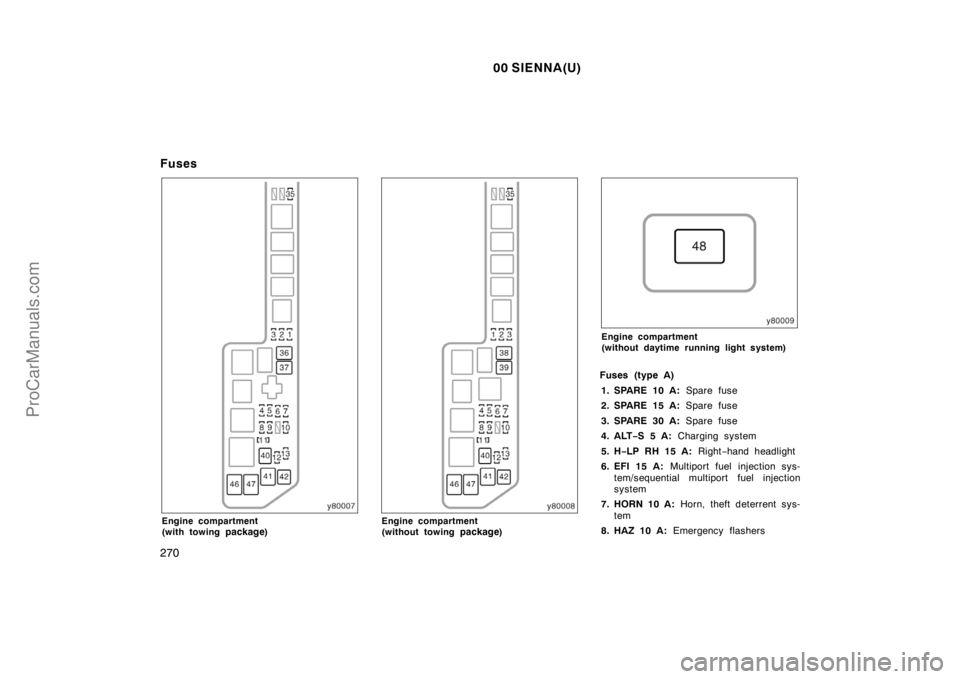
Fuses
Engine compartment
(with towing package)Engine compartment
(without towing package)
Engine compartment
(without daytime running light system)
Fuses (type A)
1. SPARE 10 A: Spare fuse
2. SPARE 15 A: Spare fuse
3. SPARE 30 A: Spare fuse
4. ALT−S 5 A: Charging system
5. H−LP RH 15 A: Right−hand headlight
6. EFI 15 A: Multiport fuel injection sys-
tem/sequential multiport fuel injection
system
7. HORN 10 A: Horn, theft deterrent sys-
tem
8. HAZ 10 A: Emergency flashers
ProCarManuals.com