Page 101 of 282
00 SIENNA(U)
95
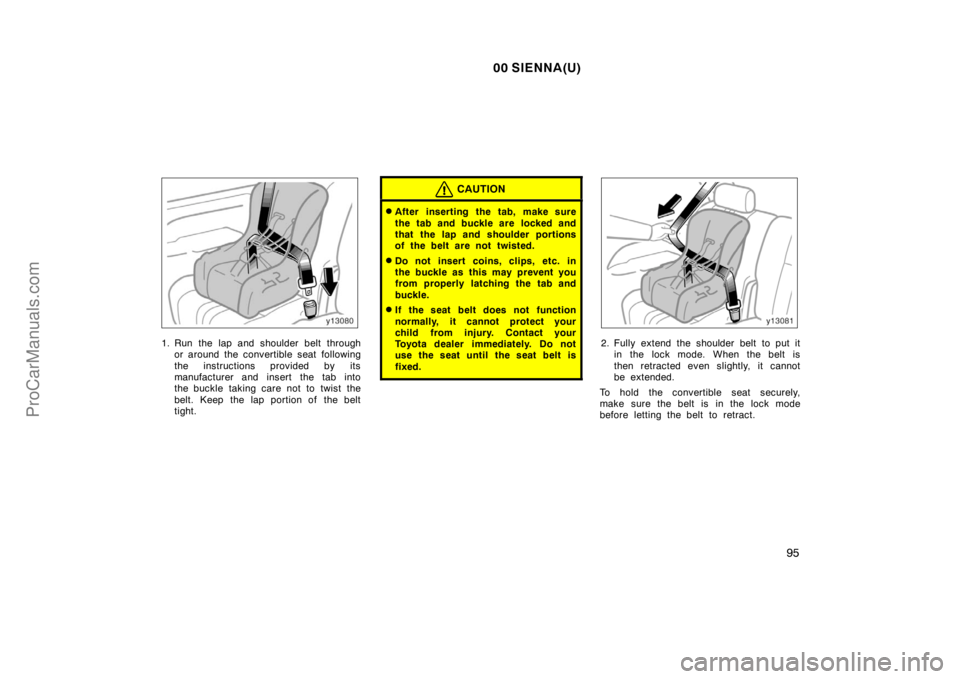
1. Run the lap and shoulder belt through
or around the convertible seat following
the instructions provided by its
manufacturer and insert the tab into
the buckle taking care not to twist the
belt. Keep the lap portion of the belt
tight.
CAUTION
�After inserting the tab, make sure
the tab and buckle are locked and
that the lap and shoulder portions
of the belt are not twisted.
�Do not insert coins, clips, etc. in
the buckle as this may prevent you
from properly latching the tab and
buckle.
�If the seat belt does not function
normally, it cannot protect your
child from injury. Contact your
Toyota dealer immediately. Do not
use the seat until the seat belt is
fixed.
2. Fully extend the shoulder belt to put it
in the lock mode. When the belt is
then retracted even slightly, it cannot
be extended.
To hold the convertible seat securely,
make sure the belt is in the lock mode
before letting the belt to retract.
ProCarManuals.com
Page 102 of 282
00 SIENNA(U)
96
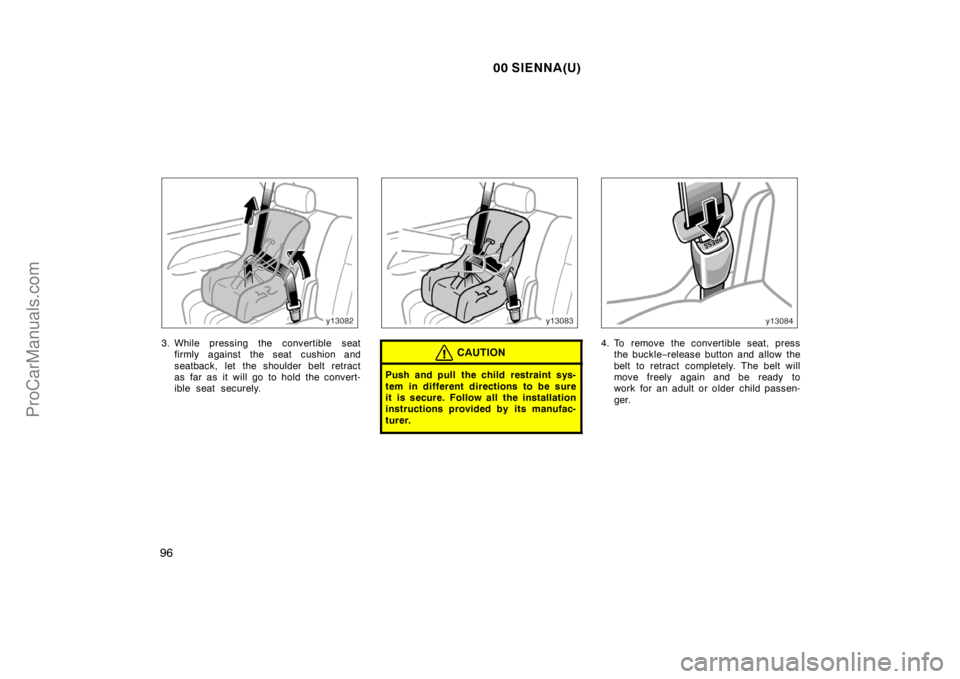
3. While pressing the convertible seat
firmly against the seat cushion and
seatback, let the shoulder belt retract
as far as it will go to hold the convert-
ible seat securely.CAUTION
Push and pull the child restraint sys-
tem in different directions to be sure
it is secure. Follow all the installation
instructions provided by its manufac-
turer.
4. To remove the convertible seat, press
the buckle−release button and allow the
belt to retract completely. The belt will
move freely again and be ready to
work for an adult or older child passen-
ger.
ProCarManuals.com
Page 137 of 282
00 SIENNA(U)
131
For ways to decrease the vehicle speed,
see “Cruise control” in this section.
CAUTION
Be careful when downshifting on a
slippery surface. Abrupt shifting
could cause the vehicle to spin or
skid.
(e) Using “2” and “L” positions
The “2” and “L” positions are used for
strong engine braking as described pre-
viously.
With the selector lever in “2” or “L”, you
can start the vehicle in motion as with the
lever in “D”.
With the selector lever in “2”, the vehicle
will start in the first gear and automatical-
ly shift to second gear.
With the selector lever in “L”, the trans-
mission is engaged in first gear.
NOTICE
�Be careful not to overrev the en-
gine. Watch the tachometer to keep
engine rpm from going into the red
zone. The approximate maximum al-
lowable speed for each position is
given below for your reference:
“2” 120 km/h (74 mph). . . . . . . . . . .
“L” 64 km/h (40 mph). . . . . . . . . . . .
�Do not continue hill climbing or
hard towing for a long time in the
“2” or “L” position. This may cause
severe automatic transmission dam-
age from overheating. To prevent
such damage, “D” position should
be used in hill climbing or hard
towing.
(f) Backing up
1. Bring the vehicle to a complete stop.
2. With the brake pedal held down with
your foot, shift the selector lever to the
“R” position.
NOTICE
Never shift into reverse while the ve-
hicle is moving.
(g) Parking
1. Bring the vehicle to a complete stop.
2. With the brake pedal pressed down,
fully depress the parking brake pedal
to apply the parking brake securely.
3. With the brake pedal pressed down,
shift the selector lever to the “P” posi-
tion.
CAUTION
Never attempt to move the selector
lever into “P” position under any cir-
cumstances while the vehicle is mov-
ing. Serious mechanical damage and
loss of vehicle control may result.
(h) Good driving practice
�If the transmission repeatedly shifts up
and down between third gear and over-
drive when climbing a gentle slope, the
overdrive should be turned off. Be sure
to turn the switch on immediately after-
ward.
�When towing a trailer, in order to main-
tain engine braking efficiency, do not
use overdrive.
ProCarManuals.com
Page 184 of 282
00 SIENNA(U)
178
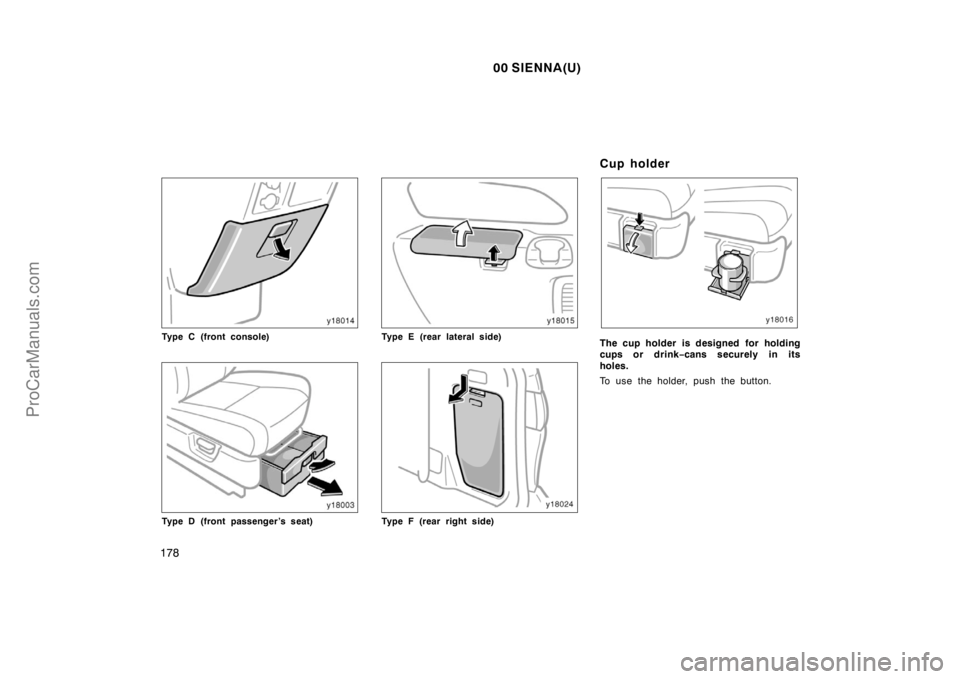
Type C (front console)
Type D (front passenger’s seat)
Type E (rear lateral side)
Type F (rear right side)
Cup holder
The cup holder is designed for holding
cups or drink−cans securely in its
holes.
To use the holder, push the button.
ProCarManuals.com
Page 185 of 282
00 SIENNA(U)
179
CAUTION
�Do not place anything else other
than cups or drink−cans on the cup
holder, as such items may be
thrown about in the compartment
and possibly injure people in the
vehicle during sudden braking or in
an accident.
�To reduce the chance of injury in
case of an accident or sudden stop
while driving, keep the cup holder
closed when it is not in use.
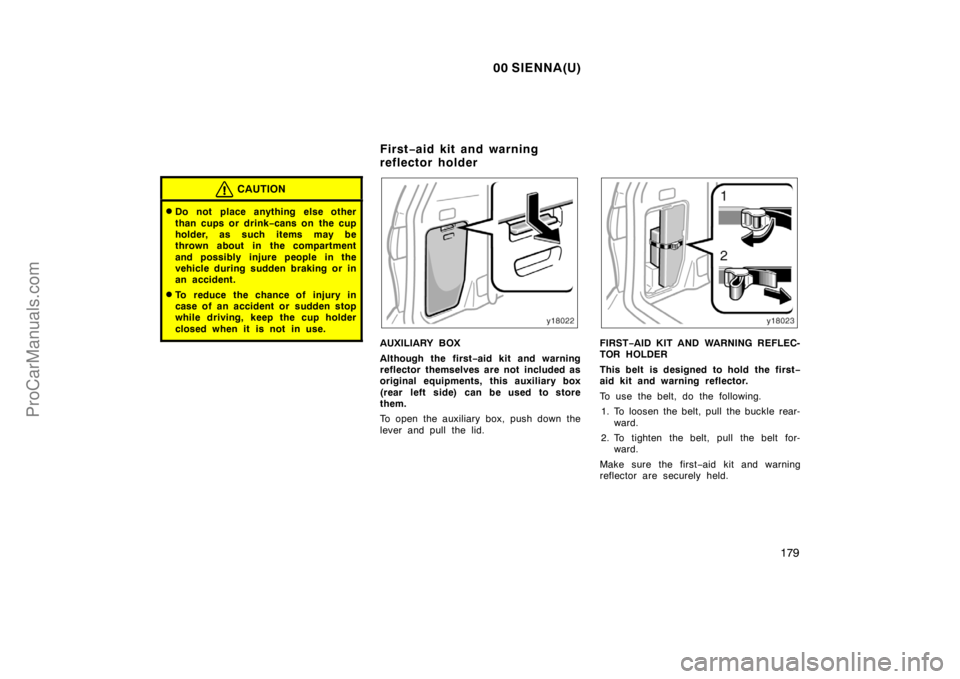
AUXILIARY BOX
Although the first−aid kit and warning
reflector themselves are not included as
original equipments, this auxiliary box
(rear left side) can be used to store
them.
To open the auxiliary box, push down the
lever and pull the lid.FIRST−AID KIT AND WARNING REFLEC-
TOR HOLDER
This belt is designed to hold the first−
aid kit and warning reflector.
To use the belt, do the following.
1. To loosen the belt, pull the buckle rear-
ward.
2. To tighten the belt, pull the belt for-
ward.
Make sure the first−aid kit and warning
reflector are securely held.
First−aid kit and warning
reflector holder
ProCarManuals.com
Page 198 of 282
00 SIENNA(U)
192
Luggage stowage precautions
When stowing luggage or cargo in the
vehicle, observe the following:
�Put luggage or cargo in the luggage
compartment when at all possible. Be
sure all items are secured in place.
�Be careful to keep the vehicle bal-
anced. Locating the weight as far for-
ward as possible helps maintain bal-
ance.
�For better fuel economy, do not carry
unneeded weight.
CAUTION
�To prevent luggage or packages
from sliding forward during braking,
do not stack anything in the lug-
gage compartment higher than the
seatbacks. Keep luggage or pack-
ages low, as close to the floor as
possible.
�Never allow anyone to ride in the
luggage compartment. It is not de-
signed for passengers. They should
ride in their seats with their seat
belts properly fastened. Otherwise,
they are much more likely to suffer
serious bodily injury, in the event
of sudden braking or a collision.
�Do not drive with objects left on
top of the instrument panel. They
may interfere with the driver’s field
of view. Or they may move during
sharp vehicle acceleration or turn-
ing, and impair the driver’s control
of the vehicle. In an accident they
may injure the vehicle occupants.
NOTICE
Do not load the vehicle beyond the
vehicle capacity weight specified in
Section 8.
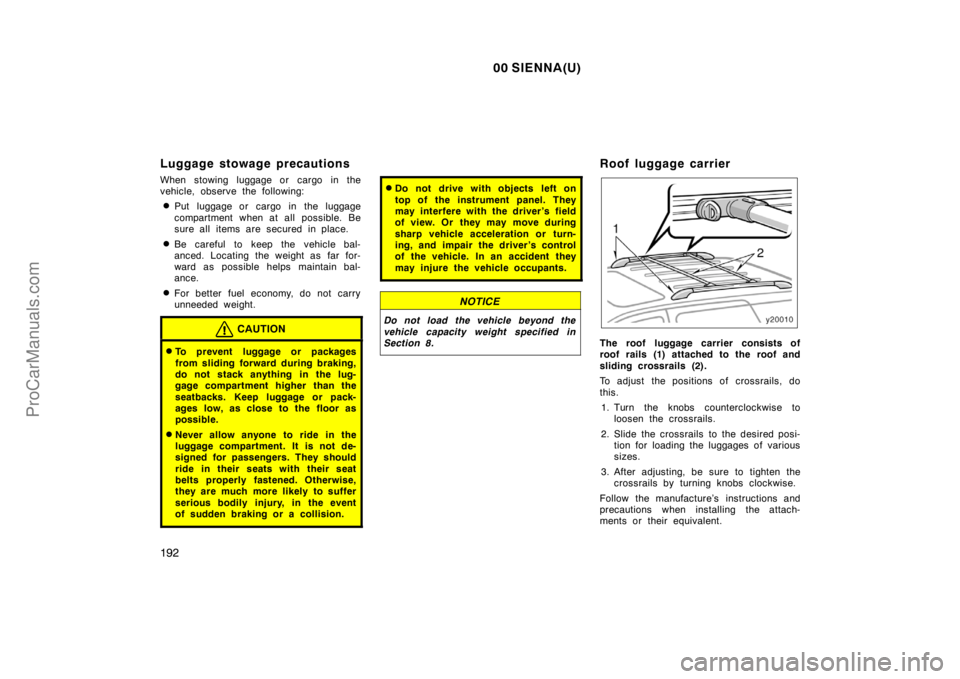
Roof luggage carrier
The roof luggage carrier consists of
roof rails (1) attached to the roof and
sliding crossrails (2).
To adjust the positions of crossrails, do
this.
1. Turn the knobs counterclockwise to
loosen the crossrails.
2. Slide the crossrails to the desired posi-
tion for loading the luggages of various
sizes.
3. After adjusting, be sure to tighten the
crossrails by turning knobs clockwise.
Follow the manufacture’s instructions and
precautions when installing the attach-
ments or their equivalent.
ProCarManuals.com
Page 199 of 282
00 SIENNA(U)
193
CAUTION
When you load cargo on the roof lug-
gage carrier, observe the following:
�Place the cargo so that its weight
is distributed evenly between the
front and rear axles.
�If loading long or wide cargo, never
exceed the vehicle overall length or
width. (See “Dimensions” in Section
8 for information on your vehicle
overall length and width.)
�Before driving, make sure the cargo
is securely fastened on the roof
luggage carrier.
�Avoid sudden starts, sharp turns or
sudden braking.
�If driving for a long distance, on
rough roads, or at high speeds,
stop the vehicle now and then dur-
ing the trip to make sure the cargo
remains in its place.
�Do not exceed 50 kg (110 lb.) cargo
weight on the roof rails. However,
if the allowable cargo weight of the
cross rails is under 50 kg (110 lb.)
observe the load limit.
NOTICE
When loading the luggages, be careful
not to scratch the surface of the
moon roof.
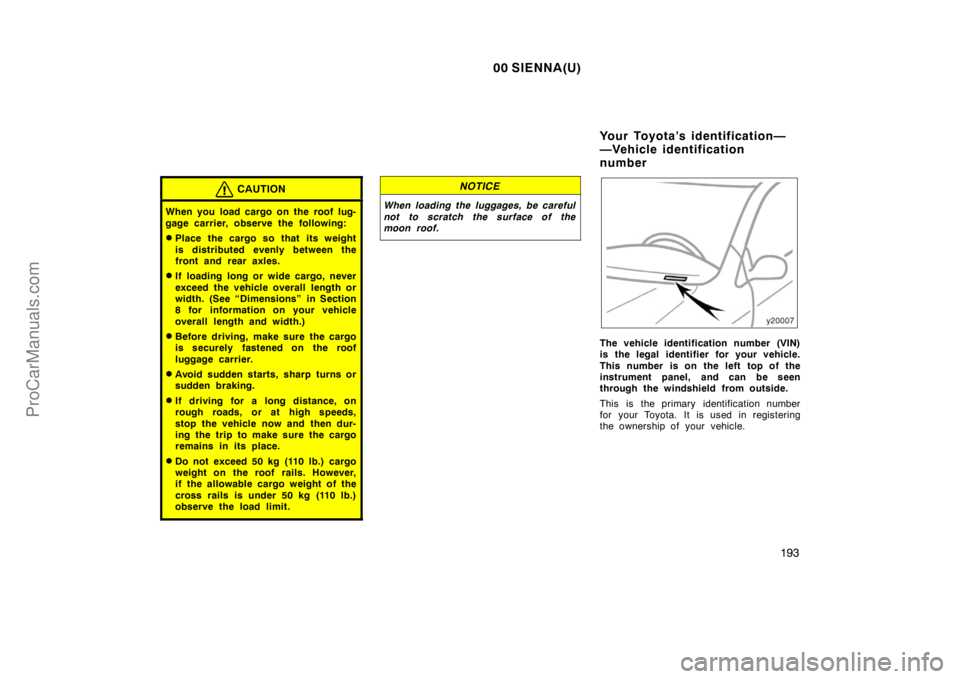
The vehicle identification number (VIN)
is the legal identifier for your vehicle.
This number is on the left top of the
instrument panel, and can be seen
through the windshield from outside.
This is the primary identification number
for your Toyota. It is used in registering
the ownership of your vehicle.
Your Toyota’s identification—
—Vehicle identification
number
ProCarManuals.com
Page 206 of 282
00 SIENNA(U)
200
�Do not drive in excess of the speed
limit. Even if the legal speed limit
permits it, do not drive over 140
km/h (85 mph) unless your vehicle
has high−speed capability tires.
Driving over 140 km/h (85 mph) may
result in tire failure, loss of control
and possible injury. Be sure to con-
sult a tire dealer to determine
whether the tires on your vehicle
are high−speed capability tires or
not before driving at such speeds.
�Do not continue normal driving
when the brakes are wet. If they are
wet, your vehicle will require a lon-
ger stopping distance, and it may
pull to one side when the brakes
are applied. Also, the parking brake
will not hold the vehicle securely.
Winter driving tips
Make sure you have a proper freeze
protection of engine coolant.
Your coolant must contain ethylene−glycol
type coolant for a proper corrosion
protection of aluminum components. Use
“TOYOTA Long Life Coolant” or equivalent.
See Section 7−2 for details about coolant
type selection.
NOTICE
Do not use alcohol type antifreeze or
plain water alone.
When it is extremely cold, we recommend
to use 60% solution for your Toyota, to
provide protection down to about −50°C
(−58°F). Do not use more than 70% solu-
tion for better coolant performance.
Check the condition of the battery and
cables.
Cold temperatures reduce the capacity of
any battery, so it must be in top shape
to provide enough power for winter start-
ing. Section 7−3 tells you how to visually
inspect the battery. Your Toyota dealer
and most service stations will be pleased
to check the level of charge.Make sure the engine oil viscosity is
suitable for the cold weather.
See Section 7−2 for recommended viscos-
ity. Leaving a heavy summer oil in your
vehicle during winter months may cause
harder starting. If you are not sure about
which oil to use, call your Toyota dealer—
he will be pleased to help.
Keep the door locks from freezing.
Squirt lock de−icer or glycerine into the
locks to keep them from freezing.
Use a washer fluid containing an anti-
freeze solution.
This product is available at your Toyota
dealer and most auto parts stores. Follow
the manufacturer ’s directions for how
much to mix with water.
NOTICE
Do not use engine antifreeze or any
other substitute because it may dam-
age your vehicle’s paint.
ProCarManuals.com