Page 79 of 282
00 SIENNA(U)
73
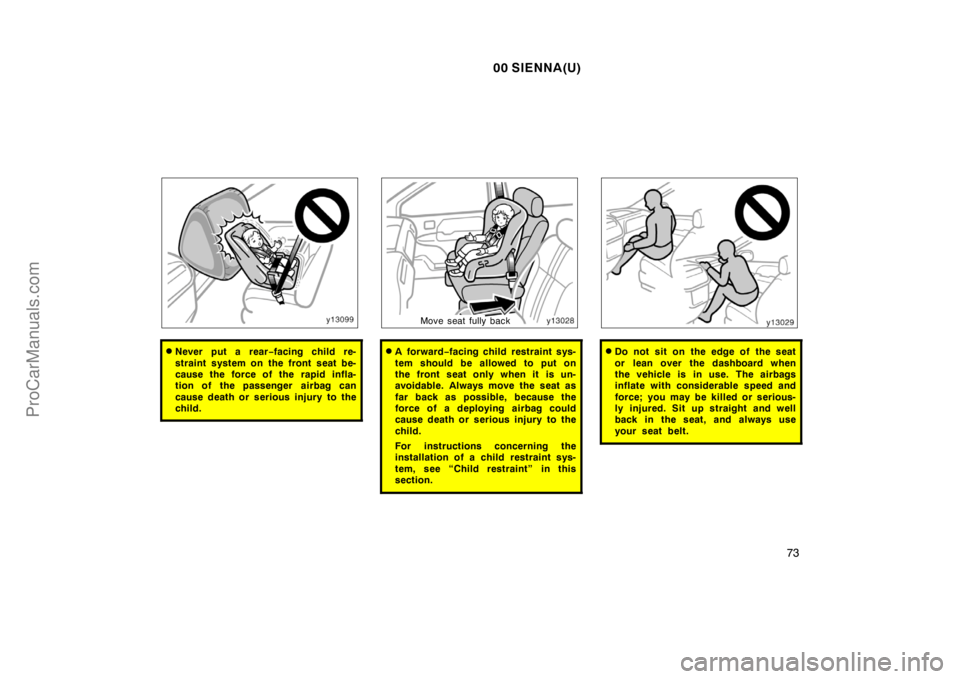
�Never put a rear−facing child re-
straint system on the front seat be-
cause the force of the rapid infla-
tion of the passenger airbag can
cause death or serious injury to the
child.
Move seat fully back
�A for war d−facing child restraint sys-
tem should be allowed to put on
the front seat only when it is un-
avoidable. Always move the seat as
far back as possible, because the
force of a deploying airbag could
cause death or serious injury to the
child.
For instructions concerning the
installation of a child restraint sys-
tem, see “Child restraint” in this
section.�Do not sit on the edge of the seat
or lean over the dashboard when
the vehicle is in use. The airbags
inflate with considerable speed and
force; you may be killed or serious-
ly injured. Sit up straight and well
back in the seat, and always use
your seat belt.
ProCarManuals.com
Page 80 of 282

00 SIENNA(U)
74
�Do not allow a child to stand up,
or to kneel on the front passenger
seat. The airbag inflates with con-
siderable speed and force; the child
may be killed or seriously injured.
�Do not hold a child on your lap or
in your arms. Use a child restraint
system in the rear seat. For instruc-
tions concerning the installation of
a child restraint system, see “Child
restraint” in this section.
�Do not put objects or your pets on
or in front of the dashboard or
steering wheel pad that houses the
airbag system. They might restrict
inflation or cause death or serious
injury as they are projected rear-
ward by the force of the deploying
airbags. Likewise, the driver and
front passenger should not hold
things in their arms or on their
knees.
�Do not modify or remove any wir-
ing. Do not modify, remove, strike
or open any components such as
the steering wheel pad, steering
wheel, column cover, front passen-
ger airbag cover, front passenger
airbag or airbag sensor assembly.
Doing any of these may cause sud-
den SRS airbag inflation or disable
the system, which could result in
death or serious injury.
Failure to follow these instructions
can result in death or serious injury.
ProCarManuals.com
Page 82 of 282
00 SIENNA(U)
76
Toyota strongly urges the use of child
restraint systems for children small
enough to use them.
The laws of all fifty states in the U.S.A.
and Canada now require the use of a
child restraint system.
Your vehicle conforms to SAE J1819.
If a child is too large for a child restraint
system, the child should sit in the rear
seat and must be restrained using the
vehicle’s seat belt. See “Seat belts” for
details.
CAUTION
�For effective protection in automo-
bile accidents and sudden stops,
children must be properly re-
strained using a seat belt or child
restraint system depending on the
age and size of the child. Holding
a child in your arms is not a sub-
stitute for a child restraint system.
In an accident, the child can be
crushed against the windshield, or
between you and the vehicle’s inte-
rior.
�Toyota strongly urges use of a
proper child restraint system which
conforms to the size of the child,
and is put on the rear seat. Accord-
ing to accident statistics, the child
is safer when properly restrained in
the rear seat than in the front seat.
�Never put a rear−facing child re-
straint system on the front seat. In
the event of an accident, the force
of the rapid inflation of the airbag
can cause death or serious injury if
a rear−facing child restraint system
is put on the front seat.
�Unless it is unavoidable, do not put
a child restraint system on the
front seat.
�A for war d−facing child restraint sys-
tem should be allowed to put on
the front seat only when it is un-
avoidable. Always move the seat as
far back as possible, because the
force of a deploying airbag could
cause death or serious injury to the
child.
�Make sure that you have complied
with all installation instructions pro-
vided by the child restraint
manufacturer and that the system is
properly secured.
Child restraint—
—Child restraint precautions
ProCarManuals.com
Page 83 of 282
00 SIENNA(U)
77
—Child restraint system
A child restraint system for a small
child or baby must itself be properly
restrained on the seat with either the
lap belt or the lap portion of the lap/
shoulder belt. You must carefully con-
sult the manufacturer ’s instructions
which accompany your child restraint
system.
To provide proper restraint, use a child
restraint system following the manufactur-
er ’s instructions about the appropriate age
and size of the child for the child restraint
system.
Install the child restraint system correctly
following the instructions provided by its
manufacturer of the system. General di-
rections are also provided under the fol-
lowing illustrations.
The child restraint system should be
installed on the rear seat if your vehicle
is equipped with rear seats. According to
accident statistics, the child is safer when
properly restrained in the rear seat than
in the front seat.CAUTION
�Never put a rear−facing child re-
straint system on the front seat. In
the event of an accident, the force
of the rapid inflation of the airbag
can cause death or serious injury if
a rear−facing child restraint system
is put on the front seat.
�Unless it is unavoidable, do not put
a child restraint system on the
front seat.
�A for war d−facing child restraint sys-
tem should be allowed to put on
the front seat only when it is un-
avoidable. Always move the seat as
far back as possible, because the
force of a deploying airbag could
cause death or serious injury to the
child.
�After installing the child restraint
system, make sure it is secured in
place following the manufacturer ’s
instructions. If it is not restrained
securely, it may cause death or se-
rious injury to the child in the
event of a sudden stop or accident.
When not using the child restraint system,
keep it secured with the seat belt or place
it somewhere other than the passenger
compartment. This will prevent it from in-
juring passengers in the event of a sud-
den stop or accident.
Your vehicle has anchors for securing the
top strap of a child restraint system. The
anchor nuts are welded beneath the sheet
metal to permit installation of an anchor
bracket for a child restraint system.
To install an anchor bracket, use an 8 mm
� 30 mm � 1.25 mm coarse thread met-
ric bolt and 15 mm (0.6 in.) spacer. Note
that the bolts accompanying many child
restraint systems are not metric. You can
damage the anchor nuts on your vehicle
if you force bolts with different thread into
the anchor nuts.
For instructions about how to install the
anchor bracket, see “Top strap anchors
and locations”.
If your child restraint system does not
provide any of the necessary parts, you
can purchase the following items from
your Toyota dealer.
ProCarManuals.com
Page 85 of 282
00 SIENNA(U)
79
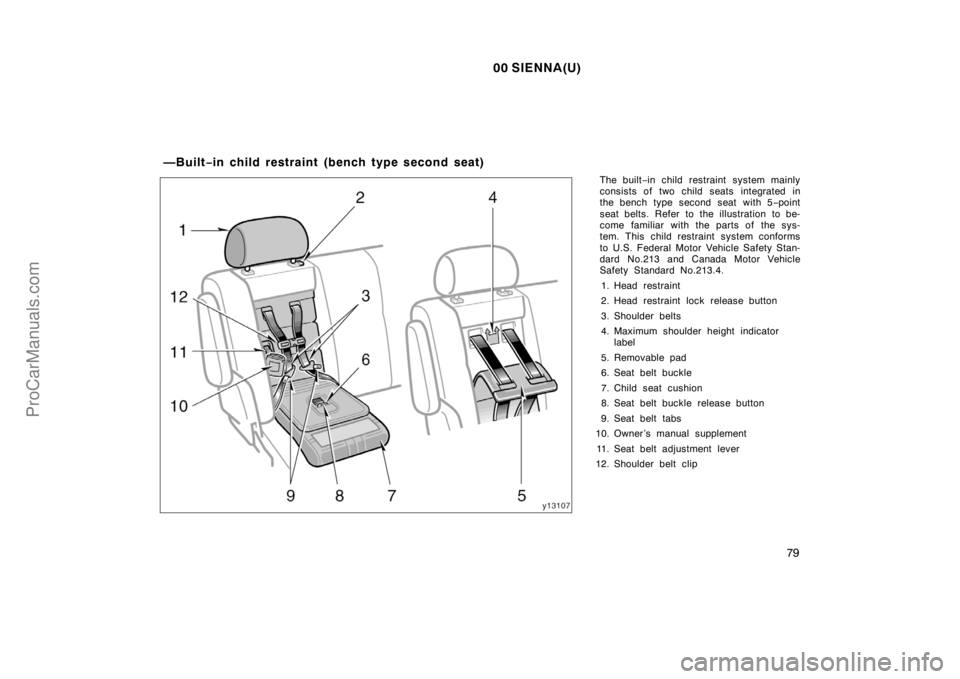
The built−in child restraint system mainly
consists of two child seats integrated in
the bench type second seat with 5−point
seat belts. Refer to the illustration to be-
come familiar with the parts of the sys-
tem. This child restraint system conforms
to U.S. Federal Motor Vehicle Safety Stan-
dard No.213 and Canada Motor Vehicle
Safety Standard No.213.4.
1. Head restraint
2. Head restraint lock release button
3. Shoulder belts
4. Maximum shoulder height indicator
label
5. Removable pad
6. Seat belt buckle
7. Child seat cushion
8. Seat belt buckle release button
9. Seat belt tabs
10. Owner ’s manual supplement
11. Seat belt adjustment lever
12. Shoulder belt clip
—Built−in child restraint (bench type second seat)
ProCarManuals.com
Page 86 of 282
00 SIENNA(U)
80
This child restraint is designed for use
only by children who weigh between 10
and 18 kg (22.1 and 39.5 lb.) and whose
height is between 85 and 101 cm (33.5
and 40.0 in.).
The child should be at least one year
old and must be capable of sitting up-
right alone and whose shoulder height
is at or below the maximum shoulder
height indicator. See indicator label be-
hind child seat pad.
It is important to use a rear−facing
child restraint until the child is about
a year old. A rear−facing restraint gives
the child’s head, neck and body the
support they would need in a crash.
See “—Child restraint system” for more
information.
If your child’s shoulders are above the
indicator position, do not use the built−
in child restraint. Your child should use
the adult lap and shoulder belt.
According to accident statistics, children
are safer when properly restrained in the
rear seat than in the front seat.CAUTION
Make sure the child is securely re-
strained with the built−in child re-
straint. WARNING! Failure to follow
the manufacturer ’s instructions on the
use of this child restraint system can
result in your child striking the ve-
hicle’s interior during a sudden stop
or crash. Snugly adjust the belts pro-
vided with this child restraint around
your child.
When using the built−in child re-
straints, observe the following:
�Use the belts of one child restraint
for only one child at a time. Do not
use the belts for two or more chil-
dren.
�Be careful not to damage the belt
webbing or hardware. Take care that
they do not get caught or pinched
in the seatback.
�Inspect the belt system periodically.
Check for cuts, fraying, and loose
parts. Damaged parts should be re-
placed. Do not disassemble or
modify the child restraint belt sys-
tem.
�Keep the belts clean and dry. If
they need cleaning, use a mild soap
solution or lukewarm water. Never
use bleach, dye, or abrasive clean-
ers. They may severely weaken the
belts.
�Replace the built−in child restraint
assembly if it has been used in a
severe impact. The entire assembly
should be replaced even if damage
is not obvious.
�Do not use a separate child re-
straint system over the opened
built−in child restraint.
�Do not use the adult lap and shoul-
der belt with the child restraint.
ProCarManuals.com
Page 87 of 282
00 SIENNA(U)
81
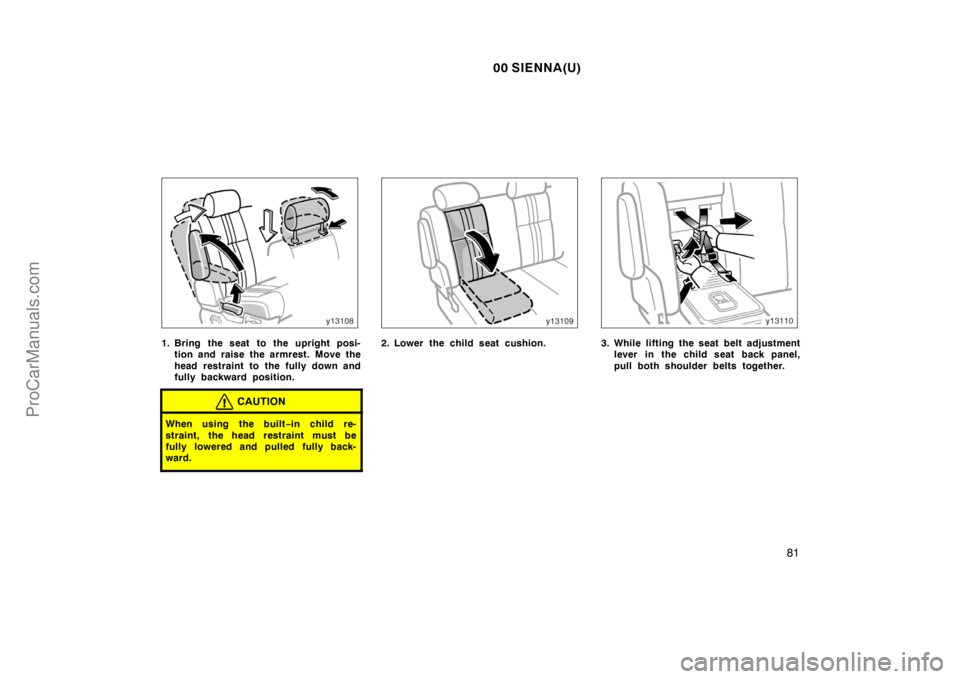
1. Bring the seat to the upright posi-
tion and raise the armrest. Move the
head restraint to the fully down and
fully backward position.
CAUTION
When using the built−in child re-
straint, the head restraint must be
fully lowered and pulled fully back-
ward.
2. Lower the child seat cushion.3. While lifting the seat belt adjustment
lever in the child seat back panel,
pull both shoulder belts together.
ProCarManuals.com
Page 88 of 282
00 SIENNA(U)
82
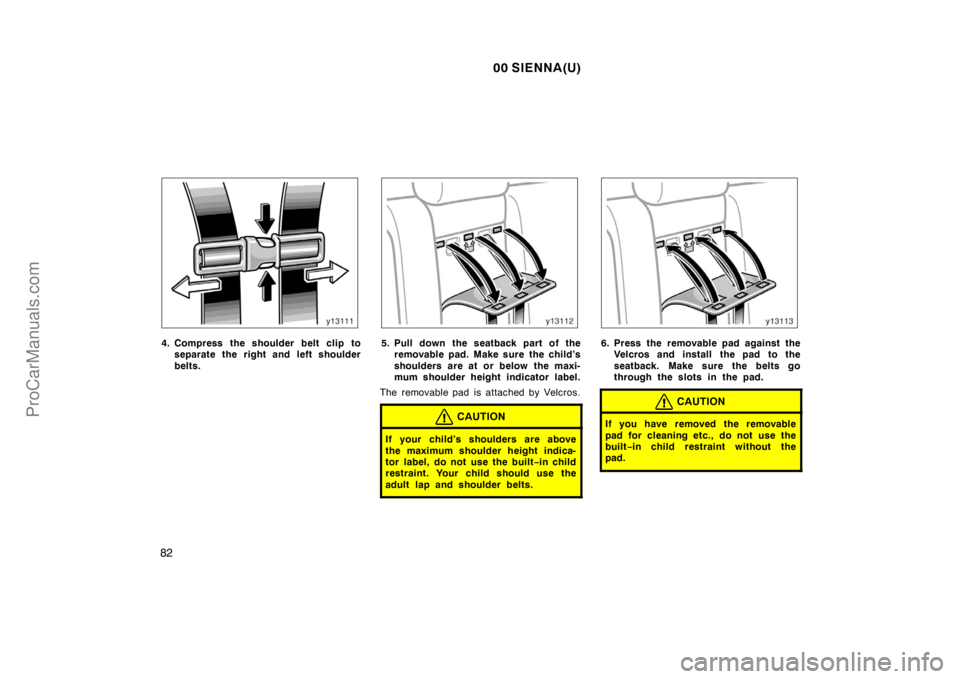
4. Compress the shoulder belt clip to
separate the right and left shoulder
belts.5. Pull down the seatback part of the
removable pad. Make sure the child’s
shoulders are at or below the maxi-
mum shoulder height indicator label.
The removable pad is attached by Velcros.
CAUTION
If your child’s shoulders are above
the maximum shoulder height indica-
tor label, do not use the built−in child
restraint. Your child should use the
adult lap and shoulder belts.
6. Press the removable pad against the
Velcros and install the pad to the
seatback. Make sure the belts go
through the slots in the pad.
CAUTION
If you have removed the removable
pad for cleaning etc., do not use the
built−in child restraint without the
pad.
ProCarManuals.com