2000 TOYOTA LAND CRUISER key
[x] Cancel search: keyPage 22 of 235
L/C 100_U
44 2000 L/C 100 (OM60866U)
For your safety and comfort, adjust the
head restraint before driving.
To raise: Pull it up.
To lower: Push it down while pressing the
lock release button.
Front head restraint only—You can also
move the head restraint forward or back-
ward. If such adjustment is desired, pull
or push the head restraint.
Rear center head restraint—When an oc-
cupant sits on the rear center seat, al-
ways pull up the rear center head re-
straint to the lock position.
The head restraint is most effective when
it is close to your head. Therefore, using
a cushion on the seatback is not recom-
mended.
CAUTION
Adjust the center of the head re-
straint so that it is closest to the
top of your ears.
After adjusting the head restraint,
make sure it is locked in position.
Do not drive with the head re-
straints removed.
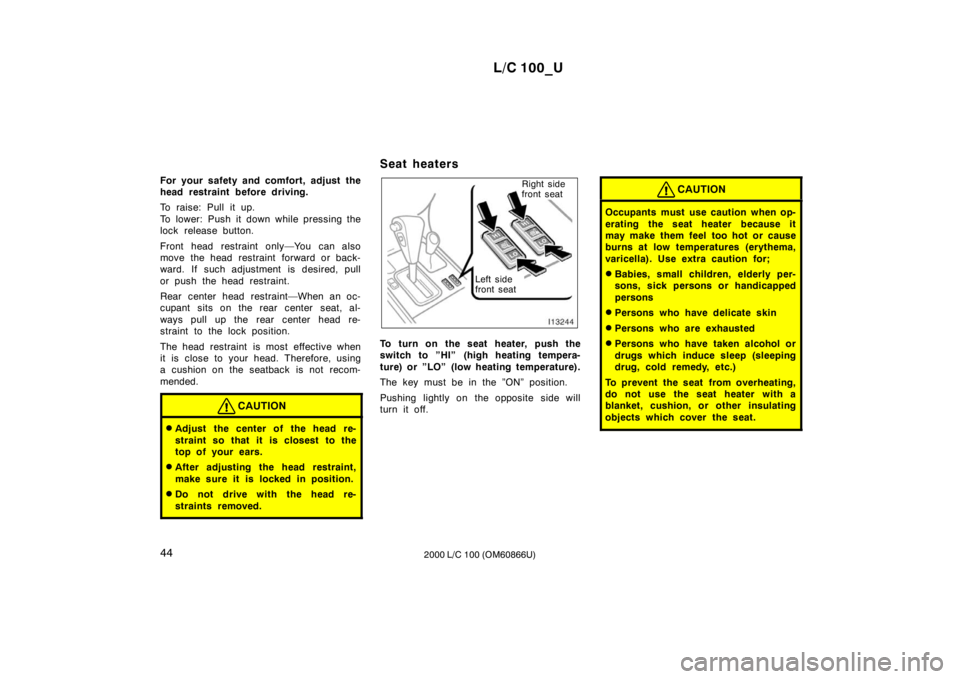
Seat heaters
Left side
front seat Right side
front seat
To turn on the seat heater, push the
switch to ”HI” (high heating tempera-
ture) or ”LO” (low heating temperature).
The key must be in the ”ON” position.
Pushing lightly on the opposite side will
turn it off.
CAUTION
Occupants must use caution when op-
erating the seat heater because it
may make them feel too hot or cause
burns at low temperatures (erythema,
varicella). Use extra caution for; Babies, small children, elderly per-
sons, sick persons or handicapped
persons
Persons who have delicate skin
Persons who are exhausted
Persons who have taken alcohol or
drugs which induce sleep (sleeping
drug, cold remedy, etc.)
To prevent the seat from overheating,
do not use the seat heater with a
blanket, cushion, or other insulating
objects which cover the seat.
Page 30 of 235
L/C 100_U
52 2000 L/C 100 (OM60866U)
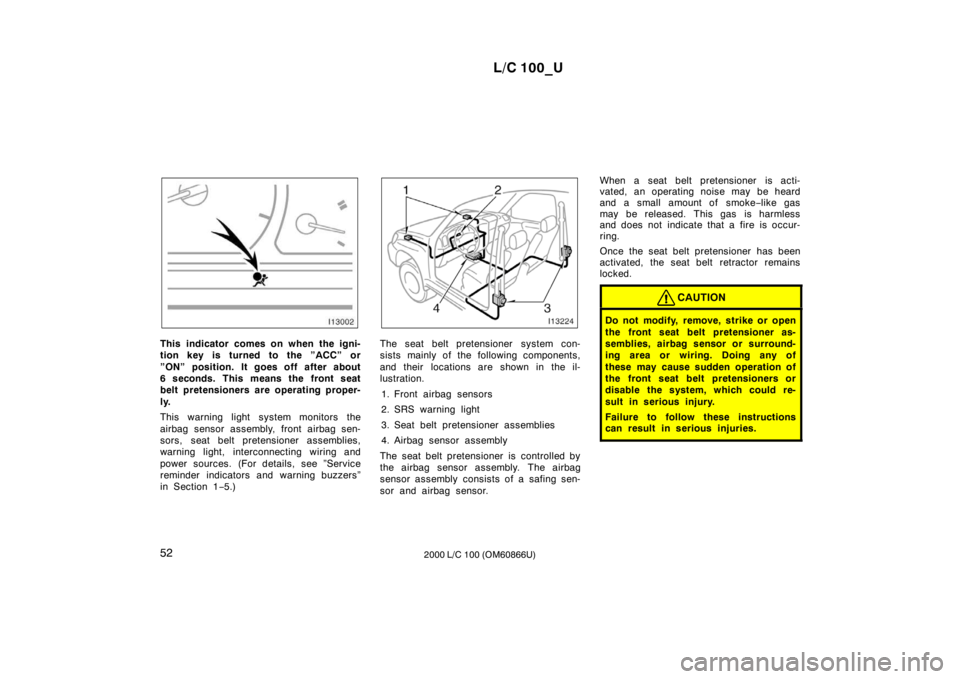
This indicator comes on when the igni-
tion key is turned to the ”ACC” or
”ON” position. It goes off after about
6 seconds. This means the front seat
belt pretensioners are operating proper-
ly.
This warning light system monitors the
airbag sensor assembly, front airbag sen-
sors, seat belt pretensioner assemblies,
warning light, interconnecting wiring and
power sources. (For details, see ”Service
reminder indicators and warning buzzers”
in Section 1−5.)The seat belt pretensioner system con-
sists mainly of the following components,
and their locations are shown in the il-
lustration.
1. Front airbag sensors
2. SRS warning light
3. Seat belt pretensioner assemblies
4. Airbag sensor assembly
The seat belt pretensioner is controlled by
the airbag sensor assembly. The airbag
sensor assembly consists of a safing sen-
sor and airbag sensor. When a seat belt pretensioner is acti-
vated, an operating noise may be heard
and a small amount of smoke
−like gas
may be released. This gas is harmless
and does not indicate that a fire is occur-
ring.
Once the seat belt pretensioner has been
activated, the seat belt retractor remains
locked.
CAUTION
Do not modify, remove, strike or open
the front seat belt pretensioner as-
semblies, airbag sensor or surround-
ing area or wiring. Doing any of
these may cause sudden operation of
the front seat belt pretensioners or
disable the system, which could re-
sult in serious injury.
Failure to follow these instructions
can result in serious injuries.
Page 31 of 235
L/C 100_U53
2000 L/C 100 (OM60866U)
NOTICE
Do not perform any of the following
changes without consulting your
Toyota dealer. Such changes can
interfere with proper operation of the
seat belt pretensioners in somecases. Installation of electronic devices
such as a mobile two −way radio,
cassette tape player or compact
disc player
Repairs on or near the front seat
belt retractor assemblies
Modification of the suspension sys-
tem
Modification of the front end struc-
ture
Attachment of a grille guard (bull
bar, kangaroo bar, etc.), snowplow,
winches or any other equipment to
the front end
Repairs made on or near the front
fenders, front end structure or con-
sole
This front seat belt pretensioner system
has a service reminder indicator to inform
the driver of operating problems. If either
of the following conditions occurs, this
indicates a malfunction of the airbags or
pretensioners. Contact your Toyota dealer
as soon as possible to service the
vehicle.
The light does not come on when the
ignition key is turned to the ”ACC” or
”ON” position, or remains on.
The light comes on or flashes while
driving.
If either front seat belt does not retract
or can not be pulled out due to a
malfunction or activation of the preten-
sioner.
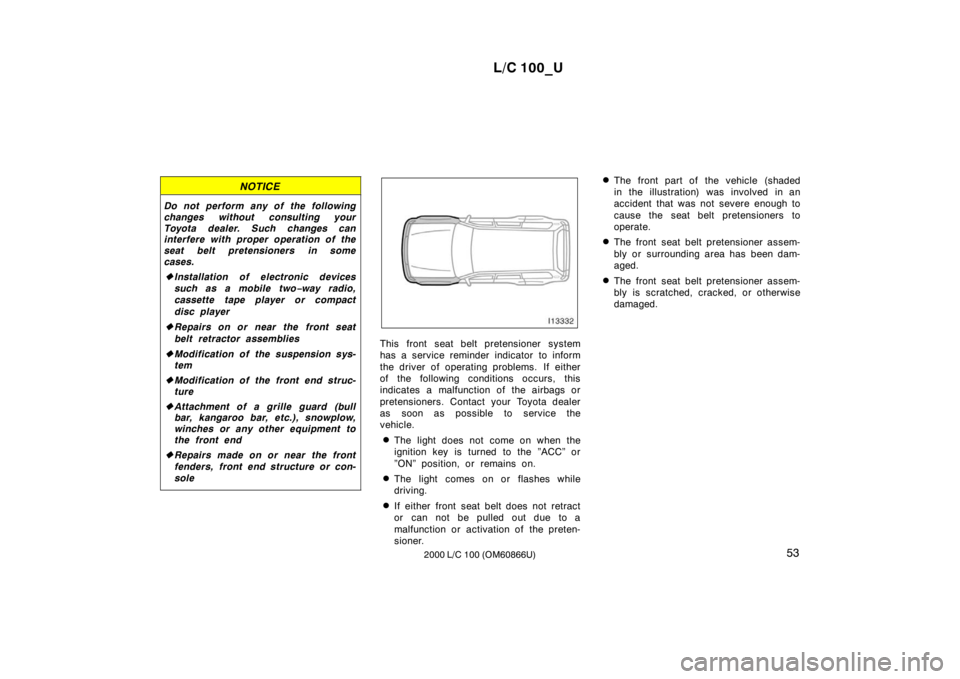
The front part of the vehicle (shaded
in the illustration) was involved in an
accident that was not severe enough to
cause the seat belt pretensioners to
operate.
The front seat belt pretensioner assem-
bly or surrounding area has been dam- aged.
The front seat belt pretensioner assem-
bly is scratched, cracked, or otherwise
damaged.
Page 32 of 235
L/C 100_U
54 2000 L/C 100 (OM60866U)
The SRS (Supplemental Restraint Sys-
tem) airbags are designed to provide
further protection for the driver and
front passenger in addition to the pri-
mary safety protection provided by the
seat belts.
In response to a severe frontal impact,
the SRS airbags work together with the
seat belts to help reduce injury by inflat-
ing. The SRS airbags help to reduce inju-
ries mainly to the driver’s or front passen-
ger ’s head or chest directly hitting the
steering wheel or dashboard. The passen-
ger airbag is activated even with no pas-
senger in the front seat.
Be sure to wear your seat belt.
CAUTION
A driver or front passenger too close
to the steering wheel or dashboard
during airbag deployment can be
killed or seriously injured. Toyota
strongly recommends that: The driver sit as far back as pos-
sible from the steering wheel while
still maintaining control of the ve-
hicle.
The front passenger sit as far back
as possible from the dashboard.
All vehicle occupants be properly
restrained using the available seat
belts.
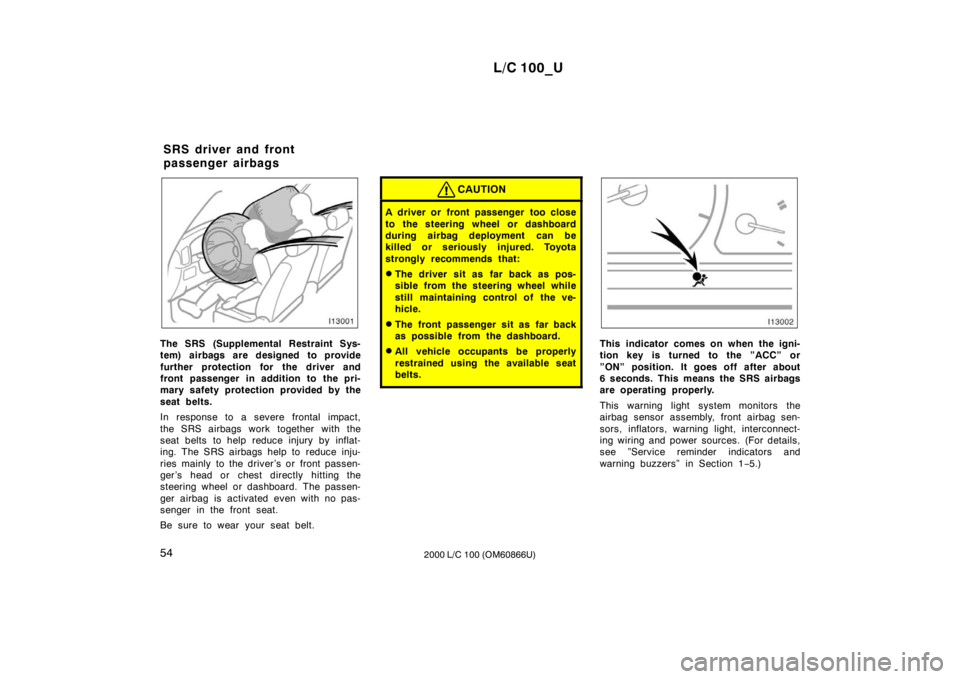
This indicator comes on when the igni-
tion key is turned to the ”ACC” or
”ON” position. It goes off after about
6 seconds. This means the SRS airbags
are operating properly.
This warning light system monitors the
airbag sensor assembly, front airbag sen-
sors, inflators, warning light, interconnect-
ing wiring and power sources. (For details,
see ”Service reminder indicators and
warning buzzers” in Section 1 −5.)
SRS driver and front
passenger airbags
Page 38 of 235
L/C 100_U
60 2000 L/C 100 (OM60866U)
NOTICE
Do not perform any of the following
changes without consulting your
Toyota dealer. Such changes can
interfere with proper operation of the
SRS airbag system in some cases. Installation of electronic devices
such as a mobile two −way radio,
cassette tape player or compact
disc player
Modification of the suspension sys-
tem
Modification of the front end struc-
ture
Attachment of a grille guard (bull
bar, kangaroo bar, etc.), snowplow,
winches or any other equipment to
the front end
Repairs made on or near the front
fenders, front end structure, con-
sole, steering column, steering
wheel or dashboard near the front
passenger airbag
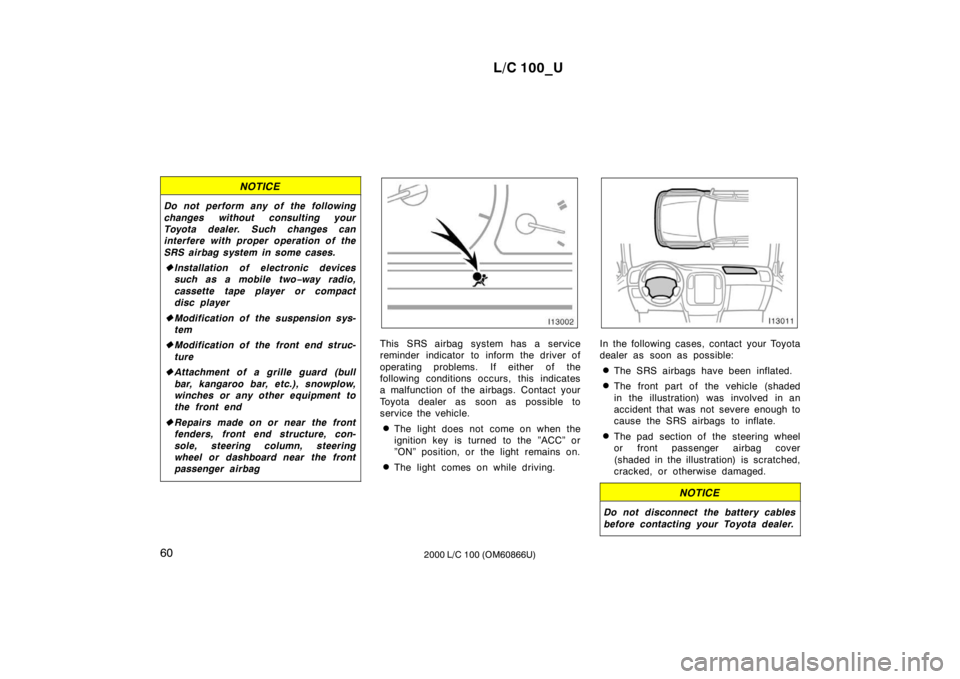
This SRS airbag system has a service
reminder indicator to inform the driver of
operating problems. If either of the
following conditions occurs, this indicates
a malfunction of the airbags. Contact your
Toyota dealer as soon as possible to
service the vehicle.
The light does not come on when the
ignition key is turned to the ”ACC” or
”ON” position, or the light remains on.
The light comes on while driving.In the following cases, contact your Toyota
dealer as soon as possible:
The SRS airbags have been inflated.
The front part of the vehicle (shaded
in the illustration) was involved in an
accident that was not severe enough to
cause the SRS airbags to inflate.
The pad section of the steering wheel
or front passenger airbag cover
(shaded in the illustration) is scratched,
cracked, or otherwise damaged.
NOTICE
Do not disconnect the battery cables
before contacting your Toyota dealer.
Page 55 of 235
L/C 100_U77
2000 L/C 100 (OM60866U)
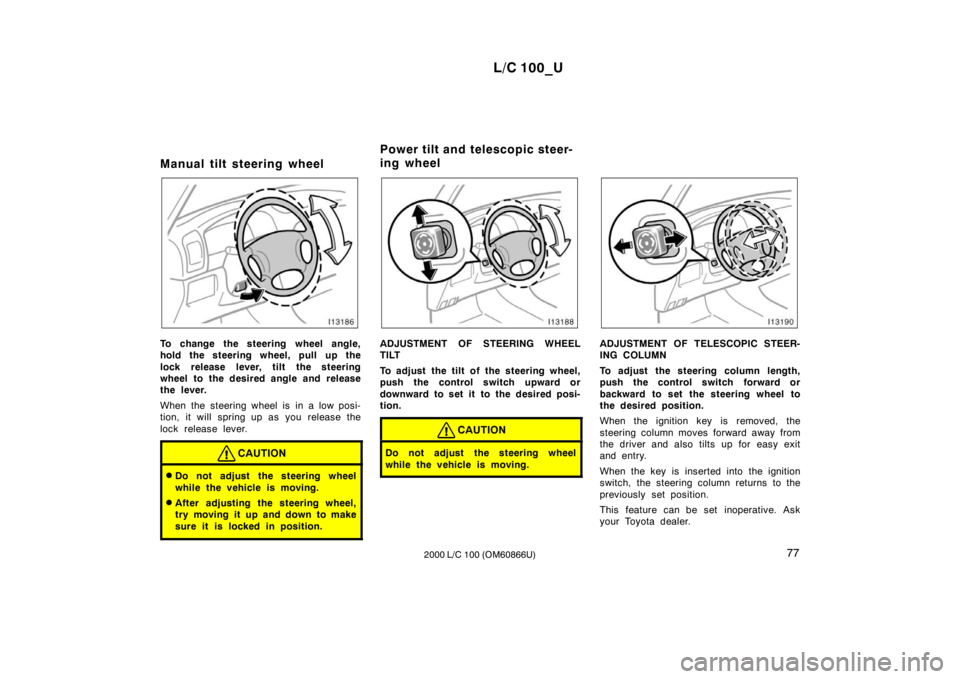
Manual tilt steering wheel
To change the steering wheel angle,
hold the steering wheel, pull up the
lock release lever, tilt the steering
wheel to the desired angle and release
the lever.
When the steering wheel is in a low posi-
tion, it will spring up as you release the
lock release lever.
CAUTION
Do not adjust the steering wheel
while the vehicle is moving.
After adjusting the steering wheel,
try moving it up and down to make
sure it is locked in position.
ADJUSTMENT OF STEERING WHEEL
TILT
To adjust the tilt of the steering wheel,
push the control switch upward or
downward to set it to the desired posi-
tion.
CAUTION
Do not adjust the steering wheel
while the vehicle is moving.
ADJUSTMENT OF TELESCOPIC STEER-
ING COLUMN
To adjust the steering column length,
push the control switch forward or
backward to set the steering wheel to
the desired position.
When the ignition key is removed, the
steering column moves forward away from
the driver and also tilts up for easy exit
and entry.
When the key is inserted into the ignition
switch, the steering column returns to the
previously set position.
This feature can be set inoperative. Ask
your Toyota dealer.
Power tilt and telescopic steer-
ing wheel
Page 57 of 235
L/C 100_U79
2000 L/C 100 (OM60866U)
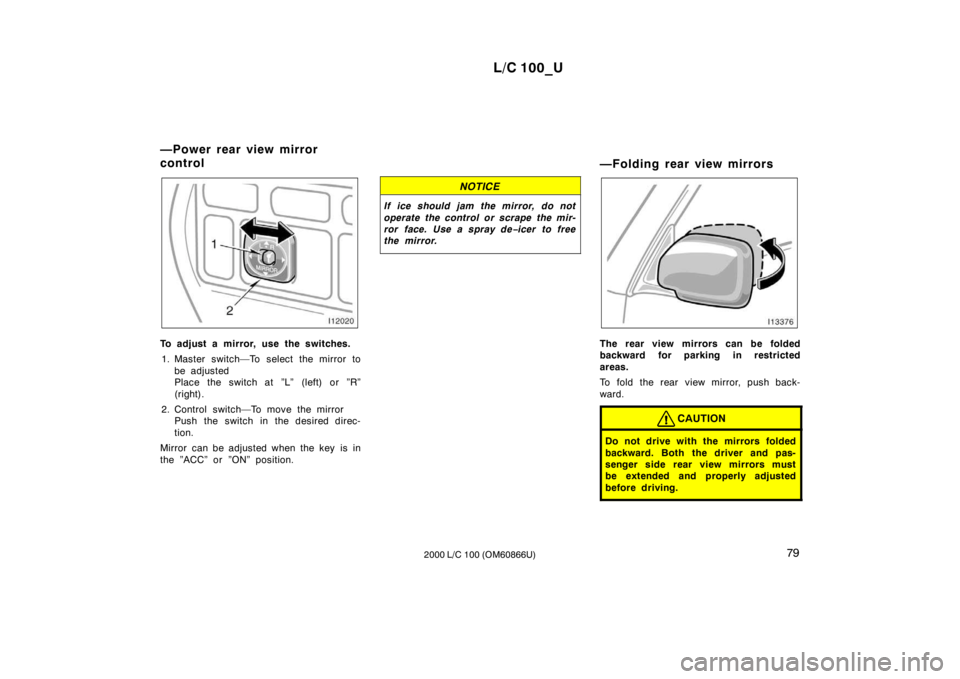
To adjust a mirror, use the switches.
1. Master switch—To select the mirror to be adjusted
Place the switch at ”L” (left) or ”R”
(right).
2. Control switch—To move the mirror Push the switch in the desired direc-
tion.
Mirror can be adjusted when the key is in
the ”ACC” or ”ON” position.
NOTICE
If ice should jam the mirror, do not
operate the control or scrape the mir-
ror face. Use a spray de −icer to free
the mirror.
—Folding rear view mirrors
The rear view mirrors can be folded
backward for parking in restricted
areas.
To fold the rear view mirror, push back-
ward.
CAUTION
Do not drive with the mirrors folded
backward. Both the driver and pas-
senger side rear view mirrors must
be extended and properly adjusted
before driving.
—Power rear view mirror
control
Page 62 of 235
L/C 100_U
84 2000 L/C 100 (OM60866U)
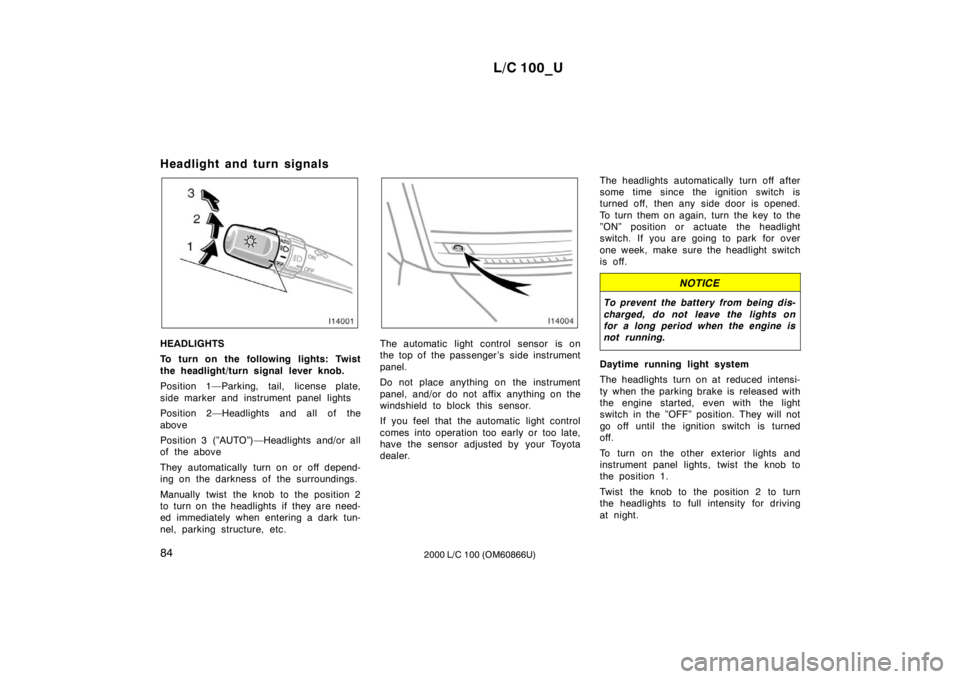
Headlight and turn signals
HEADLIGHTS
To turn on the following lights: Twist
the headlight/turn signal lever knob.
Position 1—Parking, tail, license plate,
side marker and instrument panel lights
Position 2—Headlights and all of the
above
Position 3 (”AUTO”)—Headlights and/or all
of the above
They automatically turn on or off depend-
ing on the darkness of the surroundings.
Manually twist the knob to the position 2
to turn on the headlights if they are need-
ed immediately when entering a dark tun-
nel, parking structure, etc.The automatic light control sensor is on
the top of the passenger ’s side instrument
panel.
Do not place anything on the instrument
panel, and/or do not affix anything on the
windshield to block this sensor.
If you feel that the automatic light control
comes into operation too early or too late,
have the sensor adjusted by your Toyota
dealer.
The headlights automatically turn off after
some time since the ignition switch is
turned off, then any side door is opened.
To turn them on again, turn the key to the
”ON” position or actuate the headlight
switch. If you are going to park for over
one week, make sure the headlight switch
is off.
NOTICE
To prevent the battery from being dis-
charged, do not leave the lights on
for a long period when the engine is
not running.
Daytime running light system
The headlights turn on at reduced intensi-
ty when the parking brake is released with
the engine started, even with the light
switch in the ”OFF” position. They will not
go off until the ignition switch is turned
off.
To turn on the other exterior lights and
instrument panel lights, twist the knob to
the position 1.
Twist the knob to the position 2 to turn
the headlights to full intensity for driving
at night.