2000 TOYOTA LAND CRUISER lock
[x] Cancel search: lockPage 125 of 235

L/C 100_U147
2000 L/C 100 (OM60866U)
Cigarette lighter and ashtray
CIGARETTE LIGHTER
To use the cigarette lighter, press it in.
When it becomes heated, it automatical-
ly pops out ready for use.
If the engine is not running, the key must
be in the ”ACC” position.
Do not hold the cigarette lighter pressed
in.
Use a Toyota genuine cigarette lighter or
equivalent for replacement.
ASHTRAY
To use the ashtray, pull it out.
When finished with your cigarette, thor-
oughly extinguish it in the ashtray to pre-
vent other cigarette butts from catching
fire. After using the ashtray, push it back
in completely.
To remove the ashtray, press down on the
lock spring plate and pull out.
CAUTION
To reduce the chance of injury in
case of an accident or sudden stop
while driving, always close the ash-
tray completely after using.
Power outlets
The power outlets are designed for
power supply for car accessories. To
use them, open the lids as shown in
the following illustrations.
The key must be in the ”ACC” or ”ON”
position to be used.
NOTICE
To prevent the fuse from being
blown, do not use the electricity
over the total vehicle capacity of
12V/120W (all the outlets together).
To prevent the battery from being
discharged, do not use the power
outlets longer than necessary when
the engine is not running.
Close the power outlet lids when
the power outlets are not in use.
Inserting a foreign object other than
plug that fits the outlet, or pouring
juice or other liquid into the outlet
may cause troubles or short cir-
cuits.
Page 128 of 235

L/C 100_U
150 2000 L/C 100 (OM60866U)
Glove box
To use the glove box, do this.
To open: Pull the lever.
With the instrument panel lights on, the
glove box light will come on when the
glove box is open.
To lock: Insert the master key and turn it
clockwise.
CAUTION
To reduce the chance of injury in
case of an accident or a sudden stop,
always keep the glove box door
closed while driving.
Garage door opener box
Your vehicle is equipped with a box
designed to store a garage door opener
transmitter. You can operate the stored
garage door opener through the hole on
the lid.To use the garage door opener box, do
the following.
1. Open the garage door opener box with a flat −bladed screwdriver. To
protect the surface, put a sheet of
paper or cloth on the blade.
Page 137 of 235

L/C 100_U159
2000 L/C 100 (OM60866U)
Floor mat
Use a floor mat of the correct size.
If the floor carpet and floor mat have a
hole, then it is designed for use with a
locking clip. Fix the floor mat with locking
clip into the hole in the floor carpet.
CAUTION
Make sure the floor mat is properly
placed on the floor carpet. If the floor
mat slips and interferes with the
movement of the pedals during driv-
ing, it may cause an accident.
Page 148 of 235
L/C 100_U
170 2000 L/C 100 (OM60866U)
There may be the case that the brake
system warning light stays on for a
bout
60 seconds after the engine is started. It
is normal if the light goes out after a
while.
Depressing the brake pedal repeatedly
may turn on the brake system warning
light and buzzer. It is normal if the light
goes out and the buzzer stops sounding
after a few seconds.
You may hear a small sound in the engine
compartment after the engine is started or
the brake pedal is depressed repeatedly.
This is a pump pulsating sound of the
brake system, and it is not a malfunction.
CAUTION
Do not pump the brake pedal if the
engine stalls. Each push on the
pedal uses up your brake fluid
pressure reserve.
Even if the power assist is com-
pletely lost, the brakes will still
work. But you will have to push the
pedal hard, much harder than nor-
mal. And your braking distance will
be longer.
ANTI −LOCK BRAKE SYSTEM
(with “ABS” warning light)
The anti −lock brake system is designed
to help prevent lock −up of the wheels
during a sudden braking or braking on
slippery road surfaces. This assists in
providing stability and steering perfor-
mance of the vehicle under these cir-
cumstances.
Effective way to press the ”ABS” brake
pedal: When the anti −lock brake system
function is in action, just hold the brake
pedal down more firmly. Especially in a
panic stop, you need to keep it de-
pressed more firmly, and do not pump
the brake. Pumping the brake pedal
makes the stopping distance longer.
The anti −lock brake system becomes op-
erative after the vehicle has accelerated
to a speed in excess of approximately 10
km/h (6 mph). It stops operating when the
vehicle decelerates to a speed below
approximately 5 km/h (3 mph).
Depressing the brake pedal on slippery
road surfaces such as on the manhole
cover, the steel plate under the construc-
tion, joints in the bridge, etc. on a rainy
day tends to activate the anti −lock brake
system. You may hear a click or motor sound in
the engine compartment for a few seconds
when the engine is started or just after
the vehicle is started. This means that the
anti
−lock brake system is in the self
check mode, and does not indicate a mal-
function.
When the anti −lock brake system is ac-
tivated, the following conditions may
occur, however, do not indicate a mal-
function of the system:
You may hear the anti −lock brake sys-
tem operating and feel the brake pedal
pulsating and the vibrations of the body
and steering wheel. You may also hear
the motor sound in the engine compart-
ment even after the vehicle is stopped.
At the end of the anti −lock brake sys-
tem activation, the brake pedal may
move a little forward.
Page 149 of 235
L/C 100_U171
2000 L/C 100 (OM60866U)
CAUTION
Do not overestimate the anti −lock
brake system: Although the anti −lock
brake system assists in providing ve-
hicle control, it is still important to
drive with all due care and maintain
a moderate speed and safe distance
from the vehicle in front of you, be-
cause there are limits to the vehicle
stability and effectiveness of steering
wheel operation even with the anti −
lock brake system on.
If tires grip performance exceeds its
capability, or if hydroplaning occurs
during high speed driving in the rain,
the anti −lock brake system does not
provide vehicle control.
Anti −lock brake system is not de-
signed to shorten the stopping dis-
tance: Always drive at the moderate
speed and maintain a safe distance
from the vehicle in front of you.
Compared with vehicles not fitted
with an anti −lock brake system, your
vehicle may require a longer stopping
distance in the following cases: Driving on rough, gravel or snow −
covered roads.
Driving with tire chains installed.
Driving over the steps such as the
joints on the road.
Driving on roads where the road
surface is pitted or has other differ-
ences in surface height.
Install all 4 tires of specified size at
designated pressure: The anti −lock
brake system detects vehicle speeds
using the speed sensors for respec-
tive wheels’ turning speeds. The use
of tires other than specified may fail
to detect the accurate turning speed,
resulting in a longer stopping dis-
tance.
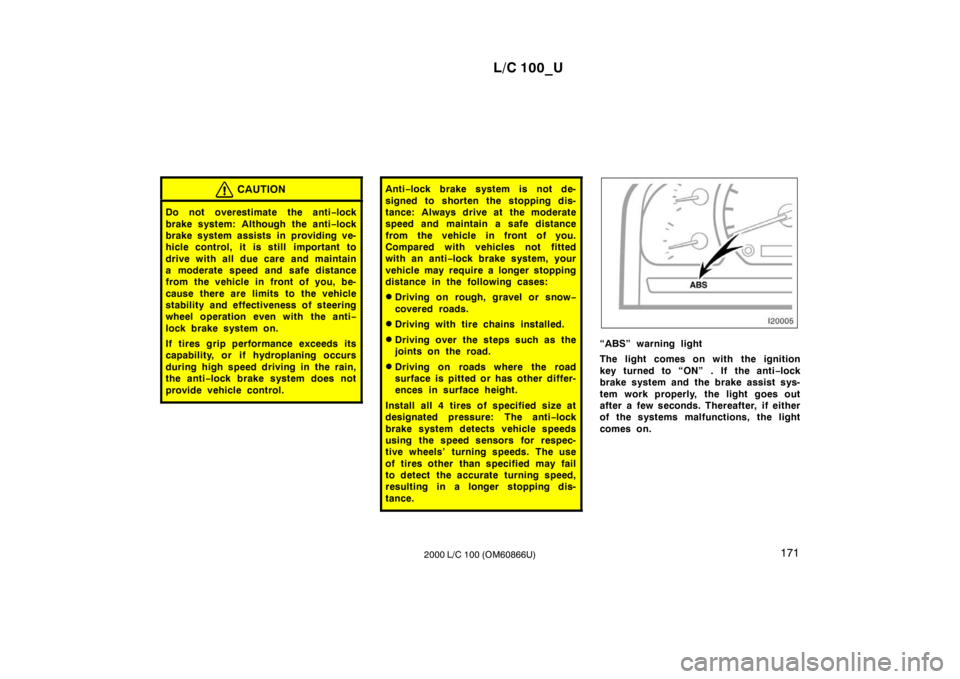
“ABS” warning light
The light comes on with the ignition
key turned to “ON” . If the anti −lock
brake system and the brake assist sys-
tem work properly, the light goes out
after a few seconds. Thereafter, if either
of the systems malfunctions, the light
comes on.
Page 150 of 235
L/C 100_U
172 2000 L/C 100 (OM60866U)
When the “ABS” warning light is on (and
the brake system warning light is off), the
anti
−lock brake system, the brake assist
system, the vehicle skid control system
and/or active traction control system do/
does not operate, but the brake system
still operates conventionally.
When the “ABS” warning light is on (and
the brake system warning light is off), the
anti −lock brake system does not operate
so that the wheels could lock up during
a sudden braking or braking on slippery
road surfaces.
If the following conditions occurs, this
indicates a malfunction somewhere in
the parts monitored by the warning
light system. Contact your Toyota deal-
er as soon as possible to service the
vehicle.
The light does not come on with the
ignition key turned to “ON”, or remainson.
The light comes on while driving.
If the light lit during driving goes out and
does not come on again, it is a normal
operation.
CAUTION
If the “ABS” warning light remains on
together with the brake system warn-
ing light, immediately stop your ve-
hicle at a safe place and contact your
Toyota dealer.
In this case, the vehicle may become
harder to control or skid during hard
braking or braking on slippery road
surfaces.
Either of the following conditions may
occur, but do not indicate the malfunc-
tion. The light may stay on for about 60
seconds after the engine is started. It
is normal if it goes out after a while.
Depressing the brake pedal repeatedly
may turn on the light. It is normal if it
goes off after a few seconds. DRUM
−IN −DISC TYPE PARKING BRAKE
SYSTEM
Your vehicle has a drum −in −disc type
parking brake system. This type of brake
system n eeds bedding −down of the brake
shoes periodically or whenever the parking
brake shoes and/or drums are replaced.
Have your Toyota dealer perform the bed-
ding −down.
BRAKE ASSIST SYSTEM
When you slam the brakes on, the
brake assist system judges as an emer-
gency stop and provides more powerful
braking for a driver who cannot hold
down the brake pedal firmly.
When you slam the brakes on, more pow-
erful braking will be applied. At this time,
you may hear a sound in the engine
compartment and feel the vibrations of the
brake pedal. This does not indicate a mal-
function.
The brake assist system becomes opera-
tive after the vehicle has accelerated to
a speed in excess of approximately 10
km/h (6 mph). It stops operating when the
vehicle decelerates to a speed below
approximately 5 km/h (3 mph).
Page 154 of 235

L/C 100_U
176 2000 L/C 100 (OM60866U)
—Engine number
The engine number is stamped on the
engine block as shown.
Theft prevention labels
Your new vehicle carries theft preven-
tion labels which are approximately 56
mm (2.20 in.) by 16 mm (0.63 in.).
The purpose of these labels is to reduce
the incidence of vehicle thefts by facilitat-
ing the tracing and recovery of parts from
stolen vehicles. The label is designed so
that once it is applied to a surface, any
attempt to remove it will result in destroy-
ing the integrity of the label. Transferring
these labels intact from one part to anoth-
er, will be impossible.NOTICE
You should not attempt to remove the
theft prevention labels as it may vio-
late certain state or federal laws.
Suspension and chassis
CAUTION
Do not modify the suspension/chassis
with lift kits, spacers, springs, etc. It
can cause dangerous handling charac-
teristics, resulting in loss of control.
Page 163 of 235
L/C 100_U199
2000 L/C 100 (OM60866U)
CAUTION
Do not attempt to remove the radiator
cap when the engine and radiator are
hot. Serious injury could result from
scalding hot fluid and steam blown
out under pressure.
7. After the engine coolant temperature
has cooled to normal, again check the
coolant level in the reservoir. If neces-
sary, bring it up to half full again. Seri-
ous coolant loss indicates a leak in the
system. You s hould have it checked as
soon as possible at your Toyota dealer. If you have a flat tire—
1. Reduce your speed gradually, keeping a straight line. Move cautiously off the
road to a safe place well away from
the traffic. Avoid stopping on the center
divider of a highway. Park on a level
spot with firm ground.
2. Stop the engine and turn on your emergency flashers.
3. Firmly set the parking brake and put the transmission in ”P”.
4. Have everyone get out of the vehicle on the side away from traffic.
5. Read the following instructions thor- oughly.
CAUTION
When jacking, be sure to observe the
following to reduce the possibility of
personal injury: Follow jacking instructions.
Do not put any part of your body
under the vehicle supported by the
jack. Personal injury may occur.
Do not start or run the engine while
your vehicle is supported by the
jack.
Stop the vehicle on a level firm
ground, firmly set the parking brake
and put the transmission in reverse.
Block the wheel diagonally opposite
to the one being changed if neces-
sary.
Make sure to set the jack properly
in the jack point. Raising the ve-
hicle with jack improperly posi-
tioned will damage the vehicle or
may allow the vehicle to fall off the
jack and cause personal injury.
Never get under the vehicle when
the vehicle is supported by the jack
alone.
Use the jack only for lifting your
vehicle during wheel changing.
Do not raise the vehicle with some-
one in the vehicle.
When raising the vehicle, do not
put an object on or under the jack.
Raise the vehicle only high enough
to remove and change the tire.