2000 TOYOTA LAND CRUISER engine
[x] Cancel search: enginePage 77 of 235

L/C 100_U99
2000 L/C 100 (OM60866U)
(b) Driver’s Seat Belt Reminder Light
and Buzzer
This light and buzzer remind you to
buckle up the driver’s seat belt.
Once the ignition key is turned to ”ON” or
”START”, the reminder light flashes and
the buzzer sounds if the driver ’s seat belt
is not fastened. Unless the driver fastens
the belt, the light keeps on flashing and
the buzzer sounds 4 to 8 seconds.
(c) Front Passenger ’s Seat Belt Re- minder Light
This light remind you to buckle up the
front passenger ’s seat belt.
Once the ignition key is turned to ”ON” or
”START”, the reminder light flashes if a
passenger sits in the front passenger seat
and does not fasten the seat belt. Unless
the front passenger fastens the belt, the
light stays flashing.
If luggage load is placed on the front
passenger seat, depending on its weight
and how it is placed on the seat, built −in
sensors in the seat cushion may detect
the pressure, causing the reminder light to
come on.
(d) Discharge Warning Light
This light warns that the battery is being
discharged. If it comes on while you are driving, there
is a problem somewhere in the charging
system.
The engine ignition will continue to oper-
ate, however, until the battery is dis-
charged. Turn off the air conditioning,
blower, radio, etc., and drive directly to
the nearest Toyota dealer or repair shop.
NOTICE
Do not continue driving if the engine
drive belt is broken or loose.
(e) Malfunction Indicator Lamp
This lamp comes on in the following
cases.
a. The fuel tank is completely empty. (See
”Fuel gauge” in Section 1
−5 for instruc-
tions.)
b. The fuel tank cap is not tightened se-
curely. (See ”Fuel tank cap” in Section1 −2 for instructions.)
c. There is a problem somewhere in your
engine electrical system, automatic trans-
mission electrical system or electronic
throttle control system. If it comes on while you are driving in
case c, have your vehicle checked/re-
paired by your Toyota dealer as soon as
possible.
If this lamp comes on and the engine
speed does not increase with the acceler-
ator pedal depressed down to about the
middle position, there may be a problem
somewhere in your electronic throttle con-
trol system.
At this time, if you depress the accelera-
tor pedal more firmly and slowly, you can
drive your vehicle at low speeds. Have
your Toyota checked by your Toyota deal-
er as soon as possible.
Even if the abnormality of the electronic
throttle control system is corrected during
low speed driving, the system may not be
recovered until the engine is stopped and
the ignition key is turned to ”ACC” or
”LOCK” position.
(f) Low Fuel Level Warning Light
This light comes on when the fuel level
in the tank becomes nearly empty. Fill up
the tank as soon as possible.
Page 78 of 235
L/C 100_U
100 2000 L/C 100 (OM60866U)
(g) SRS Warning Light
This light will come on when the igni-
tion key is turned to the ”ACC” or
”ON” position. After about 6 seconds,
the light will go off. This means the
system of the airbag and front seat belt
pretensioners are operating properly.
The warning light system monitors the air-
bag sensor assembly, front airbag sen-
sors, seat belt pretensioner assemblies,
inflators, warning light, interconnecting wir-
ing and power sources.
If either of the following conditions occurs,
this indicates a malfunction somewhere in
the parts monitored by the warning light
system. Contact your Toyota dealer as
soon as possible to service the vehicle.
The light does not come on when the
ignition key is turned to the ”ACC” or
”ON” position or remains on.
The light comes on or flashes while
driving. (h) ”ABS” Warning Light
The light comes on with the ignition
key turned to “ON”. If the anti
−lock
brake system and the brake assist sys-
tem work properly, the light goes out
after a few seconds. Thereafter, if either
of the systems malfunctions, the light
comes on.
When the “ABS” warning light is on (and
the brake system warning light is off), the
anti −lock brake system, the brake assist
system, the vehicle skid control system
and/or active traction control system do/
does not operate, but the brake system
still operates conventionally.
When the “ABS” warning light is on (and
the brake system warning light is off), the
anti −lock brake system does not operate
so that the wheels could lock up during
a sudden braking or braking on slippery
road surfaces.
If the following conditions occurs, this
indicates a malfunction somewhere in
the parts monitored by the warning
light system. Contact your Toyota deal-
er as soon as possible to service the
vehicle.
The light does not come on with the
ignition key turned to “ON”, or remains on.
The light comes on while driving.
If the light lit during driving goes out and
does not come on again, it is a normal
operation.
CAUTION
If the “ABS” warning light remains on
together with the brake system warn-
ing light, immediately stop your ve-
hicle at a safe place and contact your
Toyota dealer.
In this case, the vehicle may become
harder to control or skid during hard
braking or braking on slippery road
surfaces.
Either of the following conditions may
occur, but do not indicate the malfunc-
tion. The light may stay on for about 60
seconds after the engine is started. It
is normal if it goes out after a while.
Depressing the brake pedal repeatedly
may turn on the light. It is normal if it
goes off after a few seconds.
Page 79 of 235
L/C 100_U101
2000 L/C 100 (OM60866U)
(i) Open Door Warning Light
This light remains on until all the side
doors and back door are completely
closed.
(j) Unengaged ”Park” Warning Light
This light warns that the transmission
”Park” mechanism is not engaged. If the
four
−wheel drive control is in the ”N” posi-
tion while the selector lever is in the ”P”
position, the transmission will disengage
and the wheels will not lock.
CAUTION
To restore the park function, shift the
four −wheel drive control out of ”N”,
or the vehicle can move.
(k) Automatic Transmission Fluid Tem-
perature Warning Light
This light warns that the automatic trans-
mission fluid temperature is too high. If this light comes on while you are driv-
ing, slow down and pull off the road. Stop
the vehicle at a safe place and put the
selector lever in ”P” and leave the engine
idling until the light goes off. If the light
goes off, you can start the vehicle again.
If the light does not go off, call a Toyota
dealer or qualified repair shop for assis-
tance.
NOTICE
Continued driving with the warning
light on may damage the automatic
transmission.
(l) Vehicle Skid Control System and
Active Traction Control System
Warning Light
This light warns that there is a problem
somewhere in the vehicle skid control sys-
tem and/or active traction control system.
If the “VSC/TRAC” warning light and “VSC
OFF” indicator light come on, have your
vehicle checked by Toyota dealer as soon
as possible. However, it is no problem
that the “VSC/TRAC” warning light comes
on when the brake actuator temperature
becomes high. (For details, see “Active
traction control system” in Section 1 −6.) The lights will come on with the ignition
key turned to “ON”, and will go off after
a few seconds.
The lights may come on for 60 seconds
after the engine is started. It is normal if
they go out after a while.
Depressing the brake pedal repeatedly
may turn on the lights. it is normal if they
go out after a few seconds.
When the “VSC/TRAC” warning light and
“VSC OFF” indicator light come on, the
vehicle skid control system and/or active
traction control system do not operate, but
there is no problem to continue your driv-
ing.
(m) Key Reminder Buzzer
This buzzer reminds you to remove the
key when you open the driver’s door with
the ignition key in the ”ACC” or ”LOCK”
position.
CHECKING SERVICE REMINDER INDICA-
TORS (except the low fuel level warning
light)
1. Apply the parking brake.
2. Open one of the side doors or back door.
The open door warning light should
come on.
Page 80 of 235

L/C 100_U
102 2000 L/C 100 (OM60866U)
3. Close the door.
The open door warning light should go
off.
4. Place the four −wheel drive control lever
in ”N” position and the selector lever
in ”P” position.
5. Turn the ignition key to ”ACC”. The SRS warning light should come on.
It goes off after 6 seconds.
6. Turn the ignition key to ”ON”, but do not start the engine.
All the service reminder indicators ex-
cept the open door warning light and
SRS warning light should come on. The
”ABS”, ”VSC/TRAC”, ”VSC OFF”, ”AC-
TIVE TRAC”, and slip indicator light go
off after a few seconds.
There may be the case that the ”ABS”,
”VSC/TRAC” and ”VSC OFF” stay on
for about 60 seconds after the engine
is started. It is normal if they go out
after a while.
If any service reminder indicator or warn-
ing buzzer does not function as described
above, either the bulb is burned out or the
circuit is in need of repair. Have it
checked by your Toyota dealer as soon as
possible.
Page 82 of 235
L/C 100_U
104 2000 L/C 100 (OM60866U)
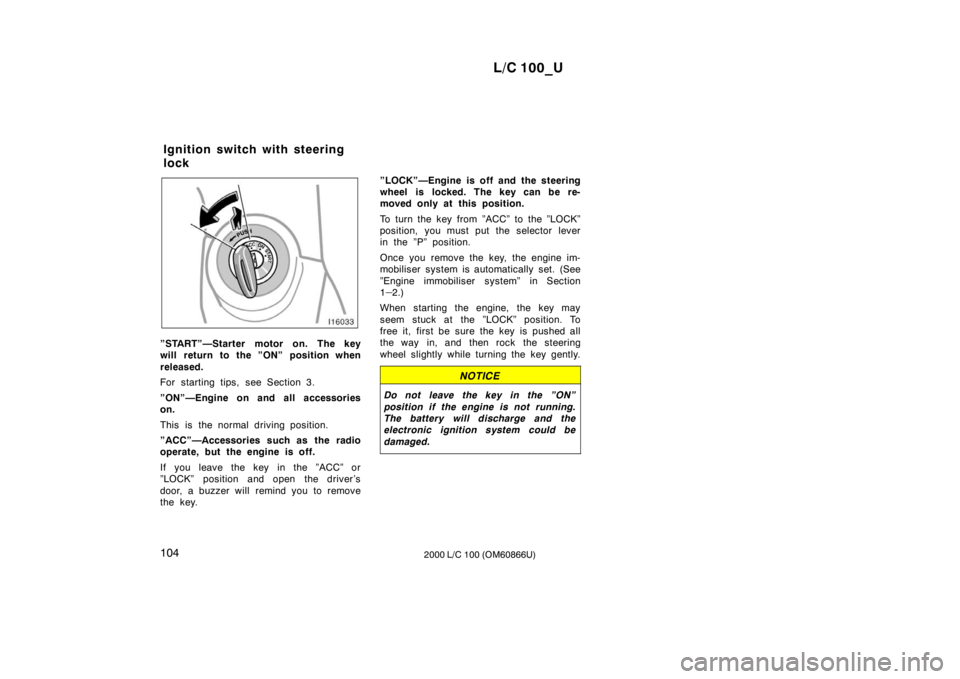
”START”—Starter motor on. The key
will return to the ”ON” position when
released.
For starting tips, see Section 3.
”ON”—Engine on and all accessories on.
This is the normal driving position.
”ACC”—Accessories such as the radio
operate, but the engine is off.
If you leave the key in the ”ACC” or
”LOCK” position and open the driver’s
door, a buzzer will remind you to remove
the key.”LOCK”—Engine is off and the steering
wheel is locked. The key can be re-
moved only at this position.
To turn the key from ”ACC” to the ”LOCK”
position, you must put the selector lever
in the ”P” position.
Once you remove the key, the engine im-
mobiliser system is automatically set. (See
”Engine immobiliser system” in Section 1
–
2.)
When starting the engine, the key may
seem stuck at the ”LOCK” position. To
free it, first be sure the key is pushed all
the way in, and then rock the steering
wheel slightly while turning the key gently.
NOTICE
Do not leave the key in the ”ON”
position if the engine is not running.
The battery will discharge and the
electronic ignition system could be damaged.
Ignition switch with steering
lock
Page 83 of 235
L/C 100_U105
2000 L/C 100 (OM60866U)
Automatic transmission
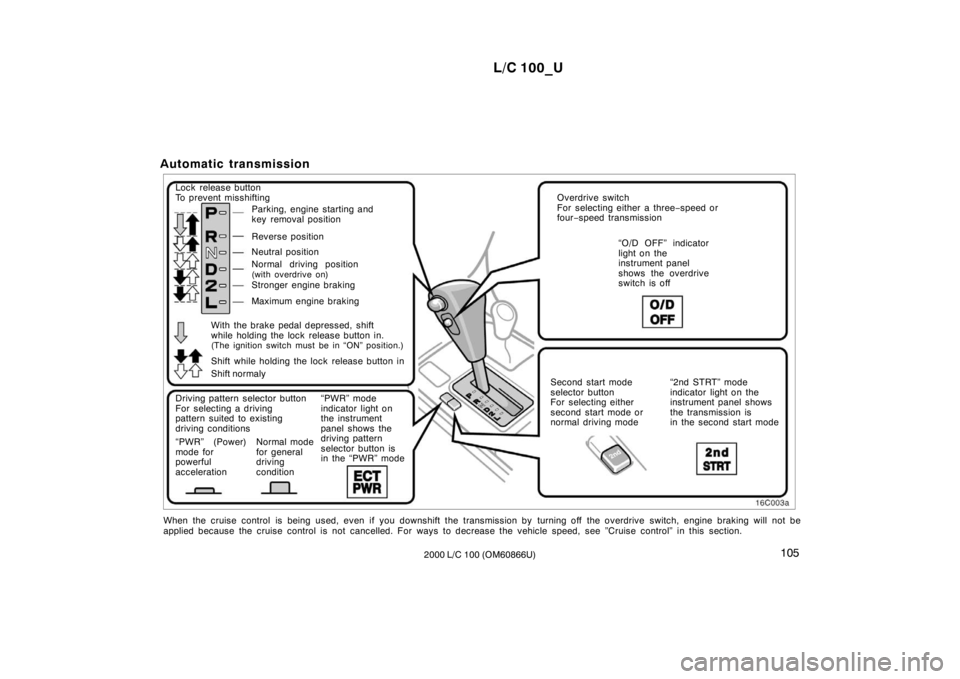
Lock release button
To prevent misshifting
Parking, engine starting and
key removal position
Reverse position
Neutral position
Normal driving position
(with overdrive on)
Stronger engine braking
Maximum engine braking
Driving pattern selector button
For selecting a driving
pattern suited to existing
driving conditions
“PWR” (Power)
mode for
powerful
acceleration Normal mode
for general
driving
condition“PWR” mode
indicator light on
the instrument
panel shows the
driving pattern
selector button is
in the “PWR” mode Overdrive switch
For selecting either a three
−speed or
four −speed transmission
“O/D OFF” indicator
light on the
instrument panel
shows the overdrive
switch is off
Second start mode
selector button
For selecting either
second start mode or
normal driving mode “2nd STRT” mode
indicator light on the
instrument panel shows
the transmission is
in the second start mode
Shift while holding the lock release button in
With the brake pedal depressed, shift
while holding the lock release button in.
(The ignition switch must be in “ON” position.)
Shift normaly
When the cruise control is being used, even if you downshift the transmis sion by turning off the overdrive switch, engine braking will not be
applied because the cruise control is not cancelled. For ways to decrease t he vehicle speed, see ”Cruise control” in this section.
Page 84 of 235
L/C 100_U
106 2000 L/C 100 (OM60866U)
Your automatic transmission has a shift
lock system to minimize the possibility of
incorrect operation. This means you can
only shift out of ”P” position when the
brake pedal is depressed (with the ignition
switch in ”ON” position and the lock re-
lease button depressed).
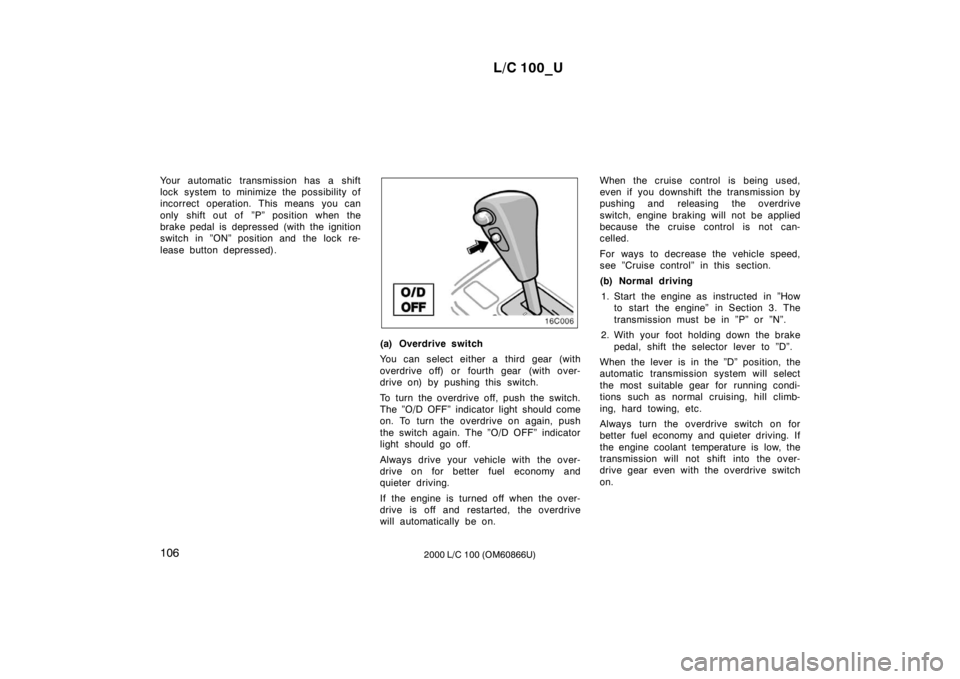
(a) Overdrive switch
You can select either a third gear (with
overdrive off) or fourth gear (with over-
drive on) by pushing this switch.
To turn the overdrive off, push the switch.
The ”O/D OFF” indicator light should come
on. To turn the overdrive on again, push
the switch again. The ”O/D OFF” indicator
light should go off.
Always drive your vehicle with the over-
drive on for better fuel economy and
quieter driving.
If the engine is turned off when the over-
drive is off and restarted, the overdrive
will automatically be on.
When the cruise control is being used,
even if you downshift the transmission by
pushing and releasing the overdrive
switch, engine braking will not be applied
because the cruise control is not can-
celled.
For ways to decrease the vehicle speed,
see ”Cruise control” in this section.
(b) Normal driving
1. Start the engine as instructed in ”How to start the engine” in Section 3. The
transmission must be in ”P” or ”N”.
2. With your foot holding down the brake pedal, shift the selector lever to ”D”.
When the lever is in the ”D” position, the
automatic transmission system will select
the most suitable gear for running condi-
tions such as normal cruising, hill climb-
ing, hard towing, etc.
Always turn the overdrive switch on for
better fuel economy and quieter driving. If
the engine coolant temperature is low, the
transmission will not shift into the over-
drive gear even with the overdrive switch on.
Page 85 of 235
L/C 100_U107
2000 L/C 100 (OM60866U)
CAUTION
Never put your foot on the accelera-
tor pedal while shifting.
3. Release the parking brake and brake
pedal. Depress the accelerator pedal
slowly for smooth starting.
(c) Using engine braking
To use engine braking, you can downshift
the transmission as follows:
Turn off the overdrive switch. The ”O/D
OFF” indicator light will come on and
the transmission will downshift to the
third gear.
Shift into the ”2” position. The trans-
mission will downshift to the second
gear when the vehicle speed drops
down to or lower than following speed
for second gear, and more powerful
engine braking will be obtained.
Four –wheel drive control lever
in ”H” 112 km/h (70 mph) . . . . . . . . . . .
Four –wheel drive control lever
in ”L” 39 km/h (24 mph) . . . . . . . . . . .
Shift into the ”L” position. The trans-
mission will downshift to the first gear
when the vehicle speed drops down to
or lower than following speed for ”L”
position and maximum engine braking
will be applied.
Four –wheel drive control lever
in ”H” 57 km/h (35 mph) . . . . . . . . . . .
Four –wheel drive control lever
in ”L” 12 km/h (7 mph) . . . . . . . . . . .
When the cruise control is being used,
even if you downshift the transmission by
turning off the overdrive switch, engine
braking will not be applied because the
cruise control is not cancelled.
For ways to decrease the vehicle speed,
see ”Cruise control” in this section.
CAUTION
Be careful when downshifting on a
slippery surface. Abrupt shifting
could cause the vehicle to spin or
skid.
(d) Using ”2” and ”L” positions
The ”2” and ”L” positions are used for
strong engine braking as described pre-
viously. With the selector lever in ”2” or ”L”, you
can start the vehicle in motion as with the
lever in ”D”.
With the selector lever in ”2”, the vehicle
will start in the first gear and automatical-
ly shift to the second gear.
With the selector lever in ”L”, the trans-
mission is engaged in the first gear.
NOTICE
Be careful not to overrev the en-
gine. Watch the tachometer to keep
engine rpm from going into the red
zone. The approximate maximum al-
lowable speed for each position is
given below for your reference:
km/h (mph)
Transmission Transfer L H
2 42 (26) 104 (65) . . . . . . .
L 23 (14) 57 (35) . . . . . . .
Do not continue hill climbing or
hard towing for a long time in the
”2” or ”L” position. This may cause
severe automatic transmission dam-
age from overheating. To prevent
such damage, ”D” position should
be used in hill climbing or hard
towing.