2000 TOYOTA LAND CRUISER ESP
[x] Cancel search: ESPPage 126 of 235
L/C 100_U
148 2000 L/C 100 (OM60866U)
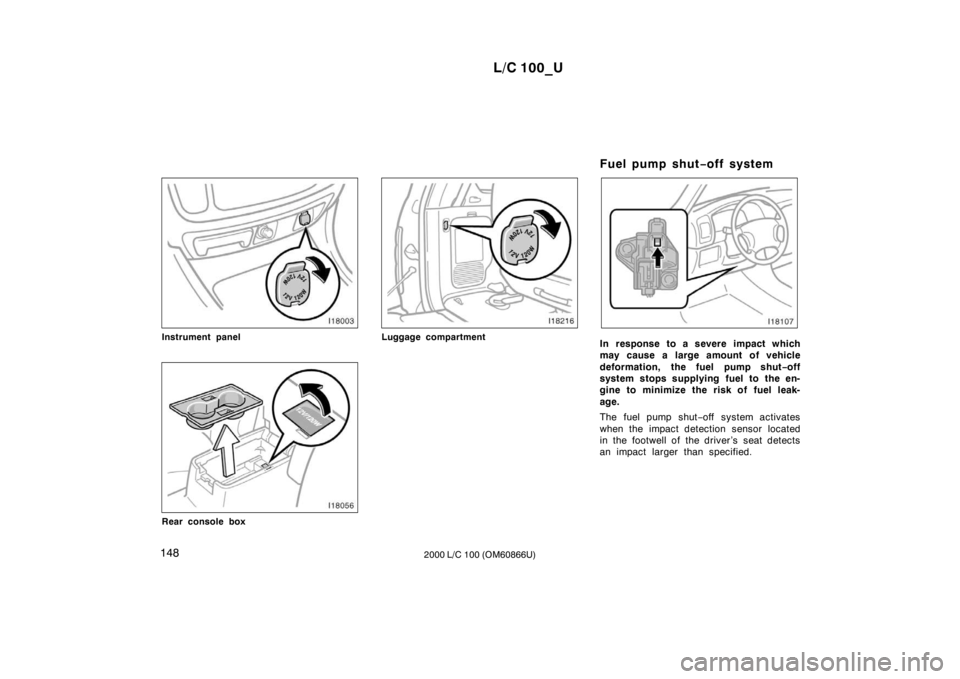
Instrument panel
Rear console box
Luggage compartmentFuel pump shut
−off systemIn response to a severe impact which
may cause a large amount of vehicle
deformation, the fuel pump shut −off
system stops supplying fuel to the en-
gine to minimize the risk of fuel leak- age.
The fuel pump shut −off system activates
when the impact detection sensor located
in the footwell of the driver’s seat detects
an impact larger than specified.
Page 148 of 235
L/C 100_U
170 2000 L/C 100 (OM60866U)
There may be the case that the brake
system warning light stays on for a
bout
60 seconds after the engine is started. It
is normal if the light goes out after a
while.
Depressing the brake pedal repeatedly
may turn on the brake system warning
light and buzzer. It is normal if the light
goes out and the buzzer stops sounding
after a few seconds.
You may hear a small sound in the engine
compartment after the engine is started or
the brake pedal is depressed repeatedly.
This is a pump pulsating sound of the
brake system, and it is not a malfunction.
CAUTION
Do not pump the brake pedal if the
engine stalls. Each push on the
pedal uses up your brake fluid
pressure reserve.
Even if the power assist is com-
pletely lost, the brakes will still
work. But you will have to push the
pedal hard, much harder than nor-
mal. And your braking distance will
be longer.
ANTI −LOCK BRAKE SYSTEM
(with “ABS” warning light)
The anti −lock brake system is designed
to help prevent lock −up of the wheels
during a sudden braking or braking on
slippery road surfaces. This assists in
providing stability and steering perfor-
mance of the vehicle under these cir-
cumstances.
Effective way to press the ”ABS” brake
pedal: When the anti −lock brake system
function is in action, just hold the brake
pedal down more firmly. Especially in a
panic stop, you need to keep it de-
pressed more firmly, and do not pump
the brake. Pumping the brake pedal
makes the stopping distance longer.
The anti −lock brake system becomes op-
erative after the vehicle has accelerated
to a speed in excess of approximately 10
km/h (6 mph). It stops operating when the
vehicle decelerates to a speed below
approximately 5 km/h (3 mph).
Depressing the brake pedal on slippery
road surfaces such as on the manhole
cover, the steel plate under the construc-
tion, joints in the bridge, etc. on a rainy
day tends to activate the anti −lock brake
system. You may hear a click or motor sound in
the engine compartment for a few seconds
when the engine is started or just after
the vehicle is started. This means that the
anti
−lock brake system is in the self
check mode, and does not indicate a mal-
function.
When the anti −lock brake system is ac-
tivated, the following conditions may
occur, however, do not indicate a mal-
function of the system:
You may hear the anti −lock brake sys-
tem operating and feel the brake pedal
pulsating and the vibrations of the body
and steering wheel. You may also hear
the motor sound in the engine compart-
ment even after the vehicle is stopped.
At the end of the anti −lock brake sys-
tem activation, the brake pedal may
move a little forward.
Page 149 of 235
L/C 100_U171
2000 L/C 100 (OM60866U)
CAUTION
Do not overestimate the anti −lock
brake system: Although the anti −lock
brake system assists in providing ve-
hicle control, it is still important to
drive with all due care and maintain
a moderate speed and safe distance
from the vehicle in front of you, be-
cause there are limits to the vehicle
stability and effectiveness of steering
wheel operation even with the anti −
lock brake system on.
If tires grip performance exceeds its
capability, or if hydroplaning occurs
during high speed driving in the rain,
the anti −lock brake system does not
provide vehicle control.
Anti −lock brake system is not de-
signed to shorten the stopping dis-
tance: Always drive at the moderate
speed and maintain a safe distance
from the vehicle in front of you.
Compared with vehicles not fitted
with an anti −lock brake system, your
vehicle may require a longer stopping
distance in the following cases: Driving on rough, gravel or snow −
covered roads.
Driving with tire chains installed.
Driving over the steps such as the
joints on the road.
Driving on roads where the road
surface is pitted or has other differ-
ences in surface height.
Install all 4 tires of specified size at
designated pressure: The anti −lock
brake system detects vehicle speeds
using the speed sensors for respec-
tive wheels’ turning speeds. The use
of tires other than specified may fail
to detect the accurate turning speed,
resulting in a longer stopping dis-
tance.
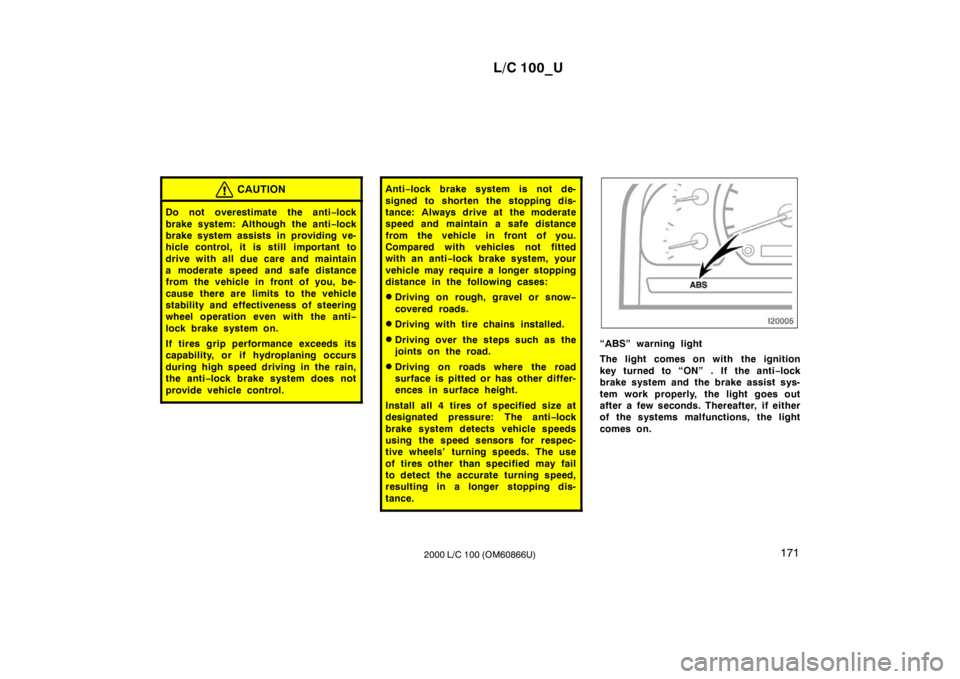
“ABS” warning light
The light comes on with the ignition
key turned to “ON” . If the anti −lock
brake system and the brake assist sys-
tem work properly, the light goes out
after a few seconds. Thereafter, if either
of the systems malfunctions, the light
comes on.
Page 162 of 235
L/C 100_U
198 2000 L/C 100 (OM60866U)
If you cannot incr
ease the en-
gine speed
If the engine speed does not increase
when the accelerator pedal is de-
pressed, the electronic throttle control
system may be faulty. Move the vehicle
to a safe place by means of creeping
and call a Toyota dealer for assistance:
1. Depress the brake pedal and shift to the ”D” position.
2. Gradually release the brake pedal, and the vehicle starts to move by creeping.
After arriving at a safe place, stop the
vehicle and call a Toyota dealer for
assistance.
CAUTION
The above method of moving the
vehicle is for emergency. Use it
only for moving minimum distances
to a safe place.
Be especially careful to prevent er-
roneous pedal operation.
If your vehicle overheats
If your engine coolant temperature
gauge indicates overheating, if you ex-
perience a loss of power, or if you hear
a loud knocking or pinging noise, the
engine has probably overheated. You
should follow this procedure...
1. Pull safely off the road, stop the ve- hicle and turn on your emergency
flashers. Put the transmission in ”P”
and apply the parking brake. Turn off
the air conditioning if it is being used.
2. If coolant or steam is boiling out of the radiator or reservoir, stop the engine.
Wait until the steam subsides before
opening the hood. If there is no coolant
boiling over or steam, leave the engine
running.
CAUTION
To help avoid personal injury, keep
the hood closed until there is no
steam. Escaping steam or coolant is
a sign of very high pressure.
3. Visually check to see if the engine drive belt (fan belt) is broken or loose.
Look for obvious coolant leaks from the
radiator, hoses, and under the vehicle.
However, note that water draining from
the air conditioning is normal if it has
been used.
CAUTION
When the engine is running, keep
hands and clothing away from the
moving fan and engine drive belts.
4. If the engine drive belt is broken or thecoolant is leaking, stop the engine im-
mediately. Call a Toyota dealer for as-
sistance.
5. If the engine drive belt is O.K. and there are no obvious leaks, you may
help the engine cool down more quickly
by running it at about 1500 rpm for a
few minutes with the accelerator pedal
lightly depressed.
6. Check the coolant reservoir. If it is dry, add coolant to the reservoir while the
engine is running. Fill it about half full.
Page 178 of 235

L/C 100_U
214 2000 L/C 100 (OM60866U)
Toyota, through its d
iligent research, de-
sign and use of the most advanced
technology available, has done its part to
help prevent corrosion and has provided
you with the finest quality vehicle
construction. Now, it is up to you. Proper
care of your Toyota can help ensure long −
term corrosion prevention.
The most common causes of corrosion
to your vehicle are:
The accumulation of road salt, dirt and
moisture in hard −to −reach areas under
the vehicle.
Chipping of paint, or undercoating
caused by minor accidents or by
stones and gravel.
Care is especially important if you live
in particular areas or operate your ve-
hicle under certain environmental condi-
tions: Road salt or dust control chemicals will
accelerate corrosion, as will the pres-
ence of salt in the air near the sea −
coast or in areas of industrial pollution.
High humidity accelerates corrosion es-
pecially when temperatures range just
above the freezing point.
Wetness or dampness to certain parts
of your vehicle for an extended period
of time, may cause corrosion even
though other parts of the vehicle may
be dry.
High ambient temperatures can cause
corrosion to those components of the
vehicle which are prevented from
quick −drying due to lack of proper ven-
tilation.
The above signifies the necessity to keep
your vehicle, particularly the underside, as
clean as possible and to repair any dam-
age to paint or protective coatings as
soon as possible.
To help prevent corrosion on your
Toyota, follow these guidelines:
Wash your vehicle frequently. It is, of
course, necessary to keep your vehicle
clean by regular washing, but to prevent
corrosion, the following points should be
observed:
If you drive on salted roads in the
winter or if you live near the ocean,
you should hose off the undercarriage
at least once a month to minimize cor-
rosion.
High pressure water or steam is effec-
tive for cleaning the vehicle’s underside
and wheel housings. Pay particular
attention to these areas as it is difficult
to see all the mud and dirt. It will do
more harm than good to simply wet the
mud and debris without removing them.
The lower edge of doors, rocker panels
and frame members have drain holes
which should not be allowed to clog
with dirt as trapped water in these
areas can cause corrosion.
Wash the underside of the vehicle thor-
oughly when winter is over.
See ”Washing and waxing your Toyota” for
more tips.
Check the condition of your vehicle’s
paint and trim. If you find any chips or
scratches in the paint, touch them up im-
mediately to prevent corrosion from start-
ing. If the chips or scratches have gone
through the bare metal, have a qualified
body shop make the repair
Protecting your Toyota
from corrosion
Page 180 of 235
L/C 100_U
216 2000 L/C 100 (OM60866U)
Road tar: Remove with turpentine or
cleaners that are marked safe for painted
surfaces.
NOTICE
Do not use organic substances (gaso-
line kerosene, benzine or strong sol-
vents) which may be toxic or causedamage.
3. Rinse thoroughly—dried soap can
cause streaking. In hot weather you
may need to rinse each section right
after you wash it.
4. To prevent water spots, dry the vehicle using a clean soft cotton towel. Do not
rub or press hard—you might scratch
the paint. Automatic car wash
Your vehicle may be washed in an auto-
matic car wash, but remember that the
paint can be scratched by some type of
brushes, unfiltered washing water, or the
washing process itself. Scratching reduces
paint durability and gloss, especially on
darker colors. The manager of the car
wash should be able to advise you wheth-
er the process is safe for the paint on
your vehicle.
NOTICE
To prevent damage to the antenna,
make sure it is retracted before driv-
ing your Toyota through an automatic
car wash.
Waxing your Toyota
Polishing and waxing is recommended
to maintain the original beauty of your
Toyota’s finish.
Once a month or if the vehicle surface
does not repel water well, apply wax.
1. Always wash and dry the vehicle be- fore you begin waxing, even if you are
using a combined cleaner and wax.
2. Use a good quality polish and wax. If the finish has become extremely weath-
ered, use a car −cleaning polish, fol-
lowed by a separate wax. Carefully fol-
low the manufacturer ’s instructions and
precautions. Be sure to polish and wax
the chrome trim as well as the paint.
3. Wax the vehicle again when water does not bead but remains on the sur-
face in large patches.
NOTICE
Always remove the plastic bumpers if
your vehicle is re −painted and placed
in a high heat paint waxing booth.
High temperatures could damage the
bumpers.
Page 182 of 235
L/C 100_U
218 2000 L/C 100 (OM60866U)
NOTICE
Do not use organic substances (sol-
vents, kerosene, alcohol, gasoline,
etc.) or alkaline or acidic solutions.
These chemicals can cause discol-
oring, staining or peeling of the
surface.
If you use cleaners or polishing
agents, make sure their ingredients
do not include the substances men-
tioned above.
If you use a liquid car freshener, do
not spill the liquid onto the ve-
hicle’s interior surfaces. It may con-
tain the ingredients mentioned
above. Immediately clean any spill
using the method mentioned above.
Leather Interior
The leather upholstery may be cleaned
with neutral detergent for wool.
Remove dirt using a soft cloth dampened
with 5% solution of neutral detergent for
wool. Then thoroughly wipe off all traces
of detergent with a clean damp cloth.
After cleaning or whenever any part of the
leather gets wet, dry with a soft clean
cloth. Allow the leather to dry in a venti-
lated shaded area.
NOTICE
If a stain should fail to come out
with a neutral detergent, apply a
cleaner that does not contain an
organic solvent.
Never use organic substances such
as benzine, alcohol or gasoline, or
alkaline or acid solutions for clean-
ing the leather as these could
cause discoloring.
Use of a nylon brush or synthetic
fiber cloth, etc. may scratch the
fine grained surface of the leather.
Mildew may develop on soiled leath-
er upholstery. Be especially careful
to avoid oil spots. Try to keep your
upholstery always clean.
Long exposure to direct sunlight
may cause the leather surface to
harden and shrink. Keep your ve-
hicle in a shaded area, especially in
the summer.
The interior of your vehicle is apt
to heat up on hot summer days, so
avoid placing on the upholstery
items made of vinyl or plastic or
containing wax as these tend to
stick to leather when warm.
Improper cleaning of the leather up-
holstery could result in discolor-
ation or staining.
If you have any questions about the
cleaning of your Toyota, your local
Toyota dealer will be pleased to answer
them.
Page 184 of 235

L/C 100_U
220 2000 L/C 100 (OM60866U)
Maintenance requirements
Your Toyota vehicle has been designed for
fewer maintenance requirements with long-
er service intervals to save both your time
and money. However, each regular mainte-
nance, as well as day
−to −day care, is
more important than ever before to ensure
smooth, trouble −free, safe, and economical
driving.
It is the owner ’s responsibility to make
sure the specified maintenance, including
general maintenance service, is performed.
Note that both the new vehicle and
emission control system warranties specify
that proper maintenance and care must be
performed. See ”Owner ’s Warranty
Information Booklet” or ”Owner ’s Manual
Supplement” for complete warranty
information.
General maintenance
General maintenance items are those day −
to −day care practices that are important to
your vehicle for proper operation. It is the
owner ’s responsib ility to ensure that the
general maintenance items are performed
regularly.
These checks or inspections can be done
either by yourself or a qualified technician,
or if you prefer, your Toyota dealer will be
pleased to do them at a nominal cost. Scheduled maintenance
The scheduled maintenance items listed in
the ”Scheduled Maintenance Guide” or
”Owner ’s Manual Supplement” are those
required to be serviced at regular inter-
vals.
For details of your maintenance schedule,
read the separate ”Scheduled Maintenance
Guide” or ”Owner ’s Manual Supplement”.
It is recommended that only genuine
Toyota parts be used for maintenance
or for the repair of the emission con-
trol system.
The owner may elect to use non
−To y o t a
supplied parts for replacement pur-
poses without invalidating the emission
control system warranty. However, use
of replacement parts which are not of
equivalent quality may impair the effec-
tiveness of the emission control sys-
tems.
You may also elect to have mainte-
nance, replacement, or repair of the
emission control devices and system
performed by any automotive repair es-
tablishment or individual without invali-
dating this warranty. See ”Owner’s War-
ranty Information Booklet” or ”Owner’s
Manual Supplement” for complete war-
ranty information. Where to go for service?
Toyota technicians are well
−trained spe-
cialists and are kept up to date with the
latest service information through technical
bulletins, service tips, and in −dealership
training programs. They learn to work on
Toyotas before they work on your vehicle,
rather than while they are working on it.
You can be confident that your Toyota
dealer ’s service department performs the
best job to meet the maintenance require-
ments on your vehicle–reliably and eco-
nomically.
Your copy of the repair order is proof that
all required maintenance has been per-
formed for warranty coverage. And if any
problems should arise with your vehicle
while under warranty, your Toyota dealer
will promptly take care of it. Again, be
sure to keep a copy of the repair order
for any service performed on your Toyota.
What about do −it −yourself maintenance?
Many of the maintenance items are easy
to do yourself if you have a little mechani-
cal ability and a few basic automotive
tools. Simple instructions for how to per-
form them are presented in Section 7.