Page 125 of 246
2000 Corolla(U)
51
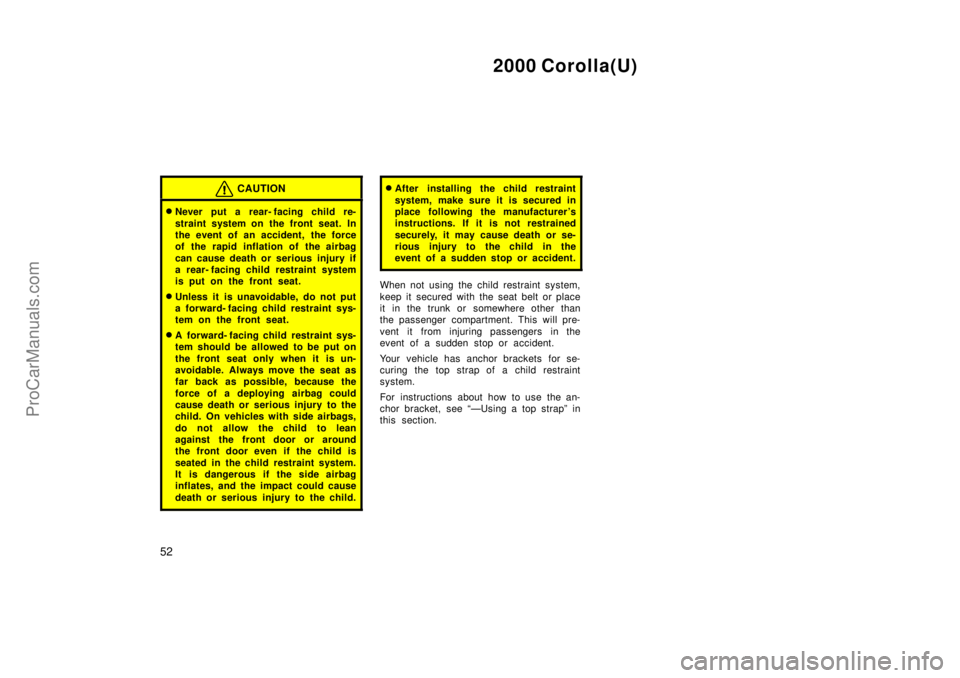
�Toyota strongly urges use of a
proper child restraint system which
conforms to the size of the child,
and is put on the rear seat. Accord-
ing to accident statistics, the child
is safer when properly restrained in
the rear seat than in the front seat.
�Never put a rear- facing child re-
straint system on the front seat. In
the event of an accident, the force
of the rapid inflation of the airbag
can cause death or serious injury if
a rear- facing child restraint system
is put on the front seat.
�Unless it is unavoidable, do not put
a forward- facing child restraint sys-
tem on the front seat.
�A forward- facing child restraint sys-
tem should be allowed to be put on
the front seat only when it is un-
avoidable. Always move the seat as
far back as possible, because the
force of a deploying airbag could
cause death or serious injury to the
child. On vehicles with side airbags,
do not allow the child to lean
against the front door or around
the front door even if the child is
seated in the child restraint system.
It is dangerous if the side airbag
inflates, and the impact could cause
death or serious injury to the child.
�Make sure that you have complied
with all installation instructions pro-
vided by the child restraint
manufacturer and that the system is
properly secured.
ÐChild restraint system
A child restraint system for a small
child or baby must itself be properly
restrained on the seat with the lap por-
tion of the lap/shoulder belt. You must
carefully consult the manufacturer 's
instructions which accompany the child
restraint system.
To provide proper restraint, use a child
restraint system following the manufactur-
er 's instructions about the appropriate age
and size of the child for the child restraint
system.
Install the child restraint system correctly
following the instructions provided by its
manufacturer of the system.
The child restraint system should be
installed on the rear seat. According to
accident statistics, the child is safer when
properly restrained in the rear seat than
in the front seat.
ProCarManuals.com
Page 126 of 246
2000 Corolla(U)
52
CAUTION
�Never put a rear- facing child re-
straint system on the front seat. In
the event of an accident, the force
of the rapid inflation of the airbag
can cause death or serious injury if
a rear- facing child restraint system
is put on the front seat.
�Unless it is unavoidable, do not put
a forward- facing child restraint sys-
tem on the front seat.
�A forward- facing child restraint sys-
tem should be allowed to be put on
the front seat only when it is un-
avoidable. Always move the seat as
far back as possible, because the
force of a deploying airbag could
cause death or serious injury to the
child. On vehicles with side airbags,
do not allow the child to lean
against the front door or around
the front door even if the child is
seated in the child restraint system.
It is dangerous if the side airbag
inflates, and the impact could cause
death or serious injury to the child.
�After installing the child restraint
system, make sure it is secured in
place following the manufacturer 's
instructions. If it is not restrained
securely, it may cause death or se-
rious injury to the child in the
event of a sudden stop or accident.
When not using the child restraint system,
keep it secured with the seat belt or place
it in the trunk or somewhere other than
the passenger compartment. This will pre-
vent it from injuring passengers in the
event of a sudden stop or accident.
Your vehicle has anchor brackets for se-
curing the top strap of a child restraint
system.
For instructions about how to use the an-
chor bracket, see ÐUsing a top strapº in
this section.
ProCarManuals.com
Page 135 of 246
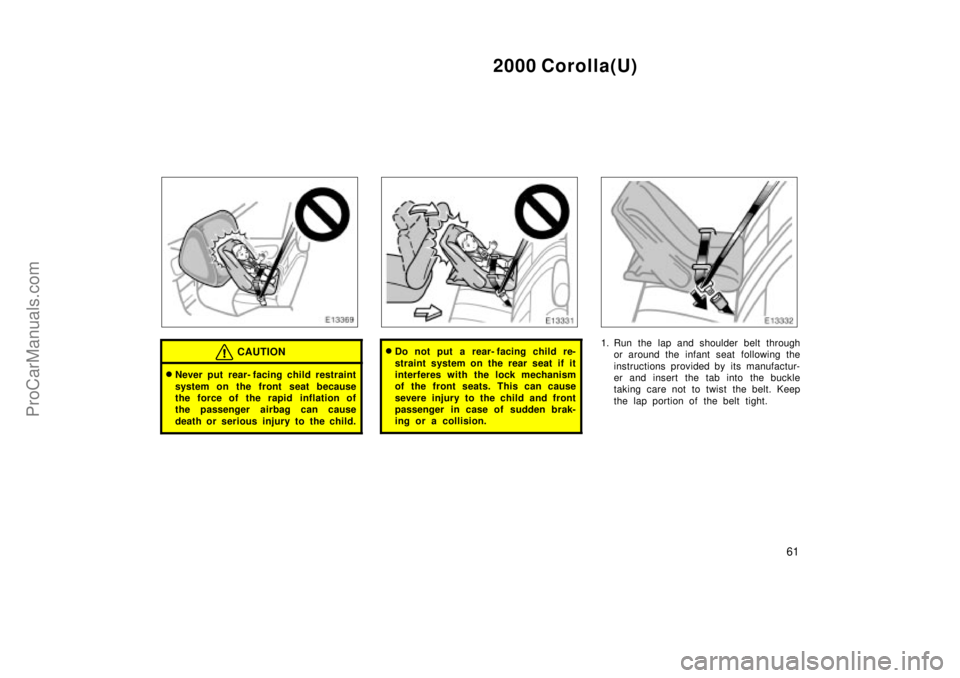
2000 Corolla(U)
61
CAUTION
�Never put rear- facing child restraint
system on the front seat because
the force of the rapid inflation of
the passenger airbag can cause
death or serious injury to the child.
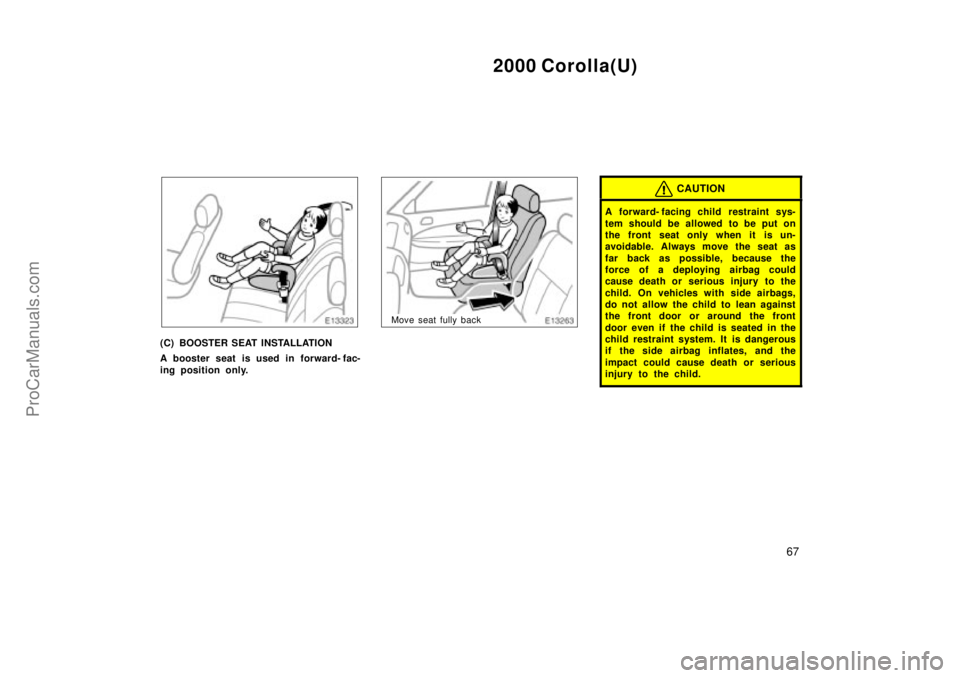
�Do not put a rear- facing child re-
straint system on the rear seat if it
interferes with the lock mechanism
of the front seats. This can cause
severe injury to the child and front
passenger in case of sudden brak-
ing or a collision.1. Run the lap and shoulder belt through
or around the infant seat following the
instructions provided by its manufactur-
er and insert the tab into the buckle
taking care not to twist the belt. Keep
the lap portion of the belt tight.
ProCarManuals.com
Page 138 of 246
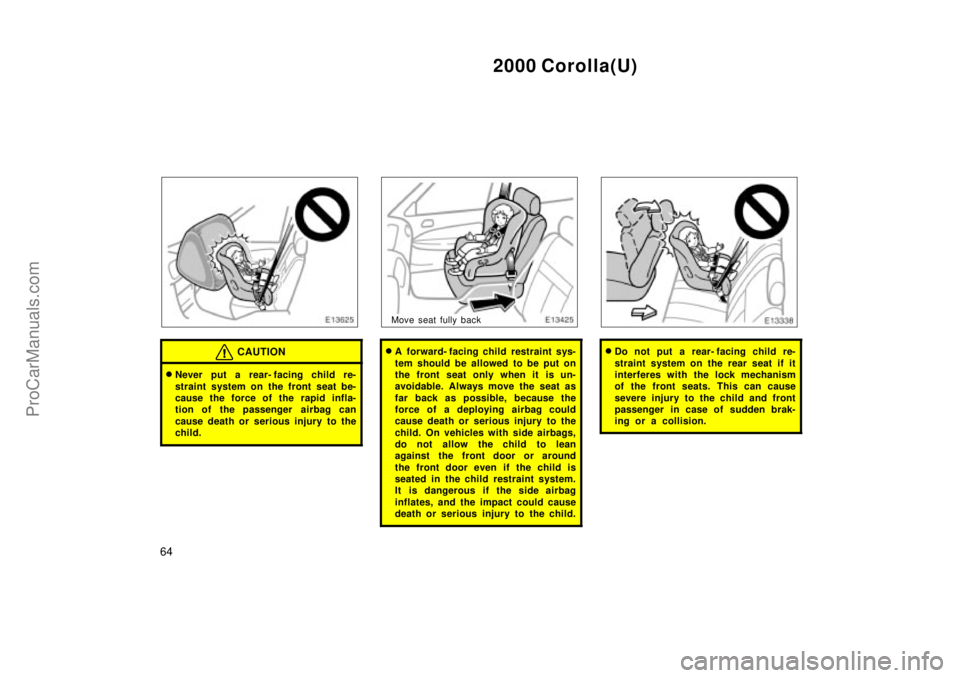
2000 Corolla(U)
64
CAUTION
�Never put a rear- facing child re-
straint system on the front seat be-
cause the force of the rapid infla-
tion of the passenger airbag can
cause death or serious injury to the
child.
Move seat fully back
�A forward- facing child restraint sys-
tem should be allowed to be put on
the front seat only when it is un-
avoidable. Always move the seat as
far back as possible, because the
force of a deploying airbag could
cause death or serious injury to the
child. On vehicles with side airbags,
do not allow the child to lean
against the front door or around
the front door even if the child is
seated in the child restraint system.
It is dangerous if the side airbag
inflates, and the impact could cause
death or serious injury to the child.�Do not put a rear- facing child re-
straint system on the rear seat if it
interferes with the lock mechanism
of the front seats. This can cause
severe injury to the child and front
passenger in case of sudden brak-
ing or a collision.
ProCarManuals.com
Page 141 of 246
2000 Corolla(U)
67
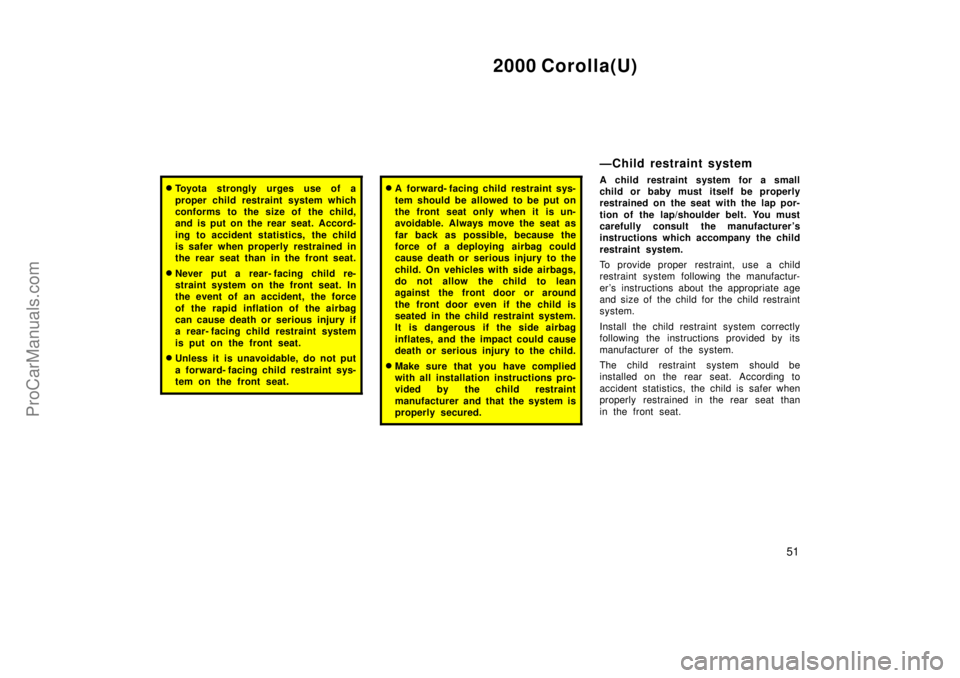
(C) BOOSTER SEAT INSTALLATION
A booster seat is used in forward- fac-
ing position only.
Move seat fully back
CAUTION
A forward- facing child restraint sys-
tem should be allowed to be put on
the front seat only when it is un-
avoidable. Always move the seat as
far back as possible, because the
force of a deploying airbag could
cause death or serious injury to the
child. On vehicles with side airbags,
do not allow the child to lean against
the front door or around the front
door even if the child is seated in the
child restraint system. It is dangerous
if the side airbag inflates, and the
impact could cause death or serious
injury to the child.
ProCarManuals.com
Page 164 of 246

2000 Corolla(U)
90
If the light lit during driving goes out and
does not come on again, it is a normal
operation.
(h) Open Door Warning Light
This light remains on until all the doors
are completely closed.
(i) SRS Warning Light
This light will come on when the igni-
tion key is turned to the ACCº or
ONº position. After about 6 seconds,
the light will go off. This means the
system of the airbag and front seat belt
pretensioners are operating properly.
The warning light system monitors the air-
bag sensor assemblies, front airbag sen-
sors, seat belt pretensioner assemblies,
inflators, warning light, interconnecting wir-
ing and power sources.
If either of the following conditions occurs,
this indicates a malfunction somewhere in
the parts monitored by the warning light
system. Contact your Toyota dealer as
soon as possible to service the vehicle.
�The light does not come on when the
ignition key is turned to the ACCº or
ONº position or remains on.
�The light comes on or flashes while
driving.(j) Low Windshield Washer Fluid Level
Warning Light
The light warns that the windshield washer
fluid level is too low. Add washer fluid at
your earliest opportunity. (For instructions,
see Adding washer fluidº in Section 7- 3.)
(k) Key Reminder Buzzer
This buzzer reminds you to remove the
key when you open the driver 's door with
the ignition key in the ACCº or LOCKº
position.
(l) Light Reminder Buzzer
This buzzer will sound if the head light
switch is left on and the driver's door is
opened with the key removed from the
ignition switch.CHECKING SERVICE REMINDER INDICA-
TORS (except the low fuel level warning
light and low windshield washer fluid
level warning light)
1. Apply the parking brake.
2. Open one of the doors.
The open door warning light should
come on.
3. Close the door.
The open door warning light should go
off.
4. Turn the ignition key to ACCº.
The SRS warning light should come on.
It goes off after about 6 seconds.
5. Turn the ignition key to ONº, but do
not start the engine.
All the service reminder indicators ex-
cept the open door warning light and
SRS warning light should come on. The
ABSº warning light goes off after a
few seconds.
If any service reminder indicator or warn-
ing buzzer does not function as described
above, either the bulb is burned out or the
circuit is in need of repair. Have it
checked by your Toyota dealer as soon as
possible.
ProCarManuals.com