2000 SAAB 9-5 Wiper
[x] Cancel search: WiperPage 3 of 256

3
Instrument panel
IB1080
Indicator and warning lights ______ 46
Speedometer _________________ 53
Odometer and trip meter ________ 52
Fuel gauge __________________ 53
Engine temperature gauge ______ 53
Parking lights ____________ 61
High/low beam __________ 61
Daytime running lights _____ 61
Rear fog light ____________ 62
Instrument illumination _____ 62
Changing bulbs _________ 182High/low beam control stalk 61
Turn signal and lane change
indicator _______________ 62
Cruise control __________ 145Front fog lights ___________ 63
Ashtrays ___________________ 112
Cigarette lighter ______________ 112
Tr i p c o m p u t e r
(Saab Information Display, SID) __ 54
Night panel __________________ 59
Clock _______________________ 60
Traction Control (TCS) Switch 51, 147
Wipers and washers ______ 65
Washer fluid ___________ 180
Replacing wiper blades __ 180Audio system ___________ 77
Steering-wheel controls____ 94Hazard warning lights _____ 63Climate control system:
automatic _____________ 67
Air conditioning: simple
fault diagnosis _________ 206
Seat heating controls __________ 106
Ventilated front seats ___________ 105Audio system steering-wheel
controls ________________ 94
ProCarManuals.com
Page 4 of 256

4Exterior
IB580
Roof-rack load _______________ 155
Mounting holes for roof rack ____ 155
Maximum loads ______________ 226
Rearview mirrors _____________ 108
Hood ______________________ 166
Engine compartment: washing __ 210
Central lock ____________ 32
Interior locking buttons ____ 34
Child safety lock catch ____ 35
Trunk/tailgate lid lock _____ 36
Car alarm (anti-theft alarm) 38Front lights _____________ 61
Headlight switch _________ 61
High/low beam
control stalk ____________ 61
Direction indicators _______ 62
Headlamp wipers ________ 65
Changing bulbs ________ 182
Fuel gauge __________________ 53
Fuel filler flap ________________ 134
Refueling ___________________ 134
Fuel economy _______________ 149
Fuel grade __________________ 228
Brakes and braking ___________ 146
Winter driving ________________ 150
Wheels and tires _____________ 198
Wheel changing ______________ 203
Spare wheel _________________ 154
Wheel and tire specifications ____ 233
Luggage compartment _________ 116
Folding down the rear seat,
9-5 Sedan ___________________ 116
Folding down the rear seat,
9-5 Wagon __________________ 119
Trunk _______________________ 116
Tool kit ______________________ 126
Spare wheel _____________ 126, 154
Jack ________________________ 203Driving with a trailer ______ 152
Towing ________________ 158
Towrope attachment eyes _ 158Light switches ___________ 61
Changing bulbs _________ 182
Tail lights _____________ 185
Stop lights ____________ 185Sunroof _______________ 111
Washing the car ________ 209
Waxing and polishing ____ 209
Touching-up of paintwork _ 211
Anticorrosion treatment ___ 211
Service program_________ 221
ProCarManuals.com
Page 6 of 256

6Engine compartment,
4-cyl engine
IB583
Engine: description ___________ 170
Engine oil level: checking ______ 171
Engine oil: changing __________ 172
Engine oil specification ________ 229
Brakes and braking ___________ 146
ABS brakes _________________ 146
Brake system ________________ 175
Brake fluid __________________ 233
Brake pads __________________ 233
Fuse panels ___________ 192
Changing a fuse ________ 192
Table of fuses __________ 194
Relays _______________ 195Temperature gauge ______ 53
Driving in hot weather ____ 151
Driving in winter_________ 150
Coolant:
checking/changing __ 174 / 175
Cooling-system capacity _ 228
Power steering __________ 176
Steering fluid: grade _____ 176
Wiper/washer control stalk _ 65
Washer fluid: topping-up __ 181
Washer jets ___________ 181
Jump starting ________________ 177
Battery _____________________ 177
Battery charge _______________ 177
Manual transmission __________ 137
Automatic transmission ________ 138
Manual transmission oil ________ 232
Automatic-transmission fluid ____ 232
Important considerations
for driving ___________________ 132
Turbo unit ___________________ 167
Engine: technical data __________ 228Ignition system _________ 130
Drive belts _____________ 179
Spark plugs ____________ 230
Catalytic converter ______ 133Warning labels ___________ 8
V.I.N. number __________ 235
Engine number _________ 235
Gearbox number ________ 235
Color code _____________ 235
ProCarManuals.com
Page 7 of 256
7
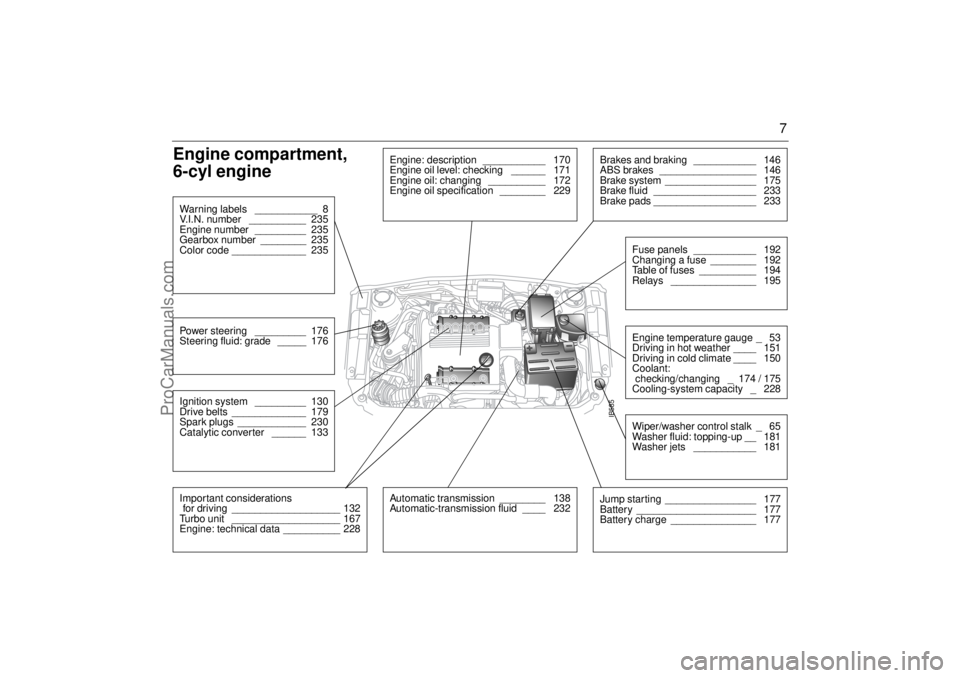
Engine compartment,
6-cyl engine
IB585
Warning labels ___________ 8
V.I.N. number __________ 235
Engine number _________ 235
Gearbox number ________ 235
Color code _____________ 235Ignition system _________ 130
Drive belts _____________ 179
Spark plugs ____________ 230
Catalytic converter ______ 133Important considerations
for driving ___________________ 132
Turbo unit ___________________ 167
Engine: technical data __________ 228
Automatic transmission ________ 138
Automatic-transmission fluid ____ 232
Brakes and braking ___________ 146
ABS brakes _________________ 146
Brake system ________________ 175
Brake fluid __________________ 233
Brake pads __________________ 233Jump starting ________________ 177
Battery _____________________ 177
Battery charge _______________ 177
Fuse panels ___________ 192
Changing a fuse ________ 192
Table of fuses __________ 194
Relays _______________ 195Engine temperature gauge _ 53
Driving in hot weather ____ 151
Driving in cold climate ____ 150
Coolant:
checking/changing _ 174 / 175
Cooling-system capacity _ 228
Power steering _________ 176
Steering fluid: grade _____ 176
Wiper/washer control stalk _ 65
Washer fluid: topping-up __ 181
Washer jets ___________ 181
Engine: description ___________ 170
Engine oil level: checking ______ 171
Engine oil: changing __________ 172
Engine oil specification ________ 229
ProCarManuals.com
Page 65 of 256

65 Instruments and controls
Wipers and washers The delay of the intermittent operation can
be adjusted to between 2 and 15 seconds.
Moving the control stalk to the
spring-loaded position between 0 and 2 will
produce a single sweep of the wipers.
The wipers are designed for optimal clean-
ing at all driving speeds. At higher speeds,
it may be possible to detect a slight "sweep-
ing" sound. This may be due to the
increased air pressure on the blades at
higher speeds.Washers When the washers are operated, the wipers
will make 3, 4 or 5 sweeps, depending on
how long the washers were kept on. If the
speed of the car is less than 12 mph
(20 km/h), the wipers will make an addi-
tional sweep after 9 seconds. Headlamp wipersThe headlamp wipers will operate at the
same time as the windshield washers are
activated.
IB359
0
41
2
3
0 OFF
1 Windshield wipers: intermittent operation.
The delay can be adjusted to between 2 and
15 seconds
2 Windshield wipers: low speed
3 Windshield wipers: high speed
4 Washers
12
IB569
Control for setting wiper delay 1 Long delay
2 Short delay
ProCarManuals.com
Page 66 of 256

66 Instruments and controlsRear-window wiper (9-5 Wagon)The rear-window wiper and washer are
operated with the same stalk switch as
used for washing and wiping the windshield
and headlights.
This stalk has two additional switches,
ON/OFF and .
The ON position provides intermittent wip-
ing.
The position provides washing and
wiping. After a few sweeps the wiper stops
or reverts to intermittent wiping, if this has
been chosen. About 15 seconds after com-
pletion of the washing/wiping of the rear
window, the wiper makes a single sweep to
wipe away any remaining washer fluid.
A spring-loaded position between the OFF
and ON positions allows for a single sweep
of the rear-window wiper.
Intermittent wiping of the rear window
occurs when reverse gear is engaged if the
windshield wipers are in position 1, 2 or 3,
see page 65.
2 1
IB1207
Rear-window wiper1 Intermittent wiping
2 Washers
ProCarManuals.com
Page 150 of 256

150 Starting and drivingIf idling, it will take much longer before the
engine becomes hot. Engine wear is
greatest during this warming-up phase.
Therefore drive away as soon as possible
after the engine is started and avoid high
revving.
Driving in a low gear results in higher fuel
consumption than in a high gear because
of the higher engine speed for a given
road speed. Always change up to a higher
gear as soon as traffic conditions allow
and use the highest gear as much as pos-
sible.
Check the air pressure in the tires once a
month. Incorrect pressures increase tire
wear. It is better to have slightly higher
pressure than lower.
Check fuel consumption regularly.
Increased consumption can indicate that
something is wrong and that the car
needs to be checked by an authorized
Saab dealer.
Practical trials on the roads have demon-
strated that substantial savings in fuel con-
sumption can be made if the above advice
is heeded.
Road conditions Wet roads increase fuel consumption, as do
unpaved roads and driving in hilly country
(the amount of fuel saved driving downhill is
less than the additional amount required to
climb the hill). Engine block heater (standard
equipment in Canada, accessory in
U.S.)The following are just some of the benefits
to the car and the environment of using an
engine block heater:
Lower fuel consumption.
Reduced wear on the engine.
Inside of car warms up faster.
Exhaust emissions substantially reduced
over short runs.
The engine heater is effective at outside
temperatures up to +15-20°C. The warmer
it is outside, the shorter the time the engine
heater needs to be connected. Longer than
1.5 hours is unnecessary.
If the car is equipped with a removable,
electrical cabin heater that is not in use, this
should be stored in the luggage compart-
ment.
Driving in winterBefore starting a journey in cold weather,
check that the wiper blades have not
become frozen to the glass. Brush any snow
away from the air intake for the heater
system (opening between hood and wind-
shield).
Periodically during the winter, add gasoline
anti-freeze to the fuel to dispel any conden-
sation in the fuel tank which could freeze
and cause problems in the system. Keep
the tank well filled to reduce the risk of con-
densation forming.
If the car is parked outside in freezing
weather, fuel additives (gasoline
anti-freeze) will not do any good as any con-
densation in the fuel tank will freeze. Con-
densation is caused by changes in the out-
door temperature or by the car being parked
alternately in a garage and outside.
It is particularly important when the roads
are slippery that the brakes and tires be in
good condition.
The car is equipped with tires designed to
provide optimum grip on both wet and dry
roads, although this has been achieved at
the expense of somewhat reduced grip on
snow and ice. For regular driving on snow
and ice, we therefore recommend that
winter (snow) tires be fitted.
Winter (snow) tires, particularly studded
tires (where use is legally permitted), gener-
ally make driving safer on snow and ice.
If winter tires are fitted, the same type must
be fitted on all wheels. Your Saab dealer will
ProCarManuals.com
Page 165 of 256

165 Car care and technical information
Car care and
technical
information
Hood release handle ....... 166
Engine compartment,
4-cyl. engine ................... 167
Engine compartment,
6-cyl. engine ................... 168
Emission control systems 169
Engine............................... 170
Engine oil ......................... 171
Transmission fluid........... 173
Coolant ............................. 174
Brake and clutch fluid ..... 175
Power steering fluid ........ 176
Battery .............................. 177 Drive belts ........................ 179
Wipers and washers ....... 180
Changing bulbs ............... 182
Fuses ................................ 192
Wheels .............................. 198
Compact spare wheel ..... 202
Flat spotting..................... 206
Air conditioning (A/C
system) ........................... 206
Safety belts ...................... 207
Upholstery and trim ........ 208
Textile carpeting.............. 208
Washing the car .............. 209 Waxing and polishing ...... 209
Engine compartment ....... 210
Touching up the paint ..... 210
Anticorrosion treatment .. 211
For long trips .................... 213
Recovery and/or recycling
of automotive materials. 213
Headlamp aiming ............. 214
ProCarManuals.com