2000 SAAB 9-5 belt
[x] Cancel search: beltPage 23 of 256

23 Safety
Airbag (Supplemental
Restraint System
"SRS") The supplementary restraint system (SRS)
comprises an airbag in the steering wheel,
a front passenger airbag and side airbags in
the front seats.
The system supplements the protection
provided by the safety belts to further
enhance the safety of occupants.
If a fault is detected in the SRS, the
AIR BAG warning light on the main instru-
ment panel will come on (see pages 48 and
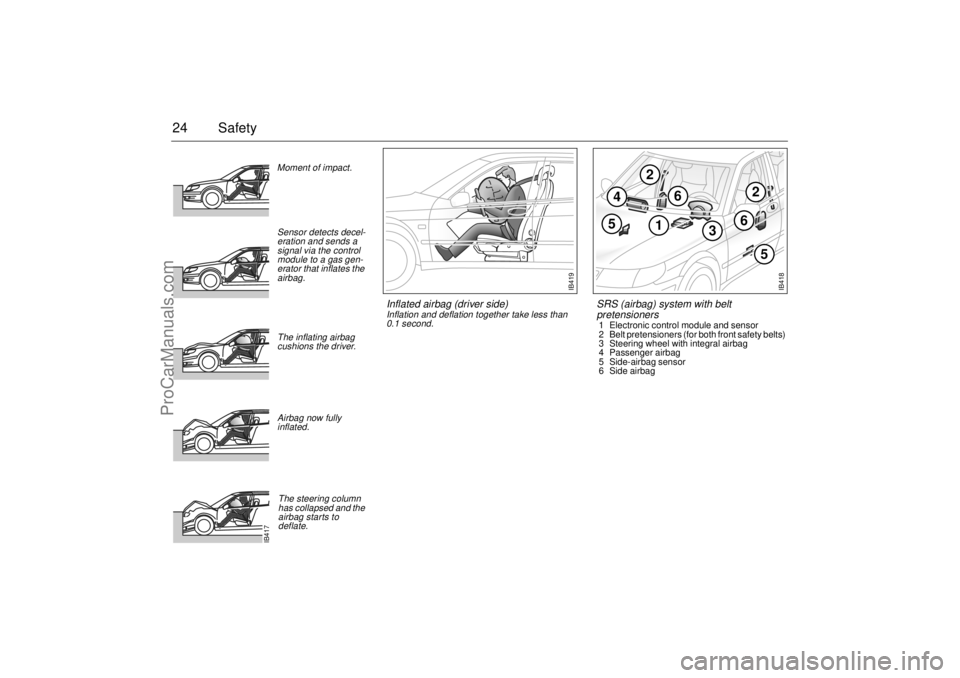
26). When the system is triggered by impact of a
frontal collision, the airbags in the steering
wheel and passenger side of the dash board
are inflated, after which they deflate through
vents in the back of the bags.
The entire process takes less than
0.1 second – literally, faster than the blink-
ing of an eye.
These airbags are triggered only by moder-
ate to severe frontal or near-frontal colli-
sions. They will not be activated by minor
front-end impacts, rear-end or side impacts,
or by the car rolling over.
WARNING
To reduce risk of injury:
Always wear your safety belt.
Always adjust your seat so that you
are as far back as possible but still
able to reach the steering wheel and
controls comfortably.
Children 12 and under or shorter than
140 cm (55 inches) should always
travel in the rear as the vehicle is
equipped with an airbag on the pas-
senger side.
WARNING
Even if the car is equipped with an
SRS (airbag), safety belts must still
always be worn by all occupants.
Note that because an airbag inflates
and deflates extremely rapidly, it will
not provide protection against a
second impact occurring in the same
incident. Always use your safety belt.
Always sit with the whole of your back
in contact with the backrest of the seat,
and with your seat as far back as is
practical. This is to reduce the risk of
injury from contact with the backrest of
the seat when the airbag inflates and
also because the airbag needs space
in which to inflate.
Never attach anything to the steering
wheel or passenger side of the instru-
ment panel, as this could result in
injury if the airbag should inflate. The
same applies to anything you might
have in your mouth, such as a pipe, for
instance.
Some components of the airbag will
be hot for a short time. In some circum-
stances the airbag can cause burns or
abrasions to the body when the airbag
inflates/deflates.
Never rest your hands or forearms on
the steering-wheel center padding.
If the AIR BAG warning light remains
on after the car has been started or
comes on while you are driving, have
the car checked immediately by an
authorized Saab dealer. The warning
light could signify that the airbags may
not inflate in a crash, or they could
even inflate without a crash.
ProCarManuals.com
Page 24 of 256
24 Safety
IB417Moment of impact.
Sensor detects decel-
eration and sends a
signal via the control
module to a gas gen-
erator that inflates the
airbag.
The inflating airbag
cushions the driver.
Airbag now fully
inflated.
The steering column
has collapsed and the
airbag starts to
deflate.
IB419
Inflated airbag (driver side) Inflation and deflation together take less than
0.1 second.
IB418
5
1
4
2
6
3
2
6
5
SRS (airbag) system with belt
pretensioners 1 Electronic control module and sensor
2 Belt pretensioners (for both front safety belts)
3 Steering wheel with integral airbag
4 Passenger airbag
5 Side-airbag sensor
6 Side airbag
ProCarManuals.com
Page 26 of 256

26 SafetyAIR BAG warning light
SRS servicingThe SRS must be inspected as part of the
normal service program but otherwise may
be regarded as maintenance-free.
Scrapping or working on airbags
and belt pretensioners Frequently asked questions on func-
tion of airbags
Do you still need to wear a
safety b
elt if air-
bags are fitted?
Yes, always! The airbag merely supple-
ments the car’s normal safety system.
Moreover, the airbag will only be actuated in
a moderate to severe frontal, or near-frontal
collision, which means, of course, that it pro-
vides no protection in minor frontal colli-
sions, major rear-end or side-on collisions
or if the car rolls over.
The safety belts help reduce the chance of
the car occupants from being thrown around
and injured inside the car.
But they also ensure that, if a collision
occurs in which the airbags are inflated, the
airbag will make the optimum contact with
the occupant, i.e. square on from the front.
If the occupant meets the airbag in an offset
position, the protection afforded will be
reduced.
In addition, airbags provide no protection
against a secondary impact occurring in the
same incident. So there is no doubt about
the benefit of wearing safety belts at all
times.
Do not sit too close to the airbag: it needs
room to inflate.
The airbag inflates very quickly and power-
fully in order to protect an adult person in a
serious frontal collision.
WARNING
If the air bag readiness light stays on
after you start your vehicle, it means
the air bag system may not be working
properly.
The air bags in your vehicle may not
inflate in a crash, or they could even
inflate without a crash.
To help avoid injury to yourself or oth-
ers, have your vehicle serviced right
away if the air bag readiness light
stays on after you start your vehicle.
WARNING
Under no circumstances may any
modifications be made that affect the
steering wheel or the airbag’s electri-
cal circuitry.
Before starting any welding work on
the car, always disconnect the nega-
tive (–) battery lead and cover the con-
ductor.
Airbags and belt pretensioners must
be deployed under controlled condi-
tions before the car is scrapped or any
of the system’s components are
removed. Airbags or belt pretension-
ers that have been deployed as a
result of an accident must be replaced
by new ones.
Airbag-system components must
never be transferred for use in another
vehicle.
All work involving the scrapping or
replacement of airbags or belt preten-
sioners must only be carried out by
knowledgeable personnel.
ProCarManuals.com
Page 29 of 256

29 Safety
WARNING
This car is equipped with side airbags
and no extra interior trim should be fit-
ted. Failure to observe this warning
could result in the side airbags not
inflating as intended and thus not pro-
viding the intended protection either.
Never place any object in the area that
would be occupied by the inflated air-
bag.
For optimum protection, sit upright in
the seat, with your safety belt correctly
fastened.
The sensors for the side airbags are
fitted in the doors.
We advise against doing any work on
the doors that could affect the mois-
ture barrier in the door or the airbag
sensors. It is essential that the mois-
ture barrier (thick plastic film) in the
door is not damaged in any way.
Improvement of the anticorrosion
treatment of the doors should only be
carried out by an authorized Saab
dealer. Otherwise there is a risk that
the side impact sensor and the mois-
ture barrier in the door could be dam-
aged.
The side airbags will inflate only in the
event of a side impact not in the event
of a front or rear-end collision or of the
car’s rolling over.
Damage to the seat cover, or the seat
seam, in the area of the side airbag
must immediately be repaired by an
authorized Saab dealer.
Do not modify the speaker installation
in the front doors or install speakers
other than those specifically approved
by Saab.
IB592
Side airbag components 1 Side airbag
2 Sensor
3 Moisture barrier
4 Label on seat
ProCarManuals.com
Page 47 of 256

47 Instruments and controls
Warning, charging
This light will come on together with if
the battery is not charging. If it comes on
while you are driving, stop the car as soon
as possible and switch off the engine.
Check the alternator drive belt (see page
179). If the belt has broken, the engine may
overheat (cooling system will not function
properly), the battery will not be charged,
the A/C compressor will not run and power
assistance for the steering will be lost.
Brake warning light
This light will come on together with if
there is insufficient brake fluid in the reser-
voir (see pages 175 / 176).
If the ABS warning light is on at the same
time, the ABS system may be inoperative
because of a fault (see “Anti-lock brake
warning”, page 48).
Parking brake warning
light
This light will show when the parking brake
is on (see page 162).
If the car is driven with the parking brake still
on, will also come on and a chime will
sound.
The parking brake is mechanical and oper-
ates on the rear wheels.
WARNING
Never drive the car when these warning
lights are on. Danger of brake failure!
Have the brake system checked by an
authorized Saab dealer.
WARNING
Always apply the parking brake when
parking.
Always apply the parking brake before
removing the ignition key.
ProCarManuals.com
Page 103 of 256

103 Interior equipment and trunk
Legroom adjustment To adjust the legroom, push the lower con-
trol forward or back.
Backrest rake angle To adjust the backrest, move the upper con-
trol forward or back.
Lumbar supportTurn the smaller wheel for stepless adjust-
ment of the lumbar support.
WARNING
The backrest should be upright during
driving, so that the safety belt, airbag and
backrest can provide optimum protection
in the event of emergency braking or an
accident.
IB403
IB402
IB1161
ProCarManuals.com
Page 116 of 256

116 Interior equipment and trunkTrunkFolding the rear seat, 9-5 SedanThe rear seat is split and the two sections can be folded indepen-
dently. Folding down of the rear seat is easier if the front seats are
not all the way back, and the rear head restraints are folded down.
1 Lift the seat cushion by pulling the loop located between the
cushion and the backrest.
2 Tip the seat cushion forward.
3 Press the button adjacent to the respective backrest to release it.
4 Fold down the backrest.
WARNING
Rear-seat passengers should always ensure that the head
restraint is raised and in proper position.
Keep hands well clear of all moving parts.
Never place heavy objects on the rear window shelf. There is
always a danger of loose objects flying about and causing
injury if the car should brake suddenly or be involved in an
accident.
Before folding up the backrest, hang the outer safety belts
onto the hook on the respective courtesy handle to prevent
them from becoming trapped.
Check that the back rest release button (3) is flush with the
surround before entering the rear seat.
IB459
1
2
4
3
IB461
Outer safety belt hooked onto courtesy handle
ProCarManuals.com
Page 118 of 256

118 Interior equipment and trunkTrunk pass-through hatch A trunk pass-through hatch is incorporated in the rear-seat backrest
to enable long, narrow items to be carried inside the car.
Items should not weigh more than 33 lbs. (15 kg) nor be more than
2 yards (2 metres) in length. See the label on the hatch.
1 Fold down the armrest.
2 Raise the hatch by lifting the handle.
Before loading or unloading long items, switch off the engine and
apply the handbrake. This averts the danger of the car moving off
suddenly if a long item were to knock the gear or selector lever into
gear. Tie DownsFour tie downs for securing the load are fitted inside the trunk. Place
the load as far in as possible.
WARNING
Anchor the load securely (e.g. using middle safety belt) to
avoid danger of injury resulting from displacement of load on
hard braking.
Do not exceed the load capacity of the car, as this will alter its
handling characteristics (see page 226).
IB463IB464
ProCarManuals.com