2000 SAAB 9-3 light
[x] Cancel search: lightPage 161 of 236

161 Starting and driving
Saab 9-3 ViggenThe front towing eye is stored in a storage
bag beside the spare wheel. Remove the
plastic cover with a screwdriver from the
car’s toolkit, and screw in the towing eye.
Towing a car with manual gearboxThe gear lever must be in neutral. Switch
hazard lights on.
Drive carefully and do not exceed the
speed limit for vehicles in tow.
Always try to keep the towrope taut by
gently applying the brake as necessary.
This will avoid the towrope being jerked vio-
lently.
NOTEThe design of the underside of the rear
bumper means that the rear towing eye
must not be used. This is to prevent dam-
aging the bumper.
NOTEIf the car is to be towed with the front
wheels off the ground, make sure the
parking brake is off, as this acts on the
rear wheels.
IB885
Rear towing eye
IB1331
Front towing eye, Saab 9-3 Viggen
ProCarManuals.com
Page 162 of 236

162 Starting and drivingTowing a car with automatic
transmission The following rules must be observed if a
car with automatic transmission is to be
towed.
The gear selector must be in the N position.
Switch hazard lights on.
Drive carefully and do not exceed the
speed limit for vehicles in tow.
Always try to keep the towrope taut by
gently applying the brake as necessary.
This will avoid the towrope being jerked vio-
lently.1 Selector lever in position N.
2 Raise the oil level in the gearbox above
normal by 2 extra quarts. Use oil of type
Texaco Texamatic Dexron III.
3 The local regulations on towing speeds
must be followed.
The highest permissible towing speed is
30 mph (50 km/h), unless the legal limit
is lower. The longest permissible towing
distance is 25-30 miles (40-50 km). If the
car has to be transported farther than
that, summon a tow truck. A flat bed tow
truck is the preferred method to tow.
4 When the car is being returned to ser-
vice, check the gearbox oil, and reduce
it to the prescribed amount if necessary.
The engine cannot be started by towing or
pushing the car. In emergency, the engine
can be started as described in the section
”Jump starting”.
Jump startingIf your battery has run down, you may want
to use another vehicle and some jumper
cables to start your Saab. Follow the steps
below to do it safely.
NOTEThe car must be towed front first.
If the car is to be towed with the front
wheels off the ground, make sure the
parking brake is off, as this acts on the
rear wheels.
WARNING
Batteries can cause injury. They can be
dangerous because:
They contain acid that can burn you.
They contain gas that can explode or
ignite.
They contain enough electricity to
injure you.
If you do not follow these steps exactly,
some or all of these things can hurt you.
ProCarManuals.com
Page 163 of 236

163 Starting and driving
To jump start your vehicle:
1 Check the other vehicle. It must have a
12-volt battery with a negative ground
system.2 Get the vehicles close enough so the
jumper cables can reach, but be sure the
vehicles are not touching each other. If
a poor connection on the negative
jumper cable should exist, it is possible
for damage to be caused to electrical
systems/components of either vehicle
should inadvertent contact be made.
You would not be able to start your car
and bad grounding could damage the
electrical systems.
3 Turn off the ignition on both vehicles.
Turn off all lights that are not needed,
and radios. This will avoid sparks and
help save both batteries and it could
save your radio.4 Open the hood and locate the battery.
Find the positive (+) and negative (-) termi-
nals on the battery.NOTEIgnoring these steps could result in costly
damage to your vehicle that would not be
covered by your warranty.
Trying to start your car by pushing or pull-
ing it could damage your vehicle, even if
you have a manual transmission. If you
have an automatic transmission, your
vehicle cannot be started by pushing or
pulling it.NOTEIf the other system is not a 12-volt system
with a negative ground, both vehicles can
be damaged.
WARNING
You could be injured if the vehicles roll.
Set the parking brake firmly on each vehi-
cle. Put an automatic transmission in P
(Park) or a manual transmission in Neu-
tral.NOTEIf you leave your radio on, it could be
badly damaged. The repairs would not be
covered by your warranty.
WARNING
An electric fan can start up even when the
engine is not running and can injure you.
Keep hands, clothing and tools away from
any underhood electric fan.
IB886
ProCarManuals.com
Page 164 of 236

164 Starting and driving
5 Check that the jumper cables do not
have loose or missing insulation. If they
do, you could get a shock and also the
vehicles could be damaged.
Before you connect the cables, here are
some basic things you should know.
Positive (+) will go to positive (+) and
negative (-) will go to negative (-) or a
major metal engine part with a good
ground. Do not connect (+) to (-) or you
will get a short that could injure you or
would damage the battery and maybe
other parts as well.
6 Connect the red positive (+) cable to the
positive (+) terminal of the vehicle with
the discharged battery.
7 Do not let the other end touch metal.
Connect it to the positive (+) terminal of
the good battery. Use a remote positive
(+) terminal if the vehicle has one.
8 Now connect the black negative (-)
cable to the good battery’s negative ter-
minal.
Do not let the other end touch anything
until the next step. The other end of the
negative cable does not go to the dead
battery. It goes to a major metal part with
a good ground on the engine of the vehi-
cle with the discharged battery.9 Attach the cable at least 18 inches
(45 cm) away from the discharged bat-
tery, but not near engine parts that
move. The electrical connection is just
as good there, but the chance of sparks
getting back to the battery is much less.
10 Start the vehicle with the good battery
and run the engine for a while.
11 Try to start the vehicle with the dis-
charged battery. If it does not start after
a few tries, it probably needs service.
12 Remove the cables in reverse order to
prevent electrical shorting. Take care
that they do not touch each other or any
other metal.
WARNING
Using a match or flame of any kind near a
battery can cause battery gas to explode.
You can suffer burns or be blinded. Use a
flashlight if you need more light.
Be sure the battery has enough water.
The battery installed in your new Saab
has filler caps. Be sure the right amount
of water is there. Add distilled or boiled
water if the level is too low. If you don’t,
explosive gas could be present.
Be sure the electrolyte in the battery is not
frozen. Discharged batteries will freeze.
When connecting jumper cables to a
frozen battery, gas from the chemical
reaction inside the battery can build up
under the ice and cause an explosion.
Battery fluid contains acid that can burn
you. Do not get it on you. If you acciden-
tally get it in your eyes or on your skin,
flush the area with water and get medical
help immediately.
ProCarManuals.com
Page 165 of 236

165 Starting and driving
Driving considerations
with compact spare
wheel/tire fitted The following should be observed when the
compact spare wheel (T115/70 R16) is
installed:
The compact spare is light and easy to
handle when changing the wheel. Do not
drive farther than necessary with the com-
pact spare fitted – the maximum life of the
wheel is only just over 2000 miles
(3,500 km). Have the standard wheel
repaired and reinstalled as soon as possi-
ble.
The car’s ground clearance is reduced with
the compact spare fitted. Note that only one
compact spare wheel may be used at any
time. Take care not to hit the curb and do not
fit snow chains. Leave the wheel cover off,
so that the warning text is readily visible.
For long tripsBefore starting off on a long journey, it is
advisable to have your car inspected over
by your Saab dealer.
Obtain a few important items to take along
on your journey such as spare bulbs, wiper
blades, fuses, a Poly-Vee-belt and the like.
You can check some points yourself before-
hand:
Make sure that the engine is in good con-
dition.
Check that no oil or fuel leaks out of the
engine or gearbox/transmission.
Inspect the Poly-Vee-belt and replace it if
it shows any signs of wear.
Check the battery charge.
Check the tires for tread pattern and air
pressure, including the compact spare
wheel.
Take an extra car key/remote control and
keep it separate, see also page 30.
Check the brakes.
Check all bulbs.
Check for the presence of the tool kit and
the jack in the car.
WARNING
Do not exceed 50 mph (80 km/h) as the
tire can overheat and adversely affect the
handling of the car.
The tire should be inflated to 60 psi
(420 kPa).
NOTETo avoid damaging a punctured alloy
wheel this can be placed outside up in the
spare-wheel well but only while driving to
the closest workshop.
A general rule is that all heavy loads must
be well secured in the luggage compart-
ment, see page 129.
ProCarManuals.com
Page 171 of 236

171 Car care
ORVR (Onboard Refueling Vapor
Recovery)All hydrocarbons formed when refuelling
will be recovered by the car and not
released into the atmosphere. The hydro-
carbons are absorbed in an evaporative
emission canister. When the engine is sub-
sequently started, the evaporative emission
canister is gradually purged as air is sucked
into it through a shut-off valve. The hydro-
carbon/air mixture passes through the evap
canister purge valve and into the engine
where it is burned. "Refueling", see page
138.
NOTEThe Trionic engine management system
continuously monitors the operation of
these systems and has on-board diag-
nostic capabilities (OBD II). If the CHECK
ENGINE light in the main instrument illu-
minates, the Trionic ECM has detected a
problem. The car will continue to operate,
but performance may be diminished. You
should have your car checked by a Saab
dealer as soon as possible.
ProCarManuals.com
Page 180 of 236

180 Car careHeadlight wipers 1 Lift the wiper arm off the headlight.
2 Detach the wiper blade by pulling it
laterally from the wiper arm.
3 Fit the new blade by sliding it into the
retainer on the wiper arm and pressing it
firmly home.
WasherThe reservoir holds 5 quarts (4.7 litres).
When the SID message "WASHER FLUID
LEVEL LOW" appears there is about
1.5 quarter (1.4 litres) left.
Fill with quality washer fluid, available from
your Saab dealer and follow the instructions
on the package to reduce the risk of freez-
ing.
If the reservoir is run dry and the car has a
rear-window wiper, then after refilling you
cannot wash the rear window until you have
first washed the windscreen.
Washer jetsThe washer jets, which are adjustable, can
be cleaned with a pin if necessary.
The jet for rear-window washing is located
in the right-hand part of the high-mounted
brake light.
IB902
IB899
Washer-fluid reservoir
IB900
ProCarManuals.com
Page 181 of 236
181 Car care
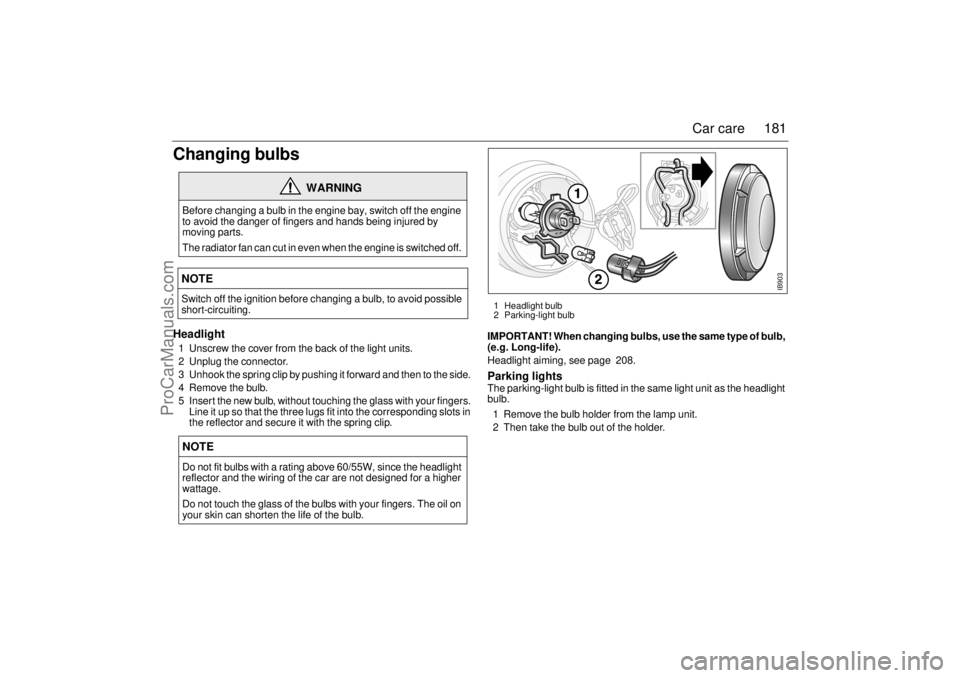
Changing bulbs Headlight 1 Unscrew the cover from the back of the light units.
2 Unplug the connector.
3 Unhook the spring clip by pushing it forward and then to the side.
4 Remove the bulb.
5 Insert the new bulb, without touching the glass with your fingers.
Line it up so that the three lugs fit into the corresponding slots in
the reflector and secure it with the spring clip.IMPORTANT! When changing bulbs, use the same type of bulb,
(e.g. Long-life).
Headlight aiming, see page 208.
Parking lights The parking-light bulb is fitted in the same light unit as the headlight
bulb.
1 Remove the bulb holder from the lamp unit.
2 Then take the bulb out of the holder.
WARNING
Before changing a bulb in the engine bay, switch off the engine
to avoid the danger of fingers and hands being injured by
moving parts.
The radiator fan can cut in even when the engine is switched off. NOTESwitch off the ignition before changing a bulb, to avoid possible
short-circuiting. NOTEDo not fit bulbs with a rating above 60/55W, since the headlight
reflector and the wiring of the car are not designed for a higher
wattage.
Do not touch the glass of the bulbs with your fingers. The oil on
your skin can shorten the life of the bulb.
IB903
1 Headlight bulb
2 Parking-light bulb
ProCarManuals.com