2000 SAAB 9-3 engine oil
[x] Cancel search: engine oilPage 173 of 236

173 Car care
Transmission fluidManual transmissionCheck and top up the fluid in accordance
with the service program.
If original fluid cannot be obtained for top-
ping up, Dexron III (synthetic fluid) auto-
matic transmission fluid can be used. If so,
the car should be taken to an authorized
Saab dealer as soon as possible to have the
reason for low fluid level corrected and orig-
inal fluid installed.Automatic transmissionCheck the fluid level as follows:
1 Park the car on level ground and apply
the parking brake. The automatic trans-
mission fluid must be at normal running
temperature, approximately 175°F
NOTEChange of engine oil and oil filter may be
required more frequently (5000-mile
intervals (8,000 km)) if any one of the fol-
lowing conditions apply to the car:
Most trips are less than 5 to 10 miles (8
to 16 km). This is particularly important
when outside temperatures are below
freezing.
Most trips include extensive idling
(such as frequent stop-and-go driving).
Most trips are through dusty areas.
You frequenty tow a trailer or use a car-
rier on top of your vehicle.
If the vehicle is used for delivery ser-
vice, police, taxi or other commerical
applications.
WARNING
Prolonged and repeated exposure of
the skin to engine oil can cause seri-
ous skin disorders.
Avoid prolonged skin contact when-
ever possible. Wash the affected area
thoroughly with soap and water after
any contact.
Keep oil out of reach of children.
Do not touch the turbocharger or
manifold. These get very hot when the
engine has been running.
Do not spill oil on hot parts of the
engine as this could cause a fire.
Protect the environment. Do not dis-
pose of oil in the ground or down a
drain. Dispose of all used oil and oil fil-
ters at an appropriate disposal facility.
+80°
MIN MAX
+80°
IB495
Oil dipstick, automatic transmission
ProCarManuals.com
Page 175 of 236

175 Car care
Changing the coolant(Usually carried out as part of the Saab
original service by an authorized Saab
dealer)
1 If the engine is hot, loosen the expan-
sion-tank filler cap a little to release the
pressure. Leave the cap in place.
2 Fit a suitable piece of hose onto the
nipple of the drain cock. Let the hose dis-
charge into a receptacle under the radi-
ator and open the drain cock, which is
located on the inside of the radiator
facing the engine bay.
3 Remove the filler cap on the expansion
tank.
4 In a couple of minutes the system will be
empty. Close the drain cock. 5 Mix antifreeze and water in a suitable
container. Use only Saab-approved
coolant.
6 Add the coolant slowly to the expansion
tank. This will take about two minutes,
as the air needs time to escape.
7 Screw the expansion-tank cap on and
run the engine to normal temperature.
Top up with coolant until the level is just
under the "KALT – COLD" mark on the
tank.
8 Check the coolant again after a few days
and top up as necessary.
NOTEAlways mix the antifreeze with the
appropriate volume of water before
adding it to the cooling system.
If pure antifreeze is added, the engine
could still freeze and be damaged. This is
because the antifreeze will not mix
properly with the coolant before the
thermostat has opened to allow full
circulation.
WARNING
Proceed with caution if the radiator is
boiling when you open the hood.
Never remove the expansion-tank
filler cap when the radiator is boiling.
Loosen the cap carefully, and let the
engine cool before removing the cap.
The cooling system is pressurized –
hot coolant and vapor can escape
when the filler cap is released.
IB893
Radiator drain cock
ProCarManuals.com
Page 181 of 236
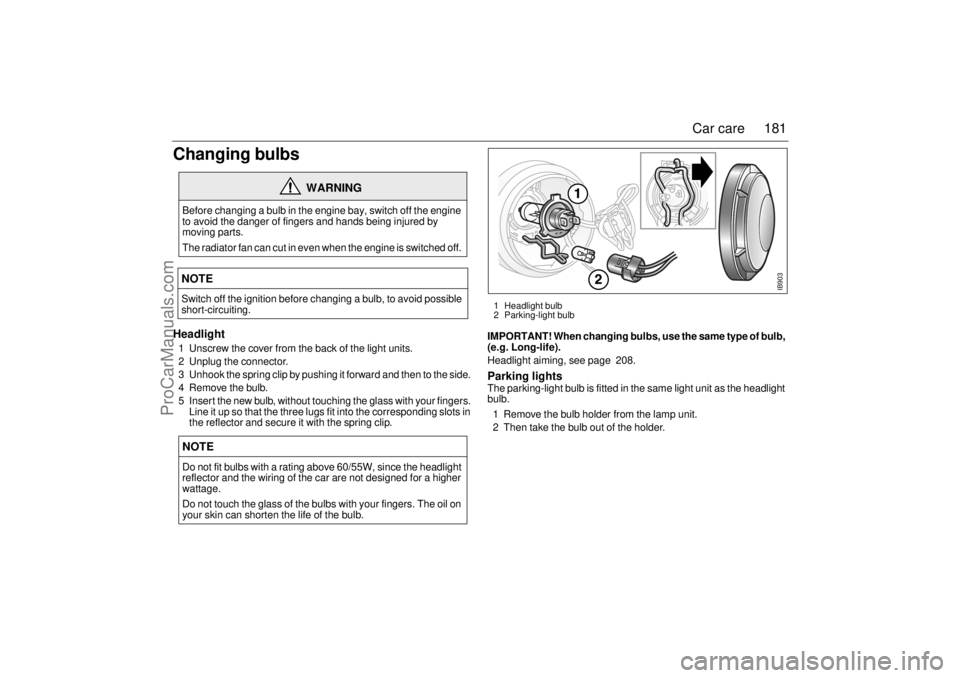
181 Car care
Changing bulbs Headlight 1 Unscrew the cover from the back of the light units.
2 Unplug the connector.
3 Unhook the spring clip by pushing it forward and then to the side.
4 Remove the bulb.
5 Insert the new bulb, without touching the glass with your fingers.
Line it up so that the three lugs fit into the corresponding slots in
the reflector and secure it with the spring clip.IMPORTANT! When changing bulbs, use the same type of bulb,
(e.g. Long-life).
Headlight aiming, see page 208.
Parking lights The parking-light bulb is fitted in the same light unit as the headlight
bulb.
1 Remove the bulb holder from the lamp unit.
2 Then take the bulb out of the holder.
WARNING
Before changing a bulb in the engine bay, switch off the engine
to avoid the danger of fingers and hands being injured by
moving parts.
The radiator fan can cut in even when the engine is switched off. NOTESwitch off the ignition before changing a bulb, to avoid possible
short-circuiting. NOTEDo not fit bulbs with a rating above 60/55W, since the headlight
reflector and the wiring of the car are not designed for a higher
wattage.
Do not touch the glass of the bulbs with your fingers. The oil on
your skin can shorten the life of the bulb.
IB903
1 Headlight bulb
2 Parking-light bulb
ProCarManuals.com
Page 205 of 236

205 Car care
Inspect the undercoating and touch up if
necessary. Pay particular attention to the
fenders and wheel housings, which are
exposed to abrasion by flying gravel, etc. If
the composition has worn or flaked off, the
steel must be thoroughly cleaned and dried
before a fresh coat is applied. The cleaning
is best done with a scraper and a steel wire
brush, followed by washing with solvent.
Apply the new coating thinly, otherwise it
may run off or fall off when dry.
Recovery and/or
recycling of automotive
materialsA typical car consists of metals (65–75%),
plastics (10–14%), rubber (5%) and small
quantities of glass, wood, paper and tex-
tiles.
Some of these materials can be recycled,
while others can be recovered in chemical
processes for reuse in new products or as a
source of energy.
While the Saab 9-3 was still at the draw-
ing-board stage, Saab engineers were
giving serious consideration to how the
maximum quantity of materials could be
reclaimed from the car on its eventual
scrapping. To facilitate sorting, plastic parts,
for instance, have been marked to identify
the precise nature of the plastic.Approximately 90% of the materials in the
car can be recycled or recovered, where
facilities exist.
Before the car is scrapped, all the oils and
other fluids that could pollute the environ-
ment should be recovered from the car. It
may be of interest in this context to learn that
the refrigerant used in the Saab 9-3’s A/C
and ACC systems (R134a) contains neither
CFCs nor any other chlorine compounds
ProCarManuals.com
Page 212 of 236

212 Maintenance and owner assistanceMaintenance scheduleThe Maintenance Schedule prescribes a
service program to the purchaser/operator
of a Saab that is reasonable and necessary
to ensure the proper emission control sys-
tems function, safety and reliability of the
Saab automobile in normal use. Additional
maintenance is recommended for specific
components when the car is operated under
certain severe conditions. Proper mainte-
nance is always a good practice!
Authorized Saab dealers are equipped and
trained to meet your Saab’s service needs.
They regularly receive up-to-date Saab ser-
vice manuals and parts and technical ser-
vice bulletins from Saab and are able,
through their franchise agreement, to attend
Saab service schools, obtain Saab special
tools and technical assistance and pur-
chase original equipment service and
replacement parts.
Today’s complex automobiles should only
be entrusted to the most knowledgeable
service professionals. A Saab dealer is your
best choice.
Service intervalsThe maintenance schedule is comprised of
a "First Service" at 1,000 miles (1,600 km),
followed by services at every 10,000 miles
(16,000 km) thereafter (20,000,
30,000 miles/32,000, 48,000 km etc.).
Engine oil and filter changesChanging the engine oil and filter is required
at every service point. Use only a Saab
approved long-life oil filter and engine oils
meeting the SAE viscosity ratings and API
service classifications stated in the “Techni-
cal data” section of this Owner’s Manual.
The use of extra additives in the oil is not
necessary and is not recommended, and
may be harmful to turbochargers.
More frequent oil changes are recom-
mended if your vehicle is operated under
any of the following conditions:
Most trips are less than 5-10 miles (8-16
km). This is particularly important when
outside temperatures are below freezing.
Most trips include extensive idling (fre-
quent stop-and-go traffic).
Most trips are through dusty areas (such
as construction zones).
If the vehicle is used for delivery service,
police, taxi or other commercial applica-
tions.
If your driving habits match this description,
have the engine oil and filter changed in-
between normal services at 5,000 mile
(8,000 km) intervals. These conditions
cause the engine oil to break down faster.
The Warranties and Service Record Book-
let has provisions to record extra oil
changes.
NOTEThe "First Service" will be done by your
Saab dealer at no charge and should be
done as close as possible to the sched-
uled mileage (1,000 miles/1,600 km).
The engine oil and filter must be changed
at this service.
ProCarManuals.com
Page 215 of 236

215 Maintenance and owner assistance
Saab Original Service Program M2000 USA, Canada, (9-3 Models)* These are the minimum required Emission Control System maintenance steps. Saab urges that all recommended maintenance procedures be performed
according to this program.
(a.) Engine oil and filter should be changed at least once a year. Intermediate oil and filter changes (halfway between indicated intervals) suggested for
cars primarily used for driving in dense city traffic or for repeated short trip operation without sufficient warm up.
** Service intervals:
Refer to the Warranties & Service Record Book for service intervals beyond 100,000 miles (160,000 km).Service Intervals **
Miles = U.S. Cars
Kilometers = Canadian Cars
1,000
(1,600 km)
10,000
(16,000 km)
20,000
(32,000 km)
30,000
(48,000 km)
40,000
(64,000 km)
50,000
(80,000 km)
60,000
(96,000 km)
70,000
(112,000 km)
80,000
(128,000 km)
90,000
(144,000 km)
100,000
(160,000 km)
Service #
1234567891011
Engine and engine compartment
E Engine oil and filter (a.)!!!!!!!!!!!
R Engine coolant freezing point and level""" "" "" "
R Engine coolant flush and replace (max. 3-year intervals)!!!
R Engine cooling system, hoses and cap""""""""""
R Drive belt; condition""""" ! """"
E Spark plugs!
*
!*
!*
E Crankcase ventilation and vacuum lines""
Application/type of service (col. 1) Service Procedure
E = emission service"= Check - top up, adjust or replace if necessary
R = regular maintenance!= Replace
#= Lubricate
ProCarManuals.com
Page 216 of 236

216 Maintenance and owner assistance* These are the minimum required Emission Control System maintenance steps. Saab urges that all recommended maintenance procedures be performed
according to this program.
(b.) Change automatic transmission fluid at more frequent intervals (30,000; 90,000 miles, etc.) if car is driven in dense city traffic where the outside tem-
perature regularly reaches 90°F or higher, if car is used in a mountainous/high altitude area or for trailer towing.
Service Intervals **
Miles = U.S. Cars
Kilometers = Canadian Cars
1,000
(1,600 km)
10,000
(16,000 km)
20,000
(32,000 km)
30,000
(48,000 km)
40,000
(64,000 km)
50,000
(80,000 km)
60,000
(96,000 km)
70,000
(112,000 km)
80,000
(128,000 km)
90,000
(144,000 km)
100,000
(160,000 km)
Service #
1234567891011
Engine and engine compartment (cont.)
E Evaporative emission system including filler cap, vapor
lines, EVAP canister and canister purge valve""
R Fuel system; leaks and damages""""""""""
E Fuel filter!
E Engine air cleaner element!
*
!*
!*
R Exhaust system and mountings; leaks and condition"""""""""""
Electrical
R Battery; state of charge and electrolyte level; clean termi-
nals if necessary"""""""""""
R Headlamp and fog lamp alignment"""""""""""
R Head, fog, brake, tail, turn signal, warning lights instru-
ment panel, backup and marker lamps"""""""""""
Transmission
R Automatic transmission change fluid (b.)!
R Automatic gearbox; oil level and condition""""""""""
R Manual gearbox; oil level"""
R Outer and inner driver joint boots""""""""""
ProCarManuals.com
Page 219 of 236

219 Technical data
Technical data General particulars .......... 220
Engine ............................... 223
Engine oil .......................... 223
Engine variants ................ 225
Electrical system.............. 225
Drive belts......................... 225
Manual transmission ....... 226
Automatic transmission .. 226
Suspension....................... 226
Steering............................. 226
Brake system.................... 227
Rims and tires .................. 227
Plates and labels .............. 229
IB993
ProCarManuals.com