Page 27 of 184

1
��������
�������� � ��������� � ������ � ����� ����
X65 - CLIOC:\Documentum\Checkout_47\Nu607-8gb_T1.WIN 12/10/2000 16:22-page27
1.19
METHODS OF RESTRAINT IN ADDITION TO THE FRONT SEAT BELT(continued)
All the warnings given below are
designed to ensure that the air bag
can inflate correctly and to prevent
serious injuries caused by items
which may be dislodged when the
air bag inflates.Warnings concerning the driver’s air bag
•Do not modify either the steering wheel or the steering wheel boss.
• Do not cover the steering wheel boss.
• Do not attach any objects (pin, logo, clock, telephone support, etc.) to the
steering wheel boss.
• The steering wheelmust notbe removed (except by qualified personnel
within the Renault network).
• Do not sit too close to the steering wheel. If you sit with your arms slightly
bent (see information on “Adjusting your driving position” in section 1), it
will ensure that there is sufficient space for the air bag to inflate properly
and to be fully effective.
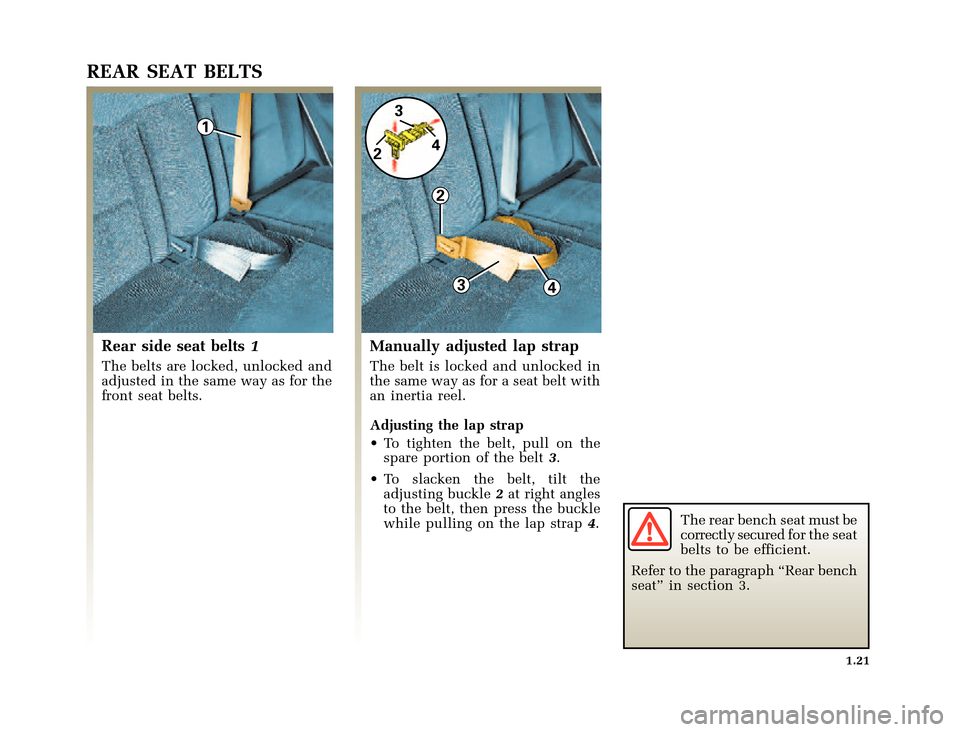
Warnings concerning the passenger air bag: location1
•Do not attach or affix with adhesive any objects (pin, logo, clock, telephone
support, etc.) on the dashboard near where the air bag is located:
• Do not place anything between the dashboard and the passenger (animal,
umbrella, walking stick, parcels, etc.).
• The passenger must not put his or her feet on the dashboard as there is a
risk that serious injuries may be sustained. As a general rule, keep all parts
of the body (knees, hands, heads, etc.) well away from the dashboard.
A REAR-FACING CHILD/BABY SEAT MUST NOT BE FITTED
TO THE FRONT PASSENGER SEAT IF THE VEHICLE IS EQUIPPED
WITH A PASSENGER AIR BAG.
Page 28 of 184
11
��������
�������� � ��������� � ������ � ����� ����
X65 - CLIOC:\Documentum\Checkout_47\Nu607-8gb_T1.WIN 12/10/2000 16:22-page28
1.20
METHODS OF RESTRAINT IN ADDITION TO THE FRONT SEAT BELT(continued)
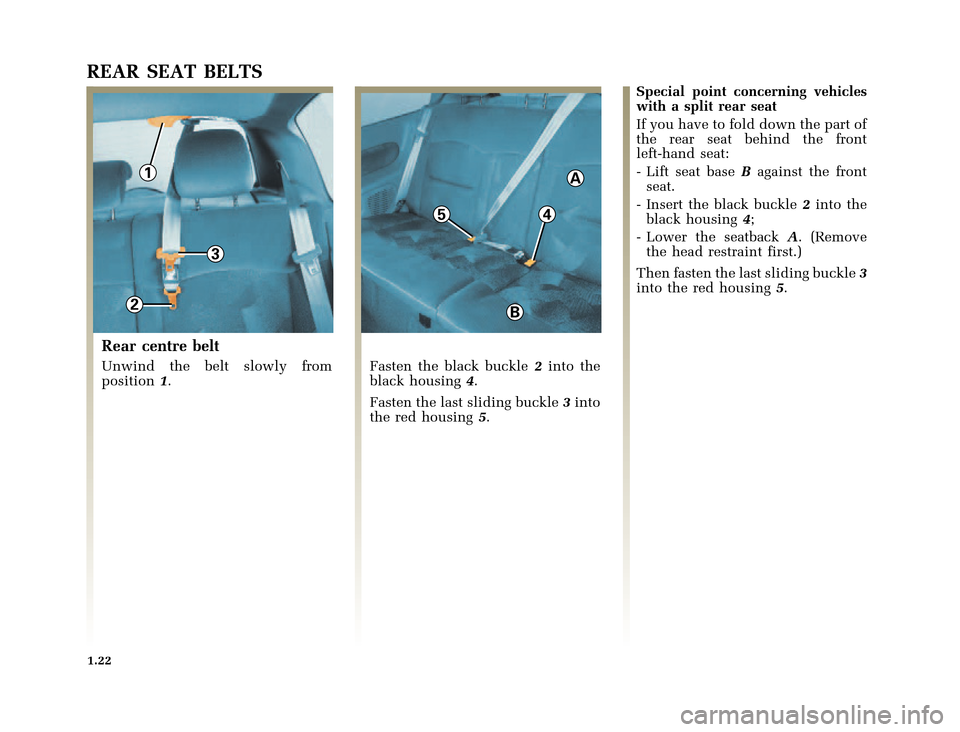
Side air bags
This air bag may be fitted to the
front seats and is activated at the
sides of the seats (door side) to
protect the occupants in the event of
a severe side impact.
The markings1on the windscreen
will remind you of the presence of
this equipment.This system will only operate if a
severe side impact occurs.Warnings concerning the
side air bag
• Fitting seat covers:Seats
equipped with an air bag
require special covers
specifically designed for your
vehicle. Consult your Renault
Dealer to see if appropriate
covers are available from Renault
outlets. The use of any covers
other than those designed for
your vehicle (and including
those designed for another
vehicle) may affect the operation
of these air bags and reduce your
protection.
• Do not place any accessories,
objects and animals between the
seatback and the door. This may
prevent the air bag from
operating correctly or cause
injury if the air bag is deployed.
• No work or modification
whatsoever may be carried out
on the seat, except by qualified
Renault Network personnel.
Page 29 of 184
3
4
2
1
2
43
��������
�������� � ��������� � ����� � ����� ����
X65 - CLIOC:\Documentum\Checkout_47\Nu607-8gb_T1.WIN 12/10/2000 16:22-page29
1.21
REAR SEAT BELTS
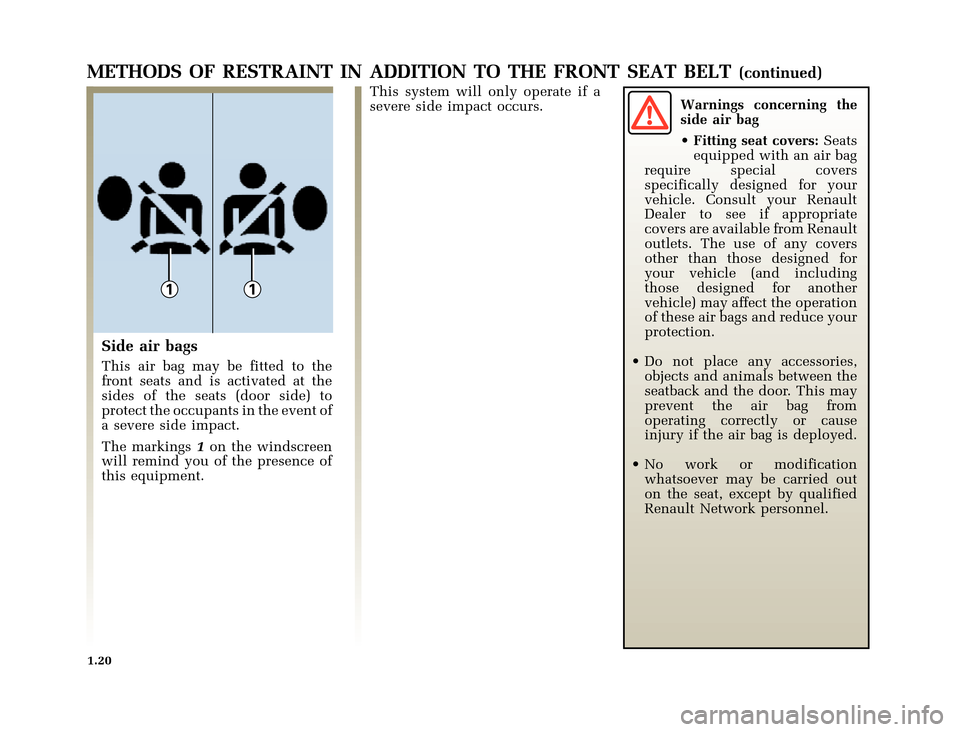
Rear side seat belts1
The belts are locked, unlocked and
adjusted in the same way as for the
front seat belts.
Manually adjusted lap strap
The belt is locked and unlocked in
the same way as for a seat belt with
an inertia reel.
Adjusting the lap strap
• To tighten the belt, pull on the
spare portion of the belt3.
• To slacken the belt, tilt the
adjusting buckle2at right angles
to the belt, then press the buckle
while pulling on the lap strap4.The rear bench seat must be
correctly secured for the seat
belts to be efficient.
Refer to the paragraph “Rear bench
seat” in section 3.
Page 30 of 184
1
3
2
5
A
B
4
��������
�������� � ��������� � ����� � ����� ����
X65 - CLIOC:\Documentum\Checkout_47\Nu607-8gb_T1.WIN 12/10/2000 16:22-page30
1.22
REAR SEAT BELTS
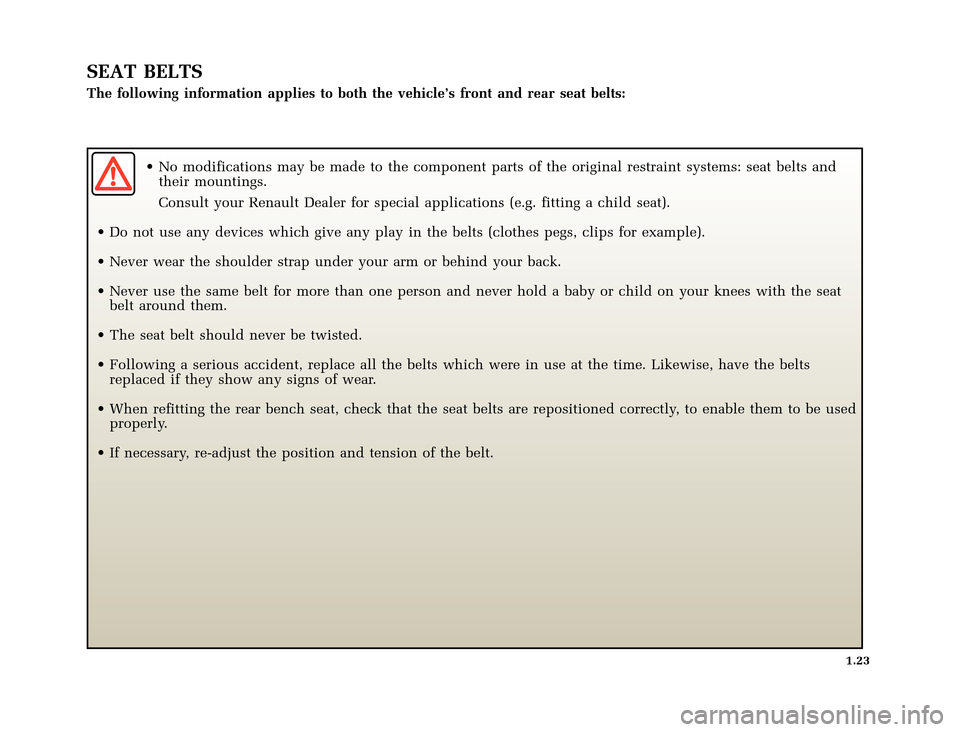
Rear centre belt
Unwind the belt slowly from
position1.Fasten the black buckle2into the
black housing4.
Fasten the last sliding buckle3into
the red housing5.Special point concerning vehicles
with a split rear seat
If you have to fold down the part of
the rear seat behind the front
left-hand seat:
-LiftseatbaseBagainst the front
seat.
- Insert the black buckle2into the
black housing4;
- Lower the seatbackA. (Remove
the head restraint first.)
Then fasten the last sliding buckle3
into the red housing5.
Page 31 of 184
��������
�������� � ��������� � ����� � ����� ����
X65 - CLIOC:\Documentum\Checkout_47\Nu607-8gb_T1.WIN 12/10/2000 16:22-page31
1.23
SEAT BELTS
The following information applies to both the vehicle’s front and rear seat belts:
• No modifications may be made to the component parts of the original restraint systems: seat belts and
their mountings.
Consult your Renault Dealer for special applications (e.g. fitting a child seat).
• Do not use any devices which give any play in the belts (clothes pegs, clips for example).
• Never wear the shoulder strap under your arm or behind your back.
• Never use the same belt for more than one person and never hold a baby or child on your knees with the seat
belt around them.
• The seat belt should never be twisted.
• Following a serious accident, replace all the belts which were in use at the time. Likewise, have the belts
replaced if they show any signs of wear.
• When refitting the rear bench seat, check that the seat belts are repositioned correctly, to enable them to be used
properly.
• If necessary, re-adjust the position and tension of the belt.
Page 32 of 184
1
3
2
��������
�������� � ��������� � ����� � ����� ����
X65 - CLIOC:\Documentum\Checkout_47\Nu607-8gb_T1.WIN 12/10/2000 16:22-page32
1.24
CHILD SAFETY: ISOFIX
Isofix - mounting system for
child seats
This is a new procedure for
installing a child seat. It can be used
on the rear side seat positions of the
vehicle.
It consists of the following
components:
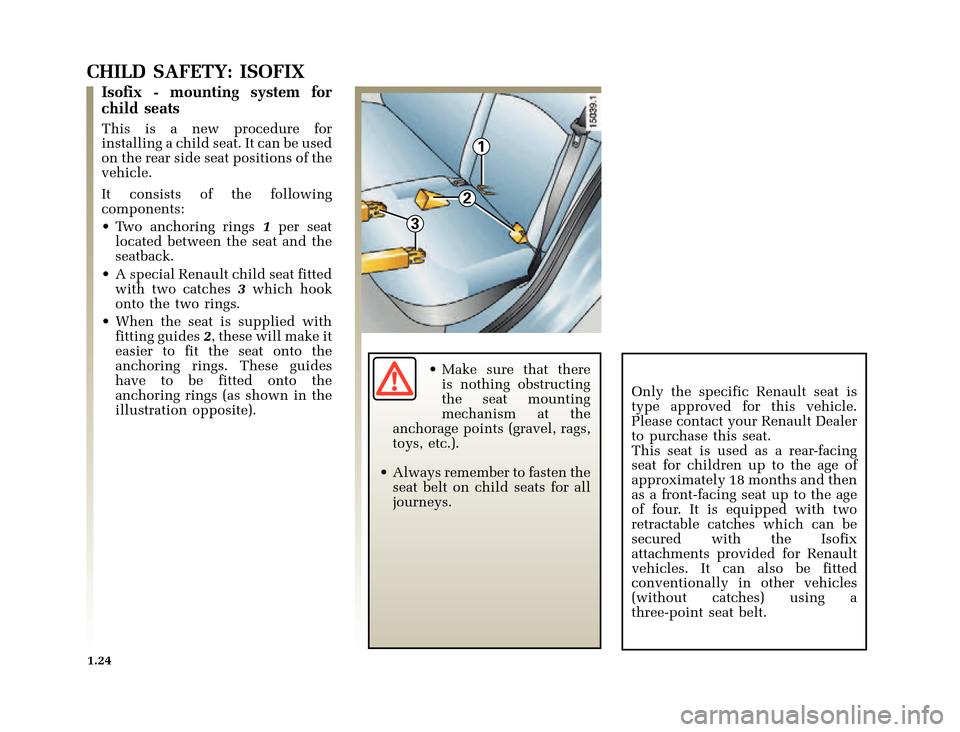
• Two anchoring rings1per seat
located between the seat and the
seatback.
• A special Renault child seat fitted
with two catches3which hook
onto the two rings.
• When the seat is supplied with
fitting guides2, these will make it
easier to fit the seat onto the
anchoring rings. These guides
have to be fitted onto the
anchoring rings (as shown in the
illustration opposite).• Make sure that there
is nothing obstructing
the seat mounting
mechanism at the
anchorage points (gravel, rags,
toys, etc.).
• Always remember to fasten the
seat belt on child seats for all
journeys.Only the specific Renault seat is
type approved for this vehicle.
Please contact your Renault Dealer
to purchase this seat.
This seat is used as a rear-facing
seat for children up to the age of
approximately 18 months and then
as a front-facing seat up to the age
of four. It is equipped with two
retractable catches which can be
secured with the Isofix
attachments provided for Renault
vehicles. It can also be fitted
conventionally in other vehicles
(without catches) using a
three-point seat belt.
Page 34 of 184

��������
�������� � ��������� � ����� � ����� ����
X65 - CLIOC:\Documentum\Checkout_47\Nu607-8gb_T1.WIN 12/10/2000 16:22-page34
1.26
CHILD SAFETY(continued)
In all countries there are regulations
governing the use of restraints for
children and babies.
In Europe, children under 12 years
of age or a height of less than
1.50 m
(1)(4 ft 11 inches) must travel
in an approved seat that is suitable
for the height and weight of the
child.
The driver is responsible for
ensuring that this equipment is used
correctly.
Remember that a collision at 30
mph (50 km/h) is the same as
falling a distance of 10 metres.
Expressed in other terms,
transporting a child without a
restraint is the equivalent of
allowing him or her to play on a
third-floor balcony which does
not have any railings.
(1) Always comply with the laws of the
country in which you are travelling.
They may be different to the
guidelines in this handbook.
Under no circumstances
should babies or children
be allowed to travel
sitting on the knees of
another passenger in the vehicle.
If a head-on collision occurs at
30 mph (50 km/h) a child
weighing 30 kg (66 lbs) will be
transformed into a missile
equivalent to one tonne: you will
find it impossible to hold the
child, even if you yourself are
wearing a belt.
It is particularly dangerous to put
the belt round your child when
he or she is sitting on your knee.
Neverusethesamebeltformore
than one person at the same time.Child restraints for which type
approval was obtained after 1992
provide a level of security greater
than for restraints with type
approval before that date.
It is therefore advisable to select a
child restraint that complies with
European regulation ECE 44.
Restraints that comply with this
legislation must be marked with an
orange label bearing the letterE
followed by a number (which
stands for the country where it is
type approved) and the year the
type approval was granted.
The standard classifies the
restraints in five categories:
Category0:from0to10kg(0to22lbs)
Category 0+: from 0 to 13 kg (0 to 28 lbs)
Category 1: from 9 to 18 kg (20 to 40 lbs)
Category 2: from 15 to 25 kg (33 to
55 lbs)
Category 3: from 22 to 36 kg (48 to
80 lbs)
Page 35 of 184
12
��������
�������� � ��������� � ����� � ����� ����
X65 - CLIOC:\Documentum\Checkout_47\Nu607-8gb_T1.WIN 12/10/2000 16:22-page35
1.27
CHILD SAFETY(continued)
The right choice
The safety of your children is also
your responsibility.
To give your children maximum
protection, we recommend that you
use seats obtained from a Renault
Dealer.
If your vehicle is equipped with an
Isofix system, it is preferable to use
an Isofix seat. (Refer to the
information in section 1 on the
Isofix system of child seats.)
Restraint systems for all categories
are available. These systems have
been developed in consultation
with the manufacturers and have
been tested in Renault vehicles.
Take the advice of your Renault
Dealer and ask him to help you to
install it.
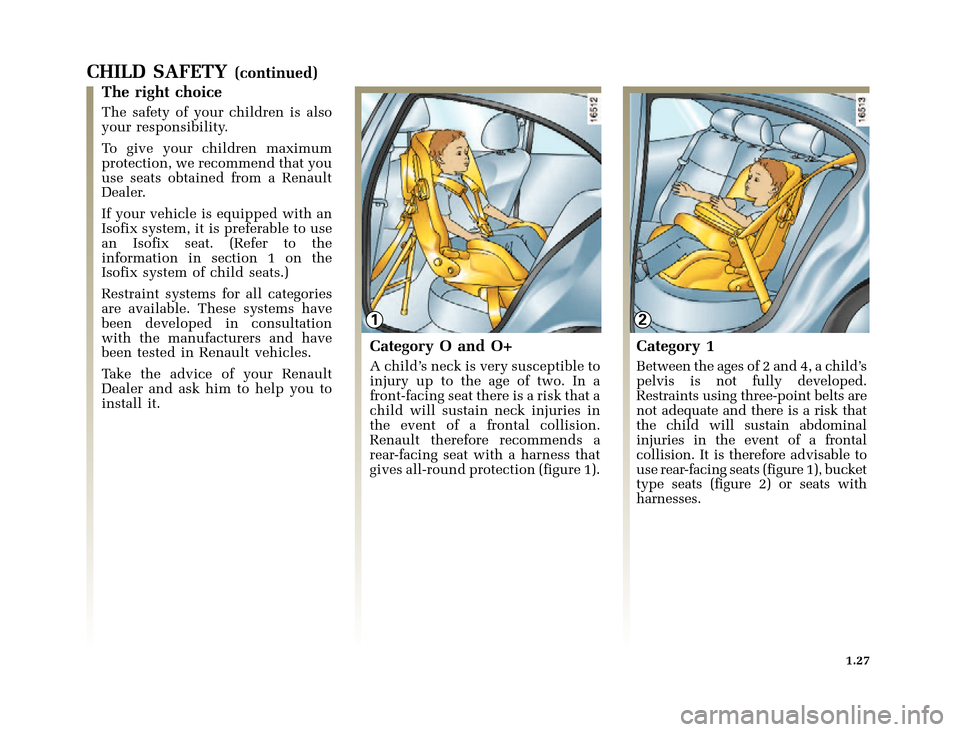
Category O and O+
A child’s neck is very susceptible to
injury up to the age of two. In a
front-facing seat there is a risk that a
child will sustain neck injuries in
the event of a frontal collision.
Renault therefore recommends a
rear-facing seat with a harness that
gives all-round protection (figure 1).
Category 1
Betweentheagesof2and4,achild’s
pelvis is not fully developed.
Restraints using three-point belts are
not adequate and there is a risk that
the child will sustain abdominal
injuries in the event of a frontal
collision. It is therefore advisable to
use rear-facing seats (figure 1), bucket
type seats (figure 2) or seats with
harnesses.