2000 NISSAN XTERRA engine
[x] Cancel search: enginePage 237 of 263

When planning to drive your NISSAN
vehicle in another country,you should
first find out if the fuel available is suitable
for your vehicle's engine.
Using fuel with too low an octane rating may
cause engine damage. All gasoline vehicles
can be operated with unleaded gasoline.
Therefore, avoid driving your vehicle in ar-
eas where appropriate fuel is not available.
When transferring the registration of
your vehicle to another country, state,
province or district,it may be necessary to
modify the vehicle to meet local laws and
regulations.
The laws and regulations for motor vehicle
emission control and safety standards vary
according to the country, state, province or
district; therefore, vehicle specifications
may differ.
When any vehicle is to be taken into
another country, state, province or dis-
trict and registered, its modifications,
transportation and registration are the
responsibility of the user. NISSAN is not
responsible for any inconvenience that
may result.
VEHICLE IDENTIFICATION
NUMBER (VIN) PLATE
The vehicle identification number plate is
attached to the top of the instrument panel
on the driver's side. This number is the
identification for your vehicle and is used in
the vehicle registration.
VEHICLE IDENTIFICATION
NUMBER (Chassis number)
CA0018ATI1027
REGISTERING YOUR
VEHICLE IN ANOTHER
COUNTRYVEHICLE IDENTIFICATION
10-12Technical and consumer information
ZX
Page 238 of 263

ENGINE SERIAL NUMBER
The number is stamped on the engine as
shown.
FMVSS CERTIFICATION LABEL
The Federal Motor Vehicle Safety Standard
(FMVSS) certification label is attached as
shown. This label contains valuable vehicle
information, such as: Gross Vehicle Weight
Rating (GVWR), Gross Axle Weight Rating
(GAWR), month and year of manufacture,
Vehicle Identification Number (VIN), etc.
Review it carefully.
ATI1016ATI1017ATI1018
Technical and consumer information10-13
ZX
Page 244 of 263
Your new vehicle was designed to be used
primarily to carry passengers and cargo.
Remember that towing a trailer will place
additional loads on your vehicle's engine,
drive train, steering, braking and other sys-
tems.
ANissan Trailer Towing Guide (U.S. only)
is available from an authorized NISSAN
dealer. This guide includes information on
trailer towing ability and the special equip-
ment required for proper towing.
Maximum load limits
Maximum trailer loads
Never allow the total trailer load to exceed
the value specified in the following Towing
Load/Specification Chart. The total trailer
load equals trailer weight plus its cargo
weight.
OWhen towing a trailer load of 1,000 lbs.
(454 kg) or more, trailers with a brake
system MUST be used.
The maximum GCWR (Gross Combined
Weight Rating) should not exceed the value
specified in the following Towing Load/
Specification Chart.
The GCWR equals the combined weight of
the towing vehicle (including passengers
and cargo) plus the total trailer load. Towing
loads greater than these or using improper
towing equipment could adversely affect
vehicle handling, braking and performance.
The ability of your vehicle to tow a trailer is
not only related to the maximum trailer
loads, but also the places you plan to tow.
Tow weights appropriate for level highway
driving may have to be reduced on very
steep grades or in low traction situations (forexample, on slippery boat ramps).WARNING
Vehicle damage and/or personal injury
resulting from improper towing proce-
dures are not covered by NISSAN war-
ranties. A Nissan Trailer Towing Guide
(U.S. only) containing information on
trailer towing ability and the special
equipment required may be obtained
from an authorized NISSAN dealer.
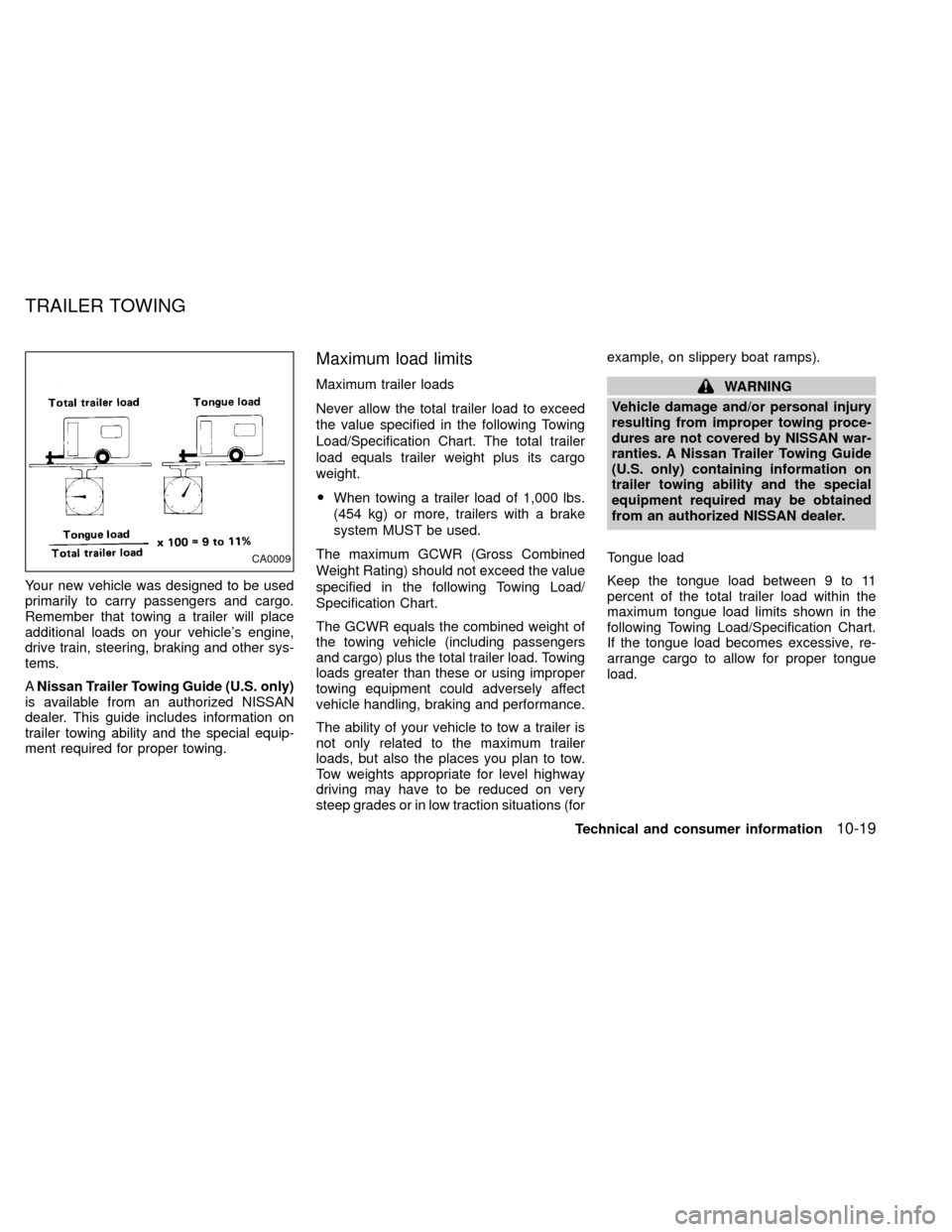
Tongue load
Keep the tongue load between 9 to 11
percent of the total trailer load within the
maximum tongue load limits shown in the
following Towing Load/Specification Chart.
If the tongue load becomes excessive, re-
arrange cargo to allow for proper tongue
load.
CA0009
TRAILER TOWING
Technical and consumer information10-19
ZX
Page 246 of 263

Unit: lbs. (kg)
Engine KA24DE (4 cyl) VG33E (V6)
Model 2WD 2WD 4WD
Transmission M/T M/T A/T M/T A/T
MAXIMUM
TRAILER
WEIGHT*13,500 (1,588) 3,500 (1,588) 5,000 (2,268) 3,500 (1,588) 5,000 (2,268)
MAXIMUM
TONGUE
LOAD350 (159) 350 (159) 500 (227) 350 (159) 500 (227)
GROSS
COMBINED
WEIGHT
RATING7,700 (3,492) 8,000 (3,628) 9,500 (4,309) 8,000 (3,628) 9,500 (4,309)
RECOMMENDED
EQUIPMENT*2Sway Control Device Sway Control Device Sway Control Device Sway Control Device Sway Control Device
*1: All towing above 1,000 lb (454 kg) requires the use of trailer brakes. NISSAN recommends the use of a tandem axle trailer whenever towing above 3,000
lb (1,361 kg).
*2: A sway control device is recommended for all towing above 2,000 lb (907 kg). Sway control devices are not offered by NISSAN. See a professional
trailer/hitch outlet for a properly designed sway control device for your trailer.
M/T = Manual Transmission
A/T = Automatic Transmission
2WD = 2-wheel drive
4WD = 4-wheel drive
TOWING LOAD/
SPECIFICATION CHART
Technical and consumer information10-21
ZX
Page 249 of 263
Trailer brakes
If your trailer is equipped with a braking
system, make sure it conforms to Federal
and/or local regulations and that it is prop-
erly installed.
WARNING
Never connect a trailer brake system
directly to the vehicle brake system.
Pre-towing tips
OBe certain your vehicle maintains a level
position when a loaded and/or unloaded
trailer is hitched. Do not drive the vehicle
if it has an abnormal nose-up or nose-
down condition; check for improper
tongue load, overload, worn suspension
or other possible causes of either condi-
tion.
OAlways secure items in the trailer to
prevent load shift while driving.
OBe certain your outside mirrors conform
to all federal, state or local regulations. If
not, install any mirrors required for towing
before driving the vehicle.
Trailer towing tips
In order to gain skill and an understanding
of the vehicle's behavior, you should prac-
tice turning, stopping and backing up in an
area which is free from traffic. Steering,
stability and braking performance will be
somewhat different than under normal driv-
ing conditions.
OAlways secure items in the trailer to
prevent load shift while driving.
O
Avoid abrupt starts, acceleration or stops.
OAvoid sharp turns or lane changes.
OAlways drive your vehicle at a moderate
speed.
OAlways block the wheels on both vehicle
and trailer when parking. Parking on a
slope is not recommended; however, if
you must do so, and if your vehicle is
equipped with automatic transmission,
first block the wheels and apply the park-
ing brake, and then move the transmis-
sion shift selector lever into the P (Park)
position. If you move the shift lever to the
P (Park) position before blocking the
wheels and applying the parking brake,
transmission damage could occur.OWhen going down a hill, shift into a lower
gear and use the engine braking effect.
When ascending a long grade, downshift
the transmission to a lower gear and
reduce speed to reduce chances of en-
gine overloading and/or overheating.
However, for long steep grades, do not
stay in 1st or 2nd gear when driving
above 35 MPH (56 km/h).
OIf the engine coolant rises to an ex-
tremely high temperature when the air
conditioning system is on, turn off the air
conditioner. Coolant heat can be addi-
tionally vented by opening the windows,
switching the fan control to high and
setting the temperature control to the
HOT position.
OTrailer towing requires more fuel than
normal circumstances.
OAvoid towing a trailer for your vehicle's
first 500 miles (805 km).
OHave your vehicle serviced more often
than at intervals specified in the recom-
mended Maintenance Schedule.
OWhen making a turn, your trailer wheels
will be closer to the inside of the turn than
your vehicle wheels. To compensate for
10-24Technical and consumer information
ZX
Page 250 of 263

this, make a larger than normal turning
radius during the turn.
OCrosswinds and rough roads adversely
affect vehicle/trailer handling, possibly
causing vehicle sway. When being
passed by larger vehicles, be prepared
for possible changes in crosswinds that
could affect vehicle handling. If swaying
does occur, firmly grip the steering
wheel, steer straight ahead, and immedi-
ately (but gradually) reduce vehicle
speed. This combination helps to stabi-
lize the vehicle. Never increase speed.
OBe careful when passing other vehicles.
Passing while towing a trailer requires
considerably more distance than normal
passing. Remember the length of the
trailer must also pass the other vehicle
before you can safely change lanes.
OTo maintain engine braking efficiency
and electrical charging performance, do
not use fifth gear (manual transmission)
or overdrive (automatic transmission).
OAvoid holding the brake pedal down too
long or too frequently. This could cause
the brakes to overheat, resulting in re-
duced braking efficiency.When towing a trailer, change oil in the
transmission more frequently. For addi-
tional information see the ``Mainte-
nance'' section earlier in this manual.DOT (Department of Transportation) Quality
Grades: All passenger car tires must con-
form to Federal Safety Requirements in
addition to these grades.
Quality grades can be found where appli-
cable on the tire sidewall between tread
shoulder and maximum section width. For
example:
Treadwear 200 Traction AA Temperature A
Treadwear
Treadwear grade is a comparative rating
based on tire wear rate when tested under
controlled conditions on specified govern-
ment test courses. For example, a tire
graded 150 would wear one and a half
(1-1/2) times as well on the government
course as a tire graded 100. However, rela-
tive tire performance depends on actual
driving conditions, and may vary signifi-
cantly due to variations in driving habits,
service practices and differences in road
characteristics and climate.
Traction AA, A, B and C
The traction grades from highest to lowest
are AA, A, B, and C. Those grades repre-
UNIFORM TIRE QUALITY
GRADING
Technical and consumer information10-25
ZX
Page 252 of 263
If you believe that your vehicle has a defect
which could cause a crash or could cause
injury or death, you should immediately
inform the National Highway Traffic Safety
Administration
(NHTSA)in addition to no-
tifying NISSAN.
If
NHTSAreceives similar complaints, it
may open an investigation, and if it finds
that a safety defect exists in a group of
vehicles, it may order a recall and remedy
campaign. However,
NHTSAcannot be-
come involved in individual problems be-
tween you, your dealer, or NISSAN.
To contact
NHTSA, you may either call the
Auto Safety Hotline toll-free at 1-800-424-
9393 (or 366-0123 in the Washington, D.C.
area) or write to:
NHTSA, U.S. Depart-
ment of Transportation, Washington, D.C.
20590. You can also obtain other informa-
tion about motor vehicle safety from the
Hotline.
You may notify NISSAN by contacting our
Consumer Affairs Department, toll-free, at
1-800-NISSAN-1.
In Hawaii call (808) 836-0888.Due to legal requirements in some states
and Canadian provinces, your vehicle may
be required to be in the ready condition for
an Inspection/Maintenance (I/M) test of the
emission control system.
The vehicle is set to the ready condition
when it is driven through certain driving
patterns. Usually, the ready condition can
be obtained by ordinary usage of the ve-
hicle.
If a powertrain system component is re-
paired or the battery is disconnected, the
vehicle may be reset to a not ready condi-
tion. Before taking the I/M test, drive the
vehicle through the following pattern to set
the vehicle to the ready condition.WARNING
Always drive the vehicle in a safe and
prudent manner according to traffic
conditions and obey all traffic laws.1. Start the engine when the engine coolant
temperature gauge needle points to C.
Allow the engine to idle until the gauge
needle points between the C and H (nor-
mal operating temperature).
2. Accelerate the vehicle to 55 mph (88
km/h), then quickly release the accelera-
tor pedal completely and keep it released
for at least 6 seconds.
3. Quickly depress the accelerator pedal for
a moment, then drive the vehicle at a
speed of 53 to 60 mph (85 to 97 km/h) for
at least 5 minutes.
4. Stop the vehicle.
5. Accelerate the vehicle to 35 mph (55
km/h) and maintain the speed for 20
seconds.
6. Repeat steps four through five least three
times.
7. Accelerate the vehicle to 55 mph (88
km/h) and maintain the speed for at least
3 minutes.
8. Stop the vehicle and turn the engine off.
9. Repeat steps one through eight at least
one more time.
REPORTING SAFETY
DEFECTS (US only)READINESS FOR
INSPECTION/MAINTENANCE
(I/M) TEST (US only)
Technical and consumer information10-27
ZX
Page 253 of 263
If step one through seven interrupted, repeat
the preceding step. Any safe driving mode is
acceptable between steps. Do not stop the
engine until step seven is completed. If you
cannot or do not want to perform the driving
pattern, an authorized NISSAN dealer can
conduct it for you.
Dynamometer testing for
Inspection/Maintenance (I/M) test
(US only)
Due to legal requirements in some
states/areas, your vehicle may be tested for
emissions on a dynamometer. The transfer
control lever (if so equipped) MUST be in
the 2H position for I/M testing on a two
wheel dynamometer.
WARNING
OIf the transfer control lever is not in
the 2H position during the dyna-
momter I/M testing, the vehicle could
come off the dynamometer and
cause serious personal injury and/or
body damage to the vehicle.OSerious damage will occur to the
4WD system if the transfer control
lever is not in the 2H position.
10-28Technical and consumer information
ZX