2000 NISSAN SENTRA trunk
[x] Cancel search: trunkPage 83 of 240
OPENER OPERATION
WARNING
cDo not drive with the trunk lid open.
This could allow dangerous exhaust
gases to be drawn into the vehicle.
See ``Exhaust gas'' in the ``Starting
and driving'' section of this manual.
cClosely supervise children when
they are around cars to prevent them
from playing and becoming locked
in the trunk where they could be
seriously injured. Keep the carlocked, with the trunk closed, when
not in use, and prevent children's
access to car keys.
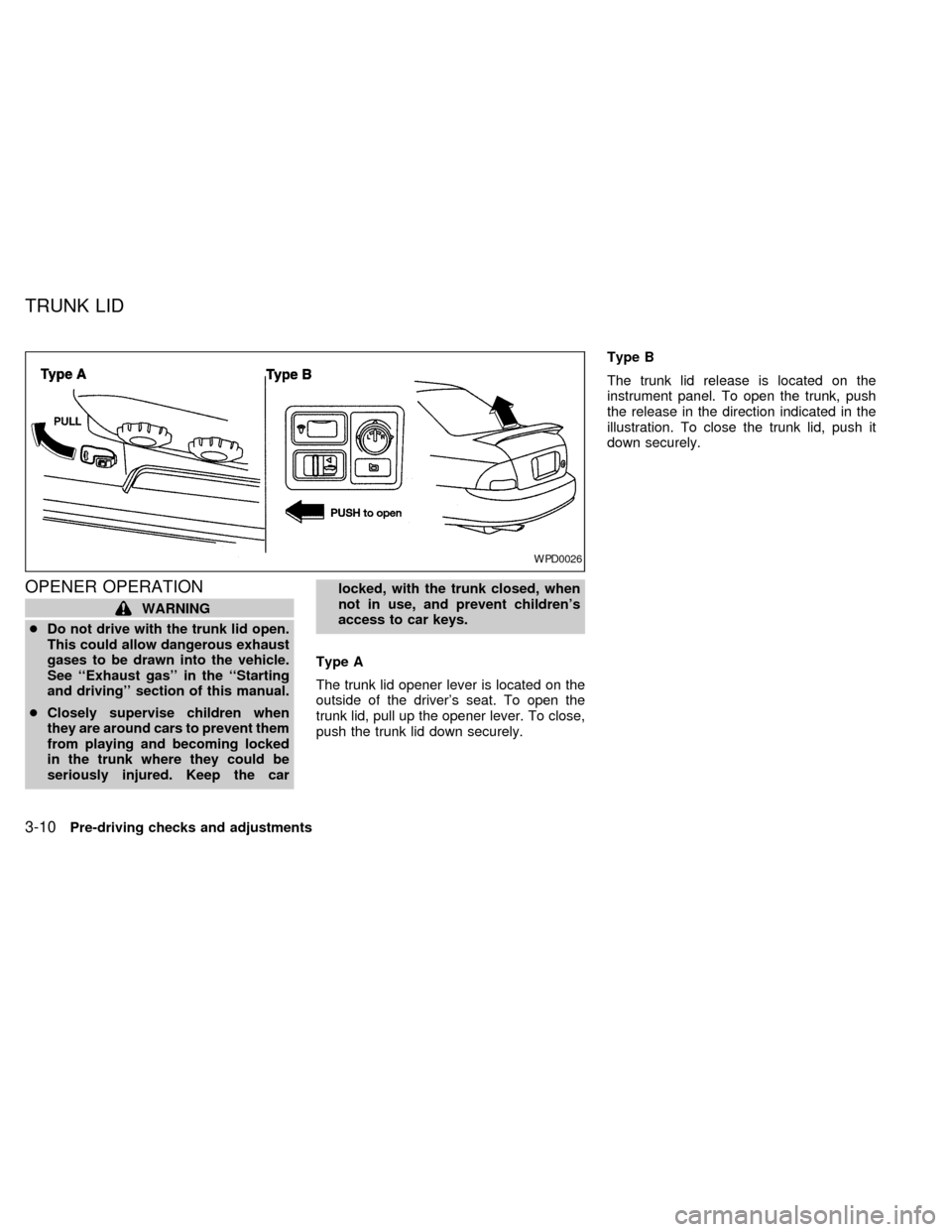
Type A
The trunk lid opener lever is located on the
outside of the driver's seat. To open the
trunk lid, pull up the opener lever. To close,
push the trunk lid down securely.Type B
The trunk lid release is located on the
instrument panel. To open the trunk, push
the release in the direction indicated in the
illustration. To close the trunk lid, push it
down securely.
WPD0026
TRUNK LID
3-10Pre-driving checks and adjustments
ZX
Page 84 of 240

Cancel lever
When the lever is in the cancel position, the
trunk lid cannot be opened with the trunk lid
opener lever. It can be opened only with the
key.
KEY OPERATION
To open the trunk lid from outside the
vehicle, turn the key clockwise. To close the
trunk lid, push the trunk lid down securely.
WPD0021APD1110
Pre-driving checks and adjustments3-11
ZX
Page 115 of 240
WARNING
cDo not leave children, impaired
adults, or pets alone in your vehicle.
They could accidentally injure them-
selves or others through inadvertent
operation of the vehicle. Also, on
hot, sunny days, temperatures in a
closed vehicle could quickly become
high enough to cause severe or pos-
sibly fatal injuries to people or ani-
mals.
cClosely supervise children when
they are around cars to prevent them
from playing and becoming locked
in the trunk where they could be
seriously injured. Keep the car
locked, with the trunk closed, when
not in use, and prevent children's
access to car keys.
EXHAUST GAS (carbon monoxide)
WARNING
cDo not breathe exhaust gases; they
contain colorless and odorless car-bon monoxide. Carbon monoxide is
dangerous. It can cause uncon-
sciousness or death.
cIf you suspect that exhaust fumes
are entering the vehicle, drive with
all windows fully open, and have the
vehicle inspected immediately.
cDo not run the engine in closed
spaces such as a garage.
cDo not park the vehicle with the
engine running for any extended
length of time.
cKeep the trunk lid closed while driv-
ing, otherwise exhaust gases could
be drawn into the passenger com-
partment. If you must drive with the
trunk lid open, follow these precau-
tions.
1. Open all the windows.
2. Set the
air recirculation but-
ton (if so equipped) to off and the
fan control dial to 4 (high) to cir-
culate the air.cIf electrical wiring or other cable
connections must pass to a trailer
through the seal on the trunk lid or
the body, follow the manufacturer's
recommendation to prevent carbon
monoxide entry into the vehicle.
cThe exhaust system and body
should be inspected by a qualified
mechanic whenever:
a. The vehicle is raised for service.
b. You suspect that exhaust fumes
are entering into the passenger
compartment.
c. You notice a change in the sound
of the exhaust system.
d.
You have had an accident involv-
ing damage to the exhaust system,
underbody, or rear of the vehicle.
THREE-WAY CATALYST
The three-way catalyst is an emission con-
trol device installed in the exhaust system.
Exhaust gases in the three-way catalyst are
burned at high temperatures to help reduce
pollutants.
PRECAUTIONS WHEN
STARTING AND DRIVING
5-2Starting and driving
ZX
Page 138 of 240

Getting the spare tire and tools
1. Open the trunk. Lift the trunk floor carpet-
ing and spare tire cover. Remove the tool
bag (which contains the jack rod and
wheel nut wrench) and the spare tire. If
necessary, use the flat end of the jack
rod as shown to loosen the spare tire
hold-down bolt.2. To remove the jack, turn the jack screw
counterclockwise. Use the tapered end
of the jack rod to loosen the jack from its
storage position.
WCE0012WCE0009
In case of emergency6-3
ZX
Page 142 of 240
Installing the spare tire
The TEMPORARY USE ONLY spare tire
is designed for emergency use. See spe-
cific instructions under the heading
``Wheels and tires'' in the ``Do-it- your-
self'' section of this owner's manual.
1. Clean any mud or dirt from the surface
between the wheel and hub.
2. Carefully put the spare tire on and tighten
the wheel nuts finger tight.
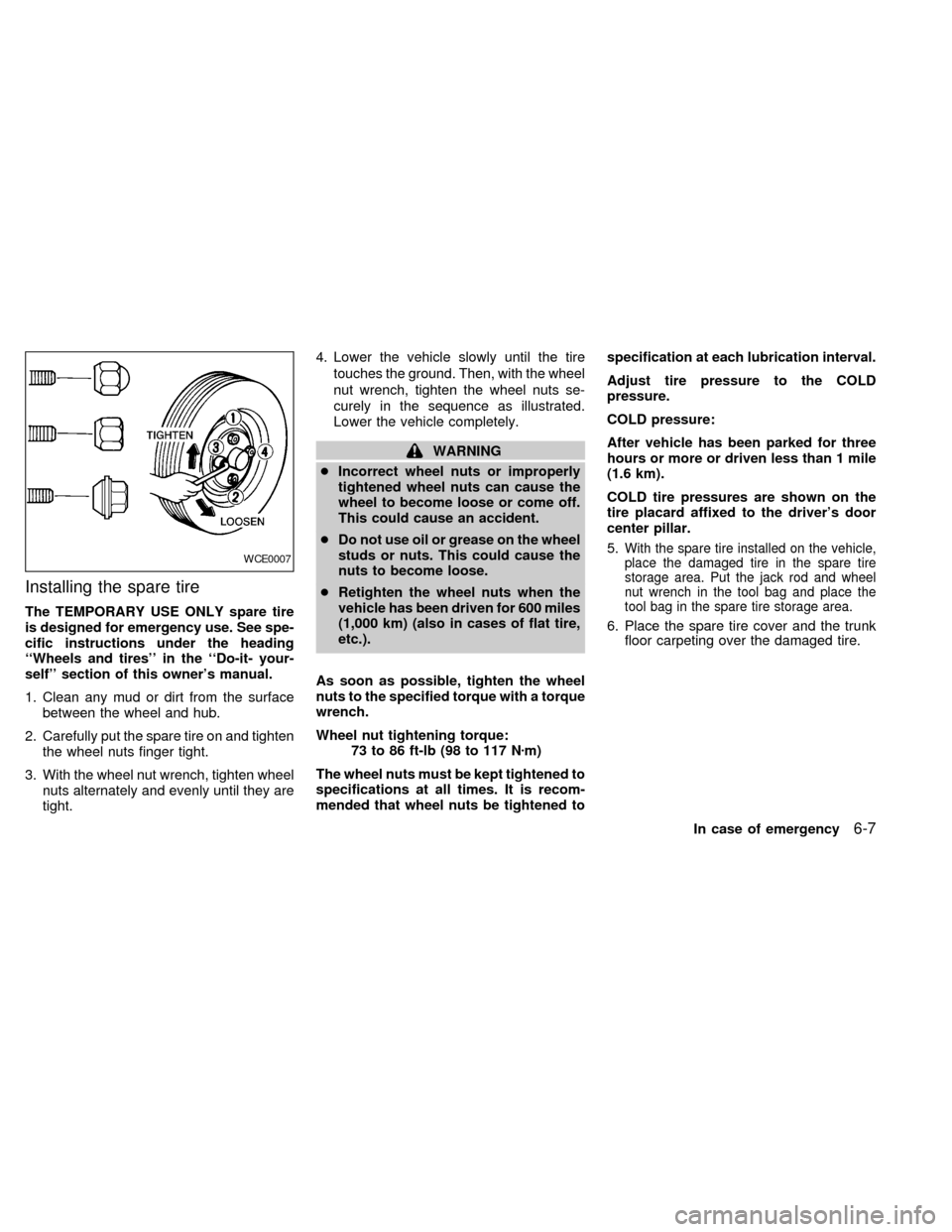
3. With the wheel nut wrench, tighten wheel
nuts alternately and evenly until they are
tight.4. Lower the vehicle slowly until the tire
touches the ground. Then, with the wheel
nut wrench, tighten the wheel nuts se-
curely in the sequence as illustrated.
Lower the vehicle completely.
WARNING
cIncorrect wheel nuts or improperly
tightened wheel nuts can cause the
wheel to become loose or come off.
This could cause an accident.
cDo not use oil or grease on the wheel
studs or nuts. This could cause the
nuts to become loose.
cRetighten the wheel nuts when the
vehicle has been driven for 600 miles
(1,000 km) (also in cases of flat tire,
etc.).
As soon as possible, tighten the wheel
nuts to the specified torque with a torque
wrench.
Wheel nut tightening torque:
73 to 86 ft-lb (98 to 117 Nzm)
The wheel nuts must be kept tightened to
specifications at all times. It is recom-
mended that wheel nuts be tightened tospecification at each lubrication interval.
Adjust tire pressure to the COLD
pressure.
COLD pressure:
After vehicle has been parked for three
hours or more or driven less than 1 mile
(1.6 km).
COLD tire pressures are shown on the
tire placard affixed to the driver's door
center pillar.
5.
With the spare tire installed on the vehicle,
place the damaged tire in the spare tire
storage area. Put the jack rod and wheel
nut wrench in the tool bag and place the
tool bag in the spare tire storage area.
6. Place the spare tire cover and the trunk
floor carpeting over the damaged tire.
WCE0007
In case of emergency6-7
ZX
Page 143 of 240
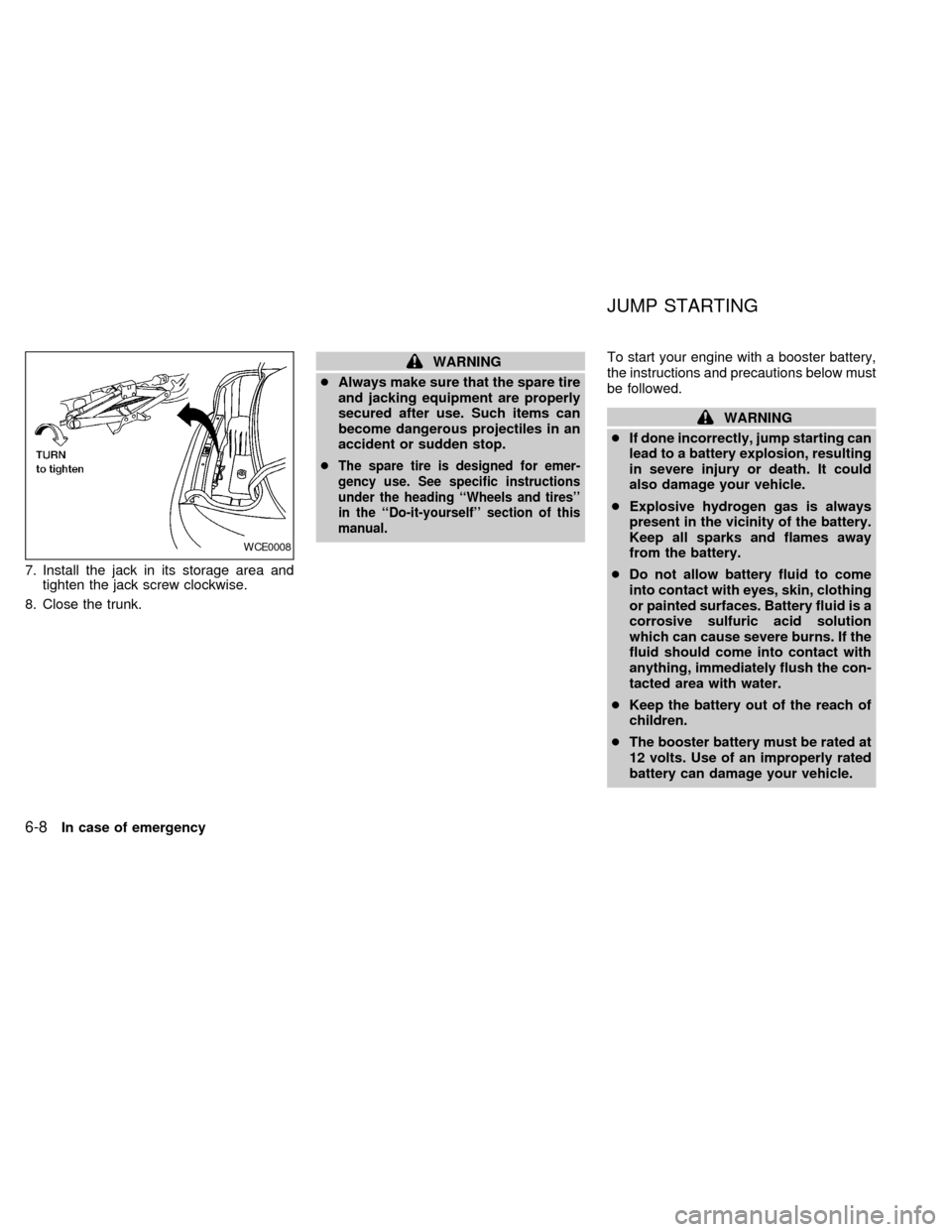
7. Install the jack in its storage area and
tighten the jack screw clockwise.
8. Close the trunk.
WARNING
cAlways make sure that the spare tire
and jacking equipment are properly
secured after use. Such items can
become dangerous projectiles in an
accident or sudden stop.
c
The spare tire is designed for emer-
gency use. See specific instructions
under the heading ``Wheels and tires''
in the ``Do-it-yourself'' section of this
manual.
To start your engine with a booster battery,
the instructions and precautions below must
be followed.
WARNING
cIf done incorrectly, jump starting can
lead to a battery explosion, resulting
in severe injury or death. It could
also damage your vehicle.
cExplosive hydrogen gas is always
present in the vicinity of the battery.
Keep all sparks and flames away
from the battery.
cDo not allow battery fluid to come
into contact with eyes, skin, clothing
or painted surfaces. Battery fluid is a
corrosive sulfuric acid solution
which can cause severe burns. If the
fluid should come into contact with
anything, immediately flush the con-
tacted area with water.
cKeep the battery out of the reach of
children.
cThe booster battery must be rated at
12 volts. Use of an improperly rated
battery can damage your vehicle.
WCE0008
JUMP STARTING
6-8In case of emergency
ZX
Page 190 of 240

EXTERIOR AND INTERIOR
LIGHTS
ItemWattage
(W)Bulb
No.*
Headlamp 65/55
9007(HB5)
Parking and turn signal
lamp8/273157NA
or
3157 AK
Fog light 55 H3
Map light (if so equipped) 8 68
Interior light 8 68
Rear combination lamp
Turn 27 1156A
Stop/tail 27/8 1157
High-mounted stoplight
Inside 18 921
Spoiler (if so
equipped)See an
authorized
NISSAN
dealer for
assistance
License plate light 5 194
Backup lamp 18 921
Trunk light 3.4 158
*: Always check with the Parts Department at an
authorized NISSAN dealer for the latest parts
information.
WDI0038
Do-it-yourself8-33
ZX
Page 236 of 240

H
Hazard warning flasher switch .................. 2-18
Head restraints ............................................ 1-5
Headlight aiming adjustment ..................... 8-30
Headlight and turn signal switch ............... 2-16
Headlights .................................................. 8-29
Heater
Heater and air conditioner controls ........ 4-3
Heater operation ..................................... 4-4
Hood release ............................................... 3-9
Horn ........................................................... 2-19
I
Ignition switch .............................................. 5-4
Immobilizer system ..................... 2-11, 3-2, 5-6
Increasing fuel economy............................ 5-16
Indicator lights and chimes (See warning/
indicator lights and chimes) ......................... 2-7
Inside mirror ............................................... 3-14
Instrument brightness control .................... 2-17
Interior light ................................................ 2-28
J
Jump starting ............................................... 6-8K
Key ............................................................... 3-2
Keyless entry system (See multi-remote
control system) ............................................ 3-5
L
Labels
Air conditioner specification label ....... 10-12
Emission control information label...... 10-12
Engine serial number ......................... 10-11
F.M.V.S.S. certification label .............. 10-11
Vehicle identification number (VIN)
plate .................................................... 10-10
Warning labels (for SRS) ..................... 1-16
License plate
Installing the license plate .................. 10-13
Light
Air bag warning light ..................... 1-16, 2-8
Brake light (See stop light) ................... 8-33
Bulb check/instrument panel .................. 2-7
Bulb replacement.................................. 8-33
Charge warning light .............................. 2-8
Front fog light switch ............................ 2-18
Headlight aiming adjustment ................ 8-30
Headlight and turn signal switch .......... 2-16
Headlights ............................................. 8-29
Interior light ........................................... 2-28
Light bulbs ............................................ 8-29
Low washer fluid warning light ............... 2-8Spotlights (See map light) .................... 2-28
Trunk light ............................................. 2-29
Warning/indicator lights and chimes ...... 2-7
Lock
Child safety rear door lock ..................... 3-4
Door locks............................................... 3-3
Fuel filler lid lock opener lever ............. 3-12
Power door locks .................................... 3-4
Trunk lid lock opener lever ................... 3-10
M
Maintenance
General maintenance ............................. 9-2
Inside the vehicle.................................... 9-3
Maintenance precautions ....................... 8-2
Outside the vehicle ................................. 9-2
Periodic maintenance schedules ............ 9-5
Seat belt maintenance.......................... 1-24
Under the hood and vehicle ................... 9-4
Malfunction indicator lamp (MIL) ............... 2-10
Manual windows ........................................ 2-26
Meters and gauges ...................................... 2-2
Mirror
Inside mirror.......................................... 3-14
Outside mirror control ........................... 3-15
Vanity mirror ......................................... 3-14
Multi-remote control system ........................ 3-5
11-3
ZX