2000 NISSAN PATHFINDER fuel pressure
[x] Cancel search: fuel pressurePage 105 of 265
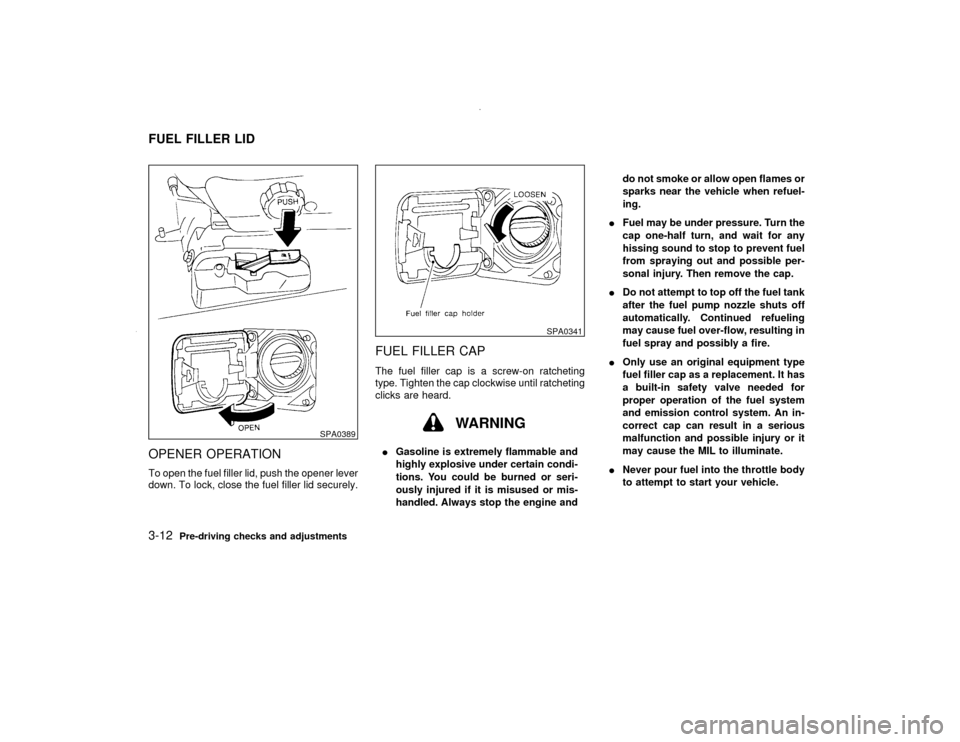
OPENER OPERATIONTo open the fuel filler lid, push the opener lever
down. To lock, close the fuel filler lid securely.
FUEL FILLER CAPThe fuel filler cap is a screw-on ratcheting
type. Tighten the cap clockwise until ratcheting
clicks are heard.
WARNING
IGasoline is extremely flammable and
highly explosive under certain condi-
tions. You could be burned or seri-
ously injured if it is misused or mis-
handled. Always stop the engine anddo not smoke or allow open flames or
sparks near the vehicle when refuel-
ing.
IFuel may be under pressure. Turn the
cap one-half turn, and wait for any
hissing sound to stop to prevent fuel
from spraying out and possible per-
sonal injury. Then remove the cap.
IDo not attempt to top off the fuel tank
after the fuel pump nozzle shuts off
automatically. Continued refueling
may cause fuel over-flow, resulting in
fuel spray and possibly a fire.
IOnly use an original equipment type
fuel filler cap as a replacement. It has
a built-in safety valve needed for
proper operation of the fuel system
and emission control system. An in-
correct cap can result in a serious
malfunction and possible injury or it
may cause the MIL to illuminate.
INever pour fuel into the throttle body
to attempt to start your vehicle.
SPA0389
SPA0341
FUEL FILLER LID3-12
Pre-driving checks and adjustments
Z
00.1.17/R50-D/V5
X
Page 120 of 265

: Air flow mainly from foot outlets.: Air flow from defroster and foot outlets.
To turn the system offPush the OFF button.OPERATING TIPSIWhen the engine coolant temperature and
outside air temperature are low, the air flow
from the foot outlets may not operate for 0
to 126 seconds. This is not a malfunction.
After the coolant temperature warms up, air
flow from the foot outlets will operate nor-
mally.
The sensor on the instrument panel helps
maintain a constant temperature. Do not put
anything on or around this sensor.The air conditioning system in your NISSAN
vehicle is charged with a refrigerant designed
with the environment in mind.
This refrigerant will not harm the earth's
ozone layer.
However, special charging equipment and lu-
bricant are required when servicing your
NISSAN air conditioner. Using improper refrig-
erants or lubricants will cause severe damage
to your air conditioning system. See ªCapaci-
ties and recommended fuel/lubricantsº in the
ª10. Technical and consumer informationº sec-
tion for air conditioning system refrigerant and
lubricant recommendation.
Your NISSAN dealer will be able to service
your environmentally friendly air conditioning
system.
WARNING
The air conditioner system contains re-
frigerant under high pressure. To avoid
personal injury, any air conditioner ser-
vice should be done only by an experi-
enced technician with proper equip-
ment.
SAA0158
SERVICING AIR CONDITIONER
Heater, air conditioner and audio systems
4-11
Z
00.1.17/R50-D/V5
X
Page 155 of 265

IAccelerate slowly and smoothly. Maintain
cruising speeds with a constant accelerator
position.
IDrive at moderate speeds on the highway.
Driving at high speed will lower fuel
economy.
IAvoid unnecessary stopping and braking.
Maintain a safe distance behind other ve-
hicles.
IUse a proper gear range which suits road
conditions. On level roads, shift into high
gear as soon as possible.
IAvoid unnecessary engine idling.IKeep your engine tuned up.
IFollow the recommended periodic mainte-
nance schedule.
IKeep the tires inflated at the correct pres-
sure. Low pressure will increase tire wear
and waste fuel.
IKeep the front wheels in correct alignment.
Improper alignment will cause increased
tire wear and lower fuel economy.
IAir conditioner operation lowers fuel
economy. Use the air conditioner only when
necessary.
IWhen cruising at highway speeds, it is
more economical to use the air conditioner
and leave the windows closed to reduce
drag.
I
Use 4H or 4L position only when neces-
sary. Four wheel drive operation lowers fuel
economy.2HÐ (2WD, high range) Only the rear wheels
are driven. Use for driving under the same
conditions as standard 2WD vehicle, or state
dynamometer I/M testing.
4HÐ (4WD, high range) Four wheels are
driven. Use when driving on roads where it is
difficult to drive in the 2H position (i.e., driving
at normal speeds on snow covered, icy, wet,
muddy or sandy roads).
The 4H position provides maximum power
and traction. Avoid excessive speed, as it
will cause loss of traction. Speed over 50
MPH (80 km/h) in 4H is not recommend.
4LÐ (4WD, low range) Four wheels are
SD0001
SSD0128
INCREASING FUEL ECONOMY
USING FOUR WHEEL DRIVE
(4WD)5-20
Starting and driving
Z
00.1.17/R50-D/V5
X
Page 189 of 265

When performing any inspection or mainte-
nance work on your vehicle, always take care
to prevent serious accidental injury to yourself
or damage to the vehicle. The following are
general precautions which should be closely
observed.
WARNING
IPark the vehicle on a level surface,
apply the parking brake securely and
block the wheels to prevent the ve-
hicle from moving. For a manual
transmission, move the shift lever to
Neutral. For an automatic transmis-
sion, move the selector lever to the P
(Park) position.
IBe sure the ignition key is in the OFF
or LOCK position when performing
any replacement or repair.
IIf you must work with the engine
running, keep your hands, clothing,
hair and tools away from moving fans
belts and any other moving parts.
IIt is advisable to secure or remove
any loose clothing and any jewelry,such as rings, watches, etc. before
working on your vehicle.
IAlways wear eye protection when-
ever you work on your vehicle.
IIf you must run the engine in an
enclosed space such as a garage, be
sure there is proper ventilation for
exhaust gases to escape.
INever get under the vehicle while it is
supported only by a jack. If it is nec-
essary to work under the vehicle,
support it with safety stands.
IKeep smoking materials, flame and
sparks away from fuel and battery.
IYour vehicle is equipped with an au-
tomatic engine cooling fan. It may
come on at any time without warning,
even if the ignition key is in the OFF
position and the engine is not run-
ning. To avoid injury, always discon-
nect the negative battery cable before
working near the fan.
IOn gasoline engine models with themultiport fuel injection (MFI) system,
the fuel filter or fuel lines should be
serviced by a NISSAN dealer because
the fuel lines are under high pressure
even when the engine is off.
CAUTION
IDo not work under the engine hood
while it is hot. Turn off the engine and
wait until it cools down.
INever connect or disconnect either
the battery or any transistorized com-
ponent connector while the ignition
key is on.
INever leave the engine or the auto-
matic transmission related compo-
nent harness connector discon-
nected while the ignition key is on.
IAvoid direct contact with used engine
oil. Improperly disposed motor oil and/
or other vehicle fluids can hurt the
environment. Always conform to lo-
MAINTENANCE PRECAUTIONS8-2
Do-it-yourself
Z
00.1.17/R50-D/V5
X
Page 264 of 265

FUEL RECOMMENDATION:Your vehicle is designed to operate on un-
leaded gasoline with an octane rating of at
least 87 AKI (Anti-Knock Index) number (Re-
search octane number 91).
CAUTION
Using a fuel other than that specified
could adversely affect the emission con-
trol devices and systems, and could
also affect the warranty coverage.
Under no circumstances should a
leaded gasoline be used since this will
damage the three way catalyst.
For additional information, see ªCapacities and
recommended fuel/lubricantsº in the ª10.
Technical and consumer informationº section.ENGINE OIL RECOMMENDATION:IAPI Certification Mark
IAPI grade SG/SH, Energy ConservingI&II
or API grade SJ, Energy Conserving.
IILSAC grade GF-I & GF-II.
ISAE 5W-30 viscosity oil is preferred for all
ambient temperatures.See ªCapacities and recommended
fuel/lubricantsº in the ª10. Technical and con-
sumer informationº section for engine oil and
oil filter recommendation.
COLD TIRE PRESSURES:See the tire placard affixed to the glove box.NEW VEHICLE BREAK-IN
PROCEDURES
RECOMMENDATION:During the first 1,000 miles (1,600 km) of
vehicle use, follow the recommendations out-
lined in the ªBreak-in scheduleº Information
found in the ª5. Starting and drivingº section of
this Owner's Manual. Follow these recommen-
dations for the future reliability and economy of
your new vehicle. Failure to follow these rec-
ommendations may result in vehicle damage
or shortened engine life.
GAS STATION INFORMATION
Z
00.1.17/R50-D/V5
X