2000 NISSAN PATHFINDER air condition
[x] Cancel search: air conditionPage 232 of 265

Chassis and body maintenanceBrake lines & cables:
Check the brake lines and hoses (including
brake booster vacuum hoses, connections &
check valve) and parking brake cables for
proper attachment, leaks, cracks, chafing,
abrasion, deterioration, etc.
Brake pads, rotors, drums & linings:
Check these and the other neighboring brake
components for wear, deterioration and leaks.
Under severe driving conditions, they may
have to be inspected more frequently.
Manual and automatic transmission,
transfer & differential gear fluid:
Visually inspect for signs of leakage and re-
place oil for limited-slip differential. Under se-
vere driving conditions, the oil should be re-
placed at the specified interval.
Steering gear, linkage & transfer gear,
axle & suspension parts & drive axle
shaft boots:
Check for damage, looseness and leakage of
oil or grease. Under severe driving conditions,
more frequent inspection should be per-
formed.Propeller shaft(s):
Check the propeller shaft(s) for damage,
looseness and grease leakage under severe
driving condition (
only).
Propeller shaft:
Apply specified grease to the greasing points
of propeller shafts in accordance with the
maintenance schedule. In the case of driving
in water, greasing should be performed imme-
diately afterwards.
Front wheel bearing grease:
Check the wheel bearing for grease leakage
around grease seals, axial end play and
smooth turning (4x2).
Check the wheel bearing grease condition or
repack these in accordance with the mainte-
nance schedule. In case of frequent driving in
muddy water, the bearing grease inspection
should be performed more frequently (
).
Exhaust system:
Visually check the exhaust pipes, muffler, and
hangers for proper attachment, leaks, cracks,
chafing, abrasion, deterioration, etc. Under
severe driving conditions, inspection should be
performed more frequently.Supplemental air bag, and supplemental
side air bag (if so equipped) systems:
Maintenance for the supplemental air bags or
supplemental side air bags should be done by
an authorized NISSAN dealer.
Automatic Speed Control Device (ASCD)
vacuum hoses:
Check vacuum hose (between ASCD actuator
and ASCD pump) for breakage, cracks or
fracture.
Maintenance
9-11
Z
00.1.17/R50-D/V5
X
Page 234 of 265

10 Technical and consumer informationCapacities and recommended fuel/lubricants ......... 10-2
Fuel recommendation ............................................. 10-4
Engine oil and oil filter recommendation................. 10-6
Recommended SAE oil viscosity number ............... 10-7
Air conditioning system refrigerant and lubricant
recommendations .................................................... 10-8
Specifications .......................................................... 10-9
Engine ..................................................................... 10-9
Wheels and tires ................................................... 10-10
Dimensions and weights ....................................... 10-10
When traveling or registering your vehicle in another
country................................................................... 10-11
Vehicle identification ............................................. 10-11
Vehicle identification number (VIN) plate.............. 10-11
Vehicle identification number (Chassis
number) ................................................................. 10-11
Engine serial number ............................................ 10-12F.M.V.S.S. certification label ................................. 10-12
Emission control information label ........................ 10-12
Tire placard ........................................................... 10-13
Air conditioner specification label.......................... 10-13
Vehicle loading information ................................... 10-13
Terms .................................................................... 10-13
Determining vehicle load capacity ........................ 10-14
Loading tips ........................................................... 10-14
Towing a trailer ..................................................... 10-15
Maximum load limits.............................................. 10-15
Towing load/specification chart ............................. 10-16
Towing safety ........................................................ 10-17
Emission control system warranty ........................ 10-18
Reporting safety defects (US only) ....................... 10-19
Readiness for inspection/maintenance (I/M) test (US
only)....................................................................... 10-19
Z
00.1.17/R50-D/V5
X
Page 236 of 265

Capacity (Approximate)
Recommended specifications
US
measureImp
measureLiter
Manual transmissionÐ Ð Ð API GL-4 Viscosity SAE 75W-90 only
Differential gear oil (exc. LSD)Ð Ð Ð API GL-5*1
Limited-slip differential (LSD) gear oil Ð Ð ÐOnly LSD gear oil:
API GL-5 and SAE 80W-90*2 approved for Nissan
LSD*3
Automatic transmission fluid
Refill to the proper oil level according to the instructions in
the ª8. Do-it-yourselfº section.Nissan Matic ªDº (Continental US and Alaska) or
Canada Nissan Automatic Transmission Fluid.*6
Power steering fluidGenuine Nissan PSF II or equivalent*7
Transfer fluidNissan Matic ªDº (Continental U.S. and Alaska) or
Canada Nissan Automatic Transmission Fluid*6 or API
GL-4*1
Brake and clutch fluidGenuine Nissan Brake Fluid*4 or equivalent
DOT 3 (US F.M.V.S.S. No. 116)
Propeller shaft grease Ð Ð ÐNLGI No. 2 (Molybdenum disulphide lithium soap
base)
Multi-purpose greaseÐ Ð Ð NLGI No. 2 (Lithium soap base)
Air conditioning system refrigerantÐ Ð Ð HFC-134a (R-134a)*5
Air conditioning system lubricantsÐ Ð Ð Nissan A/C System Oil Type S or exact equivalent*5
*1: For further details, see recommended SAE viscosity number chart.
*2: SAE 90 is acceptable in temperatures above 0ÉF (þ18ÉC).
*3: Contact your NISSAN dealer for a list of approved oils.
*4: Available in mainland USA through your NISSAN dealer.
*5: See ªVehicle identificationº later in this section for air conditioner specification label.
*6: Dexron
TM
III/Mercon
TM
or equivalent may also be used. Outside the continental United States and Alaska contact a NISSAN dealer for more information regarding
suitable fluids, including recommended brand(s) of Dexron
TM
III/Mercon
TM
Automatic Transmission Fluid.
*7: Genuine Nissan PSF, Canada Nissan Automatic Transmission Fluid, DexronTM
III/Mercon
TM
or equivalent ATF may also be used.
Technical and consumer information
10-3
Z
00.1.17/R50-D/V5
X
Page 241 of 265
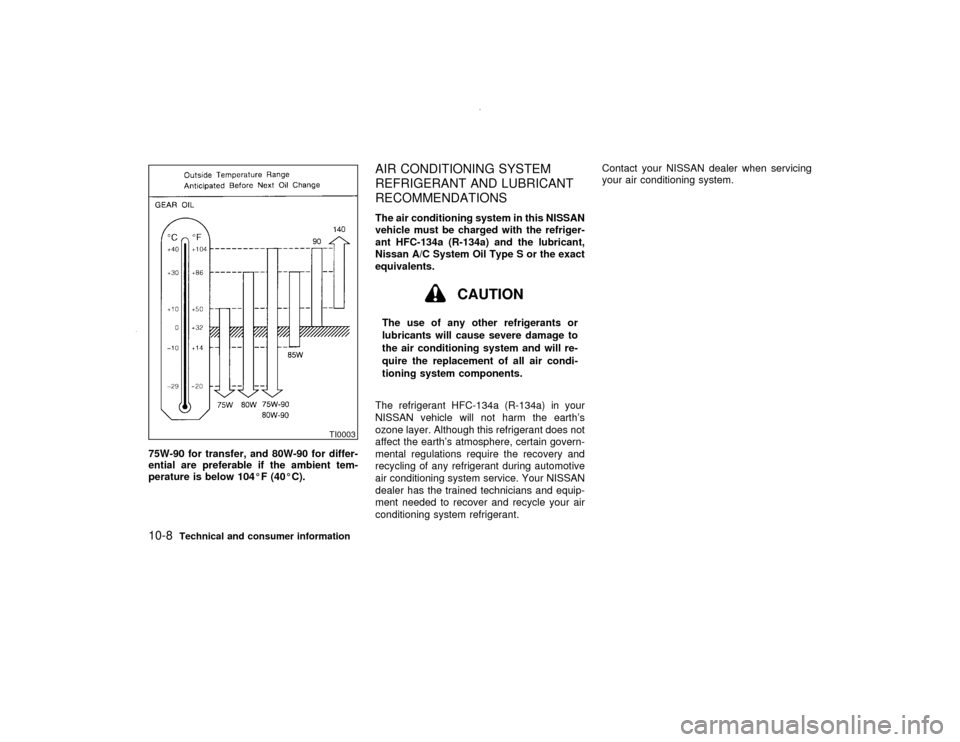
75W-90 for transfer, and 80W-90 for differ-
ential are preferable if the ambient tem-
perature is below 104ÉF (40ÉC).
AIR CONDITIONING SYSTEM
REFRIGERANT AND LUBRICANT
RECOMMENDATIONSThe air conditioning system in this NISSAN
vehicle must be charged with the refriger-
ant HFC-134a (R-134a) and the lubricant,
Nissan A/C System Oil Type S or the exact
equivalents.
CAUTION
The use of any other refrigerants or
lubricants will cause severe damage to
the air conditioning system and will re-
quire the replacement of all air condi-
tioning system components.
The refrigerant HFC-134a (R-134a) in your
NISSAN vehicle will not harm the earth's
ozone layer. Although this refrigerant does not
affect the earth's atmosphere, certain govern-
mental regulations require the recovery and
recycling of any refrigerant during automotive
air conditioning system service. Your NISSAN
dealer has the trained technicians and equip-
ment needed to recover and recycle your air
conditioning system refrigerant.Contact your NISSAN dealer when servicing
your air conditioning system.
TI0003
10-8
Technical and consumer information
Z
00.1.17/R50-D/V5
X
Page 246 of 265
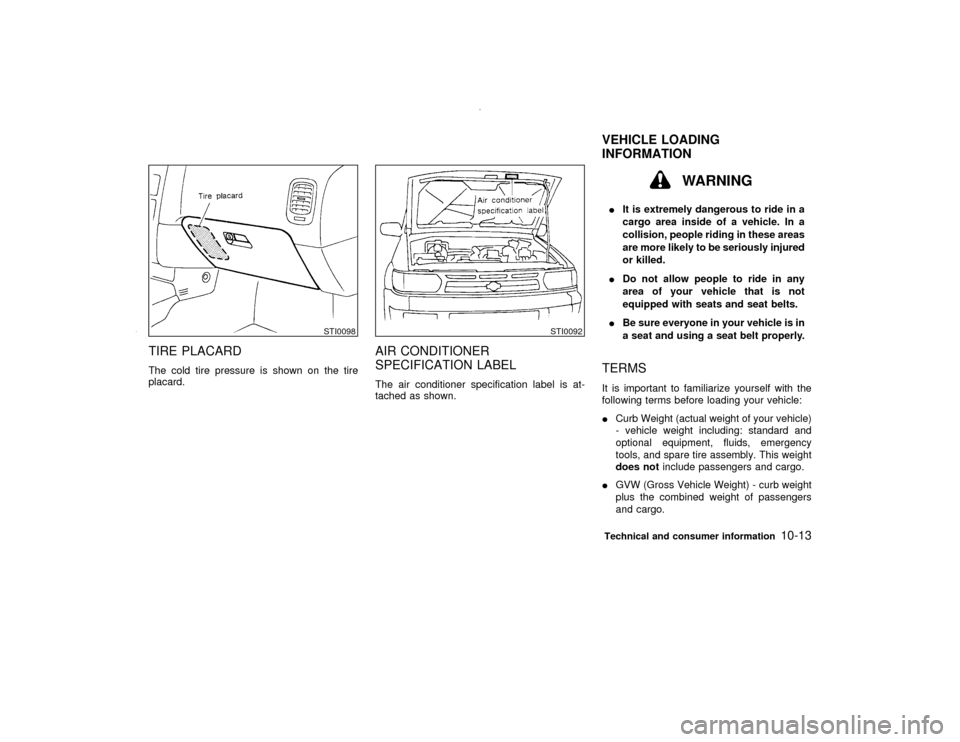
TIRE PLACARDThe cold tire pressure is shown on the tire
placard.
AIR CONDITIONER
SPECIFICATION LABELThe air conditioner specification label is at-
tached as shown.
WARNING
IIt is extremely dangerous to ride in a
cargo area inside of a vehicle. In a
collision, people riding in these areas
are more likely to be seriously injured
or killed.
IDo not allow people to ride in any
area of your vehicle that is not
equipped with seats and seat belts.
IBe sure everyone in your vehicle is in
a seat and using a seat belt properly.TERMSIt is important to familiarize yourself with the
following terms before loading your vehicle:
ICurb Weight (actual weight of your vehicle)
- vehicle weight including: standard and
optional equipment, fluids, emergency
tools, and spare tire assembly. This weight
does notinclude passengers and cargo.
IGVW (Gross Vehicle Weight) - curb weight
plus the combined weight of passengers
and cargo.
STI0098
STI0092
VEHICLE LOADING
INFORMATIONTechnical and consumer information
10-13
Z
00.1.17/R50-D/V5
X
Page 251 of 265

the vehicle's behavior, you should practice
turning, stopping and backing up in an area
which is free from traffic. Steering stability and
braking performance will be somewhat differ-
ent than under normal driving conditions.
IAlways secure items in the trailer to prevent
load shift while driving.
IAvoid abrupt starts, acceleration or stops.
IAvoid sharp turns or lane changes.
IAlways drive your vehicle at a moderate
speed.
IAlways block the wheels on both vehicle
and trailer when parking. Parking on a
slope is not recommended; however, if you
must do so, and if your vehicle is equipped
with automatic transmission, first block the
wheels and apply the parking brake, and
then move the transmission selector lever
into the P position. If you move the selector
lever to the P position before blocking the
wheels and applying the parking brake,
transmission damage could occur.
IWhen going down a hill, shift into a lower
gear and use the engine braking effect.
When ascending a long grade, downshift
the transmission to a lower gear and reduce
speed to reduce chances of engine over-
loading and/or overheating.However, for long steep grades, do not stay in
1st or 2nd gear when driving above 35 MPH
(56 km/h).
IIf the engine coolant rises to an extremely
high temperature when the air conditioning
system is on, turn off the air conditioner.
Coolant heat can be additionally vented by
opening the windows, switching the fan
control to high and setting the temperature
control to the HOT position.
ITrailer towing requires more fuel than nor-
mal circumstances.
IAvoid towing a trailer for the first 500 miles
(800 km).
IHave your vehicle serviced more often than
at intervals specified in the recommended
Maintenance Schedule.
When towing a trailer, change oil in the
transmission more frequently. See the
Maintenance Schedule.Your NISSAN is covered by the following
emission warranties.
For US:
1) Emission Defects Warranty
2) Emissions Performance Warranty
For CANADA:
Emission Control System Warranty
Details of these warranties may be found with
other vehicle warranties in your Warranty In-
formation and Maintenance Log Booklet which
comes with your NISSAN. If you did not re-
ceive a Warranty Information and Mainte-
nance Log Booklet or it becomes lost, you may
obtain a replacement by writing.
INissan North America, Inc. Consumer Af-
fairs Department P.O. Box 191 Gardena.
CA 90248-0191
INissan Canada Inc. 5290 Orbitor Drive
Mississauga, Ontario, L4W 4Z5
EMISSION CONTROL SYSTEM
WARRANTY
10-18
Technical and consumer information
Z
00.1.17/R50-D/V5
X
Page 252 of 265

If you believe that your vehicle has
a defect which could cause a crash
or could cause injury or death, you
should immediately inform the Na-
tional Highway Traffic Safety Ad-
ministration (NHTSA) in addition to
notifying NISSAN.
If NHTSA receives similar com-
plaints, it may open an investiga-
tion, and if it finds that a safety
defect exists in a group of vehicles,
it may order a recall and remedy
campaign. However, NHTSA can-
not become involved in individual
problems between you, your dealer,
or NISSAN.
To contact NHTSA, you may either
call the Auto Safety Hotline toll-free
at 1-800-424-9393 (or 366-0123 in
Washington, D.C. area) or write to:
NHTSA, U.S. Department of Trans-
portation, Washington, D.C. 20590.
You can also obtain other informa-
tion about motor vehicle safety from
the Hotline.You may notify NISSAN by contact-
ing our Consumer Affairs Depart-
ment, toll-free, at 1-800-NISSAN-1.
In Hawaii call (808) 836-0888.
Due to legal requirements in some states/
areas, your vehicle may be required to be in
what is called the ªready conditionº for an
Inspection/Maintenance (I/M) test of the emis-
sion control system.
The vehicle is set to the ªready conditionº
when it is driven through certain driving pat-
terns. Usually, the ready condition can be
obtained by ordinary usage of the vehicle.
If a powertrain system component is repaired
or the battery is disconnected, the vehicle may
be reset to a not ready condition. Before taking
the I/M test, drive the vehicle through the
following pattern to set the vehicle to the ready
condition.
WARNING
Always drive the vehicle in a safe and
prudent manner according to traffic con-
ditions, and obey all traffic laws.
1. Start the engine when the engine coolant
temperature gauge needle points to C. Al-
low the engine to idle until the gauge needle
points between the C and H (normal oper-
ating temperature).
2. Accelerate the vehicle to 55 MPH (88
REPORTING SAFETY DEFECTS
(US only)READINESS FOR INSPECTION/
MAINTENANCE (I/M) TEST (US
only)
Technical and consumer information
10-19
Z
00.1.17/R50-D/V5
X
Page 256 of 265

11 Index
A
ABS (Anti-lock brake system) ......................... 5-26
Air bag system (See supplemental restraint
system) ........................................................... 1-16
Air bag system, Side (See supplemental side air
bag system) .................................................... 1-18
Air bag warning labels .................................... 1-20
Air bag warning light.............................. 1-21, 2-11
Air cleaner housing filter ................................. 8-17
Air conditioner
Air conditioner operation ...................... 4-3, 4-9
Air conditioner service ................ 4-3, 4-9, 4-11
Air conditioner specification
label .......................................... 4-3, 4-9, 10-13
Air conditioner system refrigerant and
lubrication recommendations ............... 4-3, 4-9
Heater and air conditioner (automatic) (if so
equipped)..................................................... 4-9
Heater and air conditioner controls ............. 4-3
Servicing air conditioner .............................. 4-3
Air conditioning system refrigerant and lubricant
recommendations ........................................... 10-8
Air flow charts ............................................ 4-6, 4-9
Alcohol, drugs and driving ................................ 5-4
AM-FM radio with cassette player .................. 4-12
AM-FM radio with cassette player and compact
disc player....................................................... 4-12
AM-FM radio with compact disc player .......... 4-12Anchor point locations
Top tether strap ......................................... 1-41
Antenna
Manual ....................................................... 4-25
Power ........................................................ 4-25
Anti-lock Brake System (ABS) ........................ 5-26
Anti-lock brake warning light............................. 2-9
Appearance care
Exterior appearance care ............................ 7-2
Interior appearance care ............................. 7-3
Armrest ............................................................. 1-9
Ashtray (See cigarette lighter ashtray) ........... 2-23
ATP warning light ........................................... 2-10
Audio system .................................................. 4-12
Automatic
Automatic transmission fluid (ATF) ........... 8-10
Driving with automatic transmission.......... 5-10
Sunroof ...................................................... 2-33
Transmission park warning light ............... 2-10
Transmission selector lever lock release .. 5-13
Avoiding collision and rollover .......................... 5-4
B
Battery............................................................. 8-14
Battery saver system................................. 2-18
Battery replacement, (See multi-remote control
system) ............................................................. 3-8Before starting the engine ................................ 5-9
Belts (See drive belts) .................................... 8-15
Brake
Anti-lock brake system (ABS) ................... 5-26
Brake and clutch fluid................................ 8-12
Brake booster ............................................ 8-20
Brake fluid ................................................. 8-12
Brake pedal ............................................... 8-19
Brake pedal check..................................... 8-19
Parking brake check ........................ 5-16, 8-19
Parking brake operation ............................ 5-16
System....................................................... 5-26
Warning light ............................................. 2-10
Break-in schedule ........................................... 5-19
Bulb check/instrument panel ............................ 2-9
Bulb replacement ............................................ 8-24
C
Capacities and recommended fuel/
lubricants......................................................... 10-2
Car phone ....................................................... 4-26
Cargo (See vehicle loading information) ........ 2-30
Cargo net ........................................................ 2-30
Cassette player (See audio system) .............. 4-16
Cassette tape operation ................................. 4-12
Catalytic converter, Three way catalyst............ 5-3
CB radio or car phone .................................... 4-26
Z
00.1.17/R50-D/V5
X