2000 NISSAN PATHFINDER air condition
[x] Cancel search: air conditionPage 188 of 265

8 Do-it-yourselfMaintenance precautions .......................................... 8-2
Engine compartment check locations ....................... 8-4
Engine cooling system .............................................. 8-5
Checking engine coolant level .................................. 8-5
Changing engine coolant .......................................... 8-6
Engine oil .................................................................. 8-7
Checking engine oil level .......................................... 8-7
Changing engine oil .................................................. 8-8
Changing engine oil filter .......................................... 8-9
Automatic transmission fluid ................................... 8-10
Temperature conditions for checking ...................... 8-10
Power steering fluid ................................................ 8-12
Brake and clutch fluid ............................................. 8-12
Brake fluid ............................................................... 8-12
Clutch fluid .............................................................. 8-13
Window washer fluid ............................................... 8-13
Window washer fluid reservoir ................................ 8-13
Battery ..................................................................... 8-14
Jump starting........................................................... 8-15
Drive belts ............................................................... 8-15
Spark plugs ............................................................. 8-16
Replacing spark plugs ............................................. 8-16Air cleaner ............................................................... 8-17
Windshield wiper blades ......................................... 8-18
Cleaning .................................................................. 8-18
Replacement ........................................................... 8-18
Parking brake and brake pedal ............................... 8-19
Checking parking brake .......................................... 8-19
Checking brake pedal ............................................. 8-19
Brake booster .......................................................... 8-20
Clutch pedal ............................................................ 8-21
Checking clutch pedal ............................................. 8-21
Fuses....................................................................... 8-21
Engine compartment ............................................... 8-21
Passenger compartment ......................................... 8-22
Multi-remote controller battery replacement ........... 8-22
Lights ....................................................................... 8-24
Headlights ............................................................... 8-25
Wheels and tires ..................................................... 8-28
Tire pressure ........................................................... 8-28
Types of tires .......................................................... 8-29
Tire chains............................................................... 8-30
Changing wheels and tires...................................... 8-30
Clutch housing drain ................................... 8-34
Z
00.1.17/R50-D/V5
X
Page 193 of 265
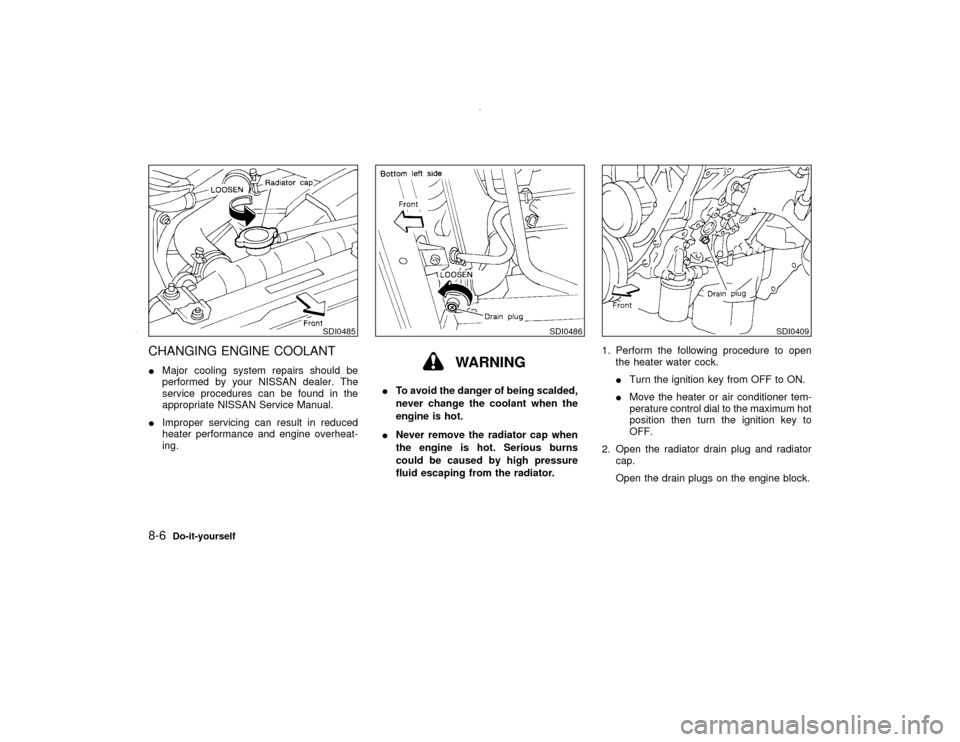
CHANGING ENGINE COOLANTIMajor cooling system repairs should be
performed by your NISSAN dealer. The
service procedures can be found in the
appropriate NISSAN Service Manual.
IImproper servicing can result in reduced
heater performance and engine overheat-
ing.
WARNING
ITo avoid the danger of being scalded,
never change the coolant when the
engine is hot.
INever remove the radiator cap when
the engine is hot. Serious burns
could be caused by high pressure
fluid escaping from the radiator.1. Perform the following procedure to open
the heater water cock.
ITurn the ignition key from OFF to ON.
IMove the heater or air conditioner tem-
perature control dial to the maximum hot
position then turn the ignition key to
OFF.
2. Open the radiator drain plug and radiator
cap.
Open the drain plugs on the engine block.
SDI0485
SDI0486
SDI0409
8-6
Do-it-yourself
Z
00.1.17/R50-D/V5
X
Page 208 of 265
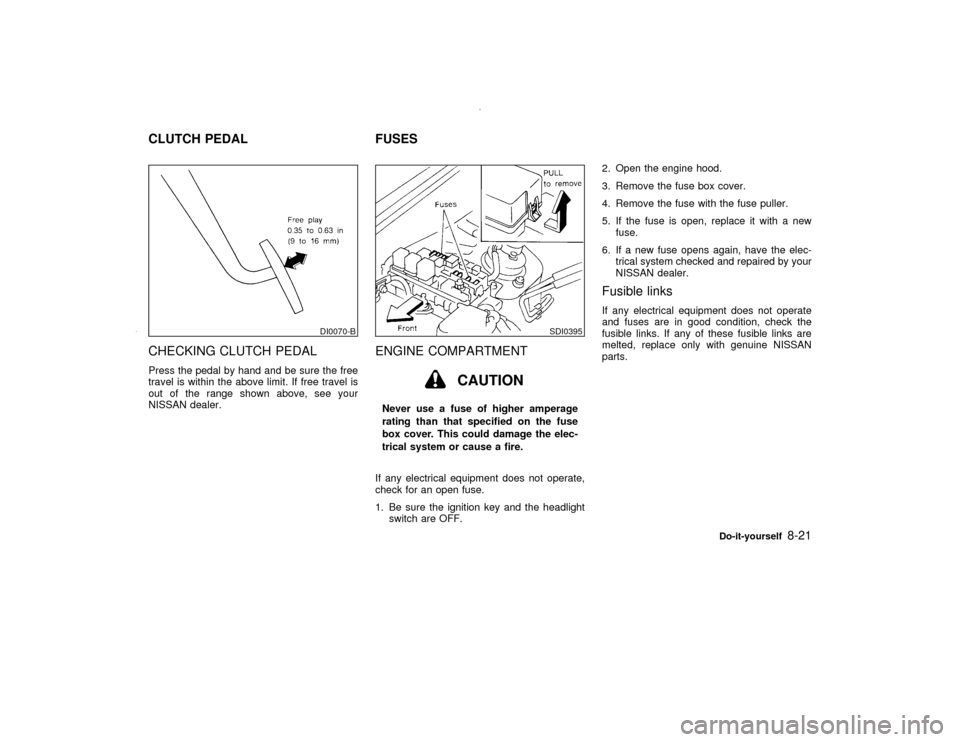
CHECKING CLUTCH PEDALPress the pedal by hand and be sure the free
travel is within the above limit. If free travel is
out of the range shown above, see your
NISSAN dealer.
ENGINE COMPARTMENT
CAUTION
Never use a fuse of higher amperage
rating than that specified on the fuse
box cover. This could damage the elec-
trical system or cause a fire.
If any electrical equipment does not operate,
check for an open fuse.
1. Be sure the ignition key and the headlight
switch are OFF.2. Open the engine hood.
3. Remove the fuse box cover.
4. Remove the fuse with the fuse puller.
5. If the fuse is open, replace it with a new
fuse.
6. If a new fuse opens again, have the elec-
trical system checked and repaired by your
NISSAN dealer.
Fusible linksIf any electrical equipment does not operate
and fuses are in good condition, check the
fusible links. If any of these fusible links are
melted, replace only with genuine NISSAN
parts.
DI0070-B
SDI0395
CLUTCH PEDAL FUSES
Do-it-yourself
8-21
Z
00.1.17/R50-D/V5
X
Page 223 of 265

Your new NISSAN has been designed to have
minimum maintenance requirements with
longer service intervals to save you both time
and money. However, some day-to-day and
regular maintenance is essential to maintain
your NISSAN's good mechanical condition, as
well as its emission and engine performance.
It is the owner's responsibility to make sure
that the specified maintenance, as well as
general maintenance, is performed.
As the vehicle owner, you are the only one
who can ensure that your vehicle receives the
proper maintenance care. You are a vital link
in the maintenance chain.
General maintenance:
General maintenance includes those items
which should be checked during normal day-
to-day operation of the vehicle. They are es-
sential if your vehicle is to continue to operate
properly. It is your responsibility to perform
these procedures regularly as prescribed.
These checks or inspections can be done by
yourself, a qualified technician or, if you prefer,
your NISSAN dealer.
Periodic maintenance:
The maintenance items listed in this part are
required to be serviced at regular intervals.However, under severe driving conditions, ad-
ditional or more frequent maintenance will be
required.
Where to go for service:
If maintenance service is required or your
vehicle appears to malfunction, have the sys-
tems checked and tuned by an authorized
NISSAN dealer.
NISSAN technicians are well-trained special-
ists and are kept up to date with the latest
service information through technical bulletins,
service tips, and in-dealership training pro-
grams. They are completely qualified to work
on NISSAN's vehicles before they work on
your vehicle, rather than after they have
worked on it.
You can be confident that your NISSAN deal-
er's service department performs the best job
to meet the maintenance requirements on your
vehicle Ð in a reliable and economic way.During the normal day-to-day operation of the
vehicle, general maintenance should be per-
formed regularly as prescribed in this section.
If you detect any unusual sounds, vibrations or
smell, be sure to check for the cause or have
your NISSAN dealer do it promptly. In addition,
you should notify your NISSAN dealer if you
think that repairs are required.
When performing any checks or maintenance
work, see ªMaintenance precautionsº in the ª8.
Do-it-yourselfº section.
EXTERIOR MAINTENANCEAdditional information on the following
items with * is found in the ª8. Do-it-
yourselfº section.Outside the vehicleThe maintenance items listed here should be
performed from time to time, unless otherwise
specified.
Tires*:
Check the pressure with a gauge periodically
when at a service station, including the spare,
and adjust to the specified pressure if neces-
sary. Check carefully for damage, cuts or
excessive wear.
MAINTENANCE PRECAUTIONS GENERAL MAINTENANCE9-2
Maintenance
Z
00.1.17/R50-D/V5
X
Page 224 of 265

Wheel nuts*:
When checking the tires, make sure no nuts
are missing, and check for any loose nuts.
Tighten if necessary.
Tire rotation*:
Tires should be rotated every 7,500 miles
(12,000 km). However, the timing for tire rota-
tion may vary according to your driving habits
and road surface conditions.
Wheel alignment and balance:
If the vehicle should pull to either side while
driving on a straight and level road, or if you
detect uneven or abnormal tire wear, there
may be a need for wheel alignment.
If the steering wheel or seat vibrates at normal
highway speeds, wheel balancing may be
needed.
Windshield wiper blades*:
Check for cracks or wear if they do not wipe
properly.
Doors and engine hood:
Check that all doors and the engine hood,
operate properly. Also ensure that all latches
lock securely. Lubricate hinges, latches, rollers
and links if necessary. Make sure that the
secondary latch keeps the hood from openingwhen the primary latch is released.
When driving in areas using road salt or other
corrosive materials, check lubrication fre-
quently.
Inside the vehicleLights*:
Make sure that the headlights, stop lights, tail
lights, turn signal lights, and other lights are all
operating properly and installed securely. Also
check headlight aim.INTERIOR MAINTENANCEThe maintenance items listed here should be
checked on a regular basis, such as when
performing periodic maintenance, cleaning the
vehicle, etc.
Warning lights and chimes:
Make sure that all warning lights and chimes
are operating properly.
Windshield wiper and washer*:
Check that the wipers and washer operate
properly and that the wipers do not streak.Windshield defroster:
Check that the air comes out of the defroster
outlets properly and in sufficient quantity when
operating the heater or air conditioner.
Steering wheel:
Check for changes in the steering conditions,
such as excessive freeplay, hard steering or
strange noises.
Seats:
Check seat position controls such as seat
adjusters, seatback recliner, etc. to ensure
they operate smoothly and that all latches lock
securely in every position. Check that the head
restraints move up and down smoothly and
that the locks (if so equipped) hold securely in
all latched positions.
Seat belts:
Check that all parts of the seat belt system
(e.g. buckles, anchors, adjusters and retrac-
tors) operate properly and smoothly, and are
installed securely. Check the belt webbing for
cuts, fraying, wear or damage.
Accelerator pedal:
Check the pedal for smooth operation and
make sure the pedal does not catch or require
Maintenance
9-3
Z
00.1.17/R50-D/V5
X
Page 226 of 265

roads or to control dust. It is very important to
remove these substances, otherwise rust will
form on the floor pan, frame, fuel lines and
around the exhaust system. At the end of
winter, the underbody should be thoroughly
flushed with plain water, being careful to clean
those areas where mud and dirt may accumu-
late. For additional information, see ªCleaning
exteriorº in the ª7. Appearance and careº sec-
tion.
Fluid leaks:
Check under the vehicle for fuel, oil, water or
other fluid leaks after the vehicle has been
parked for a while. Water dripping from the air
conditioner after use is normal. If you should
notice any leaks or if gasoline fumes are
evident, check for the cause and have it cor-
rected immediately.To ensure smooth, trouble-free, safe and eco-
nomical driving, NISSAN provides two differ-
ent maintenance schedules that may be used,
depending upon the conditions in which you
usually drive. These schedules contain both
distance and time intervals, up to 60,000 miles
(96,000 km)/48 months. For most people, the
odometer reading will indicate when service is
needed. However, if you drive very little, your
vehicle should be serviced at the regular time
intervals shown in the schedule.
After 60,000 miles (96,000 km) or 48
months, continue periodic maintenance at
the same mileage/time intervals.
SCHEDULE 1Follow Periodic Maintenance Schedule 1 if
your driving habits frequently include one or
more of the following driving conditions:
IRepeated short trips of less than 5 miles
(8 km).
IRepeated short trips of less than 10
miles (16 km) with outside temperatures
remaining below freezing.
IOperating in hot weather in stop-and-go
rush hour traffic.
IExtensive idling and/or low speed driv-
ing for long distances, such as police,taxi or door-to-door delivery use.
IDriving in dusty conditions.
IDriving on rough, muddy, or salt spread
roads.
ITowing a trailer, using a camper or a
car-top carrier.
SCHEDULE 2Follow Periodic Maintenance Schedule 2 if
none of the driving conditions shown in Sched-
ule 1 apply to your driving habits.
PERIODIC MAINTENANCE
SCHEDULES
Maintenance
9-5
Z
00.1.17/R50-D/V5
X
Page 227 of 265
![NISSAN PATHFINDER 2000 R50 / 2.G Owners Manual Schedule 1Abbreviations: R = Replace I = Inspect. Correct or replace if necessary. [ ]: At the mileage intervals onlyMAINTENANCE OPERATIONMAINTENANCE INTERVAL
Perform at number of miles, kilometers or](/manual-img/5/640/w960_640-226.png "NISSAN PATHFINDER 2000 R50 / 2.G Owners Manual Schedule 1Abbreviations: R = Replace I = Inspect. Correct or replace if necessary. [ ]: At the mileage intervals onlyMAINTENANCE OPERATIONMAINTENANCE INTERVAL
Perform at number of miles, kilometers or")
Schedule 1Abbreviations: R = Replace I = Inspect. Correct or replace if necessary. [ ]: At the mileage intervals onlyMAINTENANCE OPERATIONMAINTENANCE INTERVAL
Perform at number of miles, kilometers or
months, whichever comes first.Miles´1,000 3.75 7.5 11.25 15 18.75 22.5 26.25 30 33.75 37.5 41.25 45 48.75 52.5 56.25 60
(km´1,000) (6) (12) (18) (24) (30) (36) (42) (48) (54) (60) (66) (72) (78) (84) (90) (96)
Months 3 6 9 12 15 18 21 24 27 30 33 36 39 42 45 48
Emission control system maintenance
Drive beltsI* I*
Air cleaner filter See NOTE (1) [R] [R]
EVAP vapor linesI* I*
Fuel linesI* I*
Fuel filter See NOTE (2)*
Engine coolant See NOTE (3)R*
Engine oilRRRRRRRRRRRRRRRR
Engine oil filter
(Use Part No. 15208 31U00 or equivalent.)RRRRRRRRRRRRRRRR
Spark plugs (PLATINUM-TIPPED type)[R]
Timing beltReplace every 105,000 miles (168,000 km)NOTE: (1) If operating mainly in dusty conditions, more frequent maintenance may be required.
(2) When the filter becomes clogged, the vehicle speed cannot be increased as the driver wishes. In such an event, replace the filter.
(3) After 60,000 miles (96,000 km) or 48 months, replace every 30,000 miles (48,000 km) or 24 months.
HMaintenance items and intervals with ª*º are recommended by NISSAN for reliable vehicle operation. The owner need not perform such
maintenance in order to maintain the emission warranty or manufacturer recall liability. Other maintenance items and intervals are required.9-6
Maintenance
Z
00.1.17/R50-D/V5
X
Page 231 of 265

Maintenance for offroad driving
(
only)
Whenever you drive offroad through sand,
mud or water as deep as the wheel hub, more
frequent maintenance may be required of the
following items:G
Brake pads and discs
G
Brake lining and drums
G
Brake lines and hoses
G
Wheel bearing grease
G
Differential, transmission and transfer oil
G
Steering linkage
G
Propeller shafts and front drive shafts
G
Air cleaner filter
G
Clutch housing (See ªClutch housing drainº
in the ª8. Do-it-yourselfº section for check-
ing water entry.)
These items should be checked frequently to
assure safe and proper operation of your ve-
hicle.
EXPLANATION OF MAINTENANCE
ITEMS
Emission control system
maintenanceAdditional information on the following
items with * is found in the ª8. Do-it-
yourselfº section.
Drive belts*:
Check drive belts for wear, fraying or cracking
and also for proper tension. Replace the drive
belts if found damaged.
Air filter:
Under normal driving conditions, the air
cleaner filter should be replaced in accordance
with the maintenance schedule. However,
driving the vehicle in dusty areas may cause
more rapid clogging of the element. Conse-
quently, the element may have to be replaced
more frequently.
EVAP vapor lines:
Check vapor lines and connections for failure
or looseness. If leaks are found, replace the
lines.
Fuel lines:
Check the fuel hoses, piping and connectionsfor leaks, looseness or deterioration. Replace
any parts if they are damaged.
Fuel filter:
If the vehicle is operated under extremely
adverse weather conditions or in areas where
ambient temperatures are either extremely low
or extremely high, the filter might become
clogged. In such an event, replace the filter
immediately.
Engine coolant*:
Flush and refill the cooling system.
Engine oil & oil filter*:
Under normal driving conditions, the engine oil
and oil filter should be replaced in accordance
with the maintenance schedule. However, un-
der severe driving conditions, they may have
to be replaced more frequently.
Spark plugs*:
Replace with new plugs having the correct
heat range.
Timing belt:
Replace the timing belt for driving the cam-
shafts.
9-10
Maintenance
Z
00.1.17/R50-D/V5
X