2000 NISSAN PATHFINDER towing
[x] Cancel search: towingPage 228 of 265
![NISSAN PATHFINDER 2000 R50 / 2.G Owners Manual Schedule 1Abbreviations: R = Replace I = Inspect. Correct or replace if necessary. L = Lubricate [ ]: At the mileage intervals onlyMAINTENANCE OPERATIONMAINTENANCE INTERVAL
Perform at number of miles,](/manual-img/5/640/w960_640-227.png "NISSAN PATHFINDER 2000 R50 / 2.G Owners Manual Schedule 1Abbreviations: R = Replace I = Inspect. Correct or replace if necessary. L = Lubricate [ ]: At the mileage intervals onlyMAINTENANCE OPERATIONMAINTENANCE INTERVAL
Perform at number of miles,")
Schedule 1Abbreviations: R = Replace I = Inspect. Correct or replace if necessary. L = Lubricate [ ]: At the mileage intervals onlyMAINTENANCE OPERATIONMAINTENANCE INTERVAL
Perform at number of miles, kilometers
or months, whichever comes first.Miles´1,000 3.75 7.5 11.25 15 18.75 22.5 26.25 30 33.75 37.5 41.25 45 48.75 52.5 56.25 60
(km´1,000) (6) (12) (18) (24) (30) (36) (42) (48) (54) (60) (66) (72) (78) (84) (90) (96)
Months 3 6 9 12 15 18 21 24 27 30 33 36 39 42 45 48
Chassis and body maintenance
Brake lines & cablesIIII
Brake pads, rotors, drums & liningsIIIIIIII
Automatic transmission & transfer fluid,
manual transmission & differential gear oil
(exc. LSD)See NOTE (1)IIII
Limited-slip differential (LSD) gear oil See NOTE (1)IRIR
Steering gear, linkage & transfer gear, axle & suspension partsIIIIIIII
Tire rotation See NOTE (2)
Drive shaft boots (
) IIIIIIII
Propeller shaft See NOTE (3)LLLLLLLL
Front wheel bearing grease (4x2)II
Front wheel bearing grease (
) See NOTE (4)IRIR
Exhaust systemIIIIIIII
Supplemental air bag system and supple-
mental side air bag systems (if so
equipped)See NOTE (5)
Automatic Speed Control Device (ASCD) vacuum hosesIIII
NOTE: (1) If towing a trailer, using a camper or a car-top carrier, or driving on rough or muddy roads, change (not just inspect) oil at every 30,000 miles(48,000 km)
or 24 months except for LSD. Change LSD gear oil every 15,000 miles (24,000 km) or 12 months.
(2) Refer to ªTire rotationº under the ªGeneral maintenanceº heading earlier in this section.
(3) The propeller shaft should be re-greased after being immersed in water.
(4) If operating frequently in water, replace grease every 3,750 miles (6,000 km) or 3 months.
(5) Inspect the supplemental air bag system 10 years after the date of manufacture noted on the F.M.V.S.S. certification label.
Maintenance
9-7
Z
00.1.17/R50-D/V5
X
Page 234 of 265

10 Technical and consumer informationCapacities and recommended fuel/lubricants ......... 10-2
Fuel recommendation ............................................. 10-4
Engine oil and oil filter recommendation................. 10-6
Recommended SAE oil viscosity number ............... 10-7
Air conditioning system refrigerant and lubricant
recommendations .................................................... 10-8
Specifications .......................................................... 10-9
Engine ..................................................................... 10-9
Wheels and tires ................................................... 10-10
Dimensions and weights ....................................... 10-10
When traveling or registering your vehicle in another
country................................................................... 10-11
Vehicle identification ............................................. 10-11
Vehicle identification number (VIN) plate.............. 10-11
Vehicle identification number (Chassis
number) ................................................................. 10-11
Engine serial number ............................................ 10-12F.M.V.S.S. certification label ................................. 10-12
Emission control information label ........................ 10-12
Tire placard ........................................................... 10-13
Air conditioner specification label.......................... 10-13
Vehicle loading information ................................... 10-13
Terms .................................................................... 10-13
Determining vehicle load capacity ........................ 10-14
Loading tips ........................................................... 10-14
Towing a trailer ..................................................... 10-15
Maximum load limits.............................................. 10-15
Towing load/specification chart ............................. 10-16
Towing safety ........................................................ 10-17
Emission control system warranty ........................ 10-18
Reporting safety defects (US only) ....................... 10-19
Readiness for inspection/maintenance (I/M) test (US
only)....................................................................... 10-19
Z
00.1.17/R50-D/V5
X
Page 240 of 265
ing, use the genuine oil filter or its equivalent
for the reason described in change intervals.Change intervalsThe oil and oil filter change intervals for your
engine are based on the use of the specified
quality oils and filters. Oil and filter other than
the specified quality, or oil and filter change
intervals longer than recommended could re-
duce engine life. Damage to engines caused
by improper maintenance or use of incorrect
oil and filter quality and/or viscosity is not
covered by the new Nissan vehicle warranties.
Your engine was filled with a high quality
engine oil when it was built. You do not have to
change the oil before the first recommended
change interval. Oil and filter change intervals
depend upon how you use your vehicle. Op-
eration under the following conditions may
require more frequent oil and filter changes.
Ð repeated short distance driving at cold out-
side temperatures,
Ð driving in dusty conditions,
Ð extensive idling,
Ð towing a trailer.
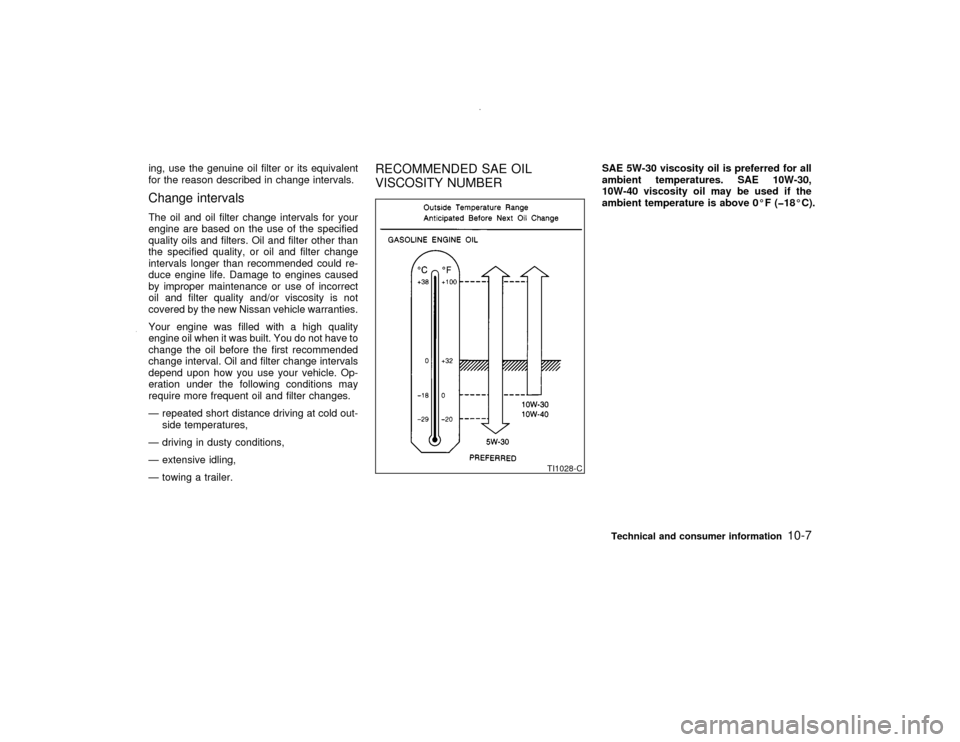
RECOMMENDED SAE OIL
VISCOSITY NUMBER
SAE 5W-30 viscosity oil is preferred for all
ambient temperatures. SAE 10W-30,
10W-40 viscosity oil may be used if the
ambient temperature is above 0ÉF (þ18ÉC).
TI1028-C
Technical and consumer information
10-7
Z
00.1.17/R50-D/V5
X
Page 248 of 265
Your new vehicle was designed to be used
primarily to carry passengers and cargo. Re-
member that towing a trailer will place addi-
tional loads on your vehicle's engine, drive
train, steering, braking and other systems.
Information on trailer towing ability and the
special equipment required should be ob-
tained from your Nissan dealer. He can obtain
aNissan Trailer Towing Guidefor you.
MAXIMUM LOAD LIMITS
Maximum trailer loadsNever allow the total trailer load to exceed the
value specified in the following Towing
Load/Specification Chart. The total trailer load
equals trailer weight plus its cargo weight.
IWhen towing a trailer load of 1,000 lb (454
kg) or more, trailers with a brake system
MUST be used.
The maximum GCWR (Gross Combined
Weight Rating) should not exceed the value
specified in the following Towing Load Speci-
fication Chart.
The GCWR equals the combined weight of the
towing vehicle (including passengers and
cargo) plus the total trailer load. Towing loads
greater than these or using improper towing
equipment could adversely affect vehicle han-
dling, braking and performance.
The ability of your vehicle to tow a trailer is not
only related to the maximum trailer loads, but
also the places you plan to tow. Tow weights
appropriate for level highway driving may have
to be reduced on very steep grades or in low
traction situations (for example, on slippery
boat ramps).
WARNING
Vehicle damage and/or personal injury
resulting from improper towing proce-
dures is not covered by NISSAN warran-
ties. A NISSAN Trailer Towing Guide
(U.S. only) containing information on
trailer towing ability and the special
equipment required may be obtained
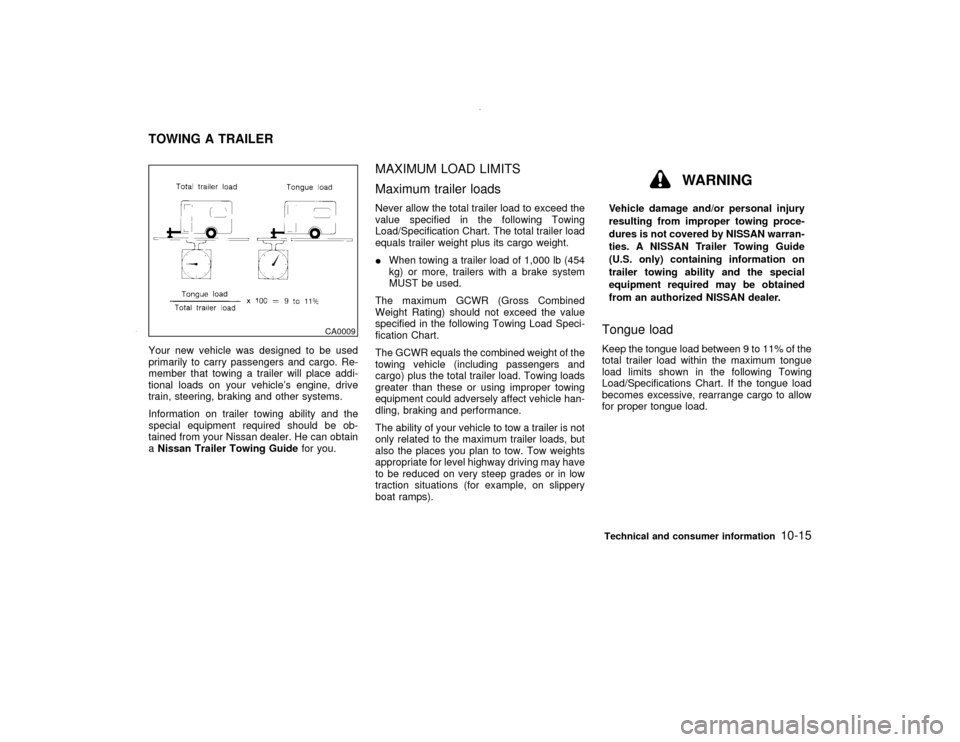
from an authorized NISSAN dealer.Tongue loadKeep the tongue load between 9 to 11% of the
total trailer load within the maximum tongue
load limits shown in the following Towing
Load/Specifications Chart. If the tongue load
becomes excessive, rearrange cargo to allow
for proper tongue load.
CA0009
TOWING A TRAILER
Technical and consumer information
10-15
Z
00.1.17/R50-D/V5
X
Page 249 of 265
Maximum gross vehicle weight/
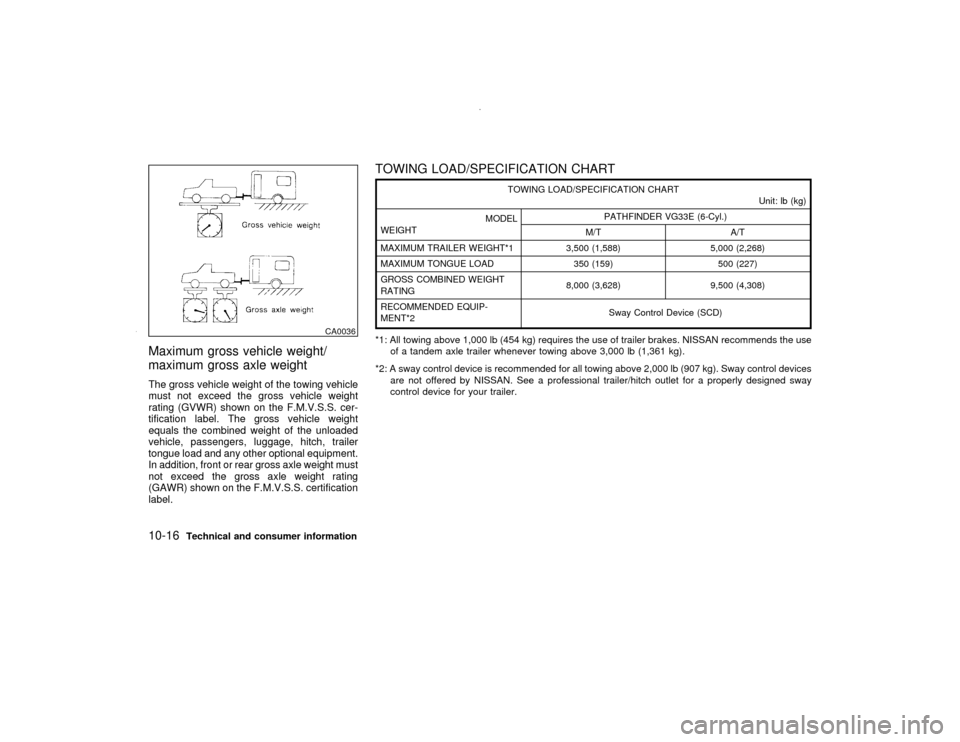
maximum gross axle weightThe gross vehicle weight of the towing vehicle
must not exceed the gross vehicle weight
rating (GVWR) shown on the F.M.V.S.S. cer-
tification label. The gross vehicle weight
equals the combined weight of the unloaded
vehicle, passengers, luggage, hitch, trailer
tongue load and any other optional equipment.
In addition, front or rear gross axle weight must
not exceed the gross axle weight rating
(GAWR) shown on the F.M.V.S.S. certification
label.
TOWING LOAD/SPECIFICATION CHART
TOWING LOAD/SPECIFICATION CHART
Unit: lb (kg)
MODEL
WEIGHTPATHFINDER VG33E (6-Cyl.)
M/T A/T
MAXIMUM TRAILER WEIGHT*1 3,500 (1,588) 5,000 (2,268)
MAXIMUM TONGUE LOAD 350 (159) 500 (227)
GROSS COMBINED WEIGHT
RATING8,000 (3,628) 9,500 (4,308)
RECOMMENDED EQUIP-
MENT*2Sway Control Device (SCD)
*1: All towing above 1,000 lb (454 kg) requires the use of trailer brakes. NISSAN recommends the use
of a tandem axle trailer whenever towing above 3,000 lb (1,361 kg).
*2: A sway control device is recommended for all towing above 2,000 lb (907 kg). Sway control devices
are not offered by NISSAN. See a professional trailer/hitch outlet for a properly designed sway
control device for your trailer.
CA0036
10-16
Technical and consumer information
Z
00.1.17/R50-D/V5
X
Page 250 of 265

TOWING SAFETY
Trailer hitchCheck the towing capacity of your receiver
type frame mounted hitch. Choose a proper
hitch for your vehicle and trailer. A genuine
NISSAN trailer hitch is available from your
NISSAN dealer (Canada only). Make sure the
trailer hitch is securely attached to the vehicle,
to help avoid personal injury or property dam-
age due to sway caused by crosswinds, rough
road surfaces or passing trucks.
CAUTION
ISpecial hitches which include frame
reinforcements are required for tow-
ing above 2,000 lb (907 kg). Suitable
Genuine NISSAN hitches for pickup
truck and sport utility vehicles are
available at an authorized NISSAN
dealer.
IDo not use axle-mounted hitches.
IDo not modify the vehicle exhaust
system, brake system, etc. to install a
trailer hitch.IAfter the hitch is removed, seal the
bolt holes to prevent exhaust fumes,
water or dust from entering the pas-
senger compartment.
IRegularly check all hitch mounting
bolts are securely mounted.
ITo reduce the possibility of additional
damage if your vehicle is struck from
the rear, where practical, remove the
hitch and/or receiver when not in use.
INever connect a trailer brake system
directly to the vehicle brake system.
Tire pressuresIWhen towing a trailer, inflate the vehicle
tires to the recommended cold tire pressure
indicated on the tire placard (affixed to the
glove box lid).
ITrailer tire condition, size, load rating and
proper inflation pressure should be in ac-
cordance with the trailer and tire manufac-
turers' specifications.Safety chainsAlways use a suitable chain between yourvehicle and the trailer. The chain should be
crossed and should be attached to the hitch,
not to the vehicle bumper or axle. Be sure to
leave enough slack in the chain to permit
turning corners.
Trailer lightsTrailer lights should comply with Federal
and/or local regulations.
When wiring vehicle for towing connection,
connect stop and tail light pickup into the
vehicle electrical circuit at point between
the sensor and stop light switch or light
switch.Trailer brakesIf your trailer is equipped with a braking sys-
tem, make sure it conforms to Federal and/or
local regulations and that it is properly in-
stalled.
WARNING
Never connect a trailer brake system
directly to the vehicle brake system.Trailer towing tipsIn order to gain skill and an understanding ofTechnical and consumer information
10-17
Z
00.1.17/R50-D/V5
X
Page 251 of 265

the vehicle's behavior, you should practice
turning, stopping and backing up in an area
which is free from traffic. Steering stability and
braking performance will be somewhat differ-
ent than under normal driving conditions.
IAlways secure items in the trailer to prevent
load shift while driving.
IAvoid abrupt starts, acceleration or stops.
IAvoid sharp turns or lane changes.
IAlways drive your vehicle at a moderate
speed.
IAlways block the wheels on both vehicle
and trailer when parking. Parking on a
slope is not recommended; however, if you
must do so, and if your vehicle is equipped
with automatic transmission, first block the
wheels and apply the parking brake, and
then move the transmission selector lever
into the P position. If you move the selector
lever to the P position before blocking the
wheels and applying the parking brake,
transmission damage could occur.
IWhen going down a hill, shift into a lower
gear and use the engine braking effect.
When ascending a long grade, downshift
the transmission to a lower gear and reduce
speed to reduce chances of engine over-
loading and/or overheating.However, for long steep grades, do not stay in
1st or 2nd gear when driving above 35 MPH
(56 km/h).
IIf the engine coolant rises to an extremely
high temperature when the air conditioning
system is on, turn off the air conditioner.
Coolant heat can be additionally vented by
opening the windows, switching the fan
control to high and setting the temperature
control to the HOT position.
ITrailer towing requires more fuel than nor-
mal circumstances.
IAvoid towing a trailer for the first 500 miles
(800 km).
IHave your vehicle serviced more often than
at intervals specified in the recommended
Maintenance Schedule.
When towing a trailer, change oil in the
transmission more frequently. See the
Maintenance Schedule.Your NISSAN is covered by the following
emission warranties.
For US:
1) Emission Defects Warranty
2) Emissions Performance Warranty
For CANADA:
Emission Control System Warranty
Details of these warranties may be found with
other vehicle warranties in your Warranty In-
formation and Maintenance Log Booklet which
comes with your NISSAN. If you did not re-
ceive a Warranty Information and Mainte-
nance Log Booklet or it becomes lost, you may
obtain a replacement by writing.
INissan North America, Inc. Consumer Af-
fairs Department P.O. Box 191 Gardena.
CA 90248-0191
INissan Canada Inc. 5290 Orbitor Drive
Mississauga, Ontario, L4W 4Z5
EMISSION CONTROL SYSTEM
WARRANTY
10-18
Technical and consumer information
Z
00.1.17/R50-D/V5
X
Page 260 of 265

Driving safety............................................... 5-4
Maintenance precautions ..................... 8-2, 9-2
On child restraints ..................................... 1-31
On seat belt usage .................................... 1-23
On supplemental restraint system ............ 1-10
On-pavement and offroad driving
precautions .................................................. 5-3
Precautions when starting and driving ........ 5-2
Push starting ................................................... 6-11
R
Rack, Luggage rack ........................................ 2-31
Radio, CB radio or car phone......................... 4-26
Readiness for inspection/maintenance (I/M) test
(USA only) .................................................... 10-19
Rear door .......................................................... 3-9
Rear door lock .................................................. 3-9
Child safety rear door lock .......................... 3-4
Rear door opener ............................................. 3-9
Rear power point ............................................ 2-23
Rear seat adjustment ....................................... 1-6
Rear window wiper and washer switch .......... 2-16
Registering your vehicle in another
country .......................................................... 10-11
Remote keyless entry, (See multi-remote control
system) ............................................................. 3-5
Reporting safety defects (USA only) ............ 10-19
Rollover ............................................................. 5-4S
Safety
Child seat belts.......................................... 1-24
Reporting safety defects (USA only)....... 10-19
Towing safety .......................................... 10-17
Seat
Belt extenders ........................................... 1-30
Belt hook ................................................... 1-28
Belt maintenance....................................... 1-31
Belt warning light ....................................... 1-22
Belt warning light and chime ..................... 2-11
Seat adjustment
Front manual seat adjustment .................... 1-2
Rear seat adjustment .................................. 1-6
Seat belt(s)
Child safety................................................ 1-24
Infants and small children ......................... 1-24
Injured persons.......................................... 1-25
Larger children .......................................... 1-25
Pre-tensioner seat belt system ................. 1-19
Precautions on seat belt usage ................ 1-23
Pregnant women ....................................... 1-25
Seat belt cleaning........................................ 7-4
Seat belts .................................................. 1-22
Three-point type with retractor .................. 1-25
Two-point type without retractor (rear center
lap belt)...................................................... 1-29
Seat(s), Seats ................................................... 1-2
Seats, Heated seats ....................................... 2-22
Security system (Nissan Vehicle Immobilizer
System), Engine start ..................................... 2-15
Security systems (See theft warning) ............. 2-14
Servicing air conditioner................... 4-3, 4-9, 4-11Shift lock release ............................................ 5-13
Shifting
Automatic transmission ............................. 5-10
Manual transmission ................................. 5-14
Shoulder belt height adjustment, For front
seats ............................................................... 1-28
Side air bag system (See supplemental side air
bag system) .................................................... 1-18
Spare tire carrier ............................................. 3-10
Spark plugs ..................................................... 8-16
Speedometer .................................................... 2-3
Spot lights ....................................................... 2-34
Starting
Before starting the engine ........................... 5-9
Jump starting ............................................... 6-9
Precautions when starting and driving ........ 5-2
Push starting ............................................. 6-11
Starting the engine ...................................... 5-9
Steering
Power steering fluid................................... 8-12
Power steering system .............................. 5-25
Tilting steering wheel ................................ 3-13
Storage ........................................................... 2-24
Sun shade....................................................... 2-34
Sun visors ....................................................... 3-14
Sunroof, Automatic sunroof ............................ 2-33
Supplemental front air bag system ................. 1-16
Supplemental air bag warning labels ............. 1-20
Supplemental air bag warning light ....... 1-21, 2-11
Supplemental restraint system ....................... 1-10
Precautions on supplemental restraint
system ....................................................... 1-10
Supplemental side air bag system ................. 1-18
Z
00.1.17/R50-D/V5
X
11-5