2000 NISSAN PATHFINDER check oil
[x] Cancel search: check oilPage 196 of 265
section for changing engine oil filter.
CAUTION
Be careful not to burn yourself, as the
engine oil is hot.
Waste oil must be disposed of properly.
Check your local regulations.
6. Clean and re-install the drain plug and new
washer. Securely tighten the drain plug with
a wrench. Do not use excessive force.
Drain plug tightening torque:
22 to 29 ft-lb (29 to 39 N×m)
7. Refill engine with recommended oil through
the oil filler opening, then install the oil filler
cap securely.
See ªCapacities and recommended
fuel/lubricantsº in the ª10. Technical and
consumer informationº section for drain and
refill capacity.
The drain and refill capacity depends on the
oil temperature and drain time. Use these
specifications for reference only. Always
use the dipstick to determine when the
proper amount of oil is in the engine.8. Start the engine.
Check for leakage around the drain plug.
Correct as required.
9. Turn the engine off and wait several min-
utes. Check the oil level with the dipstick.
Add engine oil if necessary.
WARNING
IProlonged and repeated contact with
used engine oil may cause skin can-
cer.
ITry to avoid direct skin contact with
used oil. If skin contact is made, wash
thoroughly with soap or hand cleaner
as soon as possible.
IKeep used engine oil out of reach of
children.
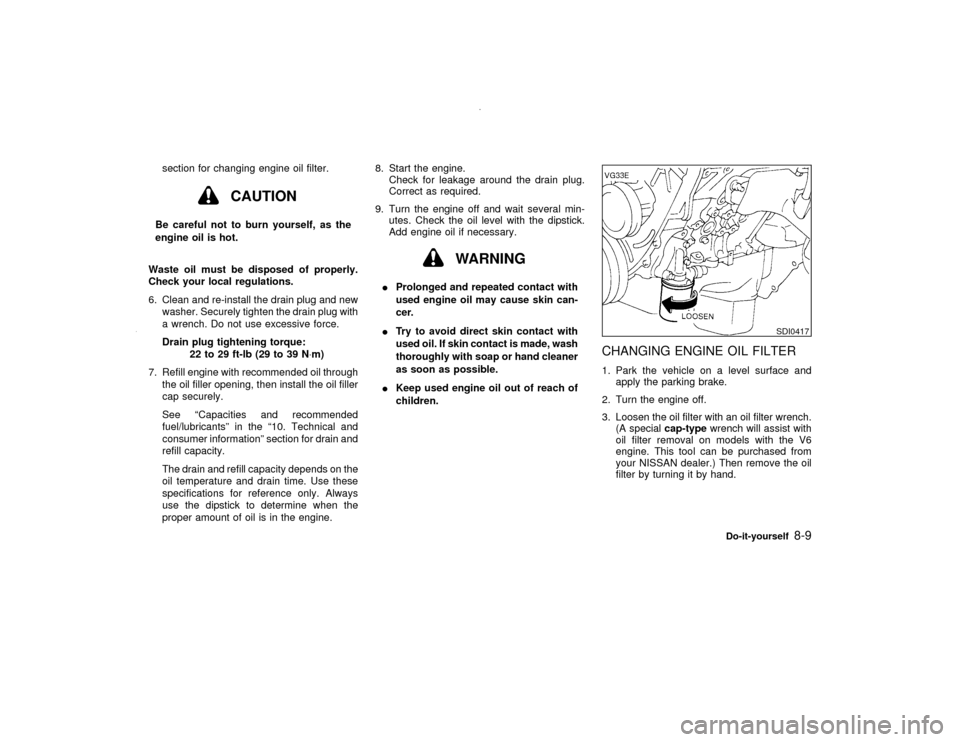
CHANGING ENGINE OIL FILTER1. Park the vehicle on a level surface and
apply the parking brake.
2. Turn the engine off.
3. Loosen the oil filter with an oil filter wrench.
(A specialcap-typewrench will assist with
oil filter removal on models with the V6
engine. This tool can be purchased from
your NISSAN dealer.) Then remove the oil
filter by turning it by hand.
SDI0417
Do-it-yourself
8-9
Z
00.1.17/R50-D/V5
X
Page 197 of 265
CAUTION
Be careful not to burn yourself, as the
engine oil may be hot.
4. Wipe the engine oil filter mounting surface
with a clean rag.
Be sure to remove any old rubber gasket
remaining on the mounting surface of the
engine.
5. Coat the rubber gasket on the new filter
with engine oil.
6. Screw in the oil filter until a slight resistance
is felt, then tighten an additional 2/3 turn.
7. Start the engine and check for leakage
around the oil filter. Correct as required.
8. Turn the engine off and wait several min-
utes. Check the oil level. Add engine oil if
necessary.
WARNING
IWhen engine is running, keep hands,
jewelry, and clothing away from any
moving parts such as fan and drive
belt.
IAutomatic transmission fluid is poi-
sonous and should be stored care-
fully in marked containers out of the
reach of children.
TEMPERATURE CONDITIONS
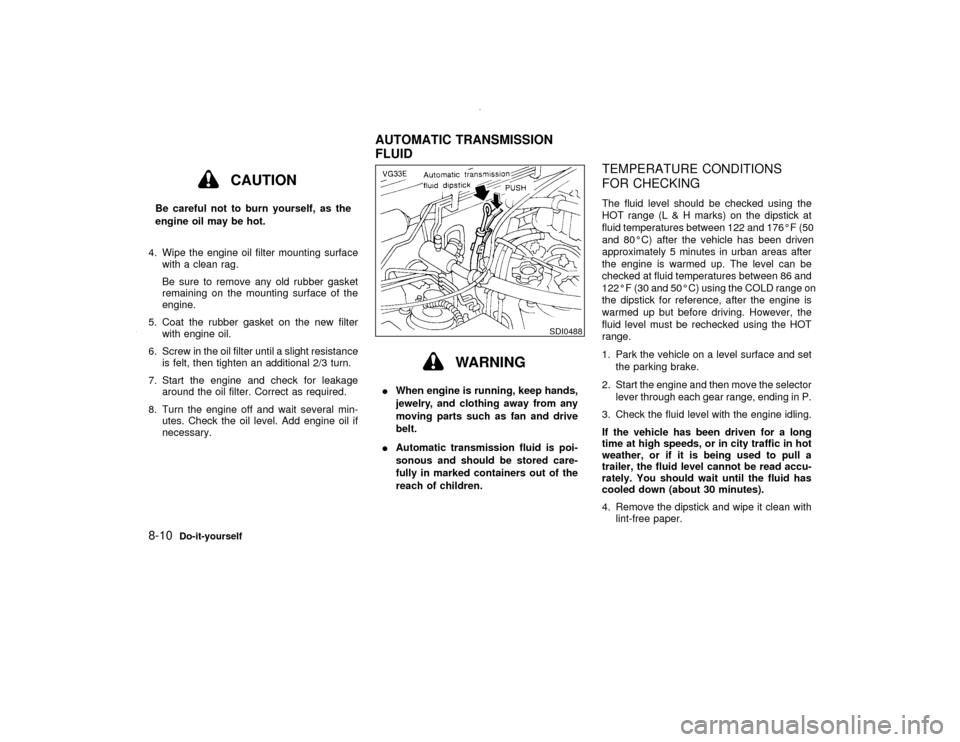
FOR CHECKINGThe fluid level should be checked using the
HOT range (L & H marks) on the dipstick at
fluid temperatures between 122 and 176ÉF (50
and 80ÉC) after the vehicle has been driven
approximately 5 minutes in urban areas after
the engine is warmed up. The level can be
checked at fluid temperatures between 86 and
122ÉF (30 and 50ÉC) using the COLD range on
the dipstick for reference, after the engine is
warmed up but before driving. However, the
fluid level must be rechecked using the HOT
range.
1. Park the vehicle on a level surface and set
the parking brake.
2. Start the engine and then move the selector
lever through each gear range, ending in P.
3. Check the fluid level with the engine idling.
If the vehicle has been driven for a long
time at high speeds, or in city traffic in hot
weather, or if it is being used to pull a
trailer, the fluid level cannot be read accu-
rately. You should wait until the fluid has
cooled down (about 30 minutes).
4. Remove the dipstick and wipe it clean with
lint-free paper.
SDI0488
AUTOMATIC TRANSMISSION
FLUID
8-10
Do-it-yourself
Z
00.1.17/R50-D/V5
X
Page 210 of 265

2. Replace the battery with a new one.
Recommended battery: Sanyo CR2025 or
equivalent
Make sure that theÅside faces the
bottom case.
3. Close the lid securely.
4. Push the remote controller button two or
three times to check its operation.
See your NISSAN dealer if you need any
assistance for replacement.
If the battery is removed for any reason
other than replacement, perform step 4
above.
IBe careful not to touch a circuit board
and a battery terminal.
IAn improperly disposed battery can
harm the environment. Always confirm
local regulations for battery disposal.
IThe remote controller is water-resistant;
however, if it does get wet, immediately
wipe completely dry.
IWhen changing batteries, do not let dust
or oil get on the controller.
FCC Notice:
Changes or modifications not expresslyapproved by the manufacturer compliance
could void the user's authority to operate
the equipment.
This device complies with Part 15 of the
FCC Rules and RSS-210 of Industry
Canada.
Operation is subject to the following two
conditions: (1) This device may not cause
harmful interference, and (2) this device
must accept any interference received, in-
cluding interference that may cause undes-
ired operation of the device.
Do-it-yourself
8-23
Z
00.1.17/R50-D/V5
X
Page 225 of 265

uneven effort. Keep the floor mats away from
the pedal.
Clutch pedal*:
Make sure the pedal operates smoothly and
check that it has the proper free travel.
Brakes:
Check that the brakes do not pull the vehicle to
one side when applied.
Brake pedal and booster*:
Check the pedal for smooth operation and
make sure it has the proper distance under it
when depressed fully. Check the brake
booster function. Be certain to keep floormats
away from the pedal.
Parking brake*:
Check that the lever has the proper travel and
confirm that your vehicle is held securely on a
fairly steep hill with only the parking brake
applied.
Automatic transmission P position
mechanism:
On a fairly steep hill check that your vehicle is
held securely with the selector lever in the P
position without applying any brakes.
Under the hood and vehicleThe maintenance items listed here should be
checked periodically e.g. each time you check
the engine oil or refuel.
Windshield washer fluid*:
Check that there is adequate fluid in the tank.
Engine oil level*:
Check the level after parking the vehicle on a
level spot and turning off the engine. (Be sure
to wait a few minutes to allow the oil to drain
back into the sump.)
Brake and clutch fluid levels*:
Make sure that the brake and clutch fluid level
is between the MAX and MIN lines on the
reservoir.
Power steering fluid level* and lines:
Check the level when the fluid is cold and the
engine is turned off. Check the lines for proper
attachment, leaks, cracks, etc.
Automatic transmission fluid level*:
Check the level after putting the selector lever
in P (Park) with the engine idling.Engine coolant level*:
Check the coolant level when the engine is
cold.
Radiator and hoses:
Check the front of the radiator and clean off
any dirt, insects, leaves, etc., that may have
accumulated. Make sure the hoses have no
cracks, deformation, rot or loose connections.
Engine drive belts*:
Make sure that no belt is frayed, worn, cracked
or oily.
Battery*:
Check the fluid level in each cell. It should be
between the MAX and MIN lines.
Exhaust system:
Make sure there are no loose supports, cracks
or holes. If the sound of the exhaust seems
unusual or there is a smell of exhaust fumes,
immediately locate the trouble and correct it.
See ªPrecautions when starting and drivingº in
the ª5. Starting and drivingº section for exhaust
gas (carbon monoxide).
Underbody:
The underbody is frequently exposed to corro-
sive substances such as those used on icy
9-4
Maintenance
Z
00.1.17/R50-D/V5
X
Page 226 of 265

roads or to control dust. It is very important to
remove these substances, otherwise rust will
form on the floor pan, frame, fuel lines and
around the exhaust system. At the end of
winter, the underbody should be thoroughly
flushed with plain water, being careful to clean
those areas where mud and dirt may accumu-
late. For additional information, see ªCleaning
exteriorº in the ª7. Appearance and careº sec-
tion.
Fluid leaks:
Check under the vehicle for fuel, oil, water or
other fluid leaks after the vehicle has been
parked for a while. Water dripping from the air
conditioner after use is normal. If you should
notice any leaks or if gasoline fumes are
evident, check for the cause and have it cor-
rected immediately.To ensure smooth, trouble-free, safe and eco-
nomical driving, NISSAN provides two differ-
ent maintenance schedules that may be used,
depending upon the conditions in which you
usually drive. These schedules contain both
distance and time intervals, up to 60,000 miles
(96,000 km)/48 months. For most people, the
odometer reading will indicate when service is
needed. However, if you drive very little, your
vehicle should be serviced at the regular time
intervals shown in the schedule.
After 60,000 miles (96,000 km) or 48
months, continue periodic maintenance at
the same mileage/time intervals.
SCHEDULE 1Follow Periodic Maintenance Schedule 1 if
your driving habits frequently include one or
more of the following driving conditions:
IRepeated short trips of less than 5 miles
(8 km).
IRepeated short trips of less than 10
miles (16 km) with outside temperatures
remaining below freezing.
IOperating in hot weather in stop-and-go
rush hour traffic.
IExtensive idling and/or low speed driv-
ing for long distances, such as police,taxi or door-to-door delivery use.
IDriving in dusty conditions.
IDriving on rough, muddy, or salt spread
roads.
ITowing a trailer, using a camper or a
car-top carrier.
SCHEDULE 2Follow Periodic Maintenance Schedule 2 if
none of the driving conditions shown in Sched-
ule 1 apply to your driving habits.
PERIODIC MAINTENANCE
SCHEDULES
Maintenance
9-5
Z
00.1.17/R50-D/V5
X
Page 231 of 265

Maintenance for offroad driving
(
only)
Whenever you drive offroad through sand,
mud or water as deep as the wheel hub, more
frequent maintenance may be required of the
following items:G
Brake pads and discs
G
Brake lining and drums
G
Brake lines and hoses
G
Wheel bearing grease
G
Differential, transmission and transfer oil
G
Steering linkage
G
Propeller shafts and front drive shafts
G
Air cleaner filter
G
Clutch housing (See ªClutch housing drainº
in the ª8. Do-it-yourselfº section for check-
ing water entry.)
These items should be checked frequently to
assure safe and proper operation of your ve-
hicle.
EXPLANATION OF MAINTENANCE
ITEMS
Emission control system
maintenanceAdditional information on the following
items with * is found in the ª8. Do-it-
yourselfº section.
Drive belts*:
Check drive belts for wear, fraying or cracking
and also for proper tension. Replace the drive
belts if found damaged.
Air filter:
Under normal driving conditions, the air
cleaner filter should be replaced in accordance
with the maintenance schedule. However,
driving the vehicle in dusty areas may cause
more rapid clogging of the element. Conse-
quently, the element may have to be replaced
more frequently.
EVAP vapor lines:
Check vapor lines and connections for failure
or looseness. If leaks are found, replace the
lines.
Fuel lines:
Check the fuel hoses, piping and connectionsfor leaks, looseness or deterioration. Replace
any parts if they are damaged.
Fuel filter:
If the vehicle is operated under extremely
adverse weather conditions or in areas where
ambient temperatures are either extremely low
or extremely high, the filter might become
clogged. In such an event, replace the filter
immediately.
Engine coolant*:
Flush and refill the cooling system.
Engine oil & oil filter*:
Under normal driving conditions, the engine oil
and oil filter should be replaced in accordance
with the maintenance schedule. However, un-
der severe driving conditions, they may have
to be replaced more frequently.
Spark plugs*:
Replace with new plugs having the correct
heat range.
Timing belt:
Replace the timing belt for driving the cam-
shafts.
9-10
Maintenance
Z
00.1.17/R50-D/V5
X
Page 232 of 265

Chassis and body maintenanceBrake lines & cables:
Check the brake lines and hoses (including
brake booster vacuum hoses, connections &
check valve) and parking brake cables for
proper attachment, leaks, cracks, chafing,
abrasion, deterioration, etc.
Brake pads, rotors, drums & linings:
Check these and the other neighboring brake
components for wear, deterioration and leaks.
Under severe driving conditions, they may
have to be inspected more frequently.
Manual and automatic transmission,
transfer & differential gear fluid:
Visually inspect for signs of leakage and re-
place oil for limited-slip differential. Under se-
vere driving conditions, the oil should be re-
placed at the specified interval.
Steering gear, linkage & transfer gear,
axle & suspension parts & drive axle
shaft boots:
Check for damage, looseness and leakage of
oil or grease. Under severe driving conditions,
more frequent inspection should be per-
formed.Propeller shaft(s):
Check the propeller shaft(s) for damage,
looseness and grease leakage under severe
driving condition (
only).
Propeller shaft:
Apply specified grease to the greasing points
of propeller shafts in accordance with the
maintenance schedule. In the case of driving
in water, greasing should be performed imme-
diately afterwards.
Front wheel bearing grease:
Check the wheel bearing for grease leakage
around grease seals, axial end play and
smooth turning (4x2).
Check the wheel bearing grease condition or
repack these in accordance with the mainte-
nance schedule. In case of frequent driving in
muddy water, the bearing grease inspection
should be performed more frequently (
).
Exhaust system:
Visually check the exhaust pipes, muffler, and
hangers for proper attachment, leaks, cracks,
chafing, abrasion, deterioration, etc. Under
severe driving conditions, inspection should be
performed more frequently.Supplemental air bag, and supplemental
side air bag (if so equipped) systems:
Maintenance for the supplemental air bags or
supplemental side air bags should be done by
an authorized NISSAN dealer.
Automatic Speed Control Device (ASCD)
vacuum hoses:
Check vacuum hose (between ASCD actuator
and ASCD pump) for breakage, cracks or
fracture.
Maintenance
9-11
Z
00.1.17/R50-D/V5
X
Page 257 of 265

Child restraints ................................................ 1-31
Installation on front passenger seat .......... 1-42
Installation on rear seat outboard
positions .................................................... 1-35
Installation on rear seat center position .... 1-33
Precautions on child restraints .................. 1-31
Top tether strap anchor point locations .... 1-41
With top tether strap.................................. 1-40
Child safety ..................................................... 1-24
Child safety rear door lock................................ 3-4
Chimes ............................................................ 2-13
Cigarette lighter (accessory) and ashtray....... 2-23
Circuit breaker, Fusible link ............................ 8-21
Cleaning exterior and interior .................... 7-2, 7-3
Clutch
Clutch pedal .............................................. 8-21
Fluid ........................................................... 8-12
Clutch housing drain (
only) .................. 8-34
Cold weather driving ....................................... 5-28
Compact Disc (CD) player (See audio
system) ........................................................... 4-23
Compact disc (CD) player operation .............. 4-12
Compass display .............................................. 2-7
Console box .................................................... 2-27
Controls
Audio controls............................................ 4-12
Audio controls (rear).................................. 4-12
Audio controls (steering wheel)................. 4-12
Heater and air conditioner controls ............. 4-3
Heater and air conditioner controls
(automatic)................................................... 4-9
Coolant
Capacities and recommended fuel/
lubricants ................................................... 10-2Changing engine coolant ............................ 8-6
Checking engine coolant level .................... 8-5
Corrosion protection ......................................... 7-4
Cruise control.................................................. 5-17
Cup holders .................................................... 2-25
D
Daytime running light system ......................... 2-19
Defogger switch, Glass hatch and outside mirror
defogger switch............................................... 2-17
Dimensions and weights ............................... 10-10
Door open warning light ................................. 2-11
Drive belts ....................................................... 8-15
Driving
Cold weather driving ................................. 5-28
Driving with automatic transmission.......... 5-10
Driving with manual transmission ............. 5-14
On-pavement and offroad driving ............... 5-3
Precautions when starting and driving ........ 5-2
Safety precautions....................................... 5-4
E
Economy, Fuel ................................................ 5-20
Emission control information label ................ 10-12
Emission control system warranty ................ 10-18
Engine
Before starting the engine ........................... 5-9
Block heater .............................................. 5-29
Capacities and recommended fuel/
lubricants ................................................... 10-2Changing engine coolant ............................ 8-6
Changing engine oil .................................... 8-8
Changing engine oil filter ............................ 8-9
Checking engine coolant level .................... 8-5
Checking engine oil level ............................ 8-7
Coolant temperature gauge ........................ 2-4
Engine compartment check locations ......... 8-4
Engine cooling system ................................ 8-5
Engine oil..................................................... 8-7
Engine oil and oil filter recommendation... 10-6
Engine oil viscosity .................................... 10-6
Engine serial number .............................. 10-12
Engine specifications................................. 10-9
If your engine overheats ........................... 6-11
Starting the engine ...................................... 5-9
Exhaust gas (Carbon monoxide) ...................... 5-2
F
F.M.V.S.S. certification label......................... 10-12
Filter, Air cleaner housing filter ....................... 8-17
Flashers (See hazard warning flasher
switch) ............................................................. 2-21
Flat tire .............................................................. 6-2
Floor mat cleaning ............................................ 7-4
Fluid
Automatic transmission fluid (ATF) ........... 8-10
Brake and clutch fluid................................ 8-12
Brake fluid ................................................. 8-12
Capacities and recommended fuel/
lubricants ................................................... 10-2
Engine coolant............................................. 8-5
Engine oil..................................................... 8-7
Z
00.1.17/R50-D/V5
X
11-2