2000 NISSAN FRONTIER service
[x] Cancel search: servicePage 222 of 269

Your new NISSAN has been designed to
have minimum maintenance requirements
with longer service intervals to save you
both time and money. However, some day-
to-day and regular maintenance is essential
to maintain your NISSAN's good mechani-
cal condition, as well as its emission and
engine performance.
It is the owner's responsibility to make sure
that the specified maintenance, as well as
general maintenance, is performed.
As the vehicle owner, you are the only one
who can ensure that your vehicle receives
proper maintenance. You are a vital link in
the maintenance chain.
General maintenance
General maintenance includes those items
which should be checked during normal
day-to-day operation of the vehicle. They
are essential if your vehicle is to continue to
operate properly. It is your responsibility to
perform these maintenance procedures
regularly as prescribed.
These checks or inspections can be done
by yourself, a qualified technician or, if you
prefer, an authorized NISSAN dealer.
Periodic maintenance
The maintenance items listed under peri-
odic maintenance in this section are re-
quired to be serviced at regular intervals.
However, under severe driving conditions,
additional or more frequent maintenance
will be required.
Where to go for service
If maintenance service is required or your
vehicle appears to malfunction, have the
systems checked and tuned by an autho-
rized NISSAN dealer.
NISSAN technicians are well-trained spe-
cialists who and are kept up to date with the
latest service information through technical
bulletins, service tips, and in-dealership
training programs. They are completely
qualified to work on NISSAN vehicles
beforethey work on your vehicle, rather
than after they have worked on it.
You can be confident that an authorized
NISSAN dealer's service department per-
forms the best job to meet the maintenance
requirements on your vehicle Ð in a reliable
and economic way.During the normal day-to-day operation of
the vehicle, general maintenance should be
performed regularly as prescribed in this
section. If you detect any unusual sounds,
vibrations or smells, be sure to check for the
cause or have an authorized NISSAN
dealer do it promptly. In addition, you should
notify an authorized NISSAN dealer if you
think that repairs are required.
When performing any checks or mainte-
nance work, closely observe the precau-
tions in the ``Do-it-yourself'' section of this
manual.
OUTSIDE THE VEHICLE
The maintenance items listed here should
be performed from time to time, unless
otherwise specified.
Additional information on the following
items with ``*'' is found in the ``Do-it-
yourself'' section of this manual.
Tires*Check the pressure with a gauge
periodically when at a service station, in-
cluding the spare, and adjust to the speci-
fied pressure if necessary. Check carefully
for damage, cuts or excessive wear.
Wheel nuts*When checking the tires, make
GENERAL MAINTENANCE
9-2Maintenance
ZX
Page 225 of 269

To ensure smooth, trouble-free, safe and
economical driving, NISSAN provides two
periodic maintenance schedules that may
be used, depending upon the conditions in
which you usually drive. These schedules
contain both distance and time intervals, up
to 60,000 miles (96,000 km)/48 months. For
most people, the odometer reading will in-
dicate when service is needed. However, if
you drive very little, your vehicle should be
serviced at the regular time intervals shown
in the schedule.
After 60,000 miles (96,000 km)/48
months, continue periodic maintenance
at the same mileage/time intervals.
SCHEDULE ONE
Follow Periodic Maintenance Schedule one
if your driving habits frequently include one
or more of the following driving conditions:
I
Repeated short trips of less than 5
miles (8 km).
I
Repeated short trips of less than 10
miles (16 km) with outside tempera-
tures below freezing.
I
Operating the vehicle in hot weatherduring stop-and-go ``rush hour'' traf-
fic.
I
Extensive idling and/or low speed
driving for long distances, such as
police, taxi or door-to-door delivery
use.
I
Driving in dusty conditions.
I
Driving on rough, muddy, or salt
spread roads.
I
Towing a trailer, using a camper or a
car-top carrier.
SCHEDULE TWO
Follow Periodic Maintenance Schedule two
if none of the driving conditions shown in
Schedule one apply to your driving habits.
Maintenance for off-road driving
(
only)
Whenever you drive off-road through sand,
mud or water as deep as the wheel hub,
more frequent maintenance may be re-
quired of the following items:
¶Brake pads and rotors
¶Brake linings and drums
¶Brake lines and hoses
¶Wheel bearing grease and free-running
hub grease
¶Differential, transmission and transfer oil
¶Steering linkage
¶Propeller shafts and front drive shafts
¶Air cleaner filter
These items should be checked frequently
to assure safe and proper operation of your
vehicle.
PERIODIC MAINTENANCE
SCHEDULES
Maintenance9-5
ZX
Page 236 of 269
FUEL RECOMMENDATION
Your vehicle is designed to operate on
unleaded gasoline with an octane rating
of at least 87 AKI (Anti-Knock Index)
(Research octane number 91).
CAUTION
IUsing a fuel other than that specified
could adversely affect the emission
control system, and may also affect
the warranty coverage.
IUnder no circumstances should a
leaded gasoline be used, since this
will damage the three-way catalyst.
Reformulated Gasoline
Some fuel suppliers are now producing re-
formulated gasolines. These gasolines are
specially designed to reduce vehicle emis-
sions. NISSAN supports efforts towards
cleaner air and suggests that you use refor-
mulated gasoline when available.
Gasoline containing oxygenates
Some fuel suppliers sell gasoline containing
oxygenates such as ethanol, MTBE and
methanol with or without advertising theirpresence. Nissan does not recommend the
use of fuels of which the oxygenate content
and the fuel compatibility for your NISSAN
cannot be readily determined. If in doubt,
ask your service station manager.
If you use oxygenate-blend gasoline, please
take the following precautions as the usage
of such fuels may cause vehicle perfor-
mance problems and/or fuel system dam-
age.
IThe fuel should be unleaded and
have an octane rating no lower than
that recommended for unleaded
gasoline.
IIf an oxygenate-blend, excepting a
methanol blend, is used, it should
contain no more than 10% oxygenate.
(MTBE may, however, be added up to
15%.)
I
If a methanol blend is used, it should
contain no more than 5% methanol
(methyl alcohol, wood alcohol). It
should also contain a suitable
amount of appropriate cosolvents
and corrosion inhibitors. If not prop-
erly formulated with appropriate co-
solvents and corrosion inhibitors,such methanol blends may cause fuel
system damage and/or vehicle perfor-
mance problems. At this time, suffi-
cient data is not available to ensure
that all methanol blends are suitable
for use in NISSAN vehicles.
If any driveability problems such as engine
stalling and hard hot starting are experi-
enced after using oxygenate-blend fuels,
immediately change to a non-oxygenate
fuel or a fuel with a low blend of MTBE.
Take care not to spill gasoline during
refueling. Gasoline containing oxygen-
ates can cause paint damage.
After Market Fuel Additives
NISSAN does not recommend the use of
any fuel additives (i.e., fuel injector cleaner,
octane booster, intake valve deposit remov-
ers, etc.) which are sold commercially. Many
of these additives intended for gum, varnish
or deposit removal may contain active sol-
vents or similar ingredients that can be
harmful to the fuel system and engine.
10-4Technical and consumer information
ZX
Page 240 of 269
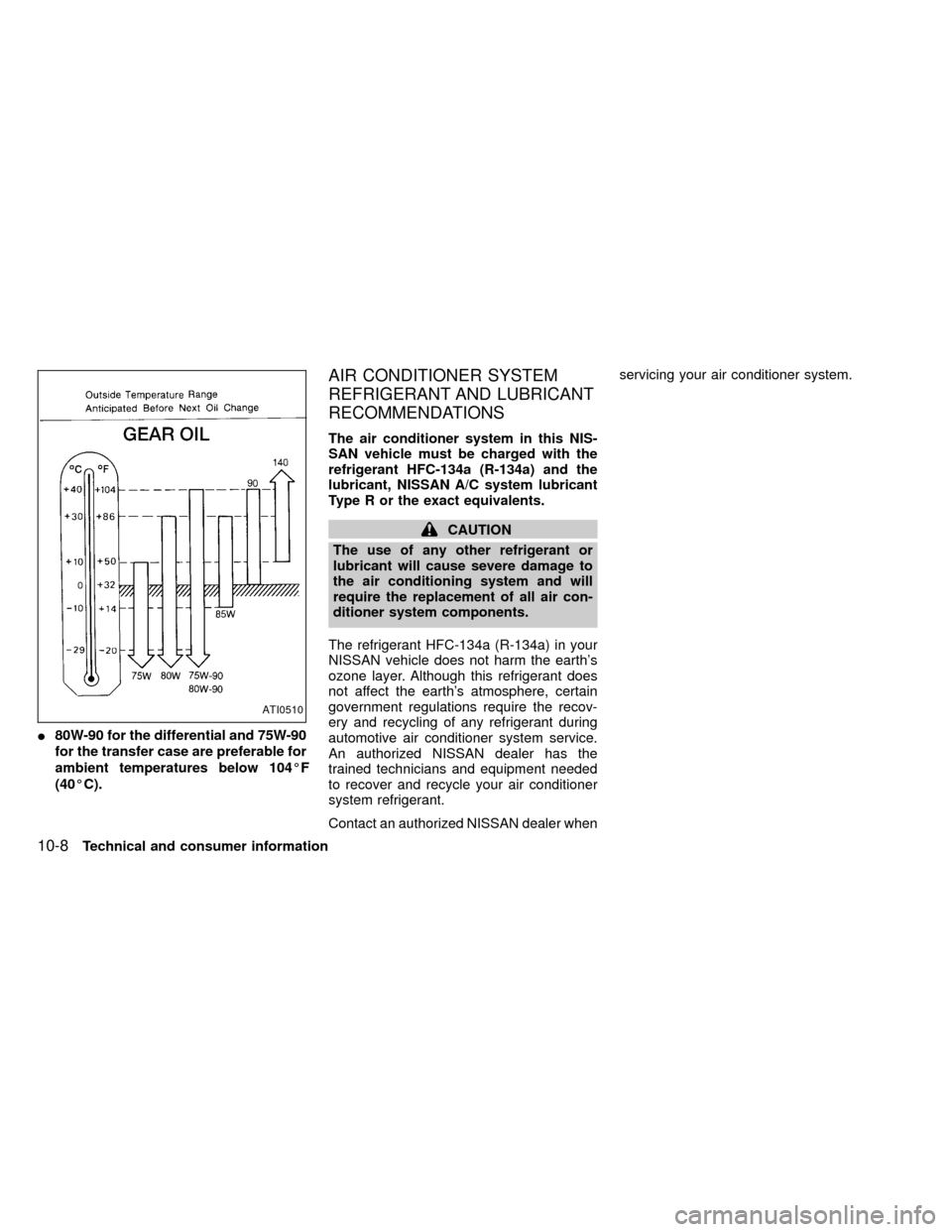
I80W-90 for the differential and 75W-90
for the transfer case are preferable for
ambient temperatures below 104ÉF
(40ÉC).
AIR CONDITIONER SYSTEM
REFRIGERANT AND LUBRICANT
RECOMMENDATIONS
The air conditioner system in this NIS-
SAN vehicle must be charged with the
refrigerant HFC-134a (R-134a) and the
lubricant, NISSAN A/C system lubricant
Type R or the exact equivalents.
CAUTION
The use of any other refrigerant or
lubricant will cause severe damage to
the air conditioning system and will
require the replacement of all air con-
ditioner system components.
The refrigerant HFC-134a (R-134a) in your
NISSAN vehicle does not harm the earth's
ozone layer. Although this refrigerant does
not affect the earth's atmosphere, certain
government regulations require the recov-
ery and recycling of any refrigerant during
automotive air conditioner system service.
An authorized NISSAN dealer has the
trained technicians and equipment needed
to recover and recycle your air conditioner
system refrigerant.
Contact an authorized NISSAN dealer whenservicing your air conditioner system.
ATI0510
10-8Technical and consumer information
ZX
Page 257 of 269

tongue load, overload, worn suspension
or other possible causes of either con-
dition.
IAlways secure items in the trailer to
prevent load shift while driving.
IBe certain your outside mirrors conform
to all federal, state or local regulations. If
not, install any mirrors required for tow-
ing before driving the vehicle.
Trailer towing tips
In order to gain skill and an understanding
of the vehicle's behavior, you should prac-
tice turning, stopping and backing up in an
area which is free from traffic. Steering,
stability and braking performance will be
somewhat different than under normal driv-
ing conditions.
IAlways secure items in the trailer to
prevent load shift while driving.
I
Avoid abrupt starts, acceleration or
stops.
IAvoid sharp turns or lane changes.
IAlways drive your vehicle at a moderate
speed.
IAlways block the wheels on both vehicleand trailer when parking. Parking on a
slope is not recommended; however, if
you must do so, and if your vehicle is
equipped with automatic transmission,
first block the wheels and apply the
parking brake, and then move the trans-
mission shift selector lever into the P
(Park) position. If you move the shift
lever to the P (Park) position before
blocking the wheels and applying the
parking brake, transmission damage
could occur.
IWhen going down a hill, shift into a lower
gear and use the engine braking effect.
When ascending a long grade, down-
shift the transmission to a lower gear
and reduce speed to reduce chances of
engine overloading and/or overheating.
However, for long steep grades, do not
stay in 1st or 2nd gear when driving
above 35 MPH (56 km/h).
IIf the engine coolant rises to an ex-
tremely high temperature when the air
conditioning system is on, turn off the air
conditioner. Coolant heat can be addi-
tionally vented by opening the windows,
switching the fan control to high and
setting the temperature control to the
HOT position.ITrailer towing requires more fuel than
normal circumstances.
IAvoid towing a trailer for your vehicle's
first 500 miles (805 km).
IHave your vehicle serviced more often
than at intervals specified in the recom-
mended Maintenance Schedule.
IWhen making a turn, your trailer wheels
will be closer to the inside of the turn
than your vehicle wheels. To compen-
sate for this, make a larger than normal
turning radius during the turn.
ICrosswinds and rough roads adversely
affect vehicle/trailer handling, possibly
causing vehicle sway. When being
passed by larger vehicles, be prepared
for possible changes in crosswinds that
could affect vehicle handling. If swaying
does occur, firmly grip the steering
wheel, steer straight ahead, and imme-
diately (but gradually) reduce vehicle
speed. This combination helps to stabi-
lize the vehicle. Never increase speed.
IBe careful when passing other vehicles.
Passing while towing a trailer requires
considerably more distance than normal
passing. Remember the length of the
Technical and consumer information
10-25
ZX
Page 258 of 269
trailer must also pass the other vehicle
before you can safely change lanes.
ITo maintain engine braking efficiency
and electrical charging performance, do
not use fifth gear (manual transmission)
or overdrive (automatic transmission).
IAvoid holding the brake pedal down too
long or too frequently. This could cause
the brakes to overheat, resulting in re-
duced braking efficiency.
When towing a trailer, change oil in the
transmission more frequently. For addi-
tional information see the ``Maintenance''
section earlier in this manual.DOT (Department of Transportation) Quality
Grades: All passenger car tires must con-
form to Federal Safety Requirements in
addition to these grades.
Quality grades can be found where appli-
cable on the tire sidewall between tread
shoulder and maximum section width. For
example:
Treadwear 200 Traction AA Temperature A
Treadwear
Treadwear grade is a comparative rating
based on tire wear rate when tested under
controlled conditions on specified govern-
ment test courses. For example, a tire
graded 150 would wear one and a half
(1-1/2) times as well on the government
course as a tire graded 100. However, rela-
tive tire performance depends on actual
driving conditions, and may vary signifi-
cantly due to variations in driving habits,
service practices and differences in road
characteristics and climate.
Traction AA, A, B and C
The traction grades from highest to lowest
are AA, A, B, and C. Those grades repre-sent the tire's ability to stop on wet pave-
ment as measured under controlled condi-
tions on specified government test surfaces
of asphalt and concrete. A tire marked C
may have poor traction performance.
WARNING
The traction grade assigned to your ve-
hicle tires is based on straight-ahead
braking traction tests, and does not in-
clude acceleration, cornering, hydro-
planing, or peak traction characteristics.
Temperature A, B and C
Temperature grades are A (the highest), B,
and C. They represent a tire's resistance to
heat build-up, and its ability to dissipate
heat when tested under controlled condi-
tions on a specified indoor laboratory test
wheel. Sustained high temperature can
cause tire material to degenerate, reducing
tire life. Excessive temperatures can lead to
sudden tire failure. Grade C corresponds to
a performance level which all passenger car
tires must meet under the Federal Motor
Vehicle Safety Standard No. 109. Grades A
and B represent higher levels of perfor-
mance on laboratory test wheels than the
UNIFORM TIRE QUALITY
GRADING
10-26Technical and consumer information
ZX
Page 261 of 269

A genuine NISSAN Service Manual is the best
source of service and repair information for
your vehicle. Filled with wiring diagrams, illus-
trations and step-by-step diagnostic and ad-
justment procedures, this manual is the same
one used by the factory trained technicians
working at authorized NISSAN dealerships.
Also available are genuine NISSAN Owner's
Manuals and genuine NISSAN Service and
Owner's Manuals for older NISSAN models.
In the USA:
For current pricing and availability of genuine
NISSAN Service Manualsfor the 2000 model
year, contact:
Tweddle Litho Company
1-800-639-8841
www.nissan-techinfo.com
For current pricing and availability of genuine
NISSAN Service Manualsfor the 1999 model
year and prior, see an authorized NISSAN
dealer, or contact:
Dyment Distribution Services
20770 Westwood Road
Strongsville, OH 44136
1-800-247-5321
For current pricing and availability of genuine
NISSAN Owner's Manualsfor the 2000
model year and prior, see an authorized NIS-
SAN dealer, or contact:
Technical and consumer information10-29
ZX
Page 262 of 269

Dyment Distribution Services
20770 Westwood Road
Strongsville, OH 44136
1-800-247-5321
In Canada:
To purchase a copy of a genuine NISSAN
Service Manual or Owner's Manual please
contact your nearest NISSAN dealer. For the
phone number and location of a NISSAN
Dealer in your area call the NISSAN Satisfac-
tion Center at 1-800-387-0122 and a bilingual
NISSAN representative will assist you.
Also available are Genuine NISSAN Service
and Owner's Manuals for older NISSAN
models.
10-30Technical and consumer information
ZX