2000 NISSAN ALTIMA height
[x] Cancel search: heightPage 11 of 242
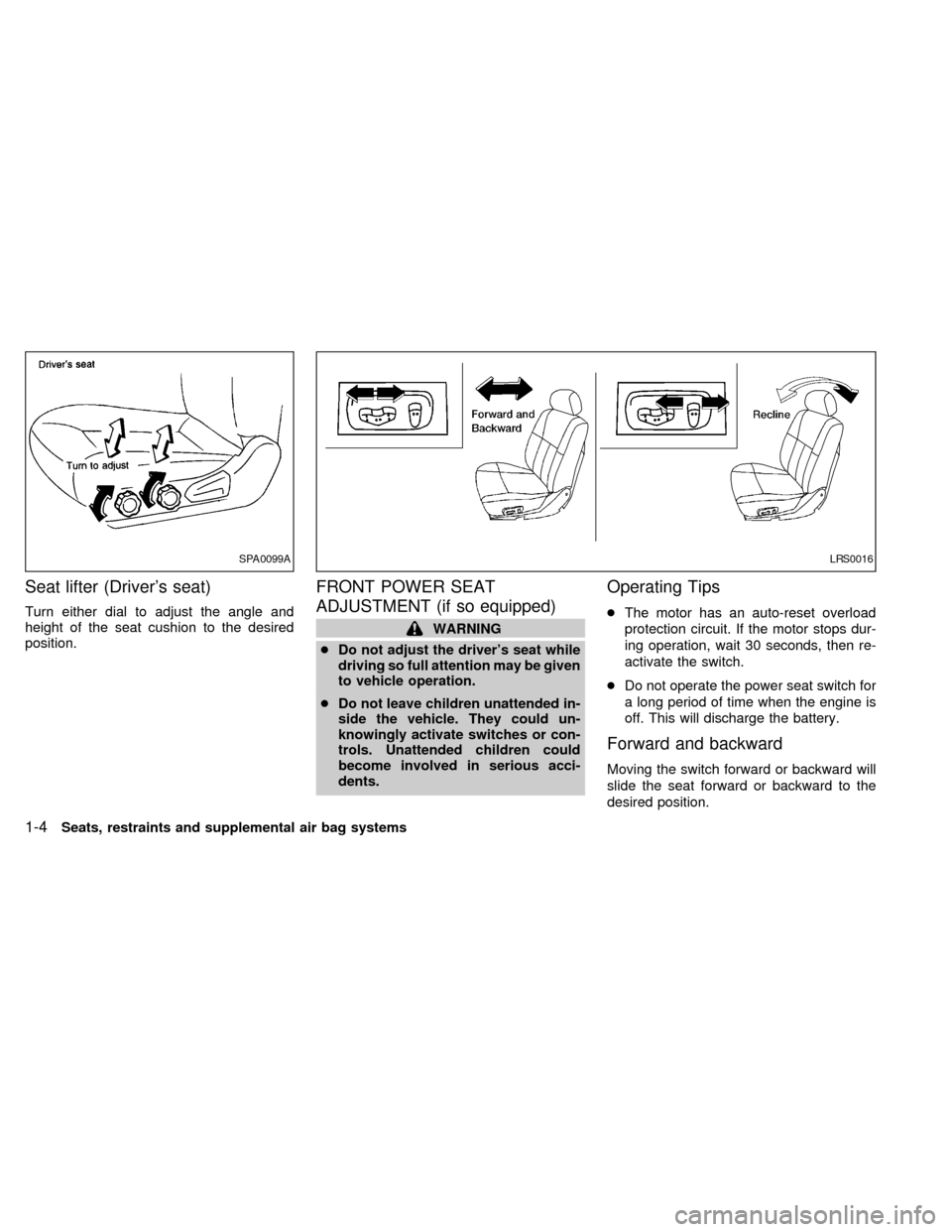
Seat lifter (Driver's seat)
Turn either dial to adjust the angle and
height of the seat cushion to the desired
position.
FRONT POWER SEAT
ADJUSTMENT (if so equipped)
WARNING
cDo not adjust the driver's seat while
driving so full attention may be given
to vehicle operation.
cDo not leave children unattended in-
side the vehicle. They could un-
knowingly activate switches or con-
trols. Unattended children could
become involved in serious acci-
dents.
Operating Tips
cThe motor has an auto-reset overload
protection circuit. If the motor stops dur-
ing operation, wait 30 seconds, then re-
activate the switch.
cDo not operate the power seat switch for
a long period of time when the engine is
off. This will discharge the battery.
Forward and backward
Moving the switch forward or backward will
slide the seat forward or backward to the
desired position.
SPA0099ALRS0016
1-4Seats, restraints and supplemental air bag systems
ZX
Page 12 of 242

Reclining
Move the recline switch backward until the
desired angle is obtained. To bring the
seatback forward again, move the switch
forward and move your body forward. The
seatback will move forward.
Seat lifter (if so equipped for driver's
seat)
Push the front or rear end of the switch up or
down to adjust the angle and height of the
seat cushion.
Lumbar support (if so equipped for
driver's seat)
The lumbar support feature provides lower
back support to the driver. Move the lever
up or down to adjust the seat lumbar area.
LRS0017ARS1035
Seats, restraints and supplemental air bag systems1-5
ZX
Page 34 of 242
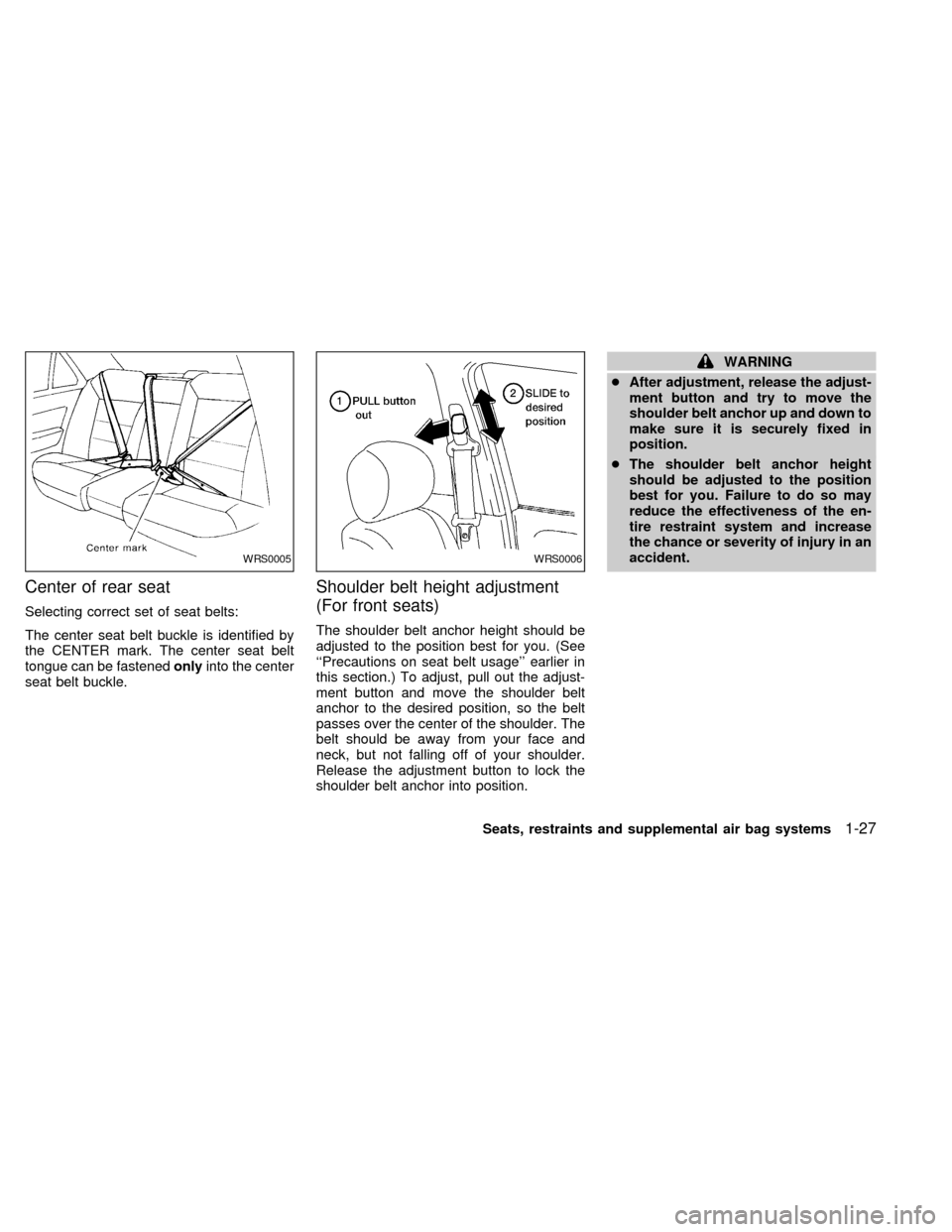
Center of rear seat
Selecting correct set of seat belts:
The center seat belt buckle is identified by
the CENTER mark. The center seat belt
tongue can be fastenedonlyinto the center
seat belt buckle.
Shoulder belt height adjustment
(For front seats)
The shoulder belt anchor height should be
adjusted to the position best for you. (See
``Precautions on seat belt usage'' earlier in
this section.) To adjust, pull out the adjust-
ment button and move the shoulder belt
anchor to the desired position, so the belt
passes over the center of the shoulder. The
belt should be away from your face and
neck, but not falling off of your shoulder.
Release the adjustment button to lock the
shoulder belt anchor into position.
WARNING
cAfter adjustment, release the adjust-
ment button and try to move the
shoulder belt anchor up and down to
make sure it is securely fixed in
position.
cThe shoulder belt anchor height
should be adjusted to the position
best for you. Failure to do so may
reduce the effectiveness of the en-
tire restraint system and increase
the chance or severity of injury in an
accident.
WRS0005WRS0006
Seats, restraints and supplemental air bag systems1-27
ZX
Page 183 of 242
Self-adjusting brakes
Your vehicle is equipped with self-adjusting
brakes.
The front (and rear, if equipped) disc-type
brakes self-adjust every time the brake
pedal is applied. The rear drum-type brakes
also self-adjust every time the brake pedal
is applied.
If the brake pedal goes down farther than
normal, it may be due to a lack of adjust-
ment of the rear drum brakes. To adjust,
apply the parking brake several times.
WARNING
See an authorized NISSAN dealer for a
brake system check if the brake pedal
height does not return to normal.
Brake pad wear indicators
The disc brake pads on your vehicle have
audible wear indicators. When a brake pad
requires replacement, it makes a high
pitched scraping or screeching sound when
the vehicle is in motion whether or not the
brake pedal is depressed. Have the brakes
checked as soon as possible if the wearindicator sound is heard.
Under some driving or climate conditions,
occasional brake squeak, squeal or other
noise may be heard. Occasional brake
noise during light to moderate stops is nor-
mal and does not affect the function or
performance of the brake system.
The rear drum brakes (if so equipped) do
not have audible wear indicators. Should
you ever hear an unusually loud noise from
the rear drum brakes, have them inspected
as soon as possible by an authorized
NISSAN dealer.
Proper brake inspection intervals should
be followed.For more information regard-
ing brake inspections, see the appropriate
maintenance schedule information in the
``Maintenance'' section of this manual.
BRAKE BOOSTER
Check the brake booster function as fol-
lows:
1. With the engine off, press and release
the brake pedal several times. When
brake pedal movement (distance of
travel) remains the same from one pedal
application to the next, continue on to the
next step.
2. While depressing the brake pedal, start
the engine. The pedal height should drop
a little.
3. With the brake pedal depressed, stop the
engine. Keep the pedal depressed for
about 30 seconds. The pedal height
should not change.
4. Run the engine for one minute without
depressing the brake pedal, then turn it
off. Depress the brake pedal several
times. The pedal travel distance will de-
crease gradually with each depression
as the vacuum is released from the
booster.
If the brakes do not operate properly, see an
authorized NISSAN dealer.
8-20Do-it-yourself
ZX
Page 188 of 242

3. Remove the three nuts and one bolt
mounting the headlamp assembly (see
above illustration).
4. Pull the headlamp assembly evenly away
from the front of the vehicle to access the
bulb sockets.5. Disconnect the harness connector from
the back side of the bulb socket (see
above illustration).
6. Turn the bulb retaining ring counter-
clockwise until it is free from the head-
lamp assembly and then remove it.
7. Remove the bulb by pulling it straight out
of the lamp assembly. Do not shake the
bulb when removing it.
8. Follow the instructions in reverse order to
install new bulb.
Headlamp mounting nuts and bolt
torque: 36 to 47 in-lb (4.1 to 5.3 Nzm)
Adjusting the headlight aim
Before performing aiming adjustment, make
sure of the following:
a. Use an aiming wall screen.
b. Keep all of the tires inflated to the correct
pressure.
c. Place the vehicle and screen on level
ground.
d. See that the vehicle is unloaded (except
for full levels of coolant, engine oil and
fuel, and that the spare tire, jack, and
tools are stored). Have the driver or an
equivalent weight placed in the driver's
seat.
Low beam
1. Open the hood. Turn headlamp low
beam on.
2. Adjust the vertical aim by turning the
adjusting screw.
cCover the opposite lamp and ensure the
fog lamps (if so equipped) are turned off.
cAdjust beam pattern until cutoff line is
positioned at the same height off ground
as bulb center (on H-line).
LDI0010LDI0011
Do-it-yourself8-25
ZX
Page 200 of 242
cImproper service of the spare tire
may result in serious personal in-
jury. If it is necessary to repair the
spare tire, contact an authorized
NISSAN dealer.
Replacing wheels and tires
When replacing a tire, use the same size,
tread design, speed rating and load carrying
capacity as originally equipped. Recom-
mended types and sizes are shown in
``wheels/tire size'' in the ``Technical and con-
sumer information'' section of this manual.
WARNING
c
The use of tires other than those rec-
ommended, or the mixed use of tires
of different brands, construction (bias,
bias-belted, radial), or tread patterns
can adversely affect the ride, braking,
handling, ground clearance, body-to-
tire clearance, tire chain clearance,
speedometer calibration, headlight
aim and bumper height. Some of these
effects may lead to accidents and
could result in serious personal injury.cIf the wheels are changed for any rea-
son, always replace with wheels which
have the same off-set dimension.
Wheels of a different off-set could
cause pre-mature tire wear, degrade
vehicle handling characteristics
and/or interference with the brake
discs/drums. Such interference can
lead to decreased braking efficiency
and/or early brake pad/shoe wear. Re-
fer to ``Wheel/tire size'' in the ``Techni-
cal and consumer information'' sec-
tion of this manual for wheel off-set
dimensions.
cDo not install a deformed wheel or
tire even if it has been repaired. Such
wheels or tires could have unknown
structural damage and could fail
without warning.
cThe use of retread tires is not recom-
mended.
Wheel balance
Unbalanced wheels may affect vehicle han-
dling and tire life. Even with regular use,
wheels can get out of balance. Therefore,
they should be balanced as required.
Wheel balance service should be per-
formed with the wheels off the vehicle. Spin
balancing the front wheels on the vehicle
could lead to transmission damage.
Care of wheels
cWash the wheels when washing the ve-
hicle to maintain their appearance.
cClean the inner side of the wheels when
the wheel is changed or the underside of
the vehicle is washed.
cDo not use abrasive cleaners when
washing the wheels.
cInspect wheel rims regularly for dents or
corrosion. Such damage may cause loss
of pressure or poor seal at the tire bead.
cNISSAN recommends waxing the road
wheels to protect against road salt in
areas where it is used during winter.
Spare tire (TEMPORARY USE
ONLY spare tire)
Observe the following precautions if the
TEMPORARY USE ONLY spare tire must
be used, otherwise your vehicle could be
damaged or involved in an accident:
Do-it-yourself
8-37
ZX
Page 222 of 242

WHEELS AND TIRES
Conventional T type (Spare)
Road wheel
Steel XE, GXE 15 x 6JJ 15 x 4T
Aluminum
SE, GLE, GXE
(1)16 x 6JJ 15 x 4T
Offset in (mm) 1.77 (45) 1.57 (40)
Tire size XE P195/65R15
GXE P205/60R15T
GXE, GLE P205/55R16T T125/70D15
SE P205/55R16H
(1) if so equipped
DIMENSIONS AND WEIGHTS
Overall length in (mm) 185.7 (4,717)
Overall width in (mm) 69.1 (1,754)
Overall height in (mm) 55.9 (1,420)
Front tread in (mm) 59.3 (1,505)
Rear tread in (mm) 58.9 (1,495)
Wheelbase in (mm) 103.1 (2,620)
Gross vehicle weight rating lb (kg)
See the ``F.M.V.S.S.
certification label'' on
the driver side, center
door pillar. Gross axle weight rating
Front lb (kg)
Rear lb (kg)
Technical and consumer information10-9
ZX
Page 239 of 242

Mirror
Inside mirror.......................................... 3-14
Outside mirror control ........................... 3-14
Vanity mirror ......................................... 3-13
Multi-remote control system ........................ 3-5
Multi-remote controller battery
replacement ............................................... 8-23
N
Nissan vehicle immobilizer system
(NVIS) ......................................... 2-12, 3-2, 5-6
O
Octane rating (See fuel octane rating) ...... 10-3
Odometer ..................................................... 2-3
Oil
Capacities and recommended fuel/
lubricants .............................................. 10-2
Changing engine oil................................ 8-9
Changing engine oil filter...................... 8-10
Checking engine oil level ....................... 8-8
Engine oil ................................................ 8-8
Engine oil and oil filter
recommendation ................................... 10-5
Engine oil viscosity ............................... 10-5
Outside mirror control ................................ 3-14
Overdrive switch ........................................ 5-11
Overheat
If your vehicle overheats ...................... 6-10Owner's manual/service manual order
information ............................................... 10-21
P
Parking
Parking brake check ............................. 8-19
Parking brake operation ....................... 5-13
Parking/parking on hills ........................ 5-17
Periodic maintenance schedules ................. 9-5
Power
Power door locks .................................... 3-3
Power socket ........................................ 2-19
Power steering fluid .............................. 8-12
Power steering system ......................... 5-18
Power windows..................................... 2-26
Precautions
Maintenance precautions ....................... 8-2
Precautions on seat belt usage............ 1-21
Precautions when starting and driving ... 5-2
Push starting .............................................. 6-10
R
Radio
Car phone or CB radio ......................... 4-24
FM-AM radio with cassette player and
compact disc (CD) player ..................... 4-17
FM-AM radio with compact disc (CD)
player .................................................... 4-10Readiness for inspection maintenance
(I/M) test................................................... 10-20
Rear seat ..................................................... 1-6
Rear window defogger switch ................... 2-15
Refrigerant recommendation ..................... 10-7
Registering your vehicle in another
country ..................................................... 10-10
Remote keyless entry system
(See multi-remote control system) .............. 3-5
Reporting safety defects (USA) ............... 10-19
S
Safety
Child safety rear door lock ..................... 3-5
Reporting safety defects (USA) .......... 10-19
Seat adjustment
Front manual seat adjustment................ 1-3
Front power seat adjustment.................. 1-4
Rear seat adjustment ............................. 1-6
Seat belt
Precautions on seat belt usage............ 1-21
Seat belt extenders .............................. 1-28
Seat belt maintenance.......................... 1-28
Seat belts.............................................. 1-21
Shoulder belt height adjustment ........... 1-27
Three-point type with retractor ............. 1-24
Seat belt warning light ................................. 2-7
Seats
Front seats.............................................. 1-2
Rear seat ................................................ 1-6
Security systems (see theft warning) ........ 2-10
11-4
ZX