2000 NISSAN ALTIMA instrument panel
[x] Cancel search: instrument panelPage 90 of 242
cause harmful interference, and (2) this
device must accept any interference re-
ceived including interference that may
cause undesired operation of the device.
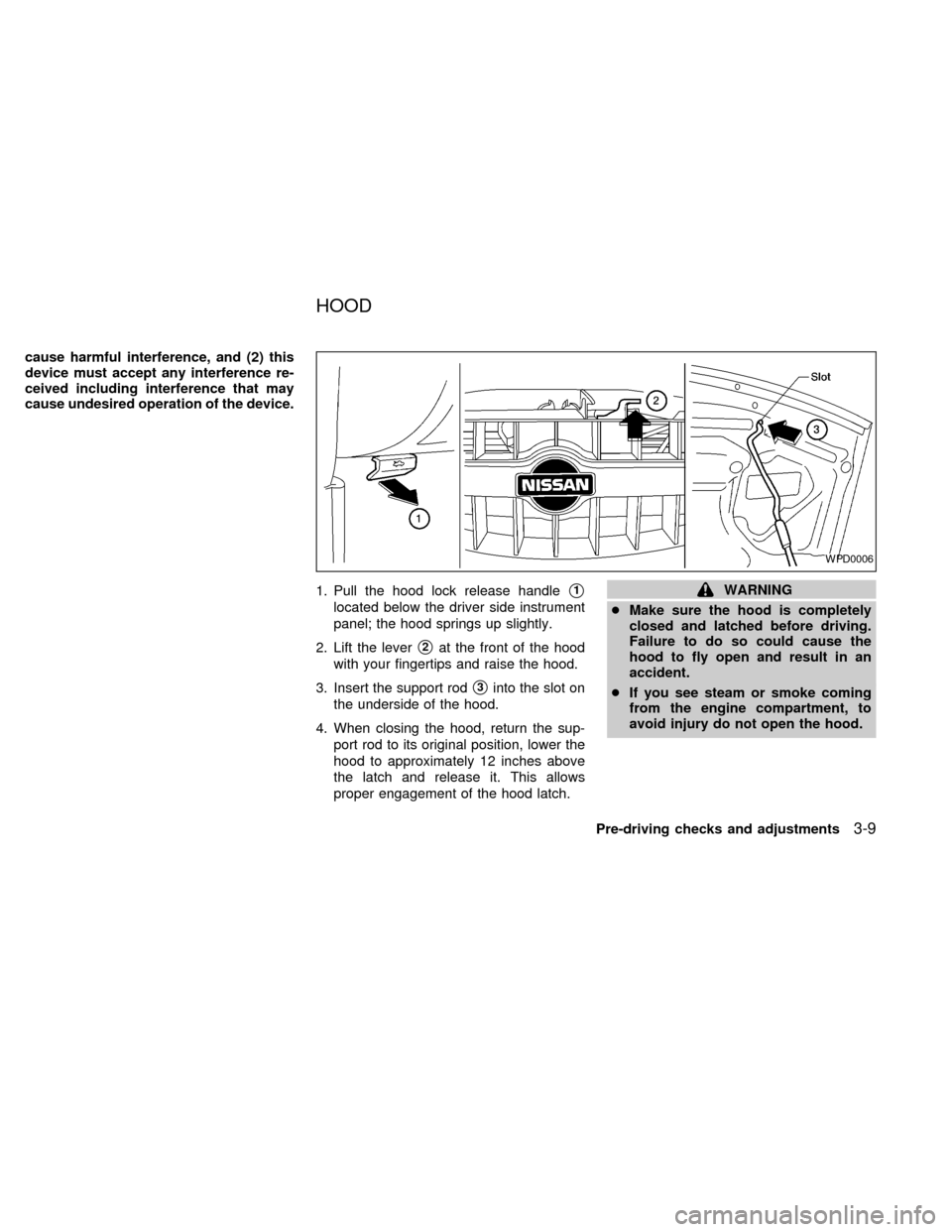
1. Pull the hood lock release handle
s1
located below the driver side instrument
panel; the hood springs up slightly.
2. Lift the lever
s2at the front of the hood
with your fingertips and raise the hood.
3. Insert the support rod
s3into the slot on
the underside of the hood.
4. When closing the hood, return the sup-
port rod to its original position, lower the
hood to approximately 12 inches above
the latch and release it. This allows
proper engagement of the hood latch.
WARNING
cMake sure the hood is completely
closed and latched before driving.
Failure to do so could cause the
hood to fly open and result in an
accident.
cIf you see steam or smoke coming
from the engine compartment, to
avoid injury do not open the hood.
WPD0006
HOOD
Pre-driving checks and adjustments3-9
ZX
Page 130 of 242

Accelerator downshiftÐ
in D positionÐ
For rapid passing or hill climbing while driv-
ing, fully depress the accelerator pedal to
the floor. This shifts the transmission down
into second gear or first gear, depending on
vehicle speed.
Overdrive switch
ON: With the engine running and the
selector lever in the D (Drive) posi-
tion, the transmission upshifts into
OVERDRIVE as vehicle speed in-
creases.
OVERDRIVE does not engage until the
engine has reached operating tempera-
ture.OFF: For driving up and down long slopes
where engine braking is necessary,
push the OVERDRIVE switch once.
The O/D OFF indicator light on the
instrument panel comes on at this
time.
When cruising at a low speed or
climbing a gentle slope, you may feel
uncomfortable shift shocks as the
transmission shifts between 3rd gear
and overdrive repeatedly. In this
case, depress the OVERDRIVE
switch to turn the OVERDRIVE off.
The O/D off indicator light on the
instrument panel comes on at this
time.
When driving conditions change, depress
the overdrive switch on the selector/lever to
turn the OVERDRIVE on.
Remember not to drive at high speeds for
extended periods of time with the OVER-
DRIVE off. This reduces fuel economy.
ASD1004
Starting and driving5-11
ZX
Page 133 of 242
PRECAUTIONS ON CRUISE
CONTROL
cIf the cruise control system malfunctions,
it cancels automatically. The SET indica-
tor light in the instrument panel then
blinks to warn the driver.
cIf the SET indicator light blinks, turn the
cruise control main switch off and have
the system checked by an authorized
NISSAN dealer.
cThe SET indicator light may blink when
the cruise control main switch is turned
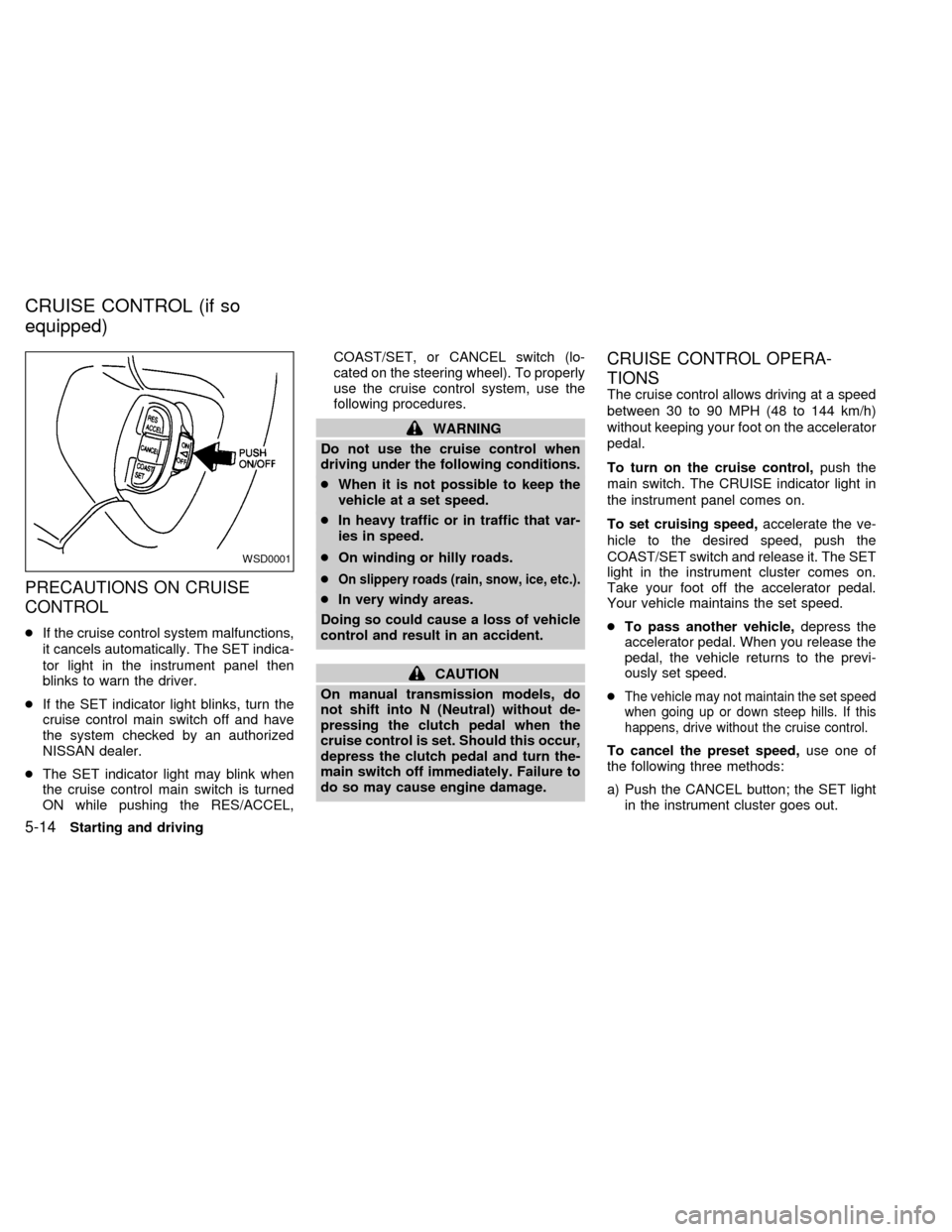
ON while pushing the RES/ACCEL,COAST/SET, or CANCEL switch (lo-
cated on the steering wheel). To properly
use the cruise control system, use the
following procedures.
WARNING
Do not use the cruise control when
driving under the following conditions.
cWhen it is not possible to keep the
vehicle at a set speed.
cIn heavy traffic or in traffic that var-
ies in speed.
cOn winding or hilly roads.
c
On slippery roads (rain, snow, ice, etc.).
cIn very windy areas.
Doing so could cause a loss of vehicle
control and result in an accident.
CAUTION
On manual transmission models, do
not shift into N (Neutral) without de-
pressing the clutch pedal when the
cruise control is set. Should this occur,
depress the clutch pedal and turn the-
main switch off immediately. Failure to
do so may cause engine damage.
CRUISE CONTROL OPERA-
TIONS
The cruise control allows driving at a speed
between 30 to 90 MPH (48 to 144 km/h)
without keeping your foot on the accelerator
pedal.
To turn on the cruise control,push the
main switch. The CRUISE indicator light in
the instrument panel comes on.
To set cruising speed,accelerate the ve-
hicle to the desired speed, push the
COAST/SET switch and release it. The SET
light in the instrument cluster comes on.
Take your foot off the accelerator pedal.
Your vehicle maintains the set speed.
cTo pass another vehicle,depress the
accelerator pedal. When you release the
pedal, the vehicle returns to the previ-
ously set speed.
c
The vehicle may not maintain the set speed
when going up or down steep hills. If this
happens, drive without the cruise control.
To cancel the preset speed,use one of
the following three methods:
a) Push the CANCEL button; the SET light
in the instrument cluster goes out.
WSD0001
CRUISE CONTROL (if so
equipped)
5-14Starting and driving
ZX
Page 134 of 242

b) Tap the brake pedal; the SET light goes
out.
c) Turn the main switch off. Both the
CRUISE indicator on the main switch and
SET light in the instrument cluster go out.
The cruise control is automatically can-
celled and the SET light in the instrument
panel goes out if:
cyou depress the brake or clutch pedal
while pushing the RES/ACCEL or
COAST/SET switch.
cthe vehicle slows down more than 8 MPH
(13 km/h) below the set speed.
cyou depress the clutch pedal (manual
transmission), or move the shift selector
lever to N (Neutral) (automatic transmis-
sion).
To reset at a faster cruising speed,use
one of the following three methods.
a) Depress the accelerator pedal. When the
vehicle attains the desired speed, push
and release the COAST/SET switch.
b) Push and hold the RES/ACCEL switch.
When the vehicle attains the speed you
desire, release the switch.c)Push and release the RES/ACCEL switch.
Each time you do this, the set speed
increases by about 1 MPH (1.6 km/h).
To reset at a slower cruising speed,use
one of the following three methods:
a) Lightly tap the brake pedal. When the
vehicle attains the desired speed, push
the COAST/SET switch and release it.
b) Push and hold the COAST/SET switch.
Release the switch when the vehicle
slows to the desired speed.
c) Push and release the COAST/SET
switch. Each time you do this, the set
speed decreases by about 1 MPH (1.6
km/h).
To resume the preset speed,push and re-
lease the RES/ACCEL switch. The vehicle
returns to the last set cruising speed when the
vehicle speed is over 30 MPH (48 km/h).
During the first 1,000 miles (1,600 km),
follow these recommendations for the future
reliability and economy of your new vehicle.
Failure to follow these recommendations
may result in vehicle damage or shortened
engine life.
cDo not drive over the legal speed limit
and do not run the engine over 4,000
rpm. Avoid driving for long periods at
constant speed, either fast or slow.
cDo not accelerate at full throttle in any
gear.
cAvoid quick starts.
cAvoid hard braking as much as possible.
cDo not tow a trailer for the first 500 miles
(800 km).
BREAK-IN SCHEDULE
Starting and driving5-15
ZX
Page 236 of 242
11 Index
A
Air bag (See supplemental restraint
system) ........................................................ 1-9
Air bag warning light ................. 1-14, 1-19, 2-7
Air cleaner housing filter ............................ 8-16
Air conditioner
Air conditioner operation ........................ 4-5
Air conditioner service ............................ 4-9
Air conditioner specification label ....... 10-12
Air conditioner system refrigerant and
lubrication recommendations ................ 10-7
Heater and air conditioner controls ........ 4-3
Servicing air conditioner ......................... 4-9
Air flow charts .............................................. 4-6
Alarm system (See theft warning) ............. 2-10
Anchor point locations ............................... 1-35
Antenna...................................................... 4-23
Anti-lock brake system (ABS).................... 5-19
Anti-lock brake warning light ....................... 2-8
Armrests....................................................... 1-8
Ashtray (See cigarette lighter and
ashtray) ...................................................... 2-20
Audio system
FM-AM radio with cassette player and
compact disc (CD) player ..................... 4-17
FM-AM radio with compact disc (CD)
player .................................................... 4-10Automatic
Automatic power window switch .......... 2-27
Automatic transmission fluid (ATF) ...... 8-10
Driving with automatic transmission ....... 5-4
Transmission selector lever lock
release .................................................. 5-10
B
Battery........................................................ 8-14
Battery
Charge warning light .............................. 2-7
Battery replacement (See multi-remote
control system) ............................................ 3-8
Before starting the engine ........................... 5-6
Belts (See drive belts) ...................... 10-8, 8-15
Brake
Anti-lock brake system (ABS) .............. 5-19
Brake booster ....................................... 8-20
Brake fluid............................................. 8-12
Brake light (See stop light) ................... 8-33
Brake pedal .......................................... 8-19
Brake system ........................................ 5-18
Brake warning light ................................. 2-7
Brake wear indicators ................... 2-8, 8-20
Parking brake check ............................. 8-19
Parking brake operation ....................... 5-13
Self-adjusting brakes ............................ 8-20Break-in schedule ...................................... 5-15
Bulb check/instrument panel ....................... 2-6
Bulb replacement ....................................... 8-30
C
Capacities and recommended fuel/
lubricants.................................................... 10-2
Car phone or CB radio .............................. 4-24
Cargo net ................................................... 2-25
Cargo (See vehicle loading
information) .............................................. 10-13
Check engine indicator light
(See malfunction indicator light) .................. 2-9
Child restraint with top tether strap ........... 1-35
Child restraints ................................. 1-23, 1-28
Child safety rear door lock .......................... 3-5
Cigarette lighter (accessory)
and ashtray ................................................ 2-20
Cleaning exterior and interior ...................... 7-2
Clock................................................. 4-12, 4-19
Clutch
Clutch fluid ............................................ 8-12
Clutch pedal.......................................... 8-21
Cold weather driving .................................. 5-20
Controls
Heater and air conditioner controls ........ 4-3
ZX
Page 238 of 242

Tachometer............................................. 2-4
Trip odometer ......................................... 2-3
General maintenance .................................. 9-2
Glasses case ............................................. 2-21
Glove box................................................... 2-23
Glove box lock ........................................... 2-23
H
Hazard warning flasher switch .................. 2-18
Head restraints ............................................ 1-8
Headlight and turn signal switch ............... 2-16
Heater
Heater and air conditioner controls ........ 4-3
Heater operation ..................................... 4-4
Homelink Transceiver
Integrated HomeLinkTUniversal
Transceiver (If so equipped) ................ 2-30
Hood release ............................................... 3-9
Horn ........................................................... 2-19
I
Ignition switch .............................................. 5-4
Immobilizer system ..................... 2-12, 3-2, 5-6
Important vehicle information label.......... 10-11
Increasing fuel economy............................ 5-16
Indicator lights and chimes (See warning/
indicator lights and chimes) ......................... 2-6
Inside mirror ............................................... 3-14
Instrument brightness control .................... 2-17Integrated HomeLinkTUniversal
Transceiver (If so equipped)...................... 2-30
Interior light ................................................ 2-29
J
Jump starting ...................................... 6-8, 8-15
K
Key ............................................................... 3-2
Keyless entry system (See multi-remote
control system) ............................................ 3-5
L
Labels
Air conditioner specification label ....... 10-12
Emission control information label...... 10-12
Engine serial number ......................... 10-11
F.M.V.S.S. certification label .............. 10-11
Vehicle identification number (VIN)
plate .................................................... 10-10
Warning labels (for SRS) ..................... 1-19
License plate
Installing the license plate .................. 10-13
Light
Air bag warning light ............ 1-14, 1-19, 2-7
Brake light (See stop light) ................... 8-33
Bulb check/instrument panel .................. 2-6
Bulb replacement.................................. 8-30Charge warning light .............................. 2-7
Cornering light ...................................... 2-18
Front fog light switch ............................ 2-18
Headlight and turn signal switch .......... 2-16
Interior light ........................................... 2-29
Low washer fluid warning light ............... 2-7
Spotlights (See map light) .................... 2-29
Trunk light ............................................. 2-30
Warning/indicator lights and chimes ...... 2-6
Lock
Child safety rear door lock ..................... 3-5
Door locks............................................... 3-2
Fuel filler lid lock opener lever ............. 3-11
Glove box lock ...................................... 2-23
Power door locks .................................... 3-3
Trunk lid lock opener lever ................... 3-10
M
Maintenance
General maintenance ............................. 9-2
Inside the vehicle.................................... 9-3
Maintenance precautions ....................... 8-2
Outside the vehicle ................................. 9-2
Periodic maintenance schedules ............ 9-5
Seat belt maintenance.......................... 1-28
Under the hood and vehicle ................... 9-4
Malfunction indicator lamp (MIL) ................. 2-9
Map lights .................................................. 2-29
Map pocket ................................................ 2-21
Meters and gauges ...................................... 2-2
11-3
ZX