2000 NISSAN ALTIMA flat tire
[x] Cancel search: flat tirePage 188 of 242

3. Remove the three nuts and one bolt
mounting the headlamp assembly (see
above illustration).
4. Pull the headlamp assembly evenly away
from the front of the vehicle to access the
bulb sockets.5. Disconnect the harness connector from
the back side of the bulb socket (see
above illustration).
6. Turn the bulb retaining ring counter-
clockwise until it is free from the head-
lamp assembly and then remove it.
7. Remove the bulb by pulling it straight out
of the lamp assembly. Do not shake the
bulb when removing it.
8. Follow the instructions in reverse order to
install new bulb.
Headlamp mounting nuts and bolt
torque: 36 to 47 in-lb (4.1 to 5.3 Nzm)
Adjusting the headlight aim
Before performing aiming adjustment, make
sure of the following:
a. Use an aiming wall screen.
b. Keep all of the tires inflated to the correct
pressure.
c. Place the vehicle and screen on level
ground.
d. See that the vehicle is unloaded (except
for full levels of coolant, engine oil and
fuel, and that the spare tire, jack, and
tools are stored). Have the driver or an
equivalent weight placed in the driver's
seat.
Low beam
1. Open the hood. Turn headlamp low
beam on.
2. Adjust the vertical aim by turning the
adjusting screw.
cCover the opposite lamp and ensure the
fog lamps (if so equipped) are turned off.
cAdjust beam pattern until cutoff line is
positioned at the same height off ground
as bulb center (on H-line).
LDI0010LDI0011
Do-it-yourself8-25
ZX
Page 197 of 242
If you have a flat tire, see the ``In case of
emergency'' section of this manual.
TIRE PRESSURE
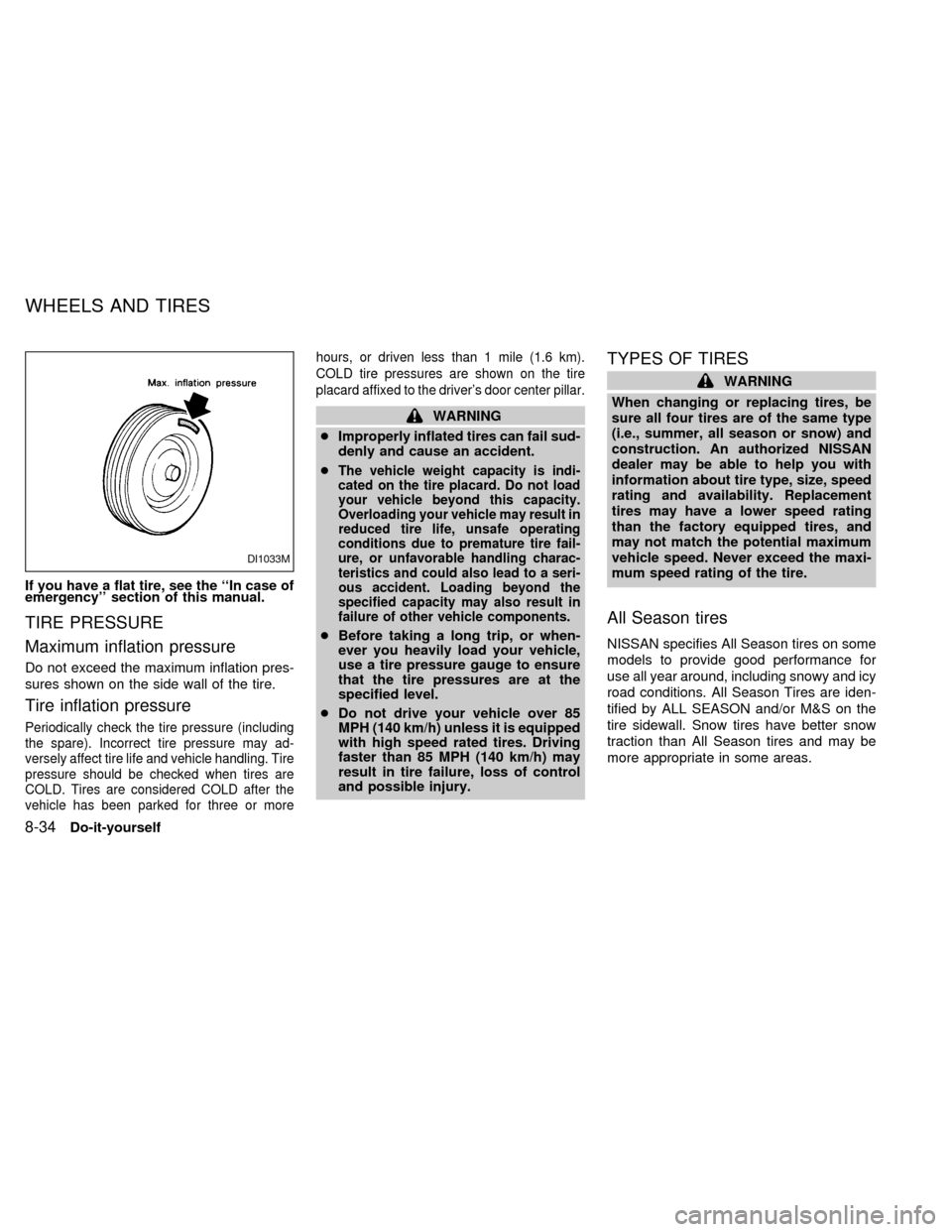
Maximum inflation pressure
Do not exceed the maximum inflation pres-
sures shown on the side wall of the tire.
Tire inflation pressure
Periodically check the tire pressure (including
the spare). Incorrect tire pressure may ad-
versely affect tire life and vehicle handling. Tire
pressure should be checked when tires are
COLD. Tires are considered COLD after the
vehicle has been parked for three or morehours, or driven less than 1 mile (1.6 km).
COLD tire pressures are shown on the tire
placard affixed to the driver's door center pillar.
WARNING
cImproperly inflated tires can fail sud-
denly and cause an accident.
c
The vehicle weight capacity is indi-
cated on the tire placard. Do not load
your vehicle beyond this capacity.
Overloading your vehicle may result in
reduced tire life, unsafe operating
conditions due to premature tire fail-
ure, or unfavorable handling charac-
teristics and could also lead to a seri-
ous accident. Loading beyond the
specified capacity may also result in
failure of other vehicle components.
cBefore taking a long trip, or when-
ever you heavily load your vehicle,
use a tire pressure gauge to ensure
that the tire pressures are at the
specified level.
cDo not drive your vehicle over 85
MPH (140 km/h) unless it is equipped
with high speed rated tires. Driving
faster than 85 MPH (140 km/h) may
result in tire failure, loss of control
and possible injury.
TYPES OF TIRES
WARNING
When changing or replacing tires, be
sure all four tires are of the same type
(i.e., summer, all season or snow) and
construction. An authorized NISSAN
dealer may be able to help you with
information about tire type, size, speed
rating and availability. Replacement
tires may have a lower speed rating
than the factory equipped tires, and
may not match the potential maximum
vehicle speed. Never exceed the maxi-
mum speed rating of the tire.
All Season tires
NISSAN specifies All Season tires on some
models to provide good performance for
use all year around, including snowy and icy
road conditions. All Season Tires are iden-
tified by ALL SEASON and/or M&S on the
tire sidewall. Snow tires have better snow
traction than All Season tires and may be
more appropriate in some areas.
DI1033M
WHEELS AND TIRES
8-34Do-it-yourself
ZX
Page 199 of 242
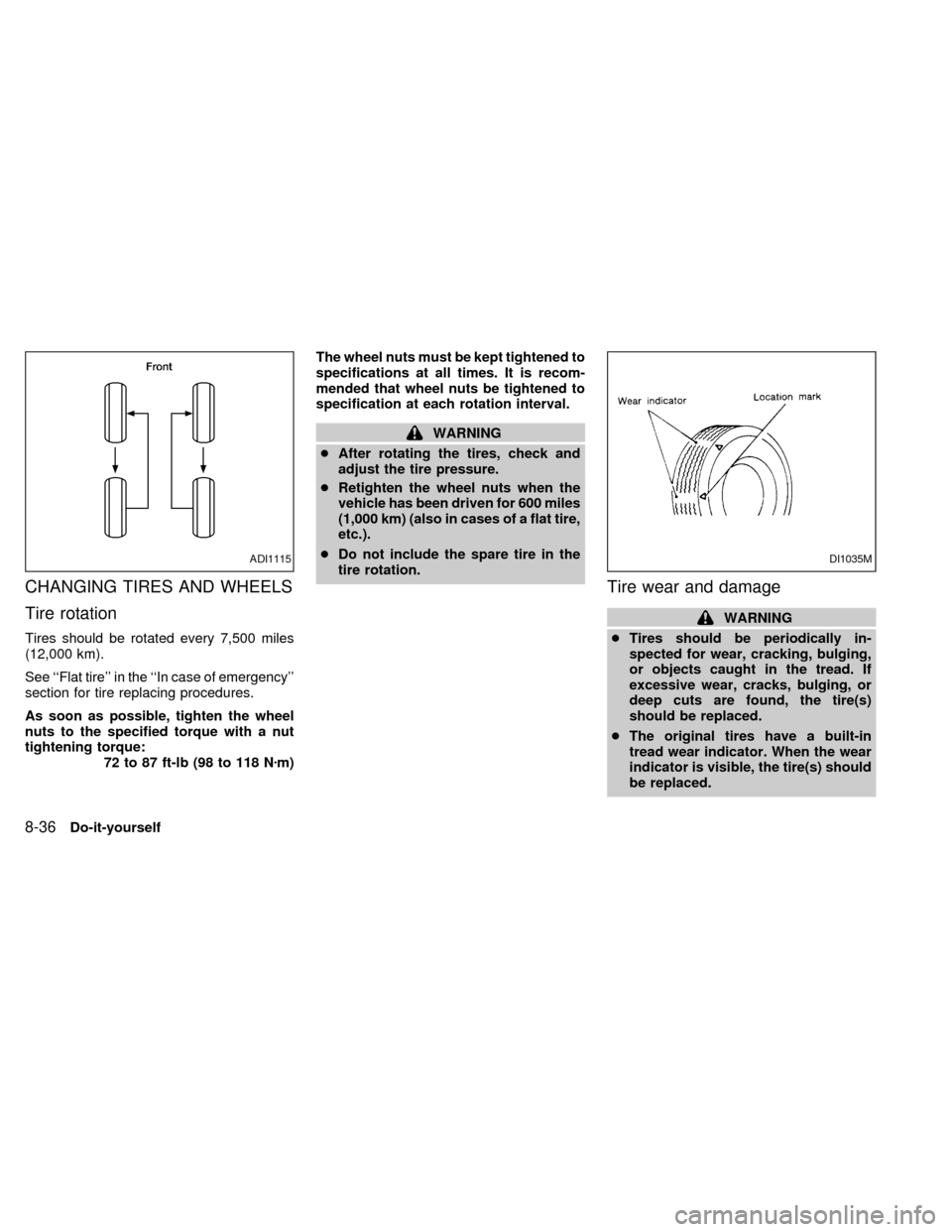
CHANGING TIRES AND WHEELS
Tire rotation
Tires should be rotated every 7,500 miles
(12,000 km).
See ``Flat tire'' in the ``In case of emergency''
section for tire replacing procedures.
As soon as possible, tighten the wheel
nuts to the specified torque with a nut
tightening torque:
72 to 87 ft-lb (98 to 118 Nzm)The wheel nuts must be kept tightened to
specifications at all times. It is recom-
mended that wheel nuts be tightened to
specification at each rotation interval.
WARNING
cAfter rotating the tires, check and
adjust the tire pressure.
cRetighten the wheel nuts when the
vehicle has been driven for 600 miles
(1,000 km) (also in cases of a flat tire,
etc.).
cDo not include the spare tire in the
tire rotation.
Tire wear and damage
WARNING
cTires should be periodically in-
spected for wear, cracking, bulging,
or objects caught in the tread. If
excessive wear, cracks, bulging, or
deep cuts are found, the tire(s)
should be replaced.
cThe original tires have a built-in
tread wear indicator. When the wear
indicator is visible, the tire(s) should
be replaced.
ADI1115DI1035M
8-36Do-it-yourself
ZX
Page 229 of 242
hitch, trailer tongue load and any other
optional equipment. In addition, front or rear
gross axle weight must not exceed the
gross axle weight rating (GAWR) shown on
the F.M.V.S.S. certification label.
TOWING LOAD/SPECIFICATION
CHART
UNIT: lb (kg)
MAXIMUM
TOWING LOAD1,000 (454)
MAXIMUM
TONGUE LOAD110 (49)
TOWING SAFETY
Trailer hitch
Choose a proper hitch for your vehicle and
trailer. A genuine NISSAN trailer hitch is
available from your NISSAN dealer
(Canada only). Make sure the trailer hitch is
securely attached to the vehicle, to help
avoid personal injury or property damage
due to sway caused by crosswinds, rough
road surfaces or passing trucks.
CAUTION
cDo not use axle-mounted hitches.
cThe hitch should not be attached to
or affect the operation of the impact-
absorbing bumper.
cDo not modify the vehicle exhaust
system, brake system, etc. to install
a trailer hitch.
cTo reduce the possibility of addi-
tional damage if your vehicle is
struck from the rear, where practical,
remove the hitch and/or receiver
when not in use.
cAfter the hitch is removed, seal the
bolt holes to prevent exhaust fumes,
water or dust from entering the pas-
senger compartment.
cRegularly check that all hitch mount-
ing bolts are securely mounted.
Tire pressures
cWhen towing a trailer, inflate the vehicle
tires to the recommended cold tire pres-
sure indicated on the tire placard (affixed
to the driver's door, center pillar).cTrailer tire condition, size, load rating and
proper inflation pressure should be in
accordance with the trailer and tire
manufacturer's specifications.
Safety chains
Always use suitable chains between your
vehicle and the trailer. Safety chains should
be crossed and should be attached to the
hitch, not to the vehicle bumper or axle. Be
sure to leave enough slack in the chains to
permit turning corners.
Trailer lights
Trailer lights should comply with federal
and/ or local regulations. When wiring the
vehicle for towing, connect the stop and tail
light pickup into the vehicle electrical circuit.
Trailer brakes
If your trailer is equipped with a braking
system, make sure it conforms to Federal
and/or local regulations and that it is prop-
erly installed.
10-16Technical and consumer information
ZX
Page 232 of 242
WARNING
The temperature grade for this tire is
established for a tire that is properly
inflated and not overloaded. Excessive
speed, underinflation, or excessive
loading, either separately or in combi-
nation, can cause heat buildup and
possible tire failure.Your NISSAN vehicle is covered by the
following emission warranties:
For US
1) Emission Defects Warranty
2) Emissions Performance Warranty
For Canada
Emission Control System Warranty
Details of these warranties may be found
with other vehicle warranties in your war-
ranty information booklet that comes with
your NISSAN vehicle. If you did not receive
a warranty booklet, or it is lost, you may
obtain a replacement by writing to:
cNissan North America Inc.
Consumer Affairs Department
P.O. Box 191
Gardena, CA 90248-0191
cNissan Canada Inc.
5290 Orbitor Drive
Mississauga, Ontario, L4W 4Z5If you believe that your vehicle has a defect
which could cause a crash or could cause
injury or death, you should immediately
inform the National Highway Traffic Safety
Administration
(NHTSA)in addition to no-
tifying NISSAN.
If
NHTSAreceives similar complaints, it
may open an investigation, and if it finds
that a safety defect exists in a group of
vehicles, it may order a recall and remedy
campaign. However,
NHTSAcannot be-
come involved in individual problems be-
tween you, your dealer, or NISSAN.
To contact
NHTSA, you may either call the
Auto Safety Hotline toll-free at 1-800-424-
9393 (or 366-0123 in Washington, D.C.
area) or write to:
NHTSA, U.S. Depart-
ment of Transportation, Washington, D.C.
20590. You can also obtain other informa-
tion about motor vehicle safety from the
Hotline.
You may notify NISSAN by contacting our
Consumer Affairs Department, toll-free, at
1-800-NISSAN-1.
In Hawaii call (808) 836-0888.
EMISSION CONTROL
SYSTEM WARRANTYREPORTING SAFETY
DEFECTS (US only)
Technical and consumer information10-19
ZX
Page 237 of 242

Coolant
Capacities and recommended fuel/
lubricants .............................................. 10-2
Changing engine coolant........................ 8-6
Checking engine coolant level ............... 8-5
Engine coolant temperature gauge ........ 2-4
Cornering light ........................................... 2-18
Corrosion protection .................................... 7-6
Cruise control............................................. 5-14
Cup holders ............................................... 2-22
D
Daytime running light system
(Canada only) ............................................ 2-17
Defogger switch
Rear window defogger switch .............. 2-15
Dimensions and weights............................ 10-9
Door locks .................................................... 3-2
Door open warning light .............................. 2-7
Drive belts .................................................. 8-15
Driving
Cold weather driving............................. 5-20
Driving with automatic transmission ....... 5-4
Driving with manual transmission ........... 5-5
Precautions when starting and driving ... 5-2
E
Economy - fuel........................................... 5-16
Emission control information label........... 10-12Emission control system warranty ........... 10-19
Engine
Before starting the engine ...................... 5-6
Capacities and recommended fuel/
lubricants .............................................. 10-2
Changing engine coolant........................ 8-6
Changing engine oil................................ 8-9
Changing engine oil filter...................... 8-10
Checking engine coolant level ............... 8-5
Checking engine oil level ....................... 8-8
Engine compartment check locations .... 8-4
Engine coolant temperature gauge ........ 2-4
Engine cooling system ........................... 8-5
Engine oil ................................................ 8-8
Engine oil and oil filter
recommendation ................................... 10-5
Engine oil pressure warning light ........... 2-6
Engine oil viscosity ............................... 10-5
Engine serial number ......................... 10-11
Engine specifications ............................ 10-8
Starting the engine ................................. 5-7
Enhanced immobilizer security system ..... 2-12
Exhaust gas (Carbon monoxide) ................. 5-2
Explanation of maintenance items .............. 9-2
F
Flashers (See hazard warning flasher
switch) ........................................................ 2-18
Flat tire ......................................................... 6-2
Floor mat positioning aid ............................. 7-5Fluid
Automatic transmission fluid (ATF) ...... 8-10
Brake fluid............................................. 8-12
Capacities and recommended fuel/
lubricants .............................................. 10-2
Clutch fluid ............................................ 8-12
Engine coolant ........................................ 8-5
Engine oil ................................................ 8-8
Power steering fluid .............................. 8-12
Window washer fluid ............................ 8-13
F.M.V.S.S. certification label ................... 10-11
Front fog light switch ................................. 2-18
Front seats ................................................... 1-2
Fuel
Capacities and recommended fuel/
lubricants .............................................. 10-2
Fuel economy ....................................... 5-16
Fuel filler cap ........................................ 3-11
Fuel filler lid lock opener lever ............. 3-11
Fuel gauge.............................................. 2-4
Fuel octane rating................................. 10-3
Fuel recommendation ........................... 10-3
Fuses ......................................................... 8-21
Fusible links ............................................... 8-21
G
Gauge
Engine coolant temperature gauge ........ 2-4
Fuel gauge.............................................. 2-4
Odometer ................................................ 2-3
Speedometer .......................................... 2-3
11-2
ZX
Page 240 of 242

Self-adjusting brakes ................................. 8-20
Servicing air conditioner .............................. 4-9
Shift lock release ....................................... 5-10
Shifting
Automatic transmission .......................... 5-9
Manual transmission............................. 5-12
Shoulder belt height adjustment ................ 1-27
Spark plug replacement............................. 8-15
Speedometer ............................................... 2-3
Spotlights (See map light) ......................... 2-29
SRS warning label ..................................... 1-19
Starting
Before starting the engine ...................... 5-6
Jump starting................................. 6-8, 8-15
Precautions when starting and driving ... 5-2
Push starting......................................... 6-10
Starting the engine ................................. 5-7
Steering
Power steering fluid .............................. 8-12
Power steering system ......................... 5-18
Tilting steering wheel............................ 3-13
Stop light .................................................... 8-33
Storage ...................................................... 2-21
Sunroof ...................................................... 2-27
Supplemental restraint system
Information and warning labels ............ 1-19
Supplemental restraint system
(Supplemental air bag system).................... 1-9
Switch
Automatic power window switch .......... 2-27
Front fog light switch ............................ 2-18Hazard warning flasher switch ............. 2-18
Headlight and turn signal switch .......... 2-16
Ignition switch ......................................... 5-4
Overdrive switch ................................... 5-11
Rear window defogger switch .............. 2-15
Windshield wiper and washer switch ... 2-14
T
Tachometer .................................................. 2-4
Theft warning (see enhanced immobilizer
security system) ......................................... 2-10
Three-way catalyst....................................... 5-2
Tilting steering wheel ................................. 3-13
Tire
Flat tire.................................................... 6-2
Spare tire....................................... 6-7, 8-37
Tire chains ............................................ 8-35
Tire placard......................................... 10-12
Tire pressure ............................. 10-16, 8-34
Tire rotation .......................................... 8-36
Types of tires ........................................ 8-34
Uniform tire quality grading ................ 10-18
Wheels and tires................................... 8-34
Wheel/tire size ...................................... 10-9
Towing
Tow truck towing .................................. 6-11
Towing load/specification chart .......... 10-16
Trailer towing ...................................... 10-15
Transmission
Automatic transmission fluid (ATF) ...... 8-10Driving with automatic transmission ....... 5-4
Driving with manual transmission ........... 5-5
Selector lever lock release ................... 5-10
Travel (See registering your vehicle in
another country)....................................... 10-10
Trip odometer .............................................. 2-3
Trunk access through the rear seat ............ 1-6
Trunk lid lock opener lever ........................ 3-10
Trunk light .................................................. 2-30
Trunk side net ............................................ 2-26
Turn signal switch (See headlight and turn
signal switch) .................................... 2-16, 2-17
U
Uniform tire quality grading ..................... 10-18
V
Vanity mirror .............................................. 3-13
Vehicle dimensions and weights ............... 10-9
Vehicle identification ................................ 10-10
Vehicle identification number (VIN)
(chassis number) ..................................... 10-10
Vehicle identification number (VIN)
plate ......................................................... 10-10
Vehicle loading information ..................... 10-13
Vehicle recovery ........................................ 6-13
Ventilators .................................................... 4-2
11-5
ZX