Page 27 of 280

LOCKING AND UNLOCKING
2–15
To tilt upWhen the switch (3) is pressed, the rear
sunroof raises approximately 35 mm for
ventilation.
NOTE
Before tilting the sunroof, completely
open the sunshade. Otherwise you will
not have good ventilation.
To closePress the switch (4).
Safety mechanismIf a hand or head is trapped in the closing
sunroof, it will re-open automatically.
Nonetheless, make sure that nobody puts
their head or hand out of the sunroof when
opening or closing.
The opened sunroof will become operational
after a few seconds.
CAUTION
The safety mechanism is cancelled
just before the sunroof is fully closed.
This allows the sunroof to close com-
pletely. Therefore be especially care-
ful that no fingers are trapped in the
sunroof.
F19A013a
SunshadeSlide the sunshade (5) manually to
open and close it.
NOTE
The sunshade will operate together with
the sunroof only when the sunroof is
opened.
CAUTION
Do not attempt to close the sunshade
when the sunroof is opened.
WARNING
(1) Do not put head, hands or anything
else out of the sunroof opening
while driving the vehicle.
(2) Never leave a child (or other per-
son who might not be capable of
safe operation of the sunroof
switch) in the vehicle alone.
(3) Before operating the sunroof,
make sure that nothing is capable
of being trapped (head, hand,
finger, etc.).
NOTE
(1) When leaving the vehicle unattended,
make sure you close the sunroof and
remove the ignition key.
(2) Do not try to operate the sunroof if it is
frozen closed (after snow fall or during
extreme cold).
(3) Do not sit or place heavy luggage on the
sunroof or roof opening edge.
Do not apply any force that may cause
damage to the sunroof.
(4) Release the switch as soon as the sun-
roof reaches the fully open or fully clo-
sed position.
(5) If the sunroof would not operate when
the sunroof switch is operated, release
the switch and check whether some-
thing is trapped by the sunroof. If no-
thing is trapped, have the sunroof chec-
ked at an authorized MITSUBISHI
dealer.
Page 28 of 280
LOCKING AND UNLOCKING
2–16
(6) Depending on the models of ski carriers
or roof carriers, the sunroof may contact
with the carrier when the sunroof is tilted
up. Be careful when tilting up the sun-
roof if such a ski carrier or a roof carrier
is installed.
(7) Be sure to close the sunroof completely
when washing the vehicle or when lea-
ving the vehicle.
(8) Be careful, not to put any wax on the
weatherstrip (black rubber) around the
sunroof opening. If stained with wax, the
weatherstrip cannot maintain a wea-
therproof seal with the sunroof.
(9) After washing the vehicle or after it has
rained, wipe off any water that is on the
sunroof before operating it.
(10) Operating the sunroof repeatedly with
the engine stationary will run down the
battery. Operate the sunroof while the
engine is running.
Page 57 of 280
SEATS AND SEATBELTS
3–29
G28L087d
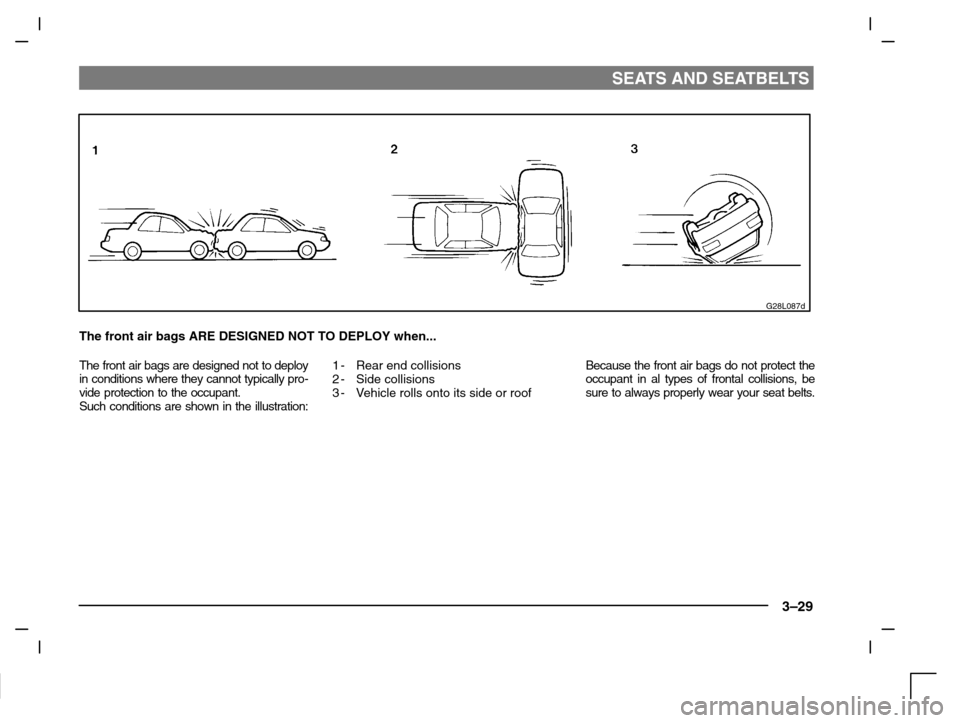
The front air bags ARE DESIGNED NOT TO DEPLOY when...
The front air bags are designed not to deploy
in conditions where they cannot typically pro-
vide protection to the occupant.
Such conditions are shown in the illustration:1-Rear end collisions
2-Side collisions
3-Vehicle rolls onto its side or roofBecause the front air bags do not protect the
occupant in al types of frontal collisions, be
sure to always properly wear your seat belts.
Page 61 of 280
SEATS AND SEATBELTS
3–33
G28L089d
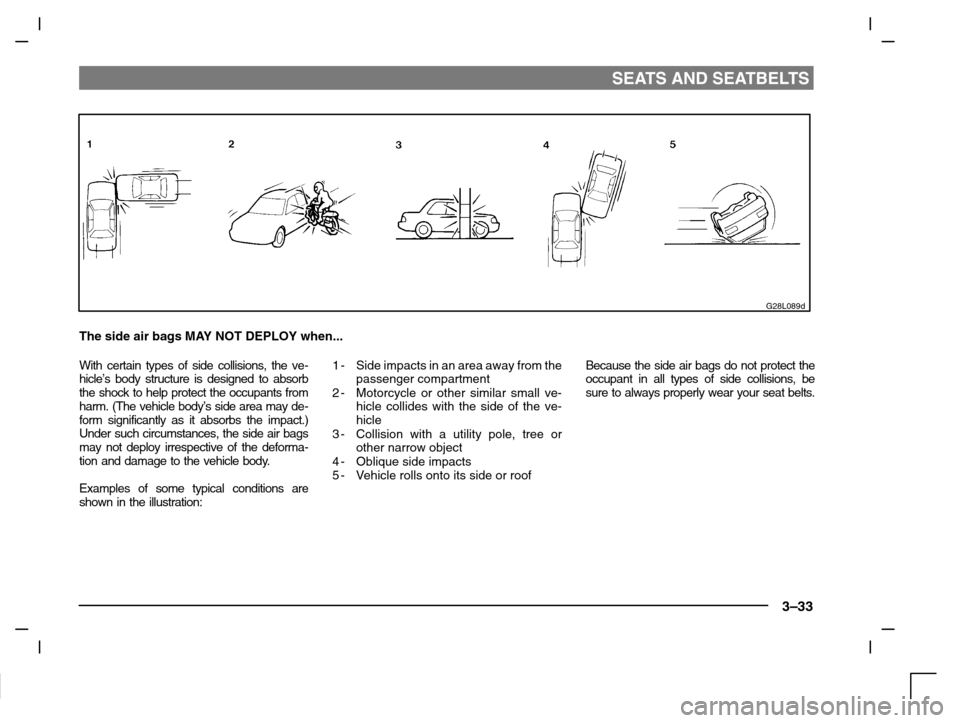
The side air bags MAY NOT DEPLOY when...
With certain types of side collisions, the ve-
hicle’s body structure is designed to absorb
the shock to help protect the occupants from
harm. (The vehicle body’s side area may de-
form significantly as it absorbs the impact.)
Under such circumstances, the side air bags
may not deploy irrespective of the deforma-
tion and damage to the vehicle body.
Examples of some typical conditions are
shown in the illustration:1-Side impacts in an area away from the
passenger compartment
2-Motorcycle or other similar small ve-
hicle collides with the side of the ve-
hicle
3-Collision with a utility pole, tree or
other narrow object
4-Oblique side impacts
5-Vehicle rolls onto its side or roofBecause the side air bags do not protect the
occupant in all types of side collisions, be
sure to always properly wear your seat belts.
Page 88 of 280
INSTRUMENTS AND CONTROLS
4–22
E23A001a
Horn switchEE23A-Ac
When the ignition switch is in the “ON” or
“ACC” position, pressing the “” mark on
the steering wheel, causes the horn to
sound.
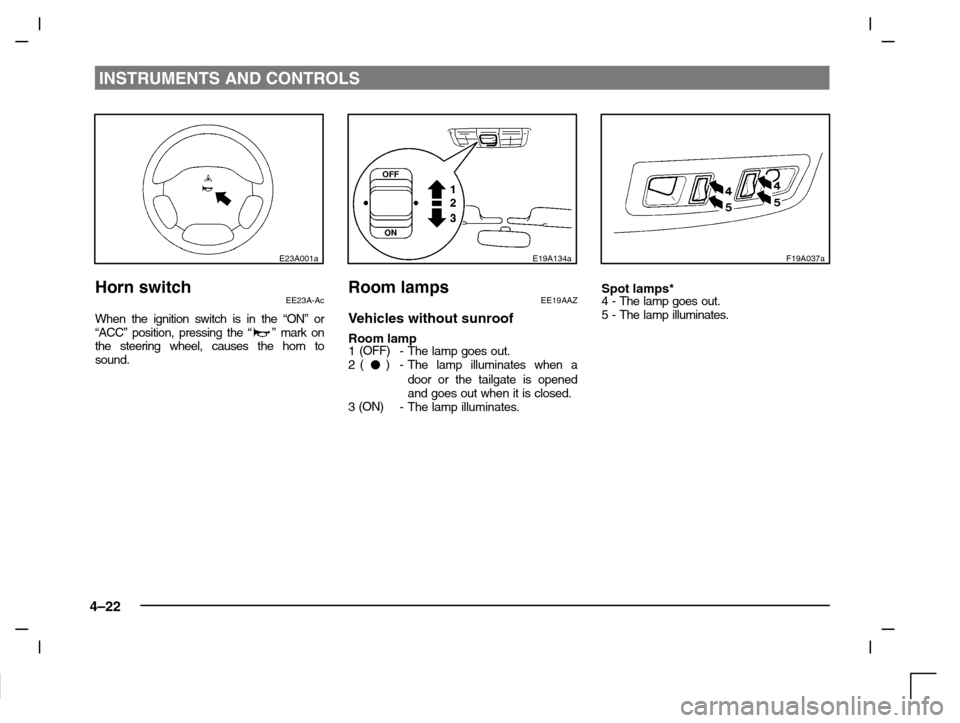
E19A134a
Room lampsEE19AAZ
Vehicles without sunroof
Room lamp1(OFF)
-The lamp goes out.
2(�)
-The lamp illuminates when a
door or the tailgate is opened
and goes out when it is closed.
3(ON)
-The lamp illuminates.
F19A037a
Spot lamps*4 - The lamp goes out.
5 - The lamp illuminates.
Page 89 of 280
INSTRUMENTS AND CONTROLS
4–23
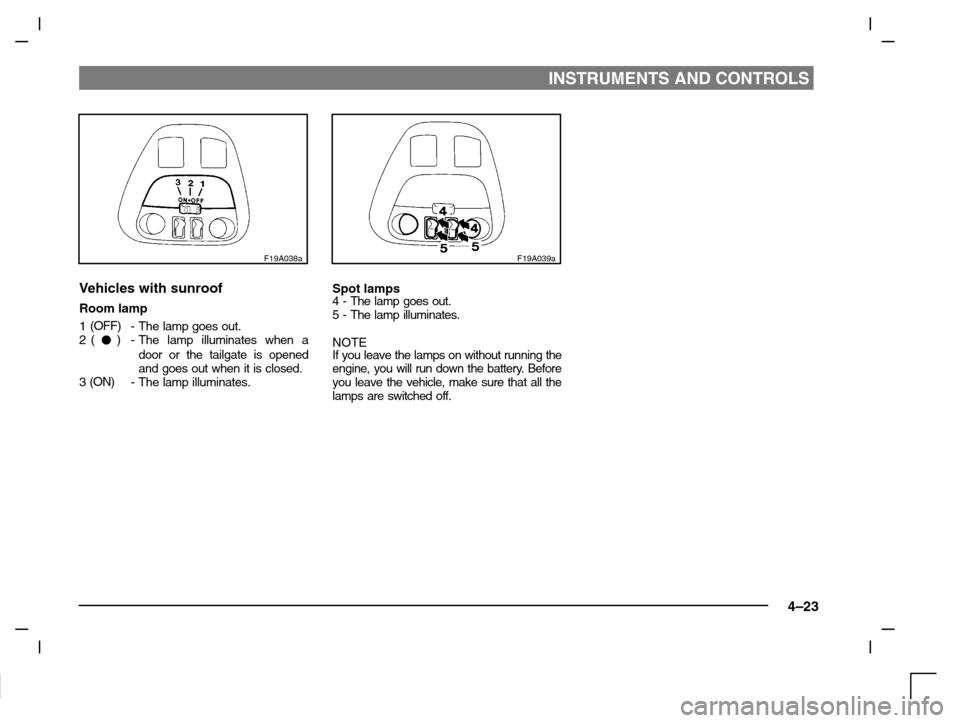
F19A038a
Vehicles with sunroof
Room lamp
1(OFF)
-The lamp goes out.
2(�)
-The lamp illuminates when a
door or the tailgate is opened
and goes out when it is closed.
3(ON)
-The lamp illuminates.
F19A039a
Spot lamps4 - The lamp goes out.
5 - The lamp illuminates.
NOTE
If you leave the lamps on without running the
engine, you will run down the battery. Before
you leave the vehicle, make sure that all the
lamps are switched off.
Page 107 of 280

STARTING AND DRIVING
5–7
(3)City traffic
Frequent starting and stopping in-
creases the average fuel consumption.
Use roads with smooth traffic flow
whenever possible. When driving on
congested roads, avoid use of a low
gear at high engine speeds.
(4) Idling
The vehicle consumes fuel even during
idling. Avoid extended idling whenever
possible.
(5)Speed
The higher the vehicle speed, the more
fuel consumed. Avoid driving at full
speed. Even a slight release of the ac-
celerator pedal will save a significant
amount of fuel.
(6)Tyre inflation pressure
Check the tyre inflation pressures at
regular intervals. Low tyre inflation pres-
sure increases road resistance and fuel
consumption. In addition, low tyre pres-
sures adversely affect tyre wear and
driving stability.(7)Load
Do not drive with unnecessary articles in
the luggage compartment. Especially
during city driving where frequent start-
ing and stopping is necessary, the in-
creased weight of the vehicle will greatly
affect fuel consumption. Also avoid driv-
ing with unnecessary luggage, etc., on
the roof; the increased air resistance will
increase fuel consumption.
(8)Cold engine starting
Starting of a cold engine consumes
more fuel.
Unnecessary fuel consumption is also
caused by keeping a hot engine run-
ning. After the engine is started, com-
mence driving as soon as possible.
(9)Air conditioning*
The use of the air conditioning will in-
crease the fuel consumption.Trailer towingEC21AMFg
In order to tow a trailer with your vehicle, a
trailer towing device that meets all relevant
regulations in your area has to be mounted.
The regulations concerning the towing of a
trailer may differ from country to country. You
are advised to obey the regulations in each
area.
CAUTION
Danger of accident!
A towing bar should be fitted by an
authorized MITSUBISHI dealer.
Page 141 of 280
For pleasant driving
UKW/MW/LW electronic tuning radio with
tape player* 6–2. . . . . . . . . . . . . . . . . . . . . . . . . . . . . .
UKW/MW/LW electronic tuning radio with
CD player* 6–15. . . . . . . . . . . . . . . . . . . . . . . . . . . . . . .
Audio system anti-theft feature 6–26. . . . . . . . . . . .
Roof antenna 6–29. . . . . . . . . . . . . . . . . . . . . . . . . . . .
Ventilators 6–29. . . . . . . . . . . . . . . . . . . . . . . . . . . . . . .
Heater/Manual air conditioning* 6–30. . . . . . . . . . . .
Automatic air conditioning* 6–36. . . . . . . . . . . . . . .
Sun visors 6–44. . . . . . . . . . . . . . . . . . . . . . . . . . . . . .
Vanity mirror 6–45. . . . . . . . . . . . . . . . . . . . . . . . . . . . .
Cigarette lighter 6–45. . . . . . . . . . . . . . . . . . . . . . . . . .
Ashtray 6–46. . . . . . . . . . . . . . . . . . . . . . . . . . . . . . . . .
Accessory boxes 6–47. . . . . . . . . . . . . . . . . . . . . . . .
Sunglasses pocket 6–48. . . . . . . . . . . . . . . . . . . . . . .
Rear shelf panel (Hatchback) 6–49. . . . . . . . . . . . . .
Installation position for first–aid kit 6–50. . . . . . . . .
Cargo net* 6–51. . . . . . . . . . . . . . . . . . . . . . . . . . . . . . .