Page 233 of 280
FOR EMERGENCIES
8–33
N10I089a
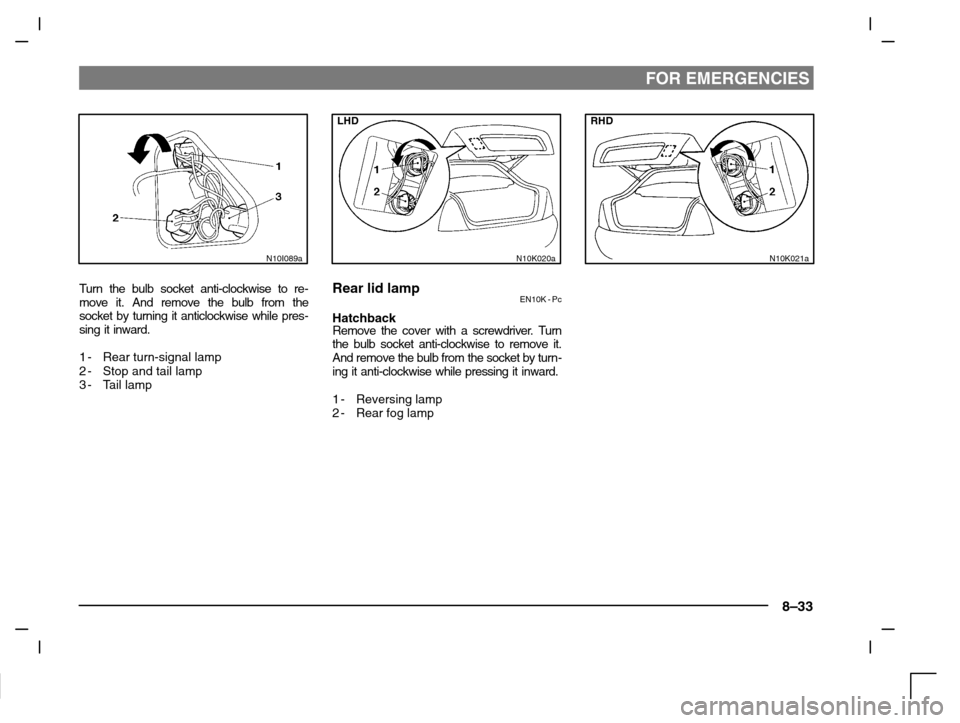
Turn the bulb socket anti-clockwise to re-
move it. And remove the bulb from the
socket by turning it anticlockwise while pres-
sing it inward.
1-Rear turn-signal lamp
2-Stop and tail lamp
3-Tail lamp
LHD
N10K020a
Rear lid lampEN10K - Pc
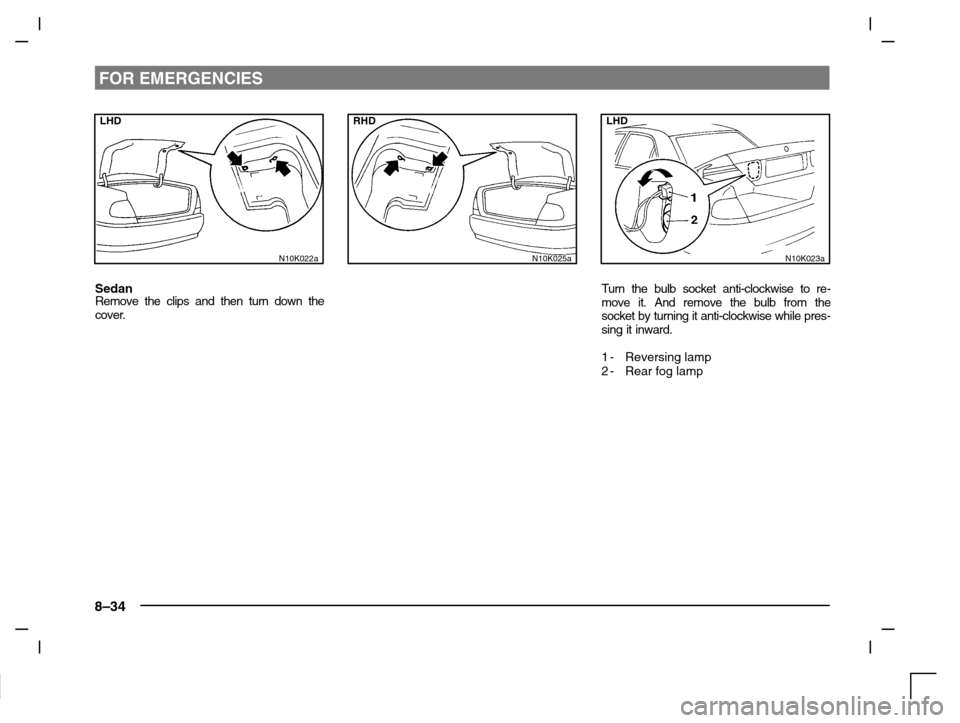
HatchbackRemove the cover with a screwdriver. Turn
the bulb socket anti-clockwise to remove it.
And remove the bulb from the socket by turn-
ing it anti-clockwise while pressing it inward.
1-Reversing lamp
2-Rear fog lamp
RHD
N10K021a
Page 234 of 280
FOR EMERGENCIES
8–34
N10K022a
LHD
SedanRemove the clips and then turn down the
cover.
RHD
N10K025a
LHD
N10K023a
Turn the bulb socket anti-clockwise to re-
move it. And remove the bulb from the
socket by turning it anti-clockwise while pres-
sing it inward.
1-Reversing lamp
2-Rear fog lamp
Page 236 of 280
FOR EMERGENCIES
8–36
N10V013a
Undo screws (B) and take the bulb out of its
socket.
N10V021a
Sedan
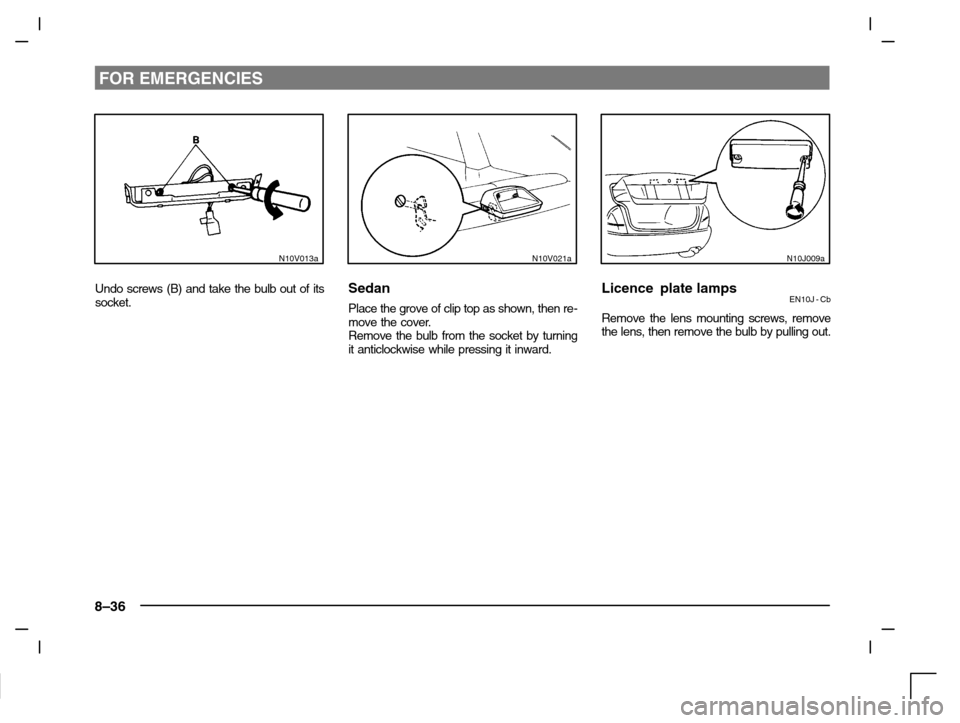
Place the grove of clip top as shown, then re-
move the cover.
Remove the bulb from the socket by turning
it anticlockwise while pressing it inward.
N10J009a
Licence plate lampsEN10J - Cb
Remove the lens mounting screws, remove
the lens, then remove the bulb by pulling out.
Page 240 of 280

MAINTENANCE
9–2
EM01A -Fh
Adequate care of your vehicle at regular in-
tervals serves to preserve the value and ap-
pearance as long as possible.
Some maintenance items can be carried out
by the owner (do it yourself), while others
should be carried out by an authorized MIT-
SUBISHI dealer (periodic inspection and
maintenance). This section describes only
those items which can be carried out by the
owner. In the event a malfunction or other
problem is discovered, have it corrected by
an authorized MITSUBISHI dealer. This sec-
tion contains information on inspection main-
tenance procedures that you can do your-
self, if you wish to do so. Follow the
instructions and cautions for each of the va-
rious procedures.
WARNING
(1)When checking or servicing the in-
side of the engine compartment,
make sure the engine is switched
off and has had a chance to cool
down.
(2)If it is necessary to do work in the
engine compartment with the en-
gine running, be especially careful
that your clothing, hair, etc., does
not become caught by the fan,
drive belts or other moving parts.
WARNING
(3) The fan may turn on automati-
cally even if the engine is not run-
ning; turn the ignition key tothe
“LOCK” position and remove the
key to ensure safety while you
work in the engine compartment.
(4) Do not smoke, cause sparks or
allow open flames around fuel or
battery. The fumes are flammable.
(5) Be extremely cautious when
working around the battery. It
contains poisonous and corros-
ive sulphuric acid.
(6) Do not get under your vehicle
with just the body jack support-
ing it. Always use automotive
jack stands.
(7) Improper handling of compo-
nents and materials used in the
vehicle can endanger your per-
sonal safety.
Consult an authorized MITSUBI-
SHI dealer for necessary informa-
tion.
Petrol-powered vehicles (1300 models)
M03A088a
Engine oil
EM03A–Id
The engine oil used has a significant effect
on the engine’s performance, service life and
startability. Be sure to use oil of the recom-
mended quality and appropriate viscosity.
All engines consume a certain amount of oil
during normal operation (See note below).
Therefore, it is important to check the oil at
regular intervals or before starting a long
journey.
Page 244 of 280

MAINTENANCE
9–6
Anti–freeze
The engine coolant contains an ethylene
glycol anti–corrosion agent. The cylinder
head and water pump housing are cast alu-
minium alloy, and periodic changing of the
engine coolant is necessary to prevent cor-
rosion of these parts.
Use High–quality Ethylene–glycol includes
coolant.
It has excellent protection against corrosion
and rust formation of all metals including alu-
minium and can avoid clogs in the radiator,
heater, cylinder head, engine block, etc.
Because of the necessity of this anti–cor-
rosion agent, the coolant must not be re-
placed with plain water even in summer. The
required concentration of anti–freeze differs
depending on the expected ambient tem-
perature.CAUTION
(1) Do not use alcohol or methanol
anti–freeze or any engine cool-
ants mixed with alcohol or meth-
anol anti–freeze. The use of an
improper anti–freeze can cause
the corrosion of the aluminium
components.
(2) For effective anti–corrosion and
anti–freeze performance, keep
the anti–freeze concentration
within the range of 45 to 60%.
Concentrations exceeding 60%
will result in a reduction of both
the anti–freeze and cooling per-
formance thus adversely affec-
ting the engine.
(3) Do not top off with water only.
Water by itself reduces the rust–
protective and anti–freeze qua-
lities of the coolant and has a
lower boiling point. It can also
cause damage to the cooling sys-
tem if it should freeze. Do not use
tapwater, or it could cause cor-
rosion and rust formation.
During cold weatherIf the temperatures in your area drop below
freezing, there is the danger that the coolant
in the engine or radiator could freeze and
cause severe damage to the engine and/or
radiator. Add a sufficient amount of anti–
freeze to the coolant to prevent it from freez-
ing.
The engine coolant mixture used at the fac-
tory provides protection against freezing for
temperatures as low as approximately
–30°C. The concentration should be
checked before the start of cold weather and
anti–freeze added to the system if necess-
ary.
Page 253 of 280
MAINTENANCE
9–15
NOTE
(1) The laws and regulations concerning
snow tyres (driving speed, required use,
type, etc.) vary. Find out and follow the
laws and regulations in driving area.
(2) If flange nuts are used on your vehicle,
change to tapered nuts when steel
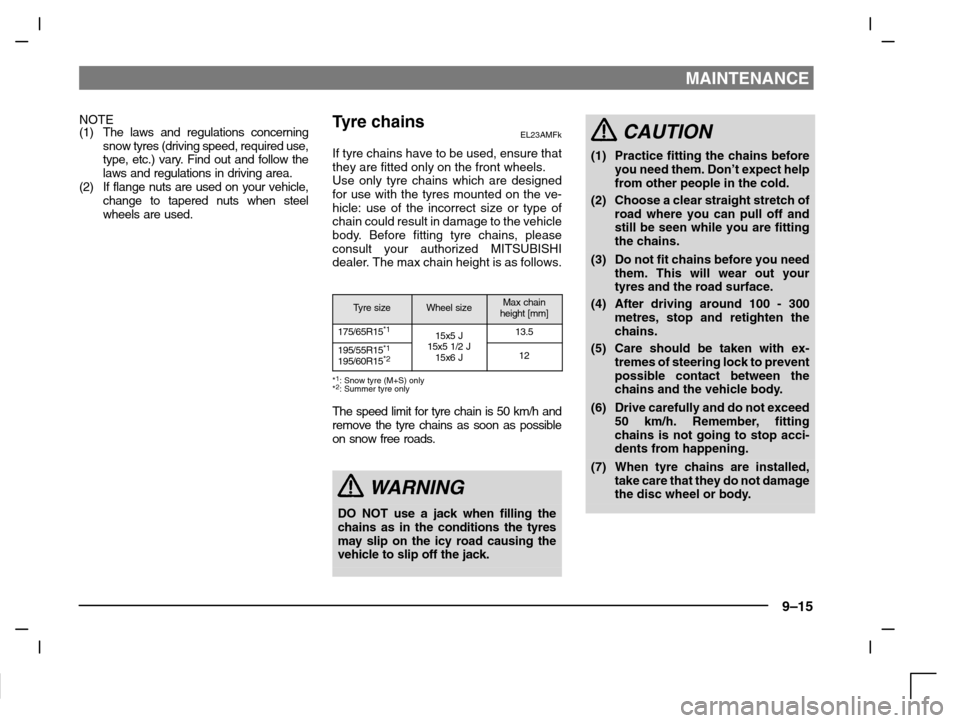
wheels are used.Tyre chainsEL23AMFk
If tyre chains have to be used, ensure that
they are fitted only on the front wheels.
Use only tyre chains which are designed
for use with the tyres mounted on the ve-
hicle: use of the incorrect size or type of
chain could result in damage to the vehicle
body. Before fitting tyre chains, please
consult your authorized MITSUBISHI
dealer. The max chain height is as follows.
Ty r e s i z eWheel sizeMax chain
height [mm]
175/65R15*115x5 J13.5
195/55R15*1195/60R15*215x5 1/2 J
15x6 J12
*1: Snow tyre (M+S) only
*2: Summer tyre only
The speed limit for tyre chain is 50 km/h and
remove the tyre chains as soon as possible
on snow free roads.
WARNING
DO NOT use a jack when filling the
chains as in the conditions the tyres
may slip on the icy road causing the
vehicle to slip off the jack.
CAUTION
(1) Practice fitting the chains before
you need them. Don’t expect help
from other people in the cold.
(2) Choose a clear straight stretch of
road where you can pull off and
still be seen while you are fitting
the chains.
(3) Do not fit chains before you need
them. This will wear out your
tyres and the road surface.
(4) After driving around 100 - 300
metres, stop and retighten the
chains.
(5) Care should be taken with ex-
tremes of steering lock to prevent
possible contact between the
chains and the vehicle body.
(6) Drive carefully and do not exceed
50 km/h. Remember, fitting
chains is not going to stop acci-
dents from happening.
(7) When tyre chains are installed,
take care that they do not damage
the disc wheel or body.
Page 260 of 280
SPECIFICATIONS
10–2
B02A005a
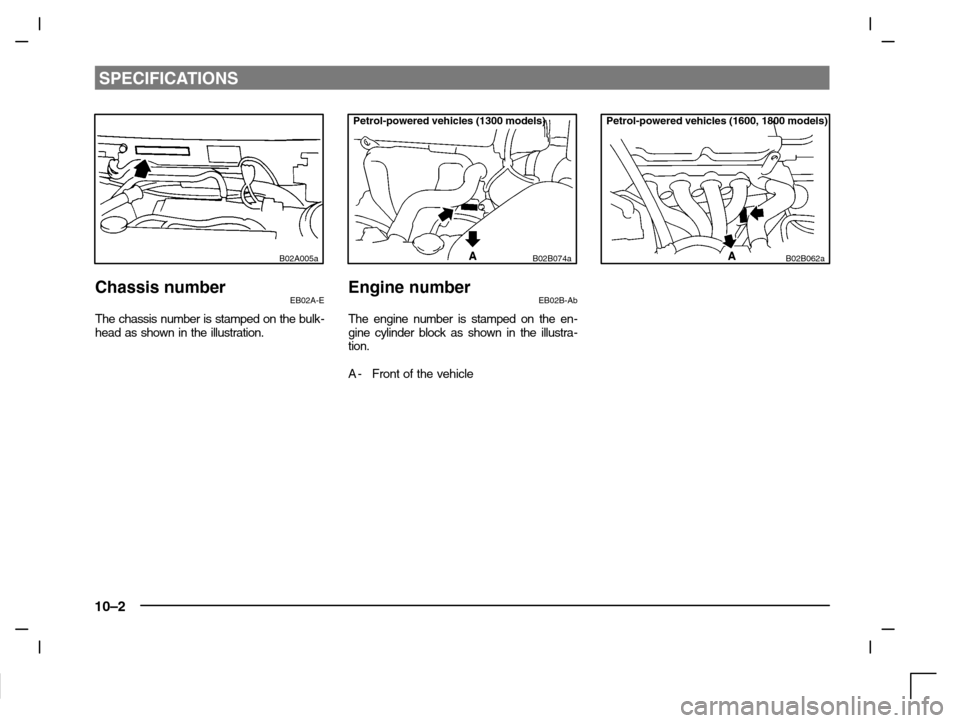
Chassis numberEB02A-E
The chassis number is stamped on the bulk-
head as shown in the illustration.
Petrol-powered vehicles (1300 models)
B02B074a
Engine numberEB02B-Ab
The engine number is stamped on the en-
gine cylinder block as shown in the illustra-
tion.
A- Front of the vehicle
Petrol-powered vehicles (1600, 1800 models)
B02B062a
Page 270 of 280
SPECIFICATIONS
10–12
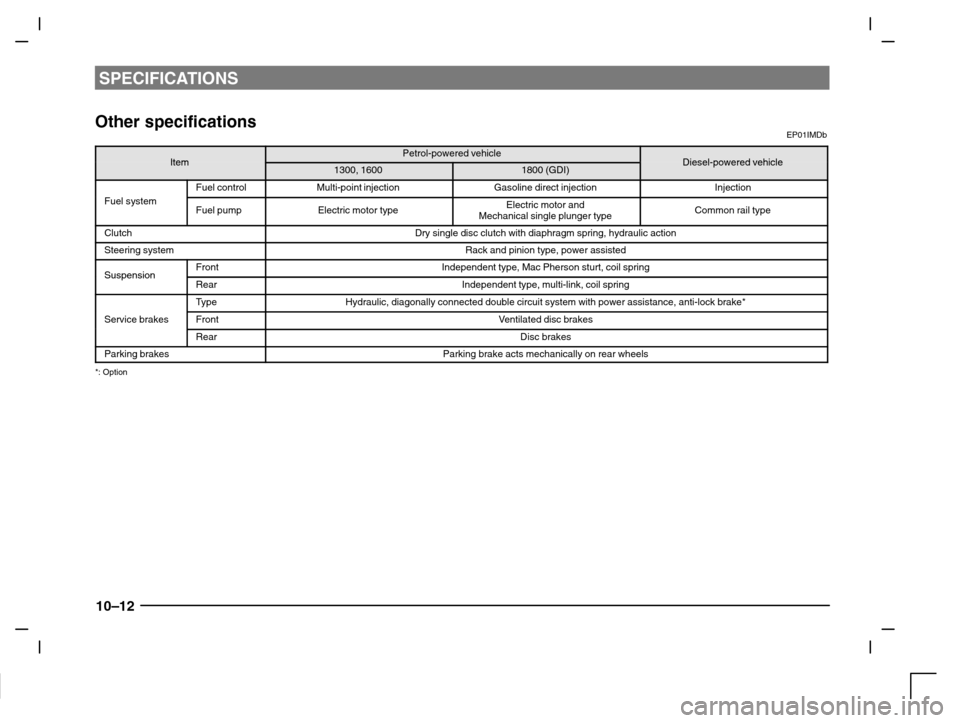
Other specificationsEP01IMDb
ItemPetrol-powered vehicleDiesel powered vehicleItem1300, 16001800 (GDI)Diesel-powered vehicle
Fuel controlMulti-point injectionGasoline direct injectionInjectionFuel systemFuel pumpElectric motor typeElectric motor and
Mechanical single plunger typeCommon rail type
ClutchDry single disc clutch with diaphragm spring, hydraulic action
Steering systemRack and pinion type, power assisted
SuspensionFrontIndependent type, Mac Pherson sturt, coil springSuspensionRearIndependent type, multi-link, coil spring
TypeHydraulic, diagonally connected double circuit system with power assistance, anti-lock brake*
Service brakesFrontVentilated disc brakes
RearDisc brakes
Parking brakesParking brake acts mechanically on rear wheels
*: Option