2000 MERCEDES-BENZ CLK-CLASS check engine
[x] Cancel search: check enginePage 227 of 299

Practical hints
Spare wheel 241
Changing wheels 242
First aid kit 228 Tire inflation pressure 247
Shelf below rear window 228 Battery 249
Stowing things in the vehicle 228 Jump starting 251
Spare wheel, vehicle tools, storage Towing the vehicle 253
compartment 229 Transmission selector lever,
Vehicle jack 230 manually unlocking 255
Fuses 231 Bulbs 256
Hood 233 Adjusting headlamp aim 261
Checking engine oil level 234 Changing batteries in the
Automatic transmission fluid level 236 electronic main key 264
Coolant level 236 Synchronizing remote control 266
Adding coolant 237 Emergency operation of
Windshield washer / headlamp
clean.system 238sliding/pop-up roof 267
Windshield and headlamp washer fluid
mixing ratio 238Manual release for fuel filler flap
268
Wheels 239 Replacing wiper blade insert 268
Tire replacement 239 Trunk lamp 270
Rotating wheels 240 Roof rack 270
227
ProCarManuals.com
Page 234 of 299
Engine compartment
Te ch n ica l
data Instruments
and controlsOperation DrivingInstrument
cluster displayPractical hintsCar care Index
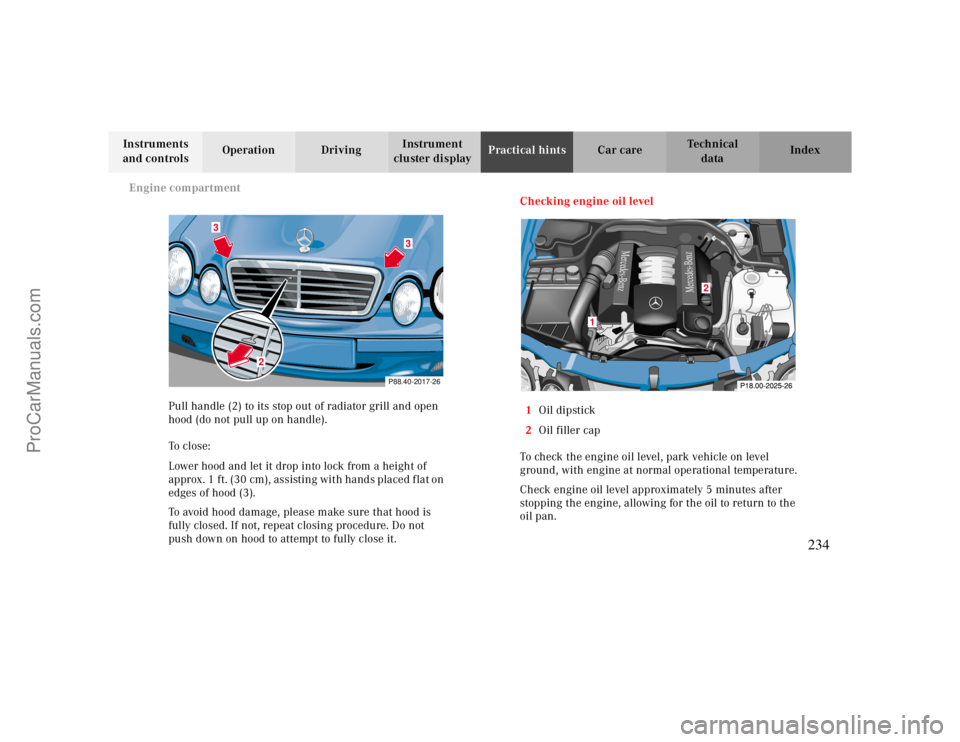
Pull handle (2) to its stop out of radiator grill and open
hood (do not pull up on handle).
To c l o s e :
Lower hood and let it drop into lock from a height of
approx. 1 ft. (30 cm), assisting with hands placed flat on
edges of hood (3).
To avoid hood damage, please make sure that hood is
fully closed. If not, repeat closing procedure. Do not
push down on hood to attempt to fully close it.
P88.40-2017-26
3
2
3
Mercedes-Benz
Mercedes-Benz
2
1
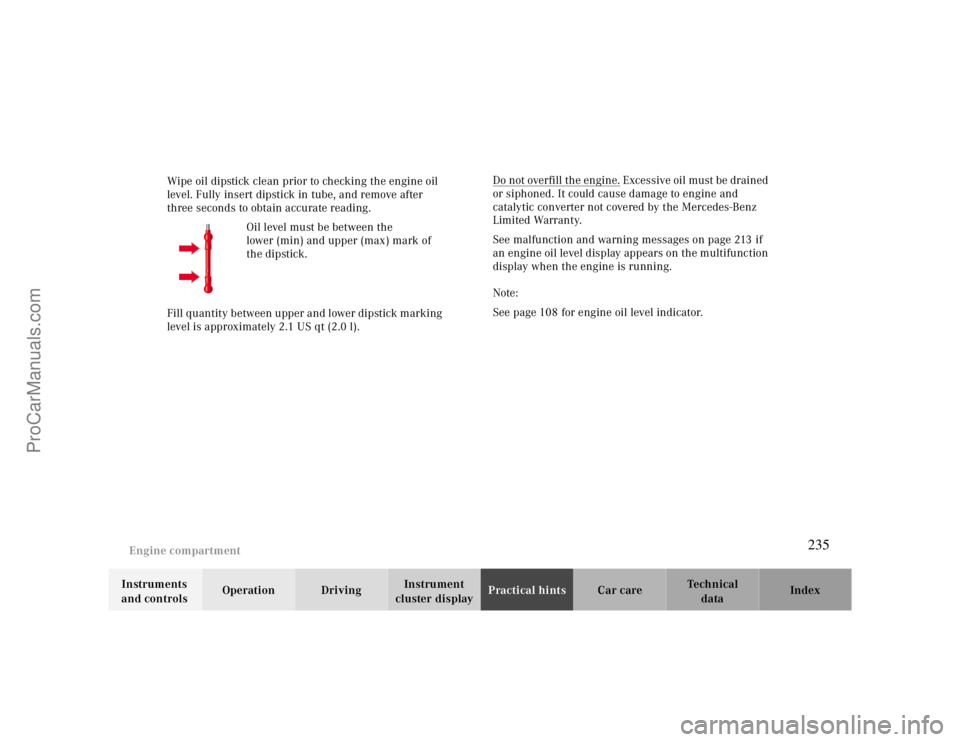
Checking engine oil level
1Oil dipstick
2Oil filler cap
To check the engine oil level, park vehicle on level
ground, with engine at normal operational temperature.
Check engine oil level approximately 5 minutes after
stopping the engine, allowing for the oil to return to the
oil pan.
234
ProCarManuals.com
Page 235 of 299
Engine compartment
Te ch n ica l
data Instruments
and controlsOperation DrivingInstrument
cluster displayPractical hintsCar care Index Wipe oil dipstick clean prior to checking the engine oil
level. Fully insert dipstick in tube, and remove after
three seconds to obtain accurate reading.
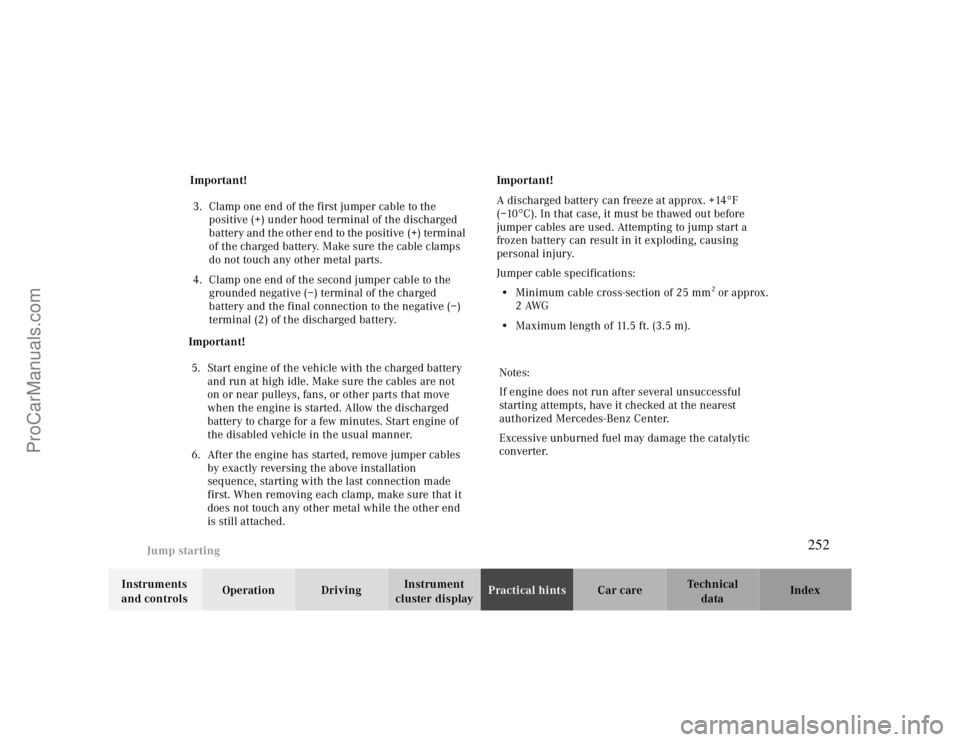
Oil level must be between the
lower (min) and upper (max) mark of
the dipstick.
Fill quantity between upper and lower dipstick marking
level is approximately 2.1 US qt (2.0 l).Do not overfill the engine.
Excessive oil must be drained
or siphoned. It could cause damage to engine and
catalytic converter not covered by the Mercedes-Benz
Limited Warranty.
See malfunction and warning messages on page 2 31 if
an engine oil level display appears on the multifunction
display when the engine is running.
Note:
See page108for engine oil level indicator.
235
ProCarManuals.com
Page 236 of 299

Engine compartment
Te ch n ica l
data Instruments
and controlsOperation DrivingInstrument
cluster displayPractical hintsCar care Index
Automatic transmission fluid level
The transmission has a permanent fill of automatic
transmission fluid.
Regular automatic transmission fluid level checks and
changes are not required. For this reason the dipstick is
omitted.
If you notice f luid leaks or gear shifting malfunctions,
have your authorized Mercedes-Benz Center check the
transmission fluid level.Coolant level
To check the coolant level, the vehicle must be parked
on level ground and the engine stopped.
Check coolant level only when coolant is cold.
The coolant level should reach the black top part of the
reservoir.
P20.30-2032-26
236
ProCarManuals.com
Page 249 of 299

Battery
Te ch n ica l
data Instruments
and controlsOperation DrivingInstrument
cluster displayPractical hintsCar care Index
Battery
Important!
Battery replacement information:
The maintenance-free battery is located in the trunk
under the trunk floor.
The service life of the battery is dependent on its
condition of charge. The battery should always be kept
sufficiently charged, in order to last an optimum length
of time.
Wa r n i n g !
Failure to follow these instructions can result in
severe injury or death.Never lean over batteries while connecting, you
might get injured.Battery fluid contains sulfuric acid. Do not allow
this fluid to come in contact with eyes, skin or
clothing. In case it does, immediately flush affected
area with water and seek medical help if necessary.A battery will also produce hydrogen gas, which is
flammable and explosive. Keep flames or sparks
away from battery, avoid improper connection of
jumper cables, smoking etc..Therefore, we strongly recommend that you have the
battery charge checked frequently, and corrected if
necessary, especially if you use the vehicle less than
approximately 200 miles (300 km) per month,
mostly for short distance trips, or if it is not used for
long periods of time.
Only charge a battery with a battery charger after the
battery has been disconnected from the vehicle’s
electrical circuit.
Always disconnect the battery negative lead first and
connect last.
When removing and connecting the battery, always
make sure that all electrical consumers are off and the
electronic key is in steering lock position 0. The battery
and its filler caps must always be securely installed
when the vehicle is in operation. During removal and
installation always protect the disconnected battery
positive (+) terminal with the cover attached to the
battery.
While the engine is running the battery terminal clamps
must not be loosened or detached, otherwise the
generator and other electronic components would be
damaged.
249
ProCarManuals.com
Page 252 of 299
Jump starting
Te ch n ica l
data Instruments
and controlsOperation DrivingInstrument
cluster displayPractical hintsCar care Index Important!
3. Clamp one end of the first jumper cable to the
positive (+) under hood terminal of the discharged
battery and the other end to the positive (+) terminal
of the charged battery. Make sure the cable clamps
do not touch any other metal parts.
4. Clamp one end of the second jumper cable to the
grounded negative (–) terminal of the charged
battery and the final connection to the negative (–)
terminal (2) of the discharged battery.
Important!
5. Start engine of the vehicle with the charged battery
and run at high idle. Make sure the cables are not
on or near pulleys, fans, or other parts that move
when the engine is started. Allow the discharged
battery to charge for a few minutes. Start engine of
the disabled vehicle in the usual manner.
6. After the engine has started, remove jumper cables
by exactly reversing the above installation
sequence, starting with the last connection made
first. When removing each clamp, make sure that it
does not touch any other metal while the other end
is still attached.Notes:
If engine does not run after several unsuccessful
starting attempts, have it checked at the nearest
authorized Mercedes-Benz Center.
Excessive unburned fuel may damage the catalytic
converter. Important!
A discharged battery can freeze at approx. +14°F
(–10°C). In that case, it must be thawed out before
jumper cables are used. Attempting to jump start a
frozen battery can result in it exploding, causing
personal injury.
Jumper cable specifications:
•Minimum cable cross-section of 25 mm
2 or approx.
2AWG
•Maximum length of 11.5 ft. (3.5 m).
252
ProCarManuals.com
Page 288 of 299

Fuels, coolants, lubricants etc.
Te ch n ica l
data Instruments
and controlsOperation DrivingInstrument
cluster displayPractical hints Car care Index
the engine temperature will increase due to the lower
heat transfer capability of the solution. Therefore, do not
use more than this amount of anticorrosion/antifreeze.
If the coolant level is low, water and MB anticorrosion/
antifreeze should be used to bring it up to the proper
level (have cooling system checked for signs of leakage).
The water in the cooling system must meet minimum
requirements, which are usually satisfied by normal
drinking water. If your are not sure about the water
quality, consult your authorized Mercedes-Benz Center.
Anticorrosion/antifreeze
Your vehicle contains a number of aluminum parts. The
use of alum inum components in m otor vehicle engines
necessitates that anticorrosion/antifreeze coolant used
in such engines be specifically formulated to protect the
aluminum parts. (Failure to use such anticorrosion/
antifreeze coolant will result in a significantly
shortened service life.)Therefore the following product is strongly
recommended for use in your vehicle: Mercedes-Benz
Anticorrosion/antifreeze agent.
Before the start of the winter season (or once a year in
the hot southern regions), you should have the
anticorrosion/antifreeze concentration checked. The
coolant is also regularly checked each time you bring
your vehicle to your authorized Mercedes-Benz Center
for service.
Anticorrosion/antifreeze quantity
Approx. freeze protection
– 35°F
(– 37°C)– 49°F
(– 45°C)
5.9 US qt
(5.6l)6.5US qt
(6.1 l)
288
ProCarManuals.com
Page 292 of 299

Automatic transmission ........................................... 175
Emergency Operation .......................................... 183Fluid level ............................................................. 236Program mode selector switch ............................. 182Selector lever position ......................................... 178Transmission selector lever,
manually unlocking ........................................ 255
BRAKE LINING WEAR - malfunction and
warning messages ............................................... 217
Brake pad wear ........................................................ 217Brake warning lamp .................................................. 209C
BBabySmart airbag deactivation system ......................62
Self-test ...................................................................62
Backrest .......................................................................51BAS (Brake assist system)......................................... 196Battery....................................................................... 249
Battery recycling ................................................. 250
BATTERY CHARGE - malfunction and
warning messages .................................................215
BRAKE ASSIST - malfunction and
warning messages .................................................216
Brake assist system (BAS) ..........................................196
Malfunction indicator lamp ..................................211
Brake fluid ................................................................285
Capacity................................................................284
BRAKE FLUID - malfunction and
warning messages .................................................217
Cargo area ................................................................. 152
Loading instructions ........................................... 153
Cargo tie-down rings................................................. 155Catalytic converter ................................................... 164Cellular telephone ................................................... 156Center console ............................................................ 20Central locking switch ................................................ 35Central locking system .............................................. 27
Choosing global or selective mode ........................ 29Electronic main key........................ ....................... 24Electronic reserve key ............................................ 25Locking and unlocking .......................................... 29Mechanical keys ..................................................... 32Remote control ....................................................... 27
Changing wheels ..................................................... 242Check engine malfunction indicator lamp .............. 208Check regularly and before a long trip .................... 205
292
ProCarManuals.com