Page 433 of 1111

BR0K9±04
F06046
SST
F01655
SST
F06047
BR±50
± BRAKEHYDRAULIC BRAKE BOOSTER
2158 Author�: Date�:
2000 LEXUS GS300/GS400 (RM718U)
REMOVAL
NOTICE:
�Before starting the work, make sure that the ignition
switch is OFF and depress the brake pedal more than
40 times.
�As high pressure is applied to the brake actuator tube
No. 1, never deform it.
�Until the work is over, do not turn the ignition switch
ON.
1. DRAW OUT FLUID WITH SYRINGE
NOTICE:
Do not let brake fluid remain on a painted surface. Wash it
off immediately.
2. REMOVE NO. 1 UNDER COVER (See page BO±88)
3. REMOVE END PAD AND NO. 1 SAFETY PAD
4. REMOVE NO. 7 HEATER TO REGISTER DUCT
5. DISCONNECT BRAKE LINES
Using SST, disconnect the 4 brake lines.
SST 09023±00100
Torque: 15 N´m (155 kgf´cm, 11 ft´lbf)
6. DISCONNECT LEFT FRONT WHEEL BRAKE LINE
Using SST, disconnect the left front wheel brake line from the
flexible hose.
SST 09023±00100
Torque: 15 N´m (155 kgf´cm, 11 ft´lbf)
7. REMOVE 2 BRAKE LINE CLAMPS
8. DISCONNECT LEVEL WARNING SWITCH CONNEC-
TOR
9. DISCONNECT 4 CONNECTORS
10. REMOVE PEDAL RETURN SPRING, CLIP AND CLE-
VIS PIN
11. REMOVE HYDRAULIC BRAKE BOOSTER ASSEMBLY
(a) Loosen the lock nut, then remove the clevis and lock nut.
Torque: 25 N´m (260 kgf´cm, 19 ft´lbf)
(b) Remove the 4 booster installation nuts.
Torque: 13 N´m (130 kgf´cm, 9 ft´lbf)
(c) Remove the booster assembly and gasket.
Page 475 of 1111
CO09X±03
Z07402
Drain Plug
Drain Plug
B01611
Drain Plug
Rubber
HoseConnect
CO±2
± COOLING (2JZ±GE)COOLANT
1540 Author�: Date�:
2000 LEXUS GS300/GS400 (RM718U)
REPLACEMENT
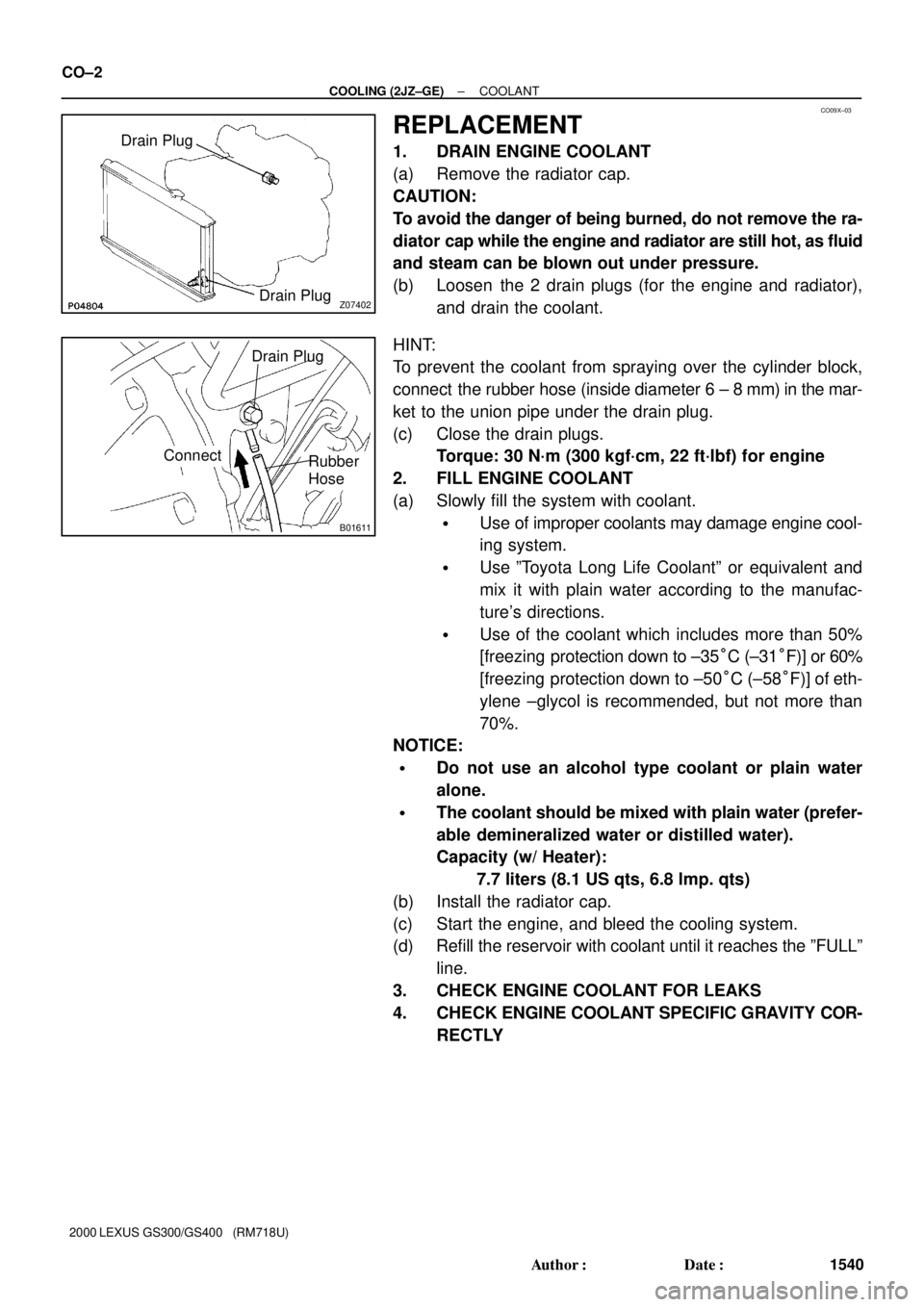
1. DRAIN ENGINE COOLANT
(a) Remove the radiator cap.
CAUTION:
To avoid the danger of being burned, do not remove the ra-
diator cap while the engine and radiator are still hot, as fluid
and steam can be blown out under pressure.
(b) Loosen the 2 drain plugs (for the engine and radiator),
and drain the coolant.
HINT:
To prevent the coolant from spraying over the cylinder block,
connect the rubber hose (inside diameter 6 ± 8 mm) in the mar-
ket to the union pipe under the drain plug.
(c) Close the drain plugs.
Torque: 30 N´m (300 kgf´cm, 22 ft´lbf) for engine
2. FILL ENGINE COOLANT
(a) Slowly fill the system with coolant.
�Use of improper coolants may damage engine cool-
ing system.
�Use ºToyota Long Life Coolantº or equivalent and
mix it with plain water according to the manufac-
ture's directions.
�Use of the coolant which includes more than 50%
[freezing protection down to ±35°C (±31°F)] or 60%
[freezing protection down to ±50°C (±58°F)] of eth-
ylene ±glycol is recommended, but not more than
70%.
NOTICE:
�Do not use an alcohol type coolant or plain water
alone.
�The coolant should be mixed with plain water (prefer-
able demineralized water or distilled water).
Capacity (w/ Heater):
7.7 liters (8.1 US qts, 6.8 lmp. qts)
(b) Install the radiator cap.
(c) Start the engine, and bleed the cooling system.
(d) Refill the reservoir with coolant until it reaches the ºFULLº
line.
3. CHECK ENGINE COOLANT FOR LEAKS
4. CHECK ENGINE COOLANT SPECIFIC GRAVITY COR-
RECTLY
Page 503 of 1111
EC04V±06
B08612
PCV Valve VSV for EVAP
Front TWC
EVAP Service Port
Fill Check LineCutoff ValveCharcoal Canister
Air Inlet Line
Vapor Pressure Sensor
Fuel Tank Cap
VSV for Vapor
Pressure Sensor
Purge Line
EVAP Line
Vent Line
Air Drain Hose
Rear TWC
EC±2
± EMISSION CONTROL (2JZ±GE)PARTS LAYOUT AND SCHEMATIC DRAWING
1453 Author�: Date�:
2000 LEXUS GS300/GS400 (RM718U)
PARTS LAYOUT AND SCHEMATIC DRAWING
LOCATION
Page 504 of 1111
EC04W±06
B08613
VSV for Vapor Pressure Sensor
Purge Line
Air Inlet LineAir Drain Hose
EVAP Line
Fuel Tank Charcoal Canister VSV for EVAPVapor Pressure Sensor
PCV Valve
Front TWC Front TWC
Vent Line
Fuel Tank
Cap
EVAP
Service
Port
Rear TWC
± EMISSION CONTROL (2JZ±GE)PARTS LAYOUT AND SCHEMATIC DRAWING
EC±3
1454 Author�: Date�:
2000 LEXUS GS300/GS400 (RM718U)
DRAWING
Page 507 of 1111
EC053±05
B06731
RH Rear Drive Shaft
Rear Suspension
Member Brace
Charcoal Canister AssemblyVapor Pressure
Sensor Connector
EVAP HoseVSV Connector
for Vapor Pressure
Sensor
Air Inlet Hose
83 (850, 61)
50 (510, 37)
Purge Hose
N´m (kgf´cm, ft´lbf) : Specified torque
Air Drain Hose
Vent Line Hose Canister Tank
EC±6
± EMISSION CONTROL (2JZ±GE)EVAPORATIVE EMISSION (EVAP) CONTROL SYSTEM
1457 Author�: Date�:
2000 LEXUS GS300/GS400 (RM718U)
EVAPORATIVE EMISSION (EVAP) CONTROL SYSTEM
COMPONENTS
Page 508 of 1111
EC0BD±02
B02709
Gasket
Vacuum
Valve Pressure
Valve
B06544
Vacuum
Gauge
B01982
LEXUS Hand±Held Tester
DLC 3
B06548Battery
± EMISSION CONTROL (2JZ±GE)EVAPORATIVE EMISSION (EVAP) CONTROL SYSTEM
EC±7
1458 Author�: Date�:
2000 LEXUS GS300/GS400 (RM718U)
INSPECTION
1. INSPECT LINES AND CONNECTORS
Visually check for loose connections, sharp bends or damage.
2. INSPECT FUEL TANK FILLER PIPE
Visually check for deformation, cracks or fuel leakage.
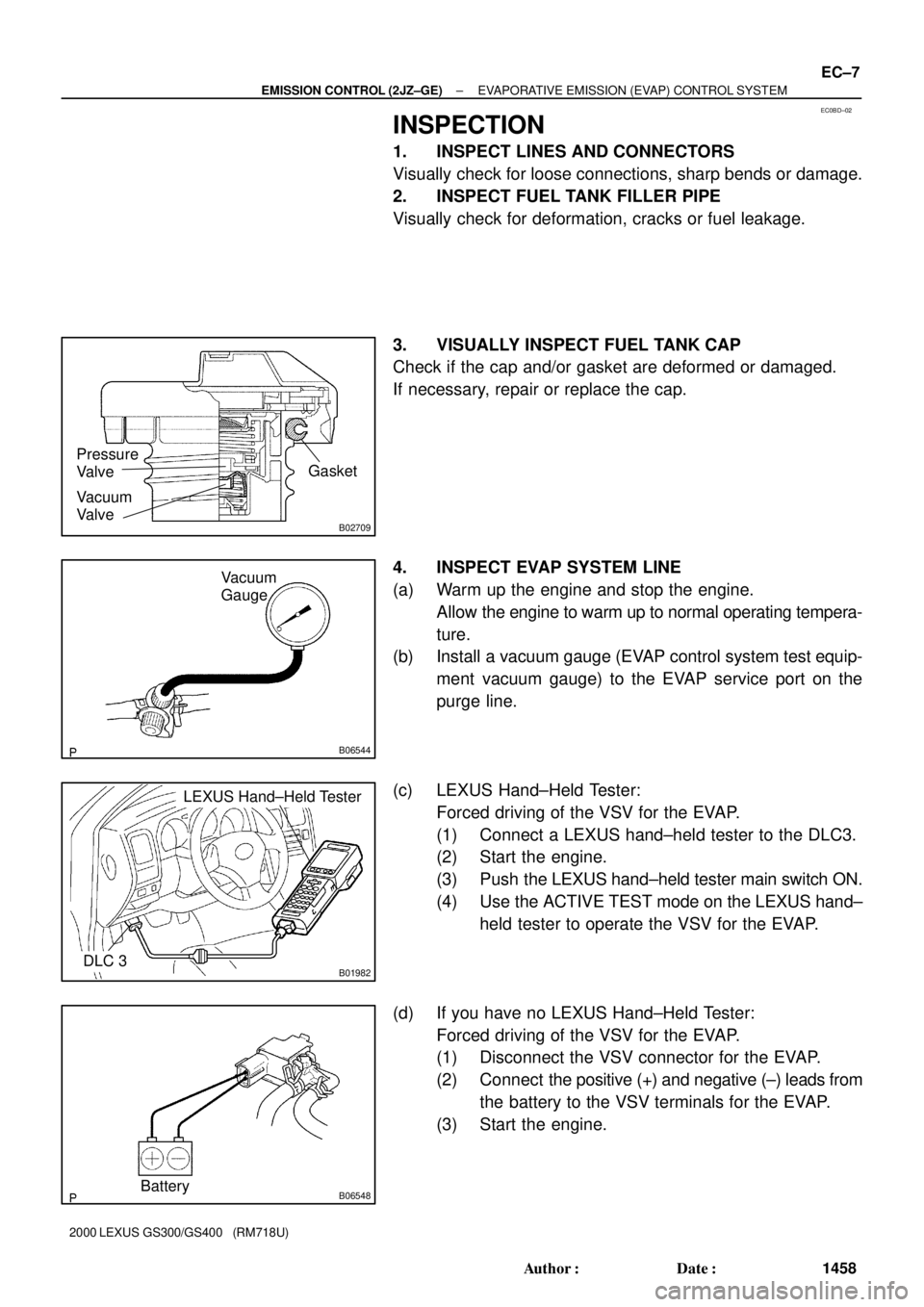
3. VISUALLY INSPECT FUEL TANK CAP
Check if the cap and/or gasket are deformed or damaged.
If necessary, repair or replace the cap.
4. INSPECT EVAP SYSTEM LINE
(a) Warm up the engine and stop the engine.
Allow the engine to warm up to normal operating tempera-
ture.
(b) Install a vacuum gauge (EVAP control system test equip-
ment vacuum gauge) to the EVAP service port on the
purge line.
(c) LEXUS Hand±Held Tester:
Forced driving of the VSV for the EVAP.
(1) Connect a LEXUS hand±held tester to the DLC3.
(2) Start the engine.
(3) Push the LEXUS hand±held tester main switch ON.
(4) Use the ACTIVE TEST mode on the LEXUS hand±
held tester to operate the VSV for the EVAP.
(d) If you have no LEXUS Hand±Held Tester:
Forced driving of the VSV for the EVAP.
(1) Disconnect the VSV connector for the EVAP.
(2) Connect the positive (+) and negative (±) leads from
the battery to the VSV terminals for the EVAP.
(3) Start the engine.
Page 509 of 1111

B06545
B06743Hose ClipperAir Drain Hose
B06546
Pressure
Gauge
Pressure EC±8
± EMISSION CONTROL (2JZ±GE)EVAPORATIVE EMISSION (EVAP) CONTROL SYSTEM
1459 Author�: Date�:
2000 LEXUS GS300/GS400 (RM718U)
(e) Check the vacuum at idle.
Vacuum:
Maintain at 0.368 ± 19.713 in.Hg (5 ± 268 in.Aq) for over
5 seconds
HINT:
If the vacuum does not change, you can conclude that the hose
connecting the VSV to the service port has come loose or is
blocked, or the VSV is malfunctioning.
(f) LEXUS Hand±Held Tester:
Conclude forced driving of the VSV for the EVAP.
(1) Stop the engine.
(2) Disconnect the LEXUS hand±held tester from the
DLC3.
(g) If you have no LEXUS Hand±Held Tester:
Conclude forced driving of the VSV for the EVAP.
(1) Stop the engine.
(2) Disconnect the positive (+) and negative (±) leads
from the battery from the VSV terminals for the
EVAP.
(3) Connect the VSV connector for the EVAP.
(h) Disconnect the vacuum gauge from the EVAP service
port on the purge line.
(i) Connect a pressure gauge to the EVAP service port on
the purge line.
(j) Check the pressure.
(1) Close off the air drain hose at the marked position
of the canister with a hose clipper or similar instru-
ment.
(2) Add the pressure (13.5 ± 15.5 in.Aq) from the EVAP
service port.
Pressure:
2 minutes after the pressure is added, the gauge
should be over 7.7 ± 8.8 in.Aq.
HINT:
If you can't add pressure, you can conclude that the hose con-
necting the VSV�canister�fuel tank has slipped off or the
VSV is open.
Page 510 of 1111
B06547
Fuel Tank Cap
B06840
AirDisconnect
EVAP Line Hose
B06841Air
Disconnect
Plug
Disconnect
EVAP Line Hose
Purge Line
Hose
Purge Port
± EMISSION CONTROL (2JZ±GE)EVAPORATIVE EMISSION (EVAP) CONTROL SYSTEM
EC±9
1460 Author�: Date�:
2000 LEXUS GS300/GS400 (RM718U)
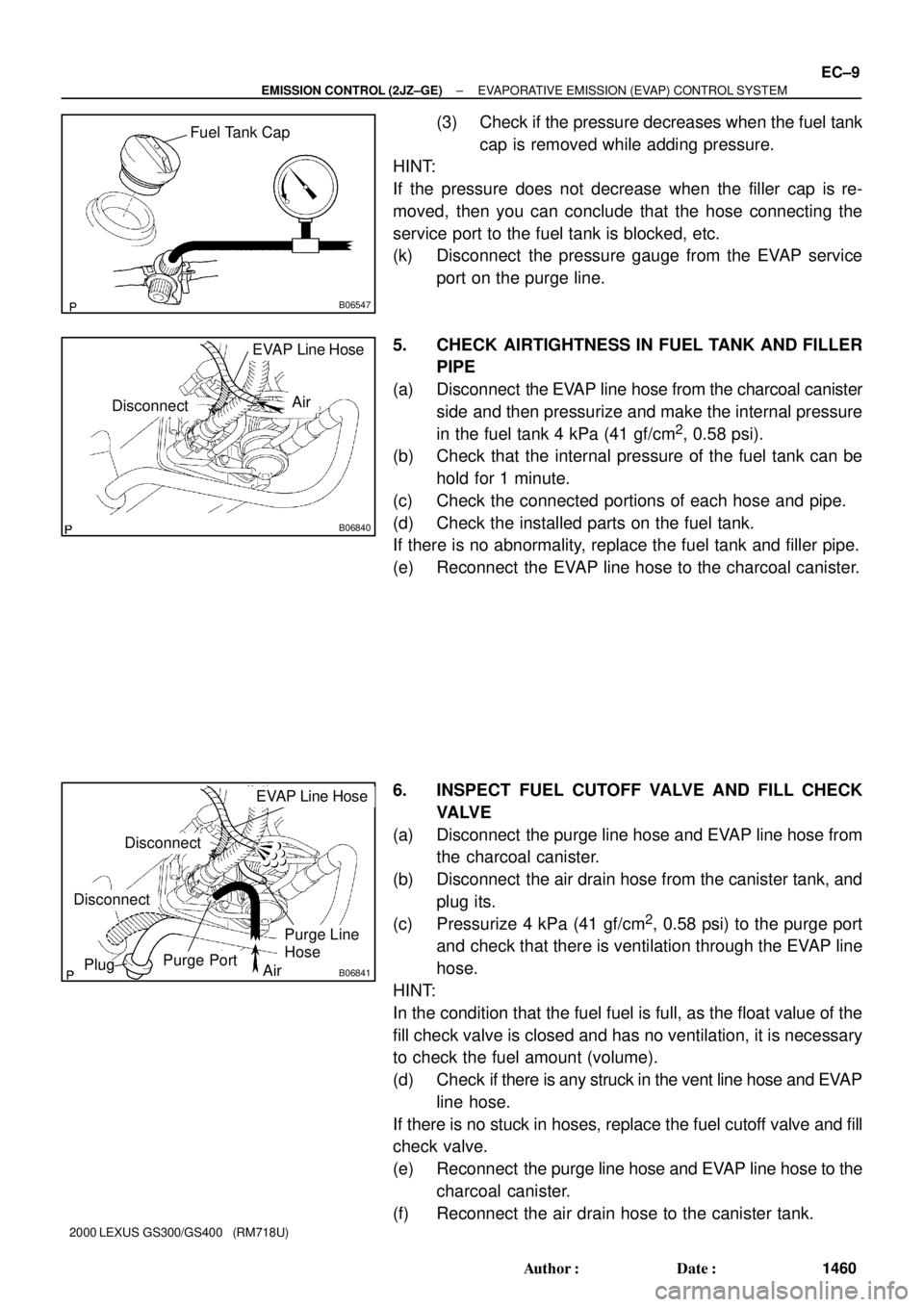
(3) Check if the pressure decreases when the fuel tank
cap is removed while adding pressure.
HINT:
If the pressure does not decrease when the filler cap is re-
moved, then you can conclude that the hose connecting the
service port to the fuel tank is blocked, etc.
(k) Disconnect the pressure gauge from the EVAP service
port on the purge line.
5. CHECK AIRTIGHTNESS IN FUEL TANK AND FILLER
PIPE
(a) Disconnect the EVAP line hose from the charcoal canister
side and then pressurize and make the internal pressure
in the fuel tank 4 kPa (41 gf/cm
2, 0.58 psi).
(b) Check that the internal pressure of the fuel tank can be
hold for 1 minute.
(c) Check the connected portions of each hose and pipe.
(d) Check the installed parts on the fuel tank.
If there is no abnormality, replace the fuel tank and filler pipe.
(e) Reconnect the EVAP line hose to the charcoal canister.
6. INSPECT FUEL CUTOFF VALVE AND FILL CHECK
VA LV E
(a) Disconnect the purge line hose and EVAP line hose from
the charcoal canister.
(b) Disconnect the air drain hose from the canister tank, and
plug its.
(c) Pressurize 4 kPa (41 gf/cm
2, 0.58 psi) to the purge port
and check that there is ventilation through the EVAP line
hose.
HINT:
In the condition that the fuel fuel is full, as the float value of the
fill check valve is closed and has no ventilation, it is necessary
to check the fuel amount (volume).
(d) Check if there is any struck in the vent line hose and EVAP
line hose.
If there is no stuck in hoses, replace the fuel cutoff valve and fill
check valve.
(e) Reconnect the purge line hose and EVAP line hose to the
charcoal canister.
(f) Reconnect the air drain hose to the canister tank.


