Page 95 of 273
Heating and Cooling
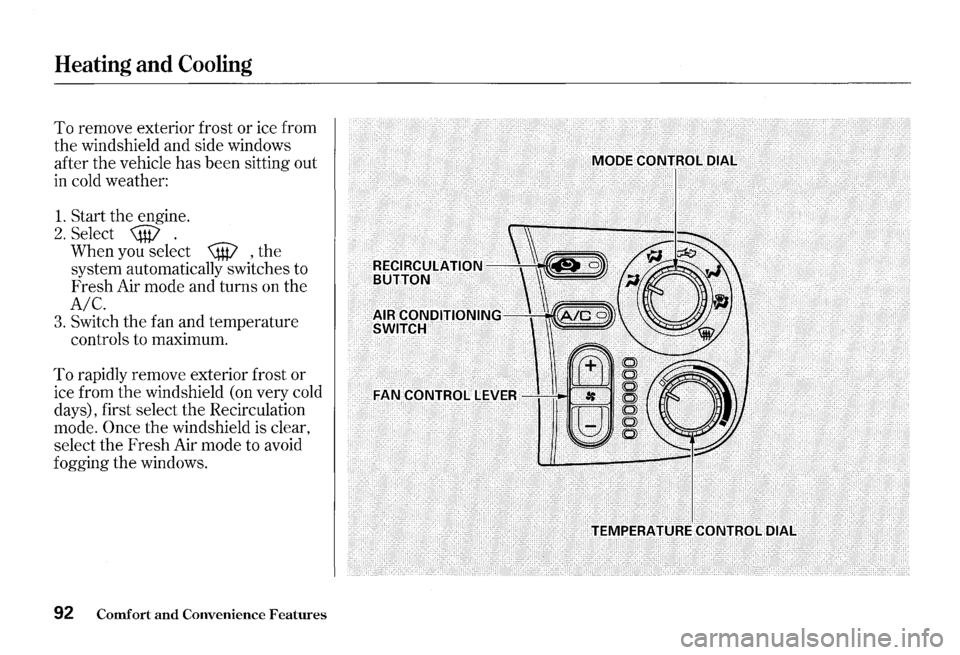
To remove exterior frost or ice from
the windshield and side windows
after the vehicle
has been sitting out
in cold weather:
1. Start the engine.
2. Select \@ .
When you select \@ , the
system automatically switches to
Fresh Air mode and turns on the
A/C.
3. Switch the fan and temperature
controls to maximum.
To rapidly remove exterior frost or
ice from the windshield (on very cold
days), first select the Recirculation
mode.
Once the windshield is clear,
select the
Fresh Air mode to avoid
fogging the windows.
92 Comfort and Convenience Features
MODE CQNTROL·.DIAL
RECIRCULATION~~~ SUlTON ~;;;;;;;;;;;;:~
AIR .coNDitiONING ·~-+-::-:
Page 96 of 273
These settings direct all the air flow
to the defroster vents at the base of
the windshield and the side window
defroster vents.
The air flow will get
warmer and clear the windows faster
as the engine warms up. You can
close the side vents with the dial
beside each vent.
This will send
more warm air to the windshield
defroster vents.
For safety, make sure you have a
clear view through all the windows
before driving away.
To Tum Everything Off
To shut off the system temporarily,
turn off the fan (no lights
illuminated).
You should shut the system
completely off only for the first few
minutes of driving in cold weather,
until the engine coolant warms up
enough to operate the heater. Keep
the fan on at
all other times so stale
air does not build up
in the interior.
Heating and Cooling
Comfort and Convenience Features 93
Page 118 of 273

Before you begin driving your Honda,
you should know what gasoline to
use, and how to check
the levels of
important fluids. You also need to
know how to properly store luggage
or packages.
The information in this
section will help you.
If you plan to
add any accessories to your vehicle,
·
please read the information in this
section first.
Before Driving
Break-in Period .............................. 116
Gasoline .......................................... 116
Service Station Procedures ..........
117
Filling the Fuel Tank ................. 117
Opening the Hood ..................... 118
Oil Check ................................ 119
Engine Coolant Check .......... 120
Fuel Economy ................................ 121
Car Condition ............................. 121
Driving Habits ............................ 121
Accessories and Modifications .... 122
Accessories ................................. 122
Modifications ............................. 123
Additional Safety Precaution .... 123
Carrying Cargo .............................. 124
General Precautions ...................... 127
Before Driving 115
Page 119 of 273

Break-in Period, Gasoline
Break-in Period
Help assure your car's future
reliability and performance by paying
extra attention to how you drive
during the first
600 miles (1,000 km).
During this period:
• Avoid full-throttle starts and rapid
acceleration.
Do not exceed 5,500 rpm for the
first
600 miles (1,000 km) of
operation.
• Avoid hard braking. New brakes
need to be broken-in by moderate
use for the first
200 miles (300
km).
You should follow these same re
commendations with an overhauled
or exchanged engine, or when the
brakes are relined.
116 Before Driving
Gasoline
Your Honda is designed to operate
on premium unleaded gasoline with a
pump octane number of
91 or higher.
If you are unable to find premium
unleaded gasoline, you may substi
tute an unleaded regular gasoline.
The engine will compensate for the
lower octane, but you may notice a
slight decrease in power as a result.
We recommend gasolines containing
detergent additives
that help prevent
fuel system and engine deposits.
Using gasoline containing lead will
damage your car's emissions
controls. This contributes to air
pollution. In
Canada, some
gasolines contain
an octane-enhancing additive called
MMT.
If you use such gasolines,
your emission control system
performance may deteriorate and
the Malfunction Indicator Lamp on
your instrument panel may turn on.
If this happens, contact your
authorized Honda dealer for service.
Page 120 of 273
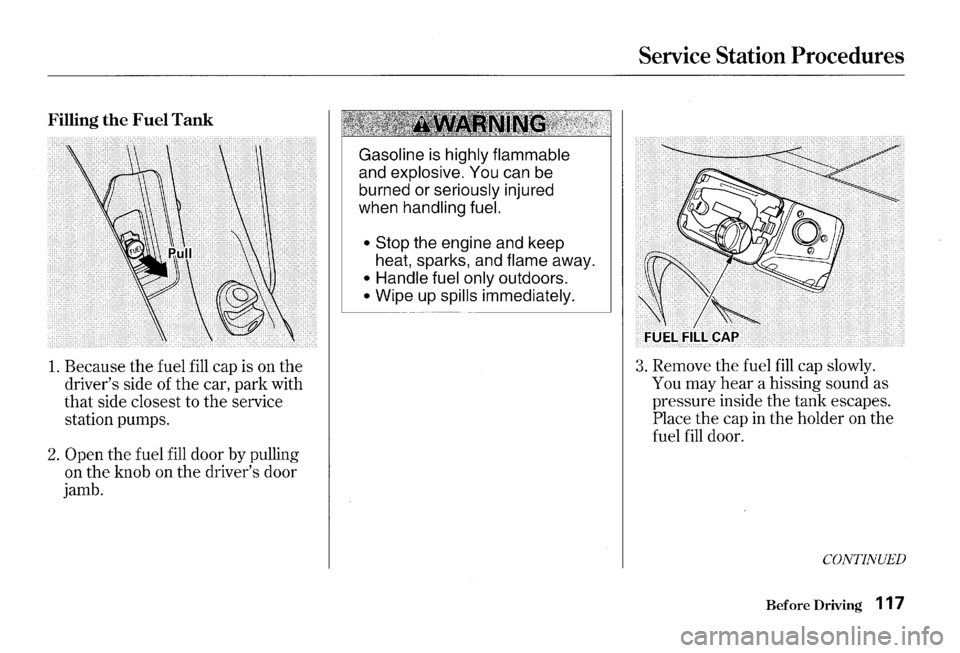
1. Because the fuel fill cap is on the
driver's side of the car, park with
that side closest to the service
station pumps.
2. Open the fuel fill door by pulling
on
the knob on the driver's door
jamb.
Gasoline is highly flammable
and explosive. You can be
burned or
seriously injured
when
handling fuel.
• Stop
the engine and keep
heat, sparks, and
flame away.
• Handle fuel only outdoors.
• Wipe up spills immediately.
Service Station Procedures
3. Remove the fuel fill cap slowly.
You may
hear a hissing sound as
pressure inside
the tank escapes.
Place the cap in the holder on the
fuel fill door.
CONTINUED
Before Driving 117
Page 122 of 273
3. Pull the support rod out of its clip
and insert
the end into the hole on
the front of the hood around the
center.
To close the hood, lift it up slightly
to remove
the support rod from
the hole. Put the support rod back
into its holding clip. Lower
the
hood to about a foot (30 em) above
the fender, then let it drop.
After closing
the hood, make sure
it is securely latched.
Oil Check
Check the engine oil level every time
you
fill the car with fuel. Wait a few
minutes after turning
the engine off
before you check
the oil.
1. Remove the dipstick (black
handle).
Service Station Procedures
2. Wipe the dipstick with a clean
cloth
or paper towel.
CONTINUED
Before Driving 119
Page 123 of 273
Service Station Procedures
3. Insert it all the way back in its tube. 4. Remove the dipstick again and
check the level.
It should be
between the upper and lower
marks.
120 Before Driving
If it is near or below the lower mark,
see
Adding Oil on page 157.
Engine Coolant Check
Look at the coolant level in the
radiator reserve tank. Make sure it is
between
the MAX and MIN lines. If
it is below the MIN line, see Adding
Engine Coolant
on page 161 for
information on adding the proper
coolant.
Refer to
Owner Maintenance
Checks
on page 155 for information
on checking other items
in your
Honda.
Page 124 of 273

The condition of your car and your
driving habits are the two most
important things
that affect the fuel
mileage you get.
Car Condition
Always maintain your car according
to the maintenance schedule. This
will keep it in top operating condition.
An important part of that mainte
nance is the
Owner Maintenance
Checks
(see page 155 ). For
example, an underinflated tire
causes more
"rolling resistance,"
which uses fuel. It also wears out
faster, so check the tire pressure
at
least monthly.
In winter, the build-up of snow on
your car's underside adds weight and
rolling resistance. Frequent cleaning
helps your fuel mileage and reduces
the chance of corrosion.
Driving Habits
You can improve fuel economy by
driving moderately. Rapid acceler
ation, abrupt cornering, and hard
braking use more fuel.
Always drive
in the highest gear that
allows the engine to run and acceler
ate smoothly.
Depending on traffic conditions, try
to maintain a constant speed. Every
time you slow down and speed up,
your car uses extra fuel.
Use the
cruise control, when appropriate, to
increase fuel economy.
A cold engine uses more fuel than a
warm engine.
It is not necessary to
"warm-up" a cold engine by letting it
idle for a long time. You can drive
away
in about a minute, no matter
how cold it is outside.
The engine
will warm up faster, and you get
better fuel economy. To cut down on
the number of
"cold starts," try to
Fuel Economy
combine several short trips into one.
The air conditioning puts an extra
load on the engine which makes it
use more fuel.
Turn off the A/C to
cut down on air conditioning use.
Use the flow-through ventilation
when the outside air temperature is
moderate.
Before Driving 121