2000 HONDA PASSPORT cooling
[x] Cancel search: coolingPage 47 of 267
Carbo
n Monoxid e Hazar d
Your vehicle's exhaust contains
carbon monoxide gas. You should
have no problem with carbon monoxide entering the vehicle in
normal driving if you maintain your vehicle properly. Have theexhaust system inspected for leaks
whenever:
The vehicle is raised for an oil
change.
You notice a change in the
sound of the exhaust.
The vehicle was in an accident that may have damaged the
underside. High levels of carbon monoxide
can collect rapidly in enclosed areas, such as a garage. Do not
run the engine with the garage door closed. Even with the door
open, run the engine only longenough to move the vehicle out of
the garage.
With the tailgate glass open, air
flow can pull exhaust gas into theinterior. This can create a
hazardous condition. If you must drive with the tailgate glass open,
open all the windows and set the
heating and cooling system asshown below.
If you must sit in your parked
vehicle, even in an unconfined
area, with the engine running, adjust the heating and cooling
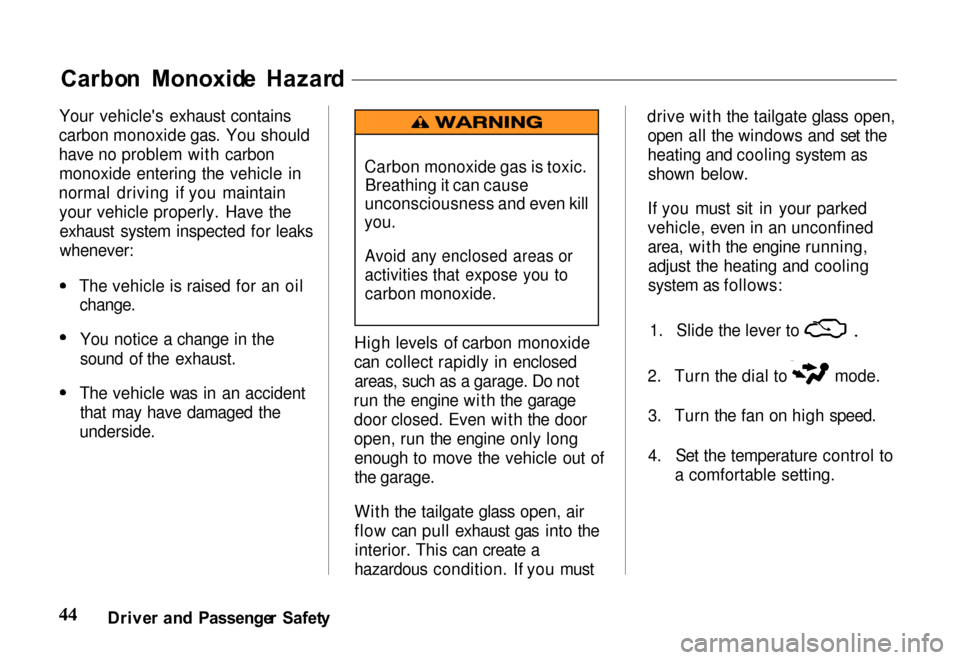
system as follows: 1. Slide the lever to
2. Turn the dial to mode.
3. Turn the fan on high speed.
4. Set the temperature control to a comfortable setting.
Driver an d Passenge r Safet y
Carbon monoxid
e gas is toxic.
Breathing it can cause
unconsciousness and even kill
you.
Avoid any enclosed areas or
activities that expose you to
carbon monoxide.
Page 61 of 267

The needle may move during
turning, stopping and
acceleration.
Fue l Doo r
This is a reminder that the fuel fill door is on the left side of the
vehicle. Always park with that side closest to the service station
pumps.
Engin
e Coolan t
Temperatur e Gaug e
When the key is in the "ON"
position, the engine coolant temperature gauge indicates the
temperature of the engine coolant.
The letters "C" and "H" on the gauge represent "Cold" and
"Hot," respectively. The gray area indicates the
normal engine coolant
temperature.
If the pointer reaches the "H"
mark, pull safely to the side of the
road. Turn to page 213 for instructions and precautions on
checking the engine's cooling
system.
Driving with the temperature gauge pointer at "H" can causeserious damage to the engine.
Instrument s an d Control s
NOTIC
E
NORMA
L
RANG E OVERHEATIN
G
Page 118 of 267
Comfor
t an d Convenienc e Feature s
The heating and air conditioning system in your vehicle provides a
comfortable driving environmentin all weather conditions.
The audio system has many
features. This section describes
those features and how to use
them.
Heating and Cooling ...... 116
Ventilation .............. 118
Audio System ............ 121 AM/FM/Cassette StereoAudio System (LX, EX) 121 Operating the Radio .. 121
Adjusting the Sound .. 123
Operating the
Cassette Player ..... 124
Caring for the
Cassette Player ..... 126
Operating the Optional CD Changer ........ 127
AM/FM/Cassette/ CD Changer StereoAudio System (EX-L) . 129 Operating the Radio . . 129
Adjusting the Sound . . 131
Radio Frequencies ... 132Operating the Cassette Player ..... 134
Caring for the Cassette Player ..... 137 Operating the
CD Changer ........ 138
Protecting
Compact Discs ...... 142
Cruise Control ........... 143
Keyless Entry ........... 147
Anti-Theft System ........ 148
Digital Clock ............ 149
Comfor t an d Convenienc e Feature s
Page 119 of 267
Heatin
g an d Coolin g
This system combines heating and
cooling capabilities for comfort in all weather conditions.
During air conditioning operation,
slight increases and decreases in
engine speed/power may be
noticed. This is normal, as the system is designed to cycle the
compressor ON and OFF to
maintain desired cooling. The
reduced compressor operation should benefit fuel economy.
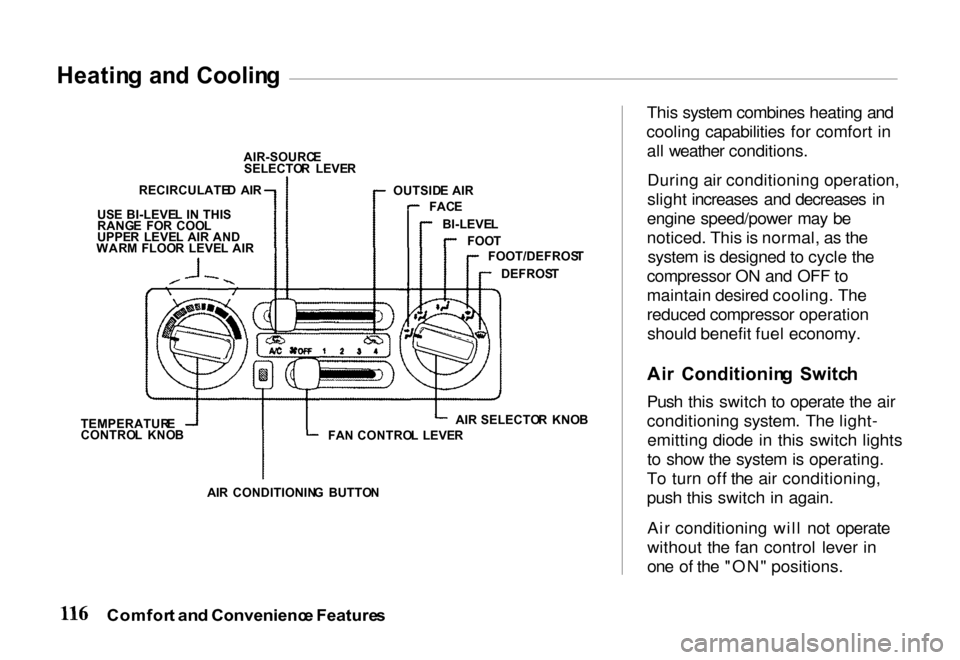
Ai r Conditionin g Switc h
Push this switch to operate the air
conditioning system. The light- emitting diode in this switch lights
to show the system is operating.
To turn off the air conditioning,
push this switch in again.
Air conditioning will not operate
without the fan control lever in
one of the "ON" positions.
Comfor t an d Convenienc e Feature s
AIR-SOURC
E
SELECTO R LEVE R
OUTSID E AIR
FAC E
BI-LEVE L
FOO T
FOOT/DEFROS T
DEFROS T
FA N CONTRO L LEVE RAIR
SELECTO R KNO B
AI R CONDITIONIN G BUTTO N
TEMPERATUR
E
CONTRO L KNO B
US
E BI-LEVE L I N THI S
RANG E FO R COO L
UPPE R LEVE L AIR AND
WAR M FLOO R LEVE L AI R
RECIRCULATE
D AI R
Page 168 of 267

Whee
l Replacemen t
Consideration s
Damaged wheels must be
replaced. For example, replace
wheels if they are bent, cracked or
heavily rusted, or if wheel nuts
often become loose. Also replace
wheels that leak air (except some
aluminum wheels that can be
repaired). See your Honda dealer.
Do not use bent wheels that have
been straightened, and do not use
tubes in leaking wheels designed
for tubeless tires. Such wheels
may have structural damage and
could fail without warning.
Maximum loads, maximum
inflation pressures, wheel
identification codes, and wheel
sizes are stamped on each wheel.
Service-tested and approved
wheels are available from your
Honda dealer.
When obtaining wheels for any
reason from any other source, the
replacement wheels should be
equal in load capacity, inflation
pressure capacity, diameter, width, offset and mounting configuration
to those originally installed on
your vehicle. A wheel of the
wrong size or type may adversely
affect load carrying capacity, wheel
and bearing life, brake cooling,
speedometer/odometer calibration,
stopping ability, headlight aim,
bumper height, vehicle ground clearance, and tire or tire chain
clearance to the body and chassis.
Replacement with used wheels is
not advised: They may have been subjected to harsh treatment or very high mileage and could fail
without warning.
Installing wheels and/or tires that
have a higher load carrying limit
than those that originally came on
your vehicle does not increase the
GAWR or GVWR of the vehicle.
Driving Tip s
Page 194 of 267

Car
e an d Maintenanc e
This section explains why it is important to keep your vehicle
well maintained and to follow
basic maintenance safety
precautions.
This section also includes Maintenance Schedules for
normal driving and severe driving
conditions, a Maintenance
Record, and instructions for simple maintenance tasks you
may want to take care of yourself.
If you have the skills and tools
required to perform more complex
maintenance tasks on your Honda,
you may want to purchase the Service Manual. See page 249 for
information on how to obtain a
copy, or see your Honda dealer. Service Station Information . 193
Fuel Fill Cap .......... 193Fuel Recommendation ... 194
Fuel Tank Capacity ..... 194
Engine Oil Recommendation ...... 194
Windshield Washer ..... 194
Tire Inflation Pressures .. 194 Battery ............... 194
Hood Release .......... 195
Engine Oil Dipstick ..... 196
Fuel Requirements ........ 196 Oxygenated Fuels ...... 196
Maintenance Safety ....... 197 Important Safety
Precautions .......... 198
Maintenance Schedule ..... 199
Required Maintenance Record 202
Owner Safety Checks ...... 204
Engine Oil and Filter ...... 207 Proper Quality Oil ...... 207 Change Interval ........ 207
Oil
Change ........... 208
Oil Filter Installation . 208
Oil Viscosity .......... 209
Oil Level Check ....... 209
Engine Oil Additives ... 210
Air Cleaner Filter ........ 210
Manual Transmission Fluid 211
Automatic Transmission Fluid .................. 212
Front (4WD) and Rear Axles ............. 212
Engine Cooling System ... 213
Other Required Maintenance 215 Brake Master Cylinder . . 215
Shift-on-the-Fly System
. 216
Front Whee
l Bearings ... 216
Hood Latch and Hinges . 217
Air Conditioning ....... 217 Body Lubrication ...... 217
Car e an d Maintenanc e
Page 216 of 267

The engine cooling system is
designed to maintain the engine at
the proper operating temperatures.
The cooling system was filled at the factory with a quality engine
coolant. The engine cooling system is designed to use coolant (a
mixture of water and ethylene glycol antifreeze) rather than plain
water. The engine coolant solutionshould be used year-round. It has
many advantages such as: provides freezing protection as
lowas — 33°F( — 36°C)
provides boiling protection up
to262°F(128°C)
protects against rust and
corrosion in the cooling system maintains the proper engine
temperature for efficient
operation and emission control
allows proper operation of the
engine coolant temperature gaugeSee the Maintenance Schedule in
this section to find out when the
engine coolant must be replaced.
Checkin g th e Coolan t Leve l
Check the engine coolant level at the interval shown in the
Maintenance Schedule unless there
is evidence of leaking or
overheating. The engine coolant
level should be between the
maximum and the minimum level
marks on the radiator reserve tank.
Car e an d Maintenanc e
Recommende
d Lubrican t
Engin
e Coolin g Syste m
Page 217 of 267

You usually do not need to remove
the radiator cap to check the engine
coolant level.
Addin g Engin e Coolan t
To add engine coolant, remove the cap on the radiator reserve tank
and fill the tank up to the
maximum level mark. Add a
50/50 mixture of water and a good
quality ethylene glycol antifreeze. If you need to add engine coolant
frequently, see your Honda dealer
for a cooling system check.
If the proper quality antifreezeis used, there is no need to add
extra inhibitors or additives. They may be harmful to the proper
operation of the system.
Coolin g Syste m Servic e
The cooling system should be serviced at the intervals specified in the Maintenance Schedule as
follows:
Wash the radiator cap and filler
neck with clean water.
Check the engine coolant level
in the radiator and have it tested
for freeze protection. Add
ethylene glycol antifreeze, if
needed, to maintain freeze
protection at —33°F (—36°C).
Have the cooling system and
radiator cap tested for a pressure capacity of 15 psi (105
kPa). If a replacement cap is
needed, use a cap specified for
your model. Tighten all radiator and heater
hose clamps and inspect all
hoses. Replace the hoses if they
are swollen, "checked," or
otherwise worn. Carefully tighten the hose clamps at the
radiator. Overtightening could bend or collapse the radiator
fittings. Clean the front of the radiator
core and air conditioning
condenser.
It is the owner's responsibility to: Maintain the cooling system
freeze protection at —33°F
Car e an d Maintenanc e
Removing the radiator cap
while the engine is hot can
cause the coolant to spray out, seriously scalding you.
Always let the engine andradiator cool down beforeremoving the radiator cap.