Page 198 of 267
Hoo
d Releas e
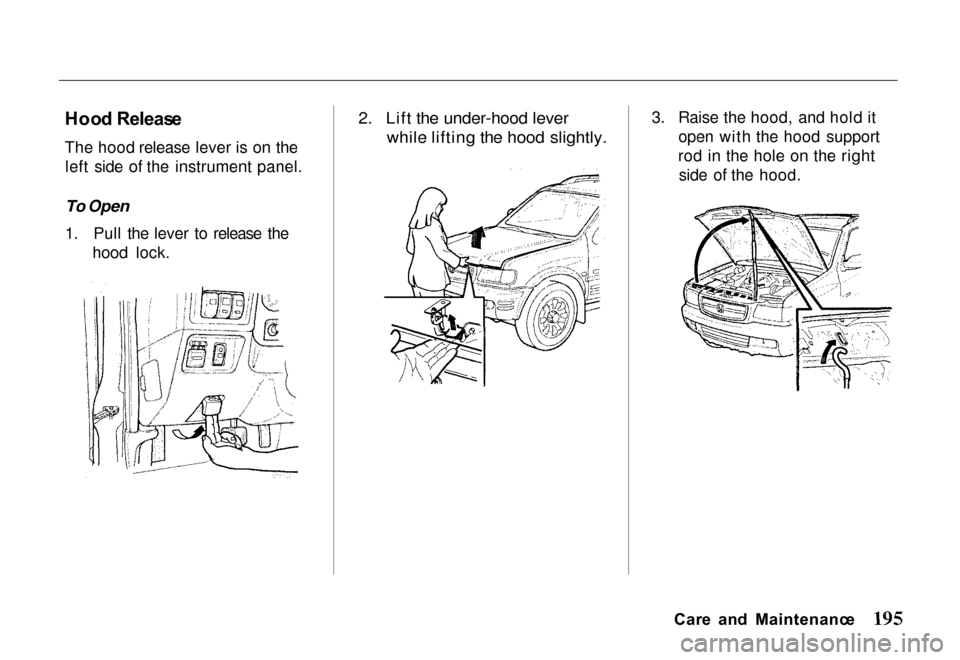
The hood release lever is on the left side of the instrument panel.
To Open
1. Pull the lever to release the hood lock.
2. Lift the under-hood lever
while lifting the hood slightly.
3. Raise the hood, and hold it
open with the hood support
rod in the hole on the right side of the hood.
Car e an d Maintenanc e
Page 209 of 267
Seat-bac
k latche s — Seat-back
latches are designed to prevent
forward motion of the seat-back when the vehicle stops suddenly.
Check to see that the seat-backlatches are holding by pulling
forward on the top of the folding
seat-back.
Also check to see that the
reclining seats are operating properly.
Light s an d beepers — Check
panel lighting, warning lights, and
the seat belt reminder light and
beeper. Also check the key beeper and interior lights. On the outside,
check the license plate light, sidemarker lights, headlights, parking
lights, taillights, brake lights, turnsignals, backup lights and hazard
warning flashers. Have the
headlight aim checked promptly if the beams seem to be aimed
improperly.
Glas
s — Check for broken,
scratched or damaged glass that
could reduce visibility or cause injury.
Doo r latches — Check that the
doors close, latch and lock
securely.
Hoo d latc h — Check that the
hood closes firmly. Check for
broken, damaged, or missing parts that might prevent secure
latching. Make sure the secondarylatch keeps the hood from
opening all the way when first
released.
Flui
d leaks — Check for fuel,
water, oil or other fluid leaks by
looking at the surface beneath the
vehicle after it has been parked
for awhile. Water dripping from
the air conditioning system after use is normal. If you notice
gasoline fumes or fluid at any
time, locate the source and have it
corrected at once.
Spar e tir e an d jac k — Check that
the spare tire and all jack gear are securely stowed at all times.
Tailgat e latc h — Check that the
tailgate closes, latches and locks
securely.
Car e an d Maintenanc e
Page 218 of 267
(—36°C) to ensure protection
against corrosion and loss of
engine coolant from boiling.
This should be done even if freezing temperatures are not
expected.
Add ethylene glycol-basedantifreeze when antifreeze has
to be added because of engine
coolant loss or if more
protection against freezing at
temperatures lower than —33 °F
(—36°C) is needed. Do not use
an alcohol-based or
methanol-based antifreeze, or
plain water. They boil at a
lower point, and do not provide corrosion protection.
Thermosta
t
The engine coolant temperature is
controlled by a thermostat, which stops engine coolant flow through
the radiator until a preset
temperature is reached. This
thermostat is installed in the
engine coolant inlet on the front of the engine block. The same
thermostat is used in both winter
and summer. Othe
r Require d
Maintenanc e
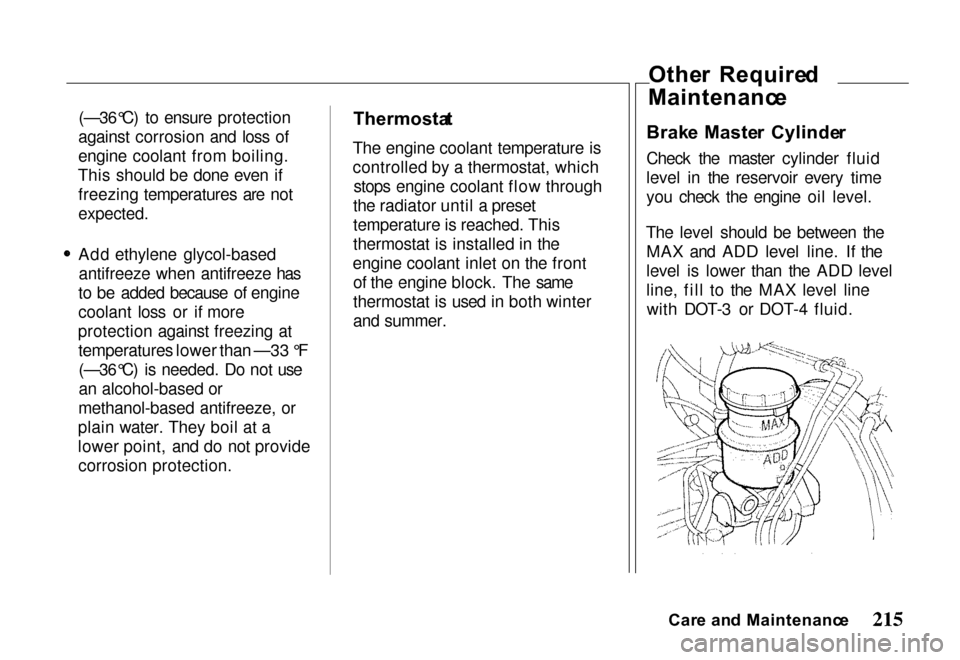
Brak e Maste r Cylinde r
Check the master cylinder fluid
level in the reservoir every time
you check the engine oil level.
The level should be between the MAX and ADD level line. If the
level is lower than the ADD level
line, fill to the MAX level linewith DOT-3 or DOT-4 fluid.
Car e an d Maintenanc e
Page 220 of 267

Hoo
d Latc h an d Hinge s
Lubricate the hood latch assembly
and hood hinge assembly as
follows:
1. Wipe off any accumulatio n of
dirt o
r contamination on the
latch parts.
2. Apply multipurpose-type grease (NLGI No. 1 or 2) to
the hood latch pin cam.
3. Apply light engine oil to all pivot points in the release
mechanism.
4. Lubricate hood hinges with multipurpose-type grease
(NLGI No. 1 or 2).
5. Check the hood hinges and
latch mechanism to assure
they are working correctly.
Ai
r Conditionin g
Periodically have your Honda dealer check your air conditioning
system to be sure there has been
no loss in cooling output. See
your Honda dealer if you suspect
that the system is not performing
as it should.
Bod y Lubricatio n
Normal use of a vehicle causes
metal-to-metal movement at certain
points in the body. Noise, wear and improper operation at these points
will result when a protective film of lubricant is not provided.
For exposed surfaces such as door
checks, door lock bolts, lock striker plates, etc., apply a thin
film of light engine oil.
Any lubricant should be used
sparingly. After application, all excess lubricant should be
carefully wiped off.
The seat adjusters and seat track should be lubricated with water-
resistant EP chassis lubricant.
There are other points on the
vehicle body which may occasionally require lubrication.
Window regulators and controls are confined in the space between
the upholstery and the outside
door panel. Easy access to the
working parts may be made by
removing the trim. Door weatherstrips and rubber hood
bumpers should be lightly coatedwith a rubber lubricant.
Car e an d Maintenanc e
Page 231 of 267
Vehicl
e Identificatio n
Vehicl e Identificatio n
Numbe r (VIN )
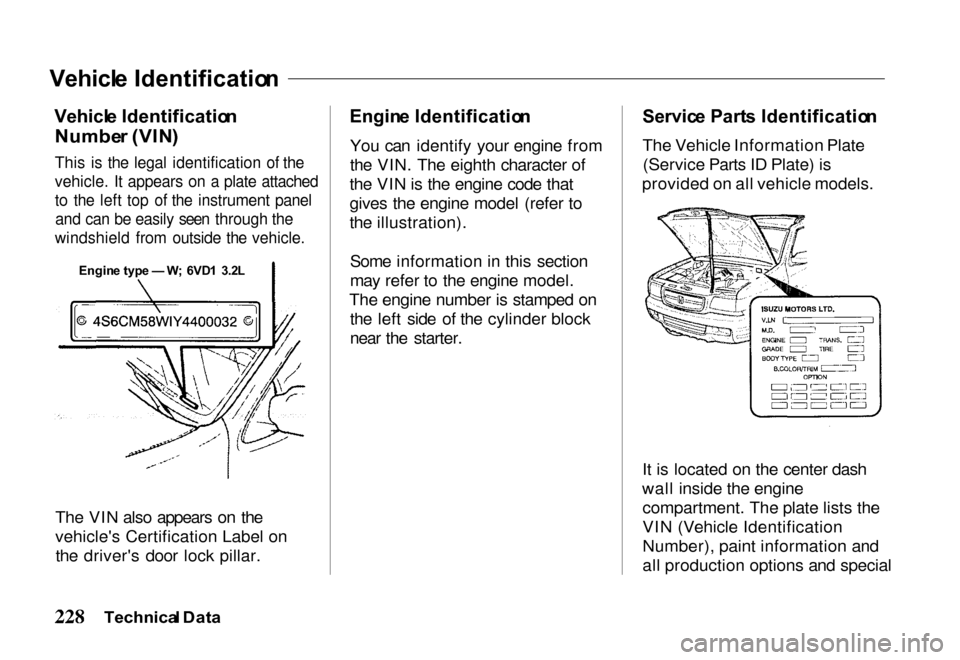
This is the legal identification of the
vehicle. It appears on a plate attached
to the left top of the instrument panel
and can be easily seen through the
windshield from outside the vehicle.
The VIN also appears on the
vehicle's Certification Label onthe driver's door lock pillar.
Engin
e Identificatio n
You can identify your engine from
the VIN. The eighth character of
the VIN is the engine code that
gives the engine model (refer to
the illustration).
Some information in this section
may refer to the engine model.
The engine number is stamped on the left side of the cylinder block
near the starter.
Servic
e Part s Identificatio n
The Vehicle Information Plate (Service Parts ID Plate) is
provided on all vehicle models.
It is located on the center dash
wall inside the engine compartment. The plate lists the
VIN (Vehicle Identification
Number), paint information and
all production options and special
Technica l Dat a
Engin
e typ e — W; 6VD 1 3.2 L
Page 232 of 267
equipment on the vehicle when it
was shipped from the factory. Be
sure to provide this information to
your authorized Honda dealer when it is necessary to order
parts.
Vehicl
e Loadin g
Vehicl e Loadin g Informatio n
The components of your vehicle are designed to providesatisfactory service only if the
vehicle is not loaded in excess of
either the Gross Vehicle Weight
Rating (GVWR) or the maximum
front and rear Gross Axle Weight
Ratings (GAWRs). These ratings are listed on the Vehicle
Certification Label located on the
left door lock pillar.
Your Honda dealer can advise you
of the proper loading conditions
for your vehicle. The use of
selected heavier suspension
components for added durability
purposes does not increase any of the weight ratings printed on the
Vehicle Certification Label. Maximu
m Fron t an d Rea r
Axl e Weigh t
The weight of the cargo load must be properly distributed over both
the front and rear axles. The
Certification Label shows themaximum weight that the front
axle (front GAWR) can carry. It also shows the maximum weight
that the rear axle (rear GAWR) can
carry. The GVWR represents the
maximum permissible loaded
weight of the vehicle and takes
into account the engine,
transmission, frame, springs,
brake, axle, and tire capabilities.
Actual loads on the front and rear
axles can only be determined by
weighing the vehicle. This can be
done at highway weight stations
or other such commercial weigh stations. Consult your Honda
dealer for assistance. The cargo
Technical Dat a
Page 254 of 267

Inde
x
ABS. See Anti-Lock Brake
System
Accessories, Installation .... 169
ACCESSORY
(Ignition Key Position) ...... 97
Accessory Power Outlets ..... 113
Adding AutomaticTransmission Fluid .... 212
Brake Fluid ............ 215
Clutch Fluid ............ 219
Engine Oil ............ 208
Manual Transmission Fluid .... 211
Power Steering Fluid ..... 219
Radiator Coolant ........ 214
Windshield Washer Fluid ..
194
Adjustments
Head
Restraints .......... 12
Mirrors
Exterior ............ 101Interior ............. 101
Power. ............. 101
Seat-Backs .......... 11,
89
Reclining the Rear ...... 93
Seats, Front ......... 10,
89
Steering Wheel ..... 15,
111
Adults, Protecting ........... 10
Airbags (SRS) ............. 7
Serious Risk to Children .... 19
Air Cleaner Filter ......
166, 210
Air Conditioning
Maintenance ........... 217
Usage ................. 116
Air Filter. See Air Cleaner Filter
Air Outlets (Vents) ......... 120
Air Pressure, Tires ......... 235
Alcohol and Driving ........ 4
Alcohol in Gasoline ........ 196
Alternator Belt. See Drive Belts
Antifreeze ................ 213
Anti-Lock Brake System
Indicator Lights .......... 65
Operation .............. 155
Anti-Theft Steering Column Lock ..... 98
System .................
..... 148
Appearance Care. See Cleaning
Ashtray .................. 112
Assist Grip ..............
111
Audio System ............. 121
Page 255 of 267
Automatic Transmission .... 74
Capacity, Fluid .......... 233
Driving Pattern Selector . . 79
Fluid Temperature Indicator 68
Oil Temperature Indicator . . 68Shift Lever Position Indicator ....... 74
Shift Lock ............. 76
Transfer Control, 4WD .... 79
Beverage Holder .......... 109
Body Repair .............. 221
Brakes
Anti-Lock Brake System . . 155
Brake System Indicator .... 59
Break-in ............... 154
Fluid .................. 215
Parking ................. 84
Power ................. 157
Wear Indicators ......... 158
Break-in, New Vehicle ...... 154
Brightness Control, Instrument
Panel. See Illumination Control
Brights, Headlights ......... 60
Bulb Replacement
Specifications ............ 239
Cables, Jump Starting with . . 180
Capacity Charts ........... 231
Carbon Monoxide Hazard ... 44
Care and Maintenance ...... 191
Cargo
Loading ............... 229
Carrying ................ 171
Cassette Player Care .................. 137
Operation .............. 124
Catalytic Converter,
Three-Way .............. 168
CAUTION, Explanation of .... iv
CD Change
r .............. 127
Certification Label ........ 230
Chains, Tire .............. 164
Battery .................. 194
Charging System Indicator . 60
Jump Starting ........... 180
Maintenance ........... 194Specifications .......... 234
Before Driving ............ 152
Belts, Seat ................ 6 Additional Information ... 38