2000 HONDA PASSPORT maintenance
[x] Cancel search: maintenancePage 217 of 267

You usually do not need to remove
the radiator cap to check the engine
coolant level.
Addin g Engin e Coolan t
To add engine coolant, remove the cap on the radiator reserve tank
and fill the tank up to the
maximum level mark. Add a
50/50 mixture of water and a good
quality ethylene glycol antifreeze. If you need to add engine coolant
frequently, see your Honda dealer
for a cooling system check.
If the proper quality antifreezeis used, there is no need to add
extra inhibitors or additives. They may be harmful to the proper
operation of the system.
Coolin g Syste m Servic e
The cooling system should be serviced at the intervals specified in the Maintenance Schedule as
follows:
Wash the radiator cap and filler
neck with clean water.
Check the engine coolant level
in the radiator and have it tested
for freeze protection. Add
ethylene glycol antifreeze, if
needed, to maintain freeze
protection at —33°F (—36°C).
Have the cooling system and
radiator cap tested for a pressure capacity of 15 psi (105
kPa). If a replacement cap is
needed, use a cap specified for
your model. Tighten all radiator and heater
hose clamps and inspect all
hoses. Replace the hoses if they
are swollen, "checked," or
otherwise worn. Carefully tighten the hose clamps at the
radiator. Overtightening could bend or collapse the radiator
fittings. Clean the front of the radiator
core and air conditioning
condenser.
It is the owner's responsibility to: Maintain the cooling system
freeze protection at —33°F
Car e an d Maintenanc e
Removing the radiator cap
while the engine is hot can
cause the coolant to spray out, seriously scalding you.
Always let the engine andradiator cool down beforeremoving the radiator cap.
Page 219 of 267
If the diaphragm inside the
reservoir cap is deformed, return
it to the original (collapsed)
condition, then tighten the cap.
It is normal for the brake fluid
level to go down slightly as the
front brake pads wear. So be sure
to keep the reservoir fluid at the
proper level.
If the reservoir needs frequent
refilling, it may indicate a serious mechanical problem.
Brake fluid absorbs water from
the air. Never use brake fluid that
has been open to the air for an
extended period. Throw it away and use new brake fluid from a
sealed container.
Brake fluid can damage your vehicle's paint. Thoroughly clean
up any brake fluid spills.
Shift-on-the-Fl
y Syste m
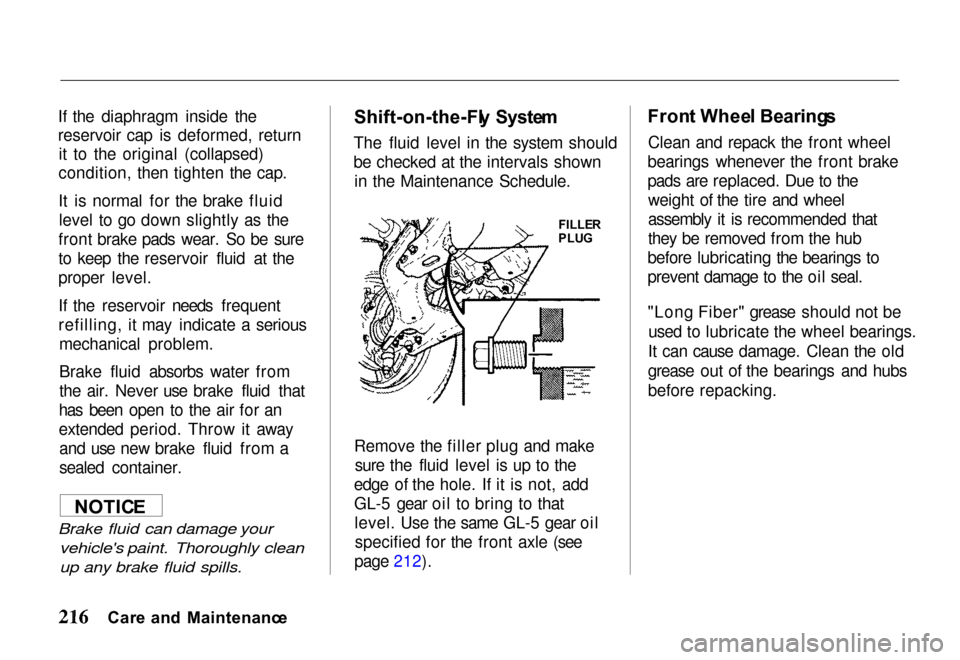
The fluid level in the system should
be checked at the intervals shown in the Maintenance Schedule.
Remove the filler plug and make sure the fluid level is up to the
edge of the hole. If it is not, add
GL-5 gear oil to bring to that level. Use the same GL-5 gear oilspecified for the front axle (see
page 212). Fron
t Whee l Bearing s
Clean and repack the front wheel
bearings whenever the front brake
pads are replaced. Due to the weight of the tire and wheel
assembly it is recommended that
they be removed from the hub
before lubricating the bearings to
prevent damage to the oil seal.
"Long Fiber" grease should not be
used to lubricate the wheel bearings.
It can cause damage. Clean the old
grease out of the bearings and hubs
before repacking.
Car e an d Maintenanc e
NOTIC
E
FILLE
R
PLU G
Page 221 of 267
Fron
t (4W D Only ) an d Rea r
Propelle r Shaf t
Lubricate the sliding yoke with
EP chassis grease. Lubricate
universal joints with grease
containing MoS 2 (molybdenum
disulfide-type grease) at the intervals shown in the
Maintenance Schedule. Also
check the propeller shaft
flange-to-pinion bolts for proper
torque of 64 N.m (46.3 Ib-ft).
Most lubrication recommendations
and procedures for four-wheel drive-
equipped vehicles are the same
for the corresponding components in conventional drive vehicles.
Exhaus t Syste m
Check the complete exhaust
system and nearby body areas for
damaged, missing, or
mispositioned parts, open seams, holes, loose connections, or other
deterioration that could allow
exhaust fumes to seep into the
passenger compartment or cause
heat build-up in the floor pan. Any
necessary corrections should be made immediately. For continuedsafety, exhaust system pipes and
resonators rearward of the muffler must be replaced whenever a new
muffler is installed.
Fue l Lin e an d Fue l Tank/Ca p
Inspect the fuel tank, cap and lines
for damage that could cause
leakage. Inspect the fuel cap and
gasket for correct sealing ability
and indications of physical
damage. Replace any damaged or
malfunctioning parts.
Driv
e Bel t
Check the belt driving the
alternator, power steering pump,
and air conditioning compressor.
Look for cracks, fraying, and wear. Replace as necessary.
Timin g Bel t
The timing belt should normally
be replaced at the intervals shown
in the Maintenance Schedule.
Valv e Clearanc e
Incorrect valve clearance will
result in increased engine noise and lower engine output, thereby
adversely affecting engine
performance.
Car e an d Maintenanc e
Page 222 of 267

Spar
k Plug s
Replace the spark plugs with the
type specified in the "Technical
Data" section.
Clutc h
Check the clutch play at the pedal.
Lubricate the clutch pedal bushing and clevis pin, at the intervalsshown in the Maintenance
Schedule, with water-resistant
chassis lubricant. If you hear a squeaking noise coming from the
area of the bushing or clevis pin at
the clutch pedal arm when the
clutch pedal is depressed,
lubricate it with water-resistant EP
chassis grease.
Check the fluid level in the clutch
reservoir at the interval shown in
the Maintenance Schedule. If the fluid is low in the reservoir, it
should be filled to the
maximum
level lin
e with DOT-3 or DOT-4
fluid.
Flui d o r Lubrican t Level s
Check the fluid or lubricant level in the brake master cylinder,
clutch master cylinder, power steering reservoir, rear axle,
engine and transmission, windshield washer reservoir and
engine coolant at specified
intervals.
Powe
r Steerin g
Check the fluid level in the power steering fluid reservoir as
recommended in the Maintenance Schedule. The fluid level should
be between the "MIN" and "MAX" marks on the reservoir.
Use only automatic transmission
fluid labeled DEXRON III.
Car e an d Maintenanc e
Page 249 of 267

maintain them. This section
summarizes how the emissions
controls work. Scheduled
maintenance is on page 200.
Crankcas e Emission s
Contro l Syste m
Your vehicle has a Positive
Crankcase Ventilation System.
This keeps gasses that build up in the engine's crankcase from goinginto the atmosphere. The Positive
Crankcase Ventilation valve
routes them from the crankcase
back to the intake manifold. They are then drawn into the engine and
burned.
Evaporativ e Emission s
Contro l Syste m
As gasoline evaporates in the fuel
tank, an evaporative emission
control canister filled with charcoal adsorbs the vapor. It is stored in this canister while the
engine is off. After the engine is
started and warmed up, the vapor
is drawn into the engine and
burned during driving.
Exhaus t Emission s Control s
The exhaust emission controls include four systems: Fuel
Injection, Ignition Timing Control, Exhaust Gas
Recirculation, and Three-Way Catalytic Converter. These four
systems work together to control
the engine's combustion and
minimize the amount of HC, CO,
and NOx that comes out the
tailpipe. The exhaust emission
control systems are separate fromthe crankcase and evaporative
emission control systems. Fuel Injection System
The Fuel Injection System uses sequential multiport fuel injection.
It has three subsystems: Air
Intake, Engine Control, and Fuel
Control. The Engine Control Module (ECM) uses various
sensors to determine how much
air is going into the engine. It then
controls how much fuel to inject
under all operating conditions.
Ignition Timing Control System This system constantly adjusts theignition timing, reducing the amount
of HC, CO and NOx produced.
Owne r Assistanc e
Page 253 of 267
These publications cannot be returned for credit without receiving advance authorization within 14 days of
delivery. On returns, a restocking fee may be applied against the original order.
P.O. BOX 07280 DETROIT, Ml 48207 1-800-782-4356
Servic
e Manua l
This manual covers maintenance and recommended
procedures for repair to engine and chassis
components. It is written for the journeyman mechanic, but is simple enough for most mechanicallyinclined owners to understand.
Electrica l Troubleshootin g Manua l
This manual complements the Service Manual by
providing in-depth troubleshooting information for
each electrical circuit in your car.
Page 254 of 267

Inde
x
ABS. See Anti-Lock Brake
System
Accessories, Installation .... 169
ACCESSORY
(Ignition Key Position) ...... 97
Accessory Power Outlets ..... 113
Adding AutomaticTransmission Fluid .... 212
Brake Fluid ............ 215
Clutch Fluid ............ 219
Engine Oil ............ 208
Manual Transmission Fluid .... 211
Power Steering Fluid ..... 219
Radiator Coolant ........ 214
Windshield Washer Fluid ..
194
Adjustments
Head
Restraints .......... 12
Mirrors
Exterior ............ 101Interior ............. 101
Power. ............. 101
Seat-Backs .......... 11,
89
Reclining the Rear ...... 93
Seats, Front ......... 10,
89
Steering Wheel ..... 15,
111
Adults, Protecting ........... 10
Airbags (SRS) ............. 7
Serious Risk to Children .... 19
Air Cleaner Filter ......
166, 210
Air Conditioning
Maintenance ........... 217
Usage ................. 116
Air Filter. See Air Cleaner Filter
Air Outlets (Vents) ......... 120
Air Pressure, Tires ......... 235
Alcohol and Driving ........ 4
Alcohol in Gasoline ........ 196
Alternator Belt. See Drive Belts
Antifreeze ................ 213
Anti-Lock Brake System
Indicator Lights .......... 65
Operation .............. 155
Anti-Theft Steering Column Lock ..... 98
System .................
..... 148
Appearance Care. See Cleaning
Ashtray .................. 112
Assist Grip ..............
111
Audio System ............. 121
Page 255 of 267
Automatic Transmission .... 74
Capacity, Fluid .......... 233
Driving Pattern Selector . . 79
Fluid Temperature Indicator 68
Oil Temperature Indicator . . 68Shift Lever Position Indicator ....... 74
Shift Lock ............. 76
Transfer Control, 4WD .... 79
Beverage Holder .......... 109
Body Repair .............. 221
Brakes
Anti-Lock Brake System . . 155
Brake System Indicator .... 59
Break-in ............... 154
Fluid .................. 215
Parking ................. 84
Power ................. 157
Wear Indicators ......... 158
Break-in, New Vehicle ...... 154
Brightness Control, Instrument
Panel. See Illumination Control
Brights, Headlights ......... 60
Bulb Replacement
Specifications ............ 239
Cables, Jump Starting with . . 180
Capacity Charts ........... 231
Carbon Monoxide Hazard ... 44
Care and Maintenance ...... 191
Cargo
Loading ............... 229
Carrying ................ 171
Cassette Player Care .................. 137
Operation .............. 124
Catalytic Converter,
Three-Way .............. 168
CAUTION, Explanation of .... iv
CD Change
r .............. 127
Certification Label ........ 230
Chains, Tire .............. 164
Battery .................. 194
Charging System Indicator . 60
Jump Starting ........... 180
Maintenance ........... 194Specifications .......... 234
Before Driving ............ 152
Belts, Seat ................ 6 Additional Information ... 38