Page 92 of 267
Fore/Af
t Sea t Adjustmen t
See pages 10-11 for important
safety information and warnings
about how to properly position
seats and seat-backs.
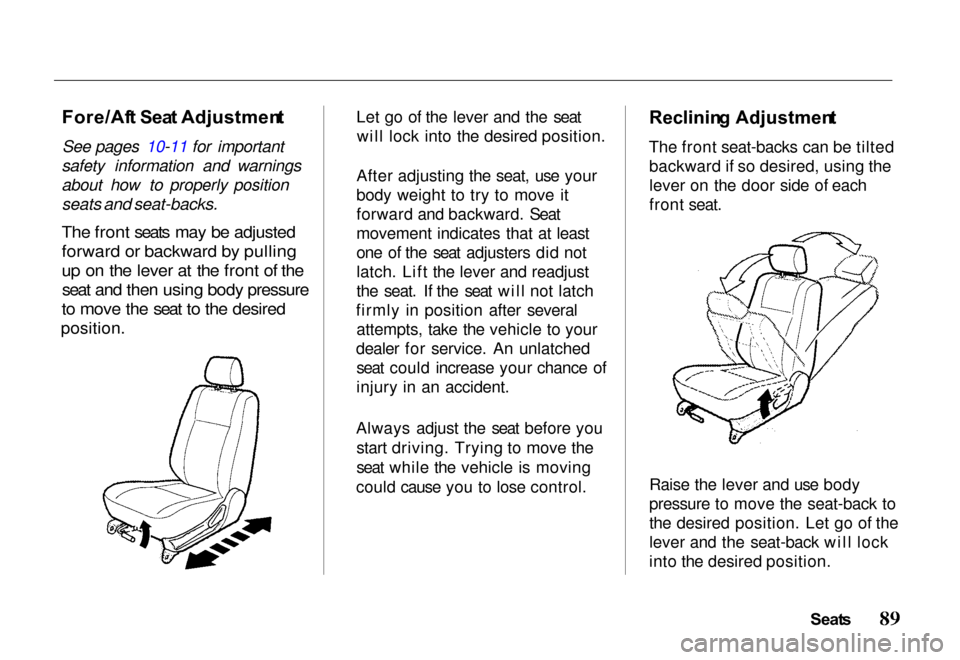
The front seats may be adjusted
forward or backward by pulling
up on the lever at the front of the seat and then using body pressure
to move the seat to the desired
position.
Let go of the lever and the seat
will lock into the desired position.
After adjusting the seat, use your
body weight to try to move it
forward and backward. Seat
movement indicates that at least
one of the seat adjusters did not
latch. Lift the lever and readjust
the seat. If the seat will not latch
firmly in position after several attempts, take the vehicle to your
dealer for service. An unlatched seat could increase your chance of
injury in an accident.
Always adjust the seat before you start driving. Trying to move the
seat while the vehicle is moving
could cause you to lose control.
Reclinin
g Adjustmen t
The front seat-backs can be tilted backward if so desired, using the
lever on the door side of each
front seat.
Raise the lever and use body
pressure to move the seat-back to
the desired position. Let go of the
lever and the seat-back will lock
into the desired position.
Seats
Page 158 of 267
If your vehicle is equipped with
an automatic transmission, set
the parking brake before you
leave the driver's seat. If the
vehicle is parked on a grade and the transmission shift leveris placed in "P" (Park) position
before you set the parking
brake, the weight of the vehicle may exert so much force on the
transmission that you may have
difficulty moving the shift
lever out of "P" (Park)
position. To prevent this, apply the parking brake BEFORE
moving the shift lever to "P" (Park). When you want to drive
away, move the shift lever out
of the "P" (Park) position
BEFORE releasing the parking
brake. It is good driving
practice to set the parking
brake first, then place the
transmission in "PARK"
position, even on level
surfaces.
If the parking brake does not
seem to hold the vehicle as
well as before, have the vehicle
serviced by your Honda dealer.
Do not park your vehicle over
high grass, dry leaves or other
combustible materials. The
catalytic converter gets very
hot and could set fire to these
materials.
Anti-Loc
k Brake s
Your vehicle has an Anti-lock
Brake System (ABS) as standard
equipment. ABS helps to prevent
the wheels from locking up and skidding during hard braking,
allowing you to retain steering
control.
When the front tires skid, you lose steering control; the vehicle
continues straight ahead even
though you turn the steering
wheel. The ABS helps to prevent
lock-up and retain steering control
by pumping the brakes rapidly;
much faster than a person can do it.
Yo u shoul d neve r pum p th e
brak e pedal , this defeats the
purpose of the ABS. Let the ABS work for you by always keeping
firm, steady pressure on the brake
pedal as you steer away from the
Driving Tip s
Brake
s
Page 170 of 267

air cleaner, so it's important to
replace the air cleaner filter at
required intervals. See "Care and Maintenance." A dirty air cleaner
filter reduces engine performance
and can waste fuel.
Air Conditioning
Turn off the air conditioning whenit is not needed. The air
conditioning compressor is not on
in this position and the reduced
engine load can improve fuel
economy.
Tuned Engine
An engine that is properly
maintained will provide better
fuel economy than one that is not.
One misfiring spark plug will cut
fuel economy significantly, and
will make a difference in the
amount of pollution emitted from
your vehicle.
Excessive Weight
Fuel economy is related to thework the engine must do. The
heavier the load, the more fuel it takes to run your vehicle. Keep
weight to a minimum by removing
unnecessary luggage or cargo.
Tire Inflation
Underinflation not only causes
needless tire wear but can also
waste fuel. It's a good idea to
check tire pressure often and keep your tires inflated to the pressures
shown on the tire placard located
on the driver's doorjamb.
Wheel Alignment
Improper alignment will cause the
front tires to roll at an angle that
will result in faster tire wear. It takes power to overcome this
improper alignment, which, inturn, wastes fuel.
Use of 4-Wheel Drive
In normal driving, put the 4WD-2WD switch in the 2WD
position.
Driving Tip s
Page 174 of 267
Carryin
g Carg o
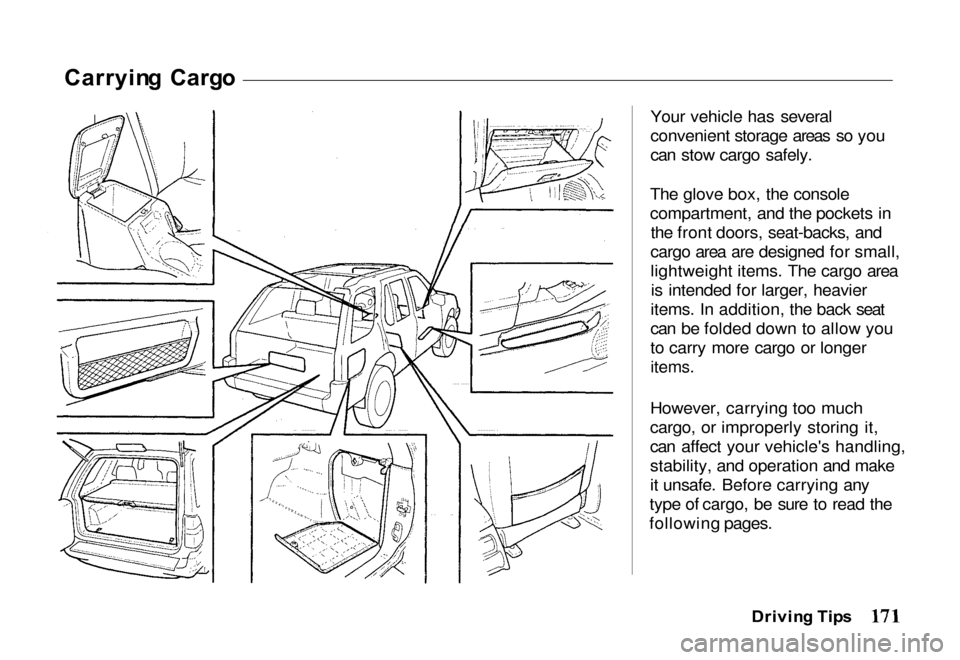
Your vehicle has several
convenient storage areas so you
can stow cargo safely.
The glove box, the console
compartment, and the pockets in the front doors, seat-backs, and
cargo area are designed for small,
lightweight items. The cargo area is intended for larger, heavier
items. In addition, the back seat
can be folded down to allow you
to carry more cargo or longer
items.
However, carrying too much
cargo, or improperly storing it,
can affect your vehicle's handling,
stability, and operation and make
it unsafe. Before carrying any
type of cargo, be sure to read the
following pages.
Drivin g Tip s
Page 175 of 267
Loa
d Limi t
The maximum load for your
vehicle is:
LX2WD
manual trans:
automatic trans:
LX4WD
manual trans:
automatic trans:
EX
manual trans:automatic trans:
895 Ib (407 kg)
840
Ib
(382
kg)
905
Ib
(411
kg) 850 Ib (386 kg)
930 Ib (423 kg) 875 Ib (398 kg)
This figure includes the total weight
of all occupants, cargo, accessories,
and the tongue weight if you are
towing a trailer. To figure out how much cargo
you can carry: Add up the weight of all
occupants.
If you are towing a trailer, add
the tongue weight to the
number above. Subtract the total from the
maximum load figure.
The final number is the total weight of cargo you can carry.
Drivin g Tip s
Overloading o
r improper
loading can affect handling
and stability and cause a
crash in which you can be hurt or killed.
Follow all load limits and
other loading guidelines in
this manual.
Page 176 of 267
Carryin
g Item s in th e
Passenge r Compartmen t
Store or secure all items that
could be thrown around and
hurt someone during a crash. Be sure items placed on the
floor behind the front seats
cannot roll under the seats
and interfere with the driver's
ability to operate the pedals,
or with the proper operation
of the seats. Keep the glove box closed
while driving. If the lid is open,
a passenger could injure his
knees during a crash or sudden
stop.
Carryin
g Carg o in th e Carg o
Are a o r o n a Roo f Rac k Distribute cargo evenly on the
floor of the cargo area, placing
the heaviest items on the
bottom and as far forward as
possible.
If you fold down the back seat,
tie down items that could be
thrown about the vehicle
during a crash or sudden stop. If you carry large items that
prevent you from closing the hatch glass or rear door,
exhaust gas can enter the
passenger area. To avoid the
possibility of carbon monoxide
poisoning, follow the instructions on page 44. If you carry any items on a roof
rack, be sure the total weight of the rack and the items does not
exceed 200 Ib (90 kg).
Driving Tip s
Page 178 of 267
Follow the recommendations in
this manual and ask your Honda
dealer for further details before
you tow a trailer with your
Passport.
Towing a trailer affects vehicle
maintenance requirements due
to the additional load. More
frequent maintenance intervals
will be required to assure
continued satisfaction with
your vehicle. Consult yourHonda dealer for recommended
maintenance and service.
The gross trailer weight (trailer weight plus cargo load) must
never exceed 4,500 Ib.
Additional equipment will be
required, depending on the specific model/load combination.
See "Trailer Hitches" in this
section.
Exceeding the weight limit will
cause damage to your vehicle and
possibly result in personal injury. The Gross Vehicle Weight
Rating (GVWR) is the
combined weight of the
unloaded vehicle, passengers,
cargo, trailer hitch, trailer
tongue load, and optional
equipment. This value is indicated on the F.M.V.S.S.
Certification Label on the
driver's doorjamb. The Gross Combined Weight
Rating (GCWR) equals the combined weight of your
vehicle (including passengers
and cargo) plus the total trailer
load. The following limits
apply.
2WD: 8,700 Ib
4WD: 8,950 Ib
The Gross Axle Weight Rating
(GAWR) is also indicated on
the Certification Label. The
load on either the front or rear
axle resulting from distribution
of the gross vehicle weight on both axles must not exceed the
values listed. Remember to
account for additional
equipment and tongue load.
Driving Tip s
Page 179 of 267
Tongue load should be between
9 percent and 11 percent of the
total trailer weight. However, itshould never exceed 450 pounds. Never load a trailer with more
weight in the rear than in the
front. The front should be
loaded with approximately
60 percent and the rear with
approximately 40 percent of
the total trailer load. Never exceed the maximum
weight limits of the trailer
or trailer towing equipment.
Improper loading can result in damage to your vehicle and
possible personal injury. Check the vehicle and trailer
loading and the weights on
each axle at a commercial scale
or a highway patrol office
equipped with a scale.
Traile
r Hitche s
A Class 3 hitch kit (up to 4,500 Ib) is available from your
Honda dealer.
Use a trailer equipped with
electric brakes and a "Weight
Distributing Hitch Attachment" when the gross trailer weight
exceeds 3,500 pounds.
A special attachment that replaces the draw bar/ball assembly is used
to distribute the proper weight to
the front axle. It uses a pair ofspring bars that are adjusted to
accomplish the distribution of the weight.
Consult your trailer's
manufacturer for assistance withselecting the proper weight
distributing hitch attachment. Check with a recreational vehicle
dealer for additional required
equipment. Have this equipment installed by a trained mechanic.
Improper equipment or installation
can damage your vehicle and cause
personal injury.
Do not use axle-mounted hitches
or equipment not designed for
your vehicle.
Do not make any modifications to
the vehicle's exhaust, braking, or
electrical system other than those
that are shown in the instructions
for the Honda Trailer Hitch Kit.
Improper modifications can affect
vehicle durability.
Periodic inspection of all added-on trailer towing equipment is
necessary to assure continued safe
operation.
Drivin g Tip s