Page 14 of 267

To reduce the chance of injury,
wear your seat belt properly, sit
upright with your back against theseat, and move the seat as far back
as possible from the steering
wheel while still maintaining full
control of the vehicle. Also make sure your front seat passenger
moves the seat as far to the rear as
possible.
Most shorter drivers can get far
enough away from the steering wheel and still reach the pedals.
However, if you are concernedabout sitting too close, we
recommend that you investigate whether some type of adaptive
equipment may help.
Once your seat is adjusted
correctly, rock it back and forth to make sure the seat is locked in
position.
See page 89 for how to adjust the
front seats.
3
. Adjus t th e Seat-Back s
Adjust the driver's seat-back to a comfortable, upright position,
leaving ample space between your
chest and the airbag cover in the
center of the steering wheel. If
you sit too close to the steering
wheel, you could be injured if the airbag inflates.
A front passenger should also
adjust the seat-back to an upright
position, but as far from the
Drive r an d Passenge r Safet y
Sitting too close to the airbag
can result in serious injury or
death if the airbags inflate.
Always sit as far back from the
airbags as possible.
Page 15 of 267
dashboard as possible. A
passenger who sits too close to the
dashboard could be injured if the
airbag inflates.
Reclining a seat-back so that the shoulder part of the belt no longer
rests against the occupant's chest
reduces the protective capability
of the belt. It also increases the
chance of sliding under the belt in a crash and being seriouslyinjured. The farther a seat-back is
reclined, the greater the risk of injury.
See page 89 for how to adjust
seat-backs.
4
. Adjus t th e Hea d Restraint s
Before driving, make sure
everyone with an adjustable head
restraint has properly positioned the head restraint. The restraint
should be positioned so the back
of the occupant's head rests
against the center of the restraint.
A taller person should adjust the
restraint as high as possible.
Drive r an d Passenge r Safet yReclining the seat-back too far
can result in serious injury or
death in a crash.
Adjust the seat-back to an upright position and sit well
back in the seat.
Page 18 of 267
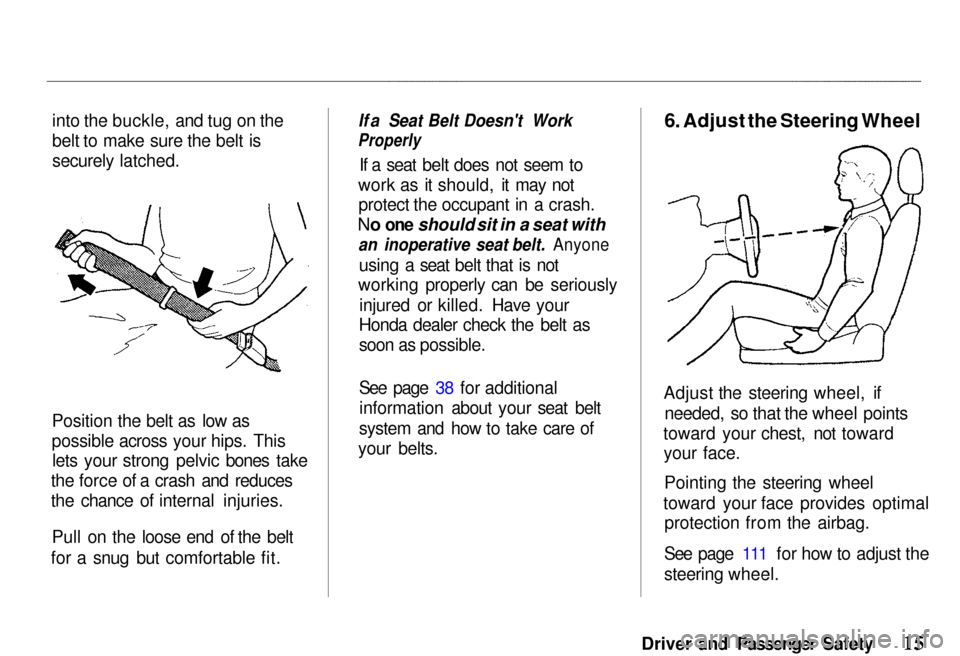
into the buckle, and tug on the
belt to make sure the belt is
securely latched.
Position
the belt as low as
possible across your hips. This lets your strong pelvic bones take
the force of a crash and reduces
the chance of internal injuries.
Pull
on the loose end of the belt
for a snug but comfortable fit.
If a Seat Belt Doesn't Work
Properly
If a seat belt does not seem to
work as it should, it may not protect
the occupant in a crash.
No one should sit in a seat with
an inoperative seat belt. Anyone
using
a seat belt that is not
working
properly can be seriously
injured or killed. Have your
Honda
dealer check the belt as
soon as possible.
See
page 38 for additional
information
about your seat belt
system and how to take care of
your
belts. 6. Adjust the Steering Wheel
Adjust
the steering wheel, if
needed, so that the wheel points
toward your chest, not toward your face.
Pointing the steering wheel
toward
your face provides optimal
protection from the airbag.
See page 111 for how to adjust the
steering
wheel.
Driver and Passenger Safety
Page 19 of 267

7
. Maintai n a Prope r Sittin g
Positio n
After all occupants have adjusted their seats and put on seat belts, itis very important that they
continue to sit upright, well back in their seats, with their feet on
the floor, until the vehicle is
parked and the engine
is off.
Sitting improperly can increase
the chance of injury during a
crash. For example, if an occupant slouches, lies down, turns
sideways, sits forward, leans
forward or sideways, or puts one
or both feet up, the chance of injury during a crash is greatly
increased.
In addition, an occupant who is
out of position in the front seat
can be seriously or fatally injured
by striking interior parts of the vehicle, or by being struck by an
inflating airbag.
Remember, to get the best
protection from your vehicle's airbags and other safety features,
you must sit properly and wear your seat belt properly.
Advic
e fo r Pregnan t Wome n
Because protecting the mother is
the best way to protect her unborn
child, a pregnant woman should
always wear a seat belt whenever she drives or rides in a vehicle.
Drive r an d Passenge r Safet y
Sitting improperly or out of
position can result in serious
injury or death in a crash.
Always sit upright, well back in
the seat, with your feet on the
floor.
Page 20 of 267
We recommend that a pregnant
woman use a lap/shoulder belt
whenever possible. Remember to
keep the lap portion of the belt as low as possible across your hips.
Pregnant women should also sit as far back as possible from thesteering wheel or dashboard. This
will reduce the risk of injuries to
both the mother and her unborn
child that can be caused by a
crash or an inflating airbag.
Each time you have a checkup,
ask your doctor if it's okay for
you to drive.
Additiona l Safet y
Precaution s
Two people should never use
the same seat belt. If they do, they could be very seriously
injured in a crash.
Do not put any accessories on
seat belts. Devices intended toimprove occupant comfort, or
reposition the shoulder part of a seat belt, can severely
compromise the protective
capability of the seat belt and increase the chance of serious
injury in a crash. Do not place hard or sharp
objects between yourself and
an airbag. Carrying hard orsharp objects on your lap, or
driving with a pipe or other sharp object in your mouth, can
result in injuries if your airbags inflate.
Keep your hands and arms
away from the airbag covers.
If your hands or arms are close
to the SRS covers in the center of the steering wheel or on top of the dashboard, they could be
injured if the airbags inflate.
Never let passengers ride in the cargo area or on top of a
folded-down back seat. All passengers must sit in locked,upright seats and be properly
restrained by seat belts.
Do not attach or place objects
on the airbag covers. Any
object attached to or placed on
the covers marked "SRS
AIRBAG" in the center of the steering wheel and on top of
the dashboard could interfere with the proper operation of theairbags. Or, if the airbags
inflate, the objects could be
propelled inside the car and hurt someone.
Drive r an d Passenge r Safet y
Page 22 of 267
Childre
n Shoul d Si t i n th e
Bac k Sea t
According to accident statistics,
children of all ages and sizes are safer when they are restrained in
the back seat, not the front seat.
The National Highway Traffic Safety Administration
recommends that all children ages 12 and under be properly
restrained in the back seat.
In the back seat, children are lesslikely to be injured by striking
hard interior parts during a
collision or hard braking. Also,
children cannot be injured by an inflating airbag when they ride in
the back.
Th
e Passenger' s Airba g
Pose s Seriou s Risk s t o
Childre n
Airbags have been designed to
help protect adults in a moderate to severe frontal collision. To do
this, the passenger's airbag is
quite large, and it inflates with
tremendous speed.
Infants
Never put a rear-facing child seat in the front seat of a vehicle
equipped with a passenger's
airbag. If the airbag inflates, it
can hit the back of the child seat
with enough force to kill or very seriously injure an infant. Small Children
Placing a forward-facing child seat in the front seat of a vehicle
equipped with a passenger's
airbag can be hazardous. If the vehicle seat is too far forward, or
the child's head is thrown forward
during a collision, an inflatingairbag can strike the child with
enough force to kill or very seriously injure a small child.
Larger Children Children who have outgrownchild seats are also at risk of
being injured or killed by an
inflating passenger's airbag.
Whenever possible, larger
children should sit in the back seat, properly restrained with a
seat belt. (See page 33 for
important information about
protecting larger children.)
Drive r an d Passenge r Safet y
Page 23 of 267

To remind you of the passenger's
airbag hazards, and that children
must be properly restrained in the
back seat, your vehicle haswarning labels on the dashboard,
and on the driver's and front
passenger's visors. Please read and follow the instructions on
these labels.
I
f Yo u Mus t Driv e Wit h
Severa l Childre n
Your vehicle has three seating
positions in the back seat where
children can be properly
restrained.
If you ever have to carry morethan three children in your
vehicle: Place the largest child in the
front seat, provided the child is
large enough to wear a seat belt
properly (see page 33). Move the vehicle seat as far to
the rear as possible (see page
89).
Have the child sit upright and well back in the seat (see page
16).
Make sure the seat belt is
properly positioned and secured (see page 13). I
f a Chil d Require s Clos e
Attentio n
Many parents say they prefer to
put an infant or small child in the front passenger seat so they canwatch the child, or because the
child requires attention.
Placing a child in the front seat
exposes the child to hazards from
the airbag, and paying close
attention to a child distracts the
driver from the important tasks of
driving, placing both of you at
risk.
If a child requires physical
attention or frequent visual
contact, we strongly recommend
that another adult ride with thechild in the back seat. The backseat is far safer for a child than the
front.
Drive r an d Passenge r Safet y
Page 26 of 267
Placing a Child Seat
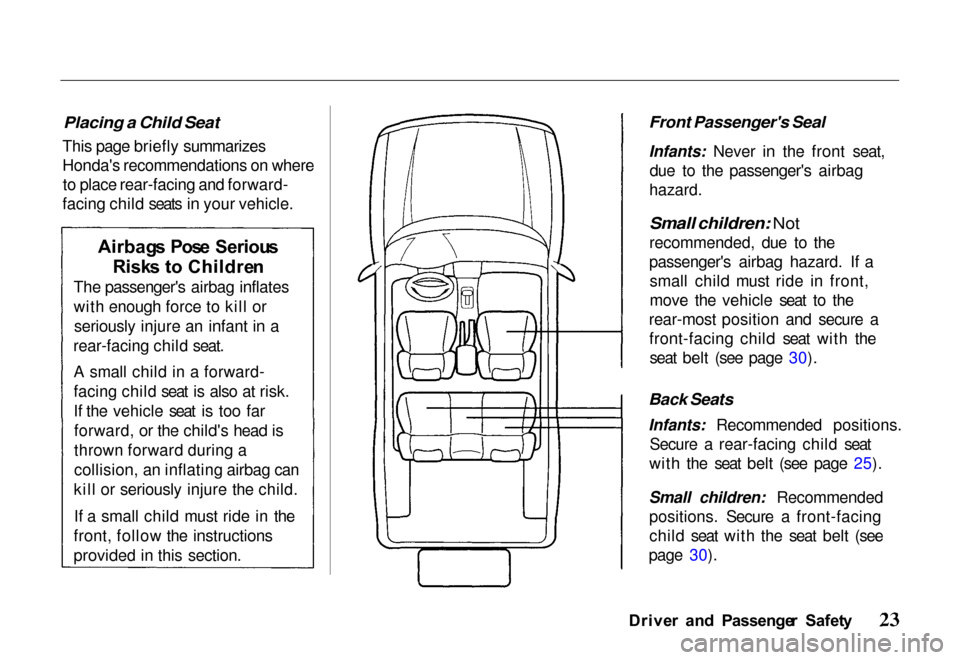
This page briefly summarizes
Honda's recommendations on where to place rear-facing and forward-
facing child seats in your vehicle.
Front Passenger's Seal
Infants: Never in the front seat,
due to the passenger's airbag
hazard.
Small children: Not
recommended, due to the
passenger's airbag hazard. If a small child must ride in front,
move the vehicle seat to the
rear-most position and secure a front-facing child seat with theseat belt (see page 30).
Back Seats
Infants: Recommended positions. Secure a rear-facing child seat
with the seat belt (see page 25).
Small children: Recommended positions. Secure a front-facing
child seat with the seat belt (see
page 30).Drive r an d Passenge r Safet y
Airbag s Pos e
Seriou
s
Risk s t o Childre n
The passenger's airbag inflates
with enough force to kill or seriously injure an infant in a
rear-facing child seat.
A small child in a forward-
facing child seat is also at risk.
If the vehicle seat is too farforward, or the child's head is
thrown forward during a
collision, an inflating airbag can
kill or seriously injure the child.
If a small child must ride in the
front, follow the instructions
provided in this section.
