Page 261 of 421

yellowblue
4-65
When towing at high altitude on steep uphill grades,
consider the following: Engine coolant will boil at a
lower temperature than at normal altitudes. If you turn
your engine off immediately after towing at high altitude
on steep uphill grades, your vehicle may show signs
similar to engine overheating. To avoid this, let the
engine run while parked (preferably on level ground)
with the automatic transmission in PARK (P) (or the
manual transmission out of gear and the parking brake
applied) for a few minutes before turning the engine off.
If you do get the overheat warning, see ªEngine
Overheatingº in the Index.
Parking on Hills
CAUTION:
You really should not park your vehicle, with a
trailer attached, on a hill. If something goes
wrong, your rig could start to move. People can
be injured, and both your vehicle and the trailer
can be damaged.
But if you ever have to park your rig on a hill, here's
how to do it:
1. Apply your regular brakes, but don't shift into
PARK (P) yet for an automatic transmission, or into
gear for a manual transmission.
2. Have someone place chocks under the trailer wheels.
3. When the wheel chocks are in place, release the
regular brakes until the chocks absorb the load.
4. Reapply the regular brakes. Then apply your
parking brake and shift into PARK (P) for an
automatic transmission, or REVERSE (R) for a
manual transmission.
5. If you have a four
-wheel-drive vehicle, be sure
the transfer case is in a drive gear and not in
NEUTRAL (N).
6. Release the regular brakes.
Page 262 of 421

yellowblue
4-66
CAUTION:
It can be dangerous to get out of your vehicle if
the shift lever is not fully in PARK (P) with the
parking brake firmly set. Your vehicle can roll.
If you have left the engine running, the vehicle
can move suddenly. You or others could be
injured. To be sure your vehicle won't move, even
when you're on fairly level ground, use the steps
that follow.
Always put the shift lever fully in PARK (P) with
the parking brake firmly set.
If the transfer case on four-wheel drive vehicles is
in NEUTRAL (N), your vehicle will be free to
roll, even if your shift lever is in PARK (P). So, be
sure the transfer case is in a drive gear
-- not in
NEUTRAL (N).
When You Are Ready to Leave After
Parking on a Hill
1. Apply your regular brakes and hold the pedal down
while you:
�Start your engine;
�Shift into a gear; and
�Release the parking brake.
2. Let up on the brake pedal.
3. Drive slowly until the trailer is clear of the chocks.
4. Stop and have someone pick up and store the chocks.
Maintenance When Trailer Towing
Your vehicle will need service more often when you're
pulling a trailer. See the Maintenance Schedule for more
on this. Things that are especially important in trailer
operation are automatic transmission fluid (don't
overfill), engine oil, axle lubricant, belt, cooling system
and brake system. Each of these is covered in this
manual, and the Index will help you find them quickly.
If you're trailering, it's a good idea to review these
sections before you start your trip.
Check periodically to see that all hitch nuts and bolts
are tight.
Page 263 of 421
yellowblue
4-67 Trailer Wiring Harness
Your vehicle is equipped with one of the following
wiring harnesses for towing a trailer or hauling a
slide
-in camper.
Basic Trailer Wiring Package
All regular and extended cab pickups have a six
-wire
trailer towing harness.
The six-wire harness is located at the rear of the vehicle
and is tied to the vehicle's frame. The harness requires
the installation of a trailer
-wiring harness connector,
which is available through your dealer.
The six
-wire harness contains the following
trailer circuits:
�Yellow: Left Stop/Turn Signal
�Dark Green: Right Stop/Turn Signal
�Brown: Taillamps
�White: Ground
�Light Green: Back
-up Lamps
�Light Blue: Center High
-Mounted
Stoplamp (CHMSL)
If you need to upgrade your vehicle to heavy
-duty
trailering, a brake controller harness and an underbody
harness with a seven
-pin universal heavy-duty trailer
connector are available from your dealer.
Page 264 of 421

yellowblue
4-68
Heavy-Duty Trailer Wiring Package (If Equipped)
Your pickup may be equipped with the eight-wire trailer
towing harness. This harness with a seven
-pin universal
heavy
-duty trailer connector is attached to a bracket on
the platform hitch.*
* The Center High
-Mounted Stoplamp (CHMSL) wire
is tied next to the trailer wiring harness for use with a
trailer, slide
-in camper or cap.The eight
-wire harness contains the following
trailer circuits:
�Yellow: Left Stop/Turn Signal
�Dark Green: Right Stop/Turn Signal
�Brown: Taillamps
�White: Ground
�Light Green: Back
-up Lamps
�Light Blue: CHMSL
�Red: Battery Feed
�Dark Blue: Trailer Brake
A jumper harness for an electric trailer brake controller
and a trailer battery feed fuse are included with this
trailering package. (SeeªInstrument Panel Jumper
Wiring Harnessº later in this section.)
If you need to tow a light
-duty trailer with a standard
four
-way round pin connector, an adapter connector is
available from your dealer.
Page 267 of 421
yellowblue
4-71
NOTICE:
When using the auxiliary battery provision, the
electrical load must not exceed 30 amps. Always
turn off any electrical equipment when not in use.
Leaving electrical equipment on for extended
periods will drain your battery.
Power Winches
If you wish to use a power winch on your vehicle, only
use it when your vehicle is stationary or anchored.
NOTICE:
Using a power winch with the transmission in
gear may damage the transmission. When
operating a power winch, always leave the
transmission in NEUTRAL (N).
Use the regular brakes, set the parking brake, or block
the wheels to keep your vehicle from rolling.
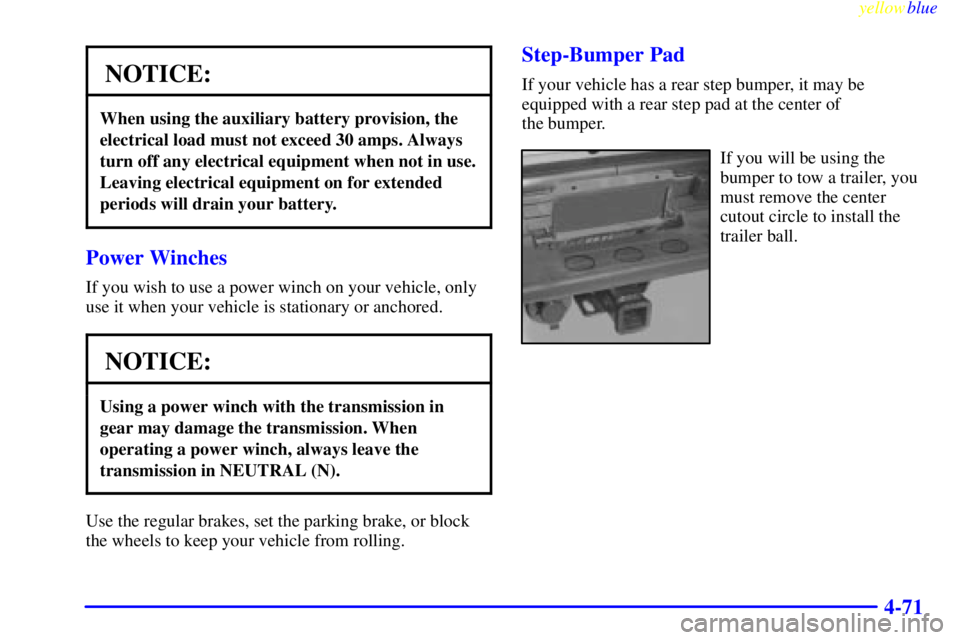
Step-Bumper Pad
If your vehicle has a rear step bumper, it may be
equipped with a rear step pad at the center of
the bumper.
If you will be using the
bumper to tow a trailer, you
must remove the center
cutout circle to install the
trailer ball.
Page 268 of 421
5-
yellowblue
5-1
Section 5 Problems on the Road
Here you'll find what to do about some problems that can occur on the road.
5
-2 Hazard Warning Flashers
5
-2 Other Warning Devices
5
-3 Jump Starting
5
-8 Towing Your Vehicle
5
-9 Engine Overheating5
-12 Cooling System
5
-18 Engine Fan Noise
5
-18 If a Tire Goes Flat
5
-18 Changing a Flat Tire
5
-34 If You're Stuck: In Sand, Mud, Ice or Snow
Page 275 of 421
yellowblue
5-8
Towing Your Vehicle
CAUTION:
To help avoid serious personal injury to you
or others:
�Never let passengers ride in a vehicle that is
being towed.
�Never tow faster than safe or posted speeds.
�Never tow with damaged parts not
fully secured.
�Never get under your vehicle after it has
been lifted by the tow truck.
�Always secure the vehicle on each side with
separate safety chains when towing it.
�Use only the correct hooks.
NOTICE:
Use the proper towing equipment to avoid
damage to the bumper, fascia or fog lamp areas
of the vehicle.
With current trends in automotive styles and design, it is
essential that the correct towing equipment is used to
tow a vehicle. Your vehicle can be towed with wheel lift
equipment or car carrier equipment. Two
-Wheel-Drive
vehicle towing limits for wheel lift equipment are
as follows:
�Front Towing
-- 35 mph (55 km/h) for
50 miles (80 km)
�Rear Towing
-- 55 mph (88 km/h) or legal speed
limit. The distance is unlimited.
Page 276 of 421

yellowblue
5-9
Four-Wheel-Drive vehicles must have the transfer case
in NEUTRAL (N). See ªFour
-Wheel Driveº in the
Index for the proper procedure to select the NEUTRAL
position for your vehicle. The towing limits for
four
-wheel-drive vehicles with wheel lift equipment:
�Front Towing
-- 55 mph (88 km/h) or legal
speed limit and distance is unlimited
�Rear Towing
-- 55 mph (88 km/h) for
50 miles (80 km).
Consult your dealer or a professional towing service if
you need to have your vehicle towed. See ªRoadside
Assistanceº in the Index.
Engine Overheating
You will find a coolant temperature gage on your
vehicle's instrument panel. See ªEngine Coolant
Temperature Gageº in the Index. In addition, you will
find a LOW COOLANT, CHECK COOLANT TEMP,
ENGINE OVERHEATED and a REDUCED ENGINE
POWER message in the message center on the
instrument panel. See ªMessage Centerº in the Index.
Overheated Engine Protection Operating
Mode (V8 Engines Only)
Should an overheated engine condition exist and the
REDUCED ENGINE POWER message is displayed, an
overheat protection mode which alternates firing groups
of cylinders helps prevent engine damage. In this mode,
you will notice a loss in power and engine performance.
This operating mode allows your vehicle to be driven to
a safe place in an emergency. Towing a trailer in the
overheat protection mode should be avoided.
NOTICE:
After driving in the overheated engine protection
operating mode, to avoid engine damage, allow
the engine to cool before attempting any repair.
The engine oil will be severely degraded. Repair
the cause of coolant loss, change the oil and
reset the oil life monitor. See ªEngine Oilº in
the Index.