Page 241 of 421

yellowblue
4-45
CAUTION:
Snow can trap exhaust gases under your vehicle.
This can cause deadly CO (carbon monoxide) gas
to get inside. CO could overcome you and kill
you. You can't see it or smell it, so you might not
know it is in your vehicle. Clear away snow from
around the base of your vehicle, especially any
that is blocking your exhaust pipe. And check
around again from time to time to be sure snow
doesn't collect there.
Open a window just a little on the side of the
vehicle that's away from the wind. This will help
keep CO out.
Run your engine only as long as you must. This saves
fuel. When you run the engine, make it go a little faster
than just idle. That is, push the accelerator slightly. This
uses less fuel for the heat that you get and it keeps the
battery charged. You will need a well
-charged battery to
restart the vehicle, and possibly for signaling later on
with your headlamps. Let the heater run for a while.
Then, shut the engine off and close the window almost
all the way to preserve the heat. Start the engine again
and repeat this only when you feel really uncomfortable
from the cold. But do it as little as possible. Preserve the
fuel as long as you can. To help keep warm, you can get
out of the vehicle and do some fairly vigorous exercises
every half hour or so until help comes.
Page 242 of 421

yellowblue
4-46
Recreational Vehicle Towing
There may be times when you want to tow your vehicle
behind another vehicle for use at your destination. Be
sure to use the proper towing equipment designed for
recreational vehicle towing. Follow the instructions for
the towing equipment.
When towing your vehicle, turn the ignition to OFF.
To prevent your battery from draining while towing,
remove the IGN 0 fuse from the instrument panel fuse
block. Be sure to replace the fuse when you reach your
destination. See ªFuses and Circuit Breakersº in
the Index.
Two-Wheel-Drive Vehicles
Tw o-wheel-drive vehicles, should not be towed with
all four wheels on the ground. Two
-wheel-drive
transmissions have no provisions for internal lubrication
while being towed. To properly tow these vehicles, they
should be placed on a platform trailer with all four
wheels off the ground.
In rare cases when it's unavoidable that a
two
-wheel-drive vehicle is to be towed with all four
wheels on the ground, the propeller shaft to axle yoke
orientation should be marked and the propeller shaft
removed following the applicable service manual
removal/installation procedure.
Dust or dirt can enter the back of the transmission
through the opening created by removing the propeller
shaft if proper protection is not provided. Also, check
the transmission fluid level before driving the truck.
Page 243 of 421

yellowblue
4-47 Four-Wheel-Drive Vehicles
CAUTION:
Shifting the transfer case into NEUTRAL (N) can
cause your vehicle to roll even if the transmission
is in PARK (P), for an automatic transmission,
or if your vehicle is in gear, for a manual
transmission. You or others could be injured.
Make sure the parking brake is firmly set before
you shift the transfer case into NEUTRAL (N).
Use the following procedure to correctly tow your
vehicle on all four wheels:
1. Firmly set the parking brake.
2. Shift an automatic transmission to PARK (P), or a
manual transmission to FIRST (1).
3. Securely attach the vehicle being towed to the
tow vehicle.
4. Shift the transfer case to NEUTRAL (N). See
ªFour
-Wheel Driveº in the Index for the proper
procedure to select the neutral position for
your vehicle.
5. Release the parking brake only after the vehicle
being towed is firmly attached to the towing vehicle.
6. Turn the ignition to OFF. The OFF position unlocks
the steering column and reduces battery drain as long
as the IGN 0 fuse is removed. Unlocking the steering
column will allow the proper movement of the front
wheels and tires during towing.
Page 264 of 421

yellowblue
4-68
Heavy-Duty Trailer Wiring Package (If Equipped)
Your pickup may be equipped with the eight-wire trailer
towing harness. This harness with a seven
-pin universal
heavy
-duty trailer connector is attached to a bracket on
the platform hitch.*
* The Center High
-Mounted Stoplamp (CHMSL) wire
is tied next to the trailer wiring harness for use with a
trailer, slide
-in camper or cap.The eight
-wire harness contains the following
trailer circuits:
�Yellow: Left Stop/Turn Signal
�Dark Green: Right Stop/Turn Signal
�Brown: Taillamps
�White: Ground
�Light Green: Back
-up Lamps
�Light Blue: CHMSL
�Red: Battery Feed
�Dark Blue: Trailer Brake
A jumper harness for an electric trailer brake controller
and a trailer battery feed fuse are included with this
trailering package. (SeeªInstrument Panel Jumper
Wiring Harnessº later in this section.)
If you need to tow a light
-duty trailer with a standard
four
-way round pin connector, an adapter connector is
available from your dealer.
Page 265 of 421

yellowblue
4-69
Camper/Fifth-Wheel Trailer Wiring Package
(If Equipped)
The eight
-wire camper harness is located under the front
edge of the pickup box on the driver's side of the
vehicle, attached to the frame bracket. A connector will
have to be added to the wiring harness which connects
to the camper.
The eight
-wire harness contains the following
camper/trailer circuits:
�Yellow: Left Stop/Turn Signal
�Dark Green: Right Stop/Turn Signal
�Brown: Taillamps
�White: Ground
�Light Green: Back
-up Lamps
�Light Blue: Center High
-Mounted
Stoplamp (CHMSL)
�Red: Battery Feed
�Dark Blue: Trailer Brake
A jumper harness for an electric trailer brake controller
and a trailer battery feed fuse are included with this
trailering package. (SeeªInstrument Panel Jumper
Wiring Harnessº later in this section.)
If your vehicle is equipped with the ªHeavy-Duty
Traileringº option, please refer to ªHeavy
-Duty Trailer
Wiring Packageº, earlier in this section.
When the camper
-wiring harness is ordered without the
heavy
-duty trailering package, an eight-wire harness
with a seven
-pin connector and separate CHMSL
connector are located at the rear of the vehicle and are
tied to the vehicle's frame.
Page 266 of 421

yellowblue
4-70
Instrument Panel Jumper Wiring Harness
This harness is included with the heavy-duty and
camper/fifth
-wheel trailer wiring packages. The harness
is for an electric trailer brake controller and includes a
trailer battery feed fuse. This harness and fuse should be
installed by your dealer or a qualified service center.
Auxiliary Battery (If Equipped)
The auxiliary battery provision can be used to supply
electrical power to additional equipment that you may
choose to add, such as a slide
-in camper.
If your vehicle has this
provision, this relay will be
located on the passenger's
side of the vehicle, next to
the auxiliary battery.
When using this provision, connection should only be
made to the upper stud (A) of the relay. Do not make
connections to the lower stud (B) of the relay.
The auxiliary battery circuit is protected by a megafuse
located behind the auxiliary battery.
Be sure to follow the proper installation instructions
that are included with any electrical equipment that
you install.
Page 267 of 421
yellowblue
4-71
NOTICE:
When using the auxiliary battery provision, the
electrical load must not exceed 30 amps. Always
turn off any electrical equipment when not in use.
Leaving electrical equipment on for extended
periods will drain your battery.
Power Winches
If you wish to use a power winch on your vehicle, only
use it when your vehicle is stationary or anchored.
NOTICE:
Using a power winch with the transmission in
gear may damage the transmission. When
operating a power winch, always leave the
transmission in NEUTRAL (N).
Use the regular brakes, set the parking brake, or block
the wheels to keep your vehicle from rolling.
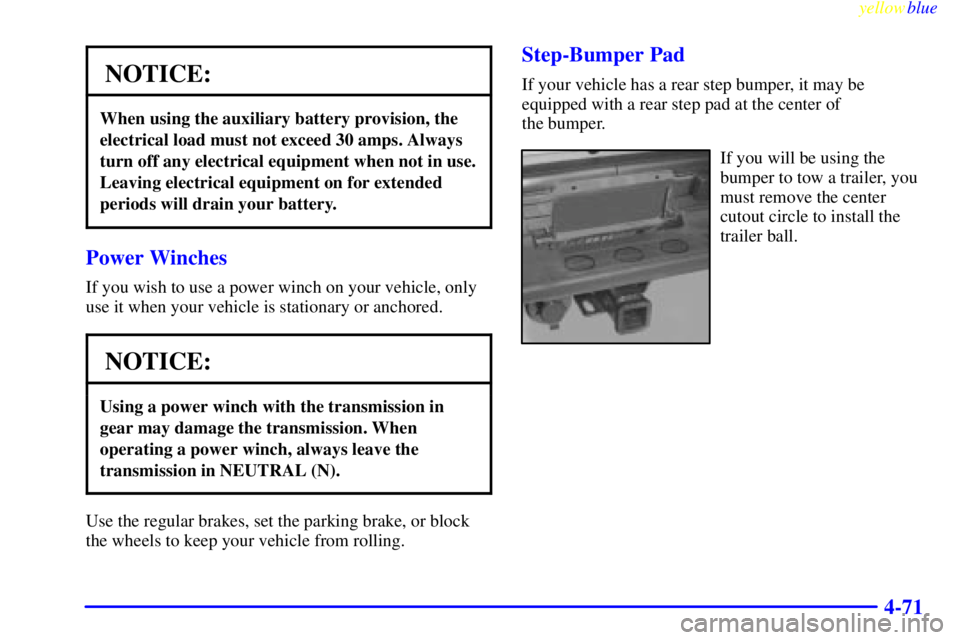
Step-Bumper Pad
If your vehicle has a rear step bumper, it may be
equipped with a rear step pad at the center of
the bumper.
If you will be using the
bumper to tow a trailer, you
must remove the center
cutout circle to install the
trailer ball.
Page 270 of 421

yellowblue
5-3
Jump Starting
If your battery has run down, you may want to use
another vehicle and some jumper cables to start your
vehicle. But please use the following steps to do
it safely.
CAUTION:
Batteries can hurt you. They can be
dangerous because:
�They contain acid that can burn you.
�They contain gas that can explode or ignite.
�They contain enough electricity to
burn you.
If you don't follow these steps exactly, some or all
of these things can hurt you.
NOTICE:
Ignoring these steps could result in costly damage
to your vehicle that wouldn't be covered by
your warranty.
The ACDelco� battery in your vehicle has a
built
-in hydrometer. Do not charge, test or jump
start the battery if the hydrometer looks clear or
light yellow. Replace the battery when there is
a clear or light yellow hydrometer and a
cranking complaint.
Trying to start your vehicle by pushing or pulling
it won't work, and it could damage your vehicle.
1. Check the other vehicle. It must have a 12-volt
battery with a negative ground system.
NOTICE:
If the other system isn't a 12-volt system with a
negative ground, both vehicles can be damaged.