Page 107 of 421

yellowblue
2-29
An indicator on the bezel near the lever shows you the
transfer case settings:
2
-Wheel High (2H): This setting is used for driving in
most street and highway situations. Your front axle is
not engaged in two
-wheel drive. This setting also
provides the best fuel economy.
4
-Wheel High (4H): Use 4HI when you need extra
traction, such as on snowy or icy roads or in most
off
-road situations. This setting also engages your front
axle to help drive your vehicle. This is the best setting to
use when plowing snow.
CAUTION:
Shifting the transfer case to NEUTRAL (N) can
cause your vehicle to roll even if the transmission
is in PARK (P), or if you have a manual
transmission, even if you are in gear. You or
someone else could be seriously injured. Be sure
to set the parking brake before placing the
transfer case in NEUTRAL (N). See ªParking
Brakeº in the Index.
NEUTRAL (N): Shift to this setting only when your
vehicle needs to be towed. The ignition switch must be
in the RUN position in order to shift the lever into
NEUTRAL (N). See ªRecreational Vehicle Towingº or
ªTowing your Vehicleº in the Index.
4
-Wheel Low (4L): This setting also engages your front
axle and delivers extra torque. You may never need
4LO. It sends maximum power to all four wheels. You
might choose 4LO if you are driving off
-road in deep
sand, deep mud, deep snow and climbing or descending
steep hills.
Page 108 of 421

yellowblue
2-30
You can shift from 2-Wheel High (2H) to 4-Wheel High
(4H) or from 4
-Wheel High (4H) to 2-Wheel High (2H)
while the vehicle is moving. Your front axle will engage
faster if you take your foot off of the accelerator for a
couple of seconds after you shift. In extremely cold
weather, it may be necessary to stop or slow the vehicle
to shift into 4
-Wheel High (4H).
To shift into or out of 4
-Wheel Low (4L) or
NEUTRAL (N):
1. Slow the vehicle to a roll, about 1 to 3 mph
(2 to 5 km/h) and shift an automatic transmission
into NEUTRAL (N), or with a manual transmission,
press the clutch pedal.
2. Shift the transfer case shift lever in one
continuous motion.
Don't pause in NEUTRAL (N) as you shift the transfer
case into 4
-Wheel Low (4L), or your gears could clash.
Remember that driving in 4
-Wheel High (4H) or
4
-Wheel Low (4L) may reduce fuel economy. Also,
driving in four
-wheel drive on dry pavement could
cause your tires to wear faster and make your transfer
case harder to shift and run noisier.
Automatic Transfer Case (If Equipped)
The transfer case switches
are located to the left of the
instrument panel cluster.
Use these switches to shift into and out of
four
-wheel drive.
Page 114 of 421

yellowblue
2-36
�Move the lever up as far as it will go.
3. Be sure the transfer case is in a drive gear
-- not in
NEUTRAL (N).
4. Turn the ignition key to LOCK.
5. Remove the key and take it with you. If you can
leave your vehicle with the ignition key in your
hand, your vehicle is in PARK (P).
Leaving Your Vehicle With the Engine
Running (Automatic Transmission Only)
CAUTION:
It can be dangerous to leave your vehicle with the
engine running. Your vehicle could move
suddenly if the shift lever is not fully in PARK (P)
with the parking brake firmly set. If you have
four
-wheel drive with a manual transfer case
shift lever and your transfer case is in
NEUTRAL (N), your vehicle will be free to roll,
even if your shift lever is in PARK (P). So be sure
the transfer case is in a drive gear
-- not in
NEUTRAL (N). And, if you leave the vehicle with
the engine running, it could overheat and even
catch fire. You or others could be injured. Don't
leave your vehicle with the engine running unless
you have to.
Page 116 of 421
yellowblue
2-38
Parking Your Vehicle
(Manual Transmission Models Only)
CAUTION:
Shifting the transfer case to NEUTRAL (N) can
cause your vehicle to roll even if the manual
transmission is in gear. You or someone else could
be seriously injured. Be sure to set the parking
brake before placing the transfer case in
NEUTRAL (N). See ªParking Brakeº in
the Index.
Before you get out of your vehicle, put your manual
transmission in REVERSE (R), turn off the engine, and
firmly apply the parking brake.
If you are parking on a hill, or if you are pulling a
trailer, see ªTowing a Trailerº in the Index.
Parking Over Things That Burn
CAUTION:
Things that can burn could touch hot exhaust
parts under your vehicle and ignite. Don't park
over papers, leaves, dry grass or other things that
can burn.
Page 129 of 421

yellowblue
2-51
To idle your vehicle with the automatic headlamp
system off, set the parking brake while the ignition is
off. Then start your vehicle. The automatic headlamp
system will stay off until you release the parking brake.
As with any vehicle, you should turn on the regular
headlamp system when you need it.
Lamps On Reminder
A reminder chime will sound when your headlamps or
parking lamps are manually turned on and your ignition
is in OFF, LOCK or ACCESSORY. To disable the
chime, rotate the thumbwheel all the way down. In the
automatic mode, the headlamps turn off once the
ignition key is in OFF.
Daytime Running Lamps
Daytime Running Lamps (DRL) can make it easier for
others to see the front of your vehicle during the day.
DRL can be helpful in many different driving
conditions, but they can be especially helpful in the
short periods after dawn and before sunset.
The DRL system will come on when:
�the ignition is on,
�the headlamp switch is in automatic headlamp mode,�the automatic transmission is not in PARK (P),
�the light sensor determines it is daytime and
�the parking brake is released.
When the DRL are on, only your DRL lamps will be on.
The taillamps, sidemarker and other lamps won't be on.
The instrument panel won't be lit up either.
When it begins to get dark, the automatic headlamp
system will switch from DRL to the headlamps or the
last chosen headlamp setting that was used.
When you turn the headlamp switch off, the headlamps
will go off, and your DRL lamps will illuminate,
provided it is not dark outside.
To idle an automatic transmission equipped vehicle with
the DRL off, set the parking brake. Shifting the
transmission into PARK (P) will also allow you to idle
the vehicle with the DRL off. The DRL will stay off
until you release the parking brake or shift the
transmission out of PARK (P).
To idle a manual transmission equipped vehicle with the
DRL off, set the parking brake. The DRL will stay off
until you release the parking brake.
As with any vehicle, you should turn on the regular
headlamp system when you need it.
Page 147 of 421
yellowblue
2-69
A. Dome Lamp Switch
B. Lamp Controls
C. Air Outlets
D. Automatic Transfer Case (If Equipped)
E. Multifunction Lever
F. Instrument Cluster
G. Gearshift Lever (Automatic Transmission)
H. Tow/Haul Selector Switch
I. Audio System
J. Comfort Control System
K. Glove BoxL. Passenger Air Bag Off Switch
M. Manual Selectable Ride Control (If Equipped)
N. Ashtray
O. Storage Area or Compact Disc Player (If Equipped)
P. Rear Window Defogger Switch (If Equipped)
Q. Lighter and Auxiliary Power Outlets
R. Parking Brake Release
S. Tilt Lever (If Equipped)
T. Center Instrument Panel Utility Block
U. Hood Release
V. Instrument Panel Fuse Block
Page 148 of 421
yellowblue
2-70
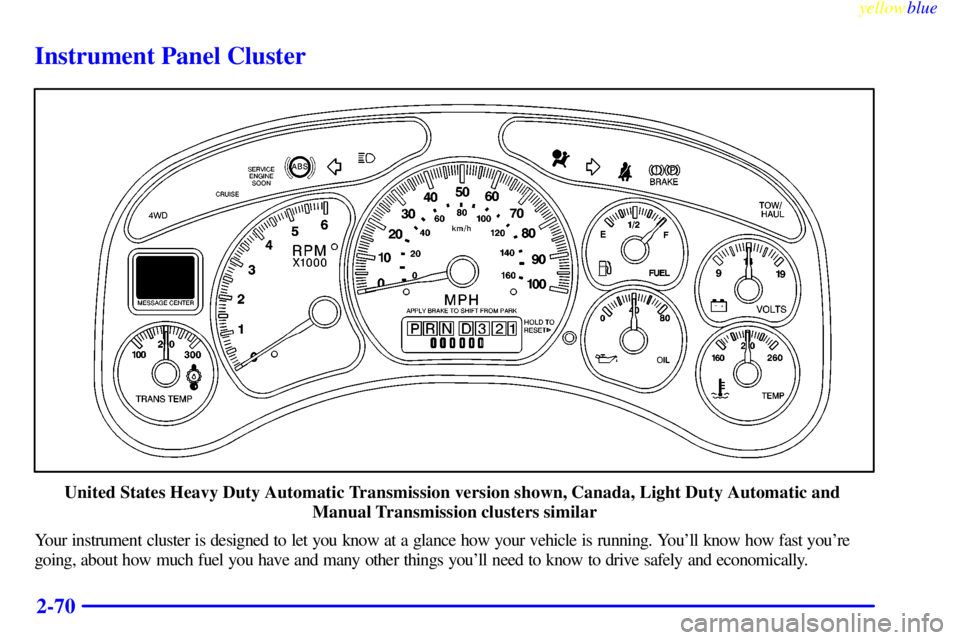
Instrument Panel Cluster
United States Heavy Duty Automatic Transmission version shown, Canada, Light Duty Automatic and
Manual Transmission clusters similar
Your instrument cluster is designed to let you know at a glance how your vehicle is running. You'll know how fast you're
going, about how much fuel you have and many other things you'll need to know to drive safely and economically.
Page 149 of 421

yellowblue
2-71 Speedometer and Odometer
Your speedometer lets you see your speed in both miles
per hour (mph) and kilometers per hour (km/h). Your
odometer shows how far your vehicle has been driven,
in either miles (used in the United States) or kilometers
(used in Canada).
Trip Odometer
The trip odometer can tell you how far your vehicle has
been driven since you last set the trip odometer to zero.
Press the reset button to toggle between the trip
odometer and the regular odometer. Holding the reset
button for two seconds while the trip odometer is
displayed will reset it.
To display the odometer reading with the ignition off,
press the reset button.
Engine Hour Meter Display
The odometer can also display the number of hours the
engine has run. To display the hour meter, turn the
ignition off, press and hold the reset button for at least
four seconds. The hour meter will be displayed for up to
30 seconds, or until the ignition is turned on.
Tachometer
Your tachometer displays the engine speed in
revolutions per minute (rpm).
NOTICE:
On vehicles with a manual transmission, if you
operate the engine with the tachometer in the red
area, your engine or other parts could be damaged.
Damage to your engine or vehicle caused by
operating the engine in the red area isn't covered
by your vehicle warranty. Don't operate the
engine with the tachometer in the red area.