Page 49 of 430
1-37
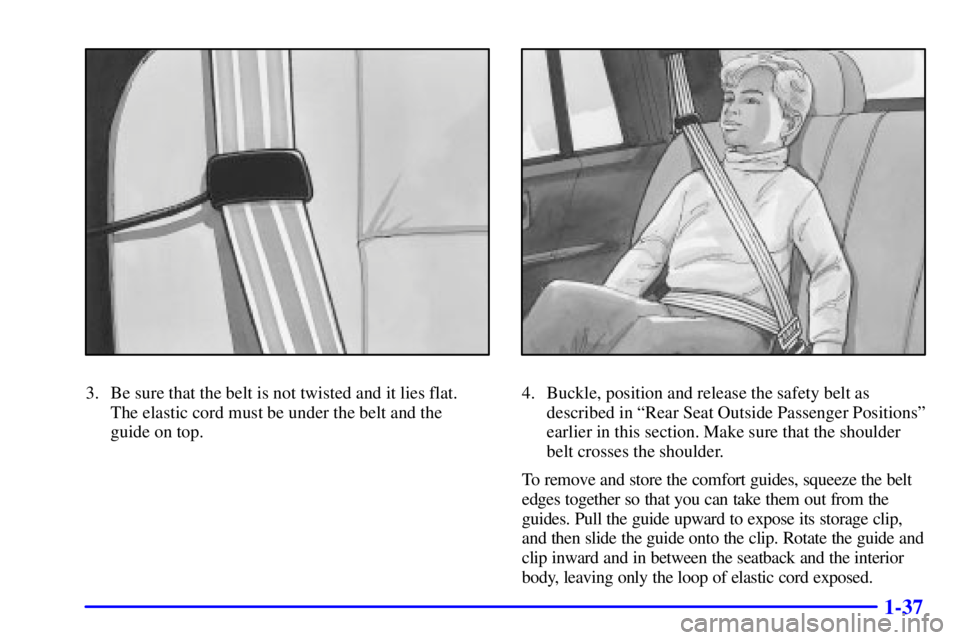
3. Be sure that the belt is not twisted and it lies flat.
The elastic cord must be under the belt and the
guide on top.4. Buckle, position and release the safety belt as
described in ªRear Seat Outside Passenger Positionsº
earlier in this section. Make sure that the shoulder
belt crosses the shoulder.
To remove and store the comfort guides, squeeze the belt
edges together so that you can take them out from the
guides. Pull the guide upward to expose its storage clip,
and then slide the guide onto the clip. Rotate the guide and
clip inward and in between the seatback and the interior
body, leaving only the loop of elastic cord exposed.
Page 50 of 430
1-38
Center Rear Passenger Position
(4-Door Models)Lap Belt
When you sit in the center rear seating position, you
have a lap safety belt which has a retractor.
1. Pick up the latch plate and pull the belt across you.
Don't let it get twisted.
2. Push the latch plate into the buckle until it clicks.
Pull up on the latch plate to make sure it is secure.
3. Feed the lap belt into the retractor to tighten it.
Page 55 of 430
1-43
A rear-facing infant restraint (B) positions an infant
to face the rear of the vehicle. Rear-facing infant
restraints are designed for infants of up to about
20 lbs. (9 kg) and about one year of age. This type
of restraint faces the rear so that the infant's head,
neck and body can have the support they need in a
frontal crash. Some infant seats come in two
parts -- the base stays secured in the vehicle and the
seat part is removable.
Page 56 of 430
1-44
A forward-facing child restraint (C-E) positions a
child upright to face forward in the vehicle. These
forward-facing restraints are designed to help
protect children who are from 20 to 40 lbs.
(9 to 18 kg) and about 26 to 40 inches
(66 to 102 cm) in height, or up to around four years
of age. One type, a convertible restraint, is
designed to be used either as a rear-facing infant
seat or a forward-facing child seat.
Page 58 of 430

1-46 Where to Put the Restraint
Accident statistics show that children are safer if they
are restrained in the rear rather than the front seat. We at
General Motors therefore recommend that you put your
child restraint in a rear seat outside position. Never put
a rear-facing child restraint in the front passenger seat.
Here's why:
CAUTION:
A child in a rear-facing child restraint can be
seriously injured or killed if the right front
passenger's air bag inflates. This is because the
back of the rear-facing child restraint would be
very close to the inflating air bag. Always secure
a rear-facing child restraint in a rear seat
outside position.
CAUTION: (Continued)
CAUTION: (Continued)
You may secure a forward-facing child restraint
in the right front seat, but before you do, always
move the front passenger seat as far back as it
will go. It's better to secure the child restraint in
a rear seat outside position.
Wherever you install it, be sure to secure the child
restraint properly.
Keep in mind that an unsecured child restraint can move
around in a collision or sudden stop and injure people in
the vehicle. Be sure to properly secure any child
restraint in your vehicle -- even when no child is in it.
Page 59 of 430
1-47 Top Strap
In Canada, the law requires that forward-facing child
restraints have a top strap, and that the strap be
anchored. In the United States, some child restraints also
have a top strap. If your child restraint has a top strap, it
should be anchored.Anchor brackets for the rear outside seat positions are
located on the floor in the cargo area of your vehicle.
Don't use the rear set of tie-down brackets. Anchor the
top strap to the closest bracket on the same side of the
vehicle as the child restraint.
Once you have the top strap anchored, you'll be ready to
secure the child restraint itself.
Page 60 of 430
1-48 Securing a Child Restraint in a Rear
Outside Seat Position
You'll be using the lap-shoulder belt. See the earlier part
about the top strap if the child restraint has one. Be sure
to follow the instructions that came with the child
restraint. Secure the child in the child restraint when and
as the instructions say.
1. Put the restraint on the seat.
2. Pick up the latch plate, and run the lap and shoulder
portions of the vehicle's safety belt through or
around the restraint. The child restraint instructions
will show you how.
If the shoulder belt goes in front of the child's face or
neck, put it behind the child restraint.
3. Buckle the belt. Make sure the release button is
positioned so you would be able to unbuckle the
safety belt quickly if you ever had to.
Page 62 of 430
1-50
To remove the child restraint, just unbuckle the vehicle's
safety belt and let it go back all the way. The safety belt
will move freely again and be ready to work for an adult
or larger child passenger.
Center Seat Positions (4-Door Models)
Don't use child restraints in these positions.
The restraints won't work properly.
Securing a Child Restraint in the Right
Front Seat Position
Your vehicle has a right front passenger air bag. Never
put a rear-facing child restraint in this seat. Here's why: