Page 155 of 256
CHANGING THE TIRES
If you get a flat tire while driving, do not apply the brake heavily.
Instead, gradually decrease your speed. Hold the steering wheel firmly
and slowly move to a safe place on the side of the road.
Spare tire information
Your vehicle may be equipped with a spare tire that can be used as
either a spare or a regular tire. The spare tire is not equipped with wheel
trim. The wheel trim from the original wheel/tire may be used on the
spare.
If your vehicle is equipped with 4WD, a spare tire of a different
size than the road tires should not be used. Such a tire could
result in damage to driveline components and make the vehicle
difficult to control.
Location of the spare tire and tools
The spare tire and tools for your vehicle are stowed in the following
locations:
Tool Location
Spare tire (pick-up
trucks only)Under the vehicle, just forward of the rear
bumper
Jack Regular cab, crew cab and SuperCab without
rear bench seat: Fastened to floor pan behind
rearmost seat on passenger side
SuperCab with rear bench seat: Under rear
bench on passenger side
Jack handle and lug
wrenchOn top of the radiator support at the front of
the engine compartment
Key, spare tire lock (if
equipped)In the glove box
Removing the spare tire (with spare tire carrier only)
1. The following tools are required to remove the spare tire:
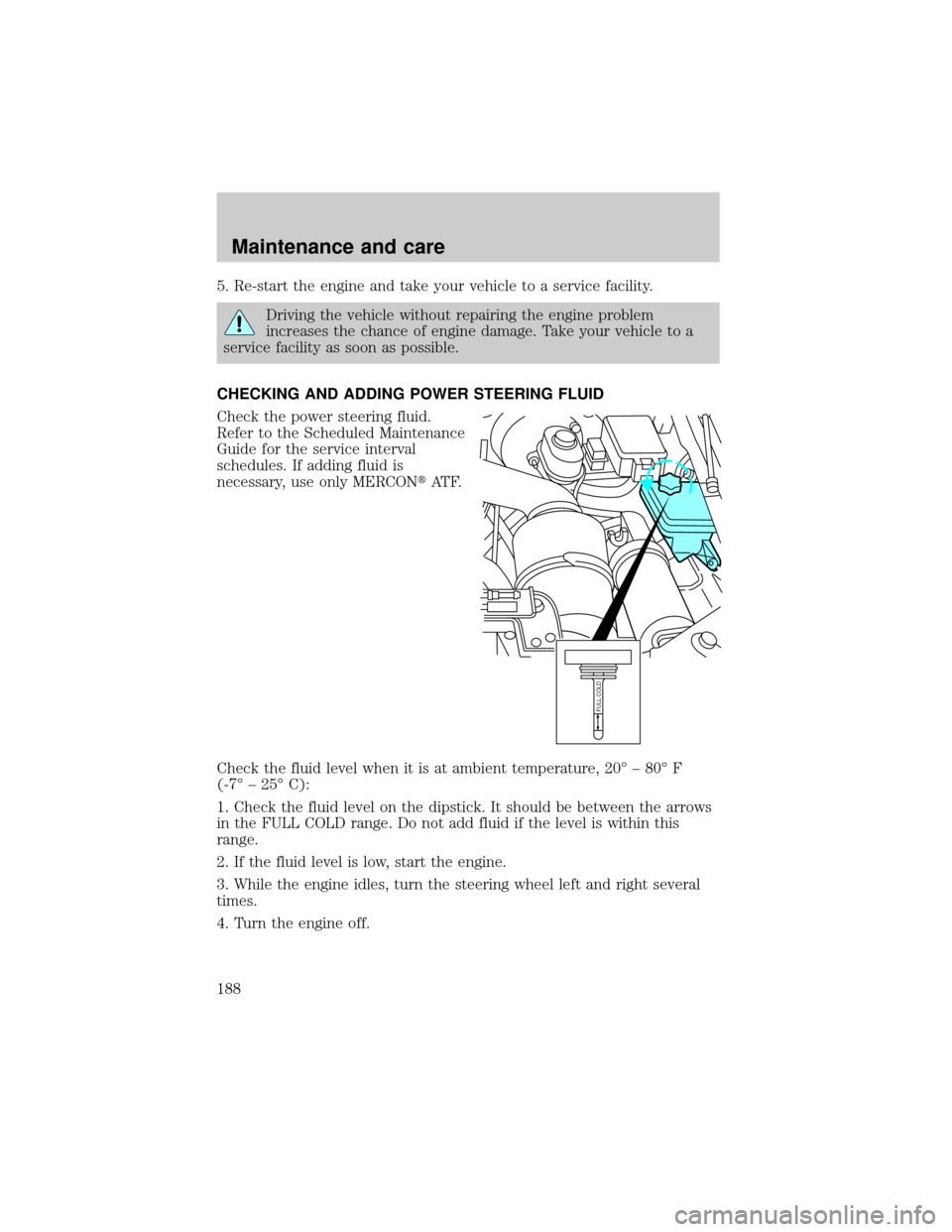
²one handle extension and one
typical extension. To assemble,
align button with hole and slide
parts together. To disconnect,
depress button and pull apart.
Roadside emergencies
155
Page 188 of 256
5. Re-start the engine and take your vehicle to a service facility.
Driving the vehicle without repairing the engine problem
increases the chance of engine damage. Take your vehicle to a
service facility as soon as possible.
CHECKING AND ADDING POWER STEERING FLUID
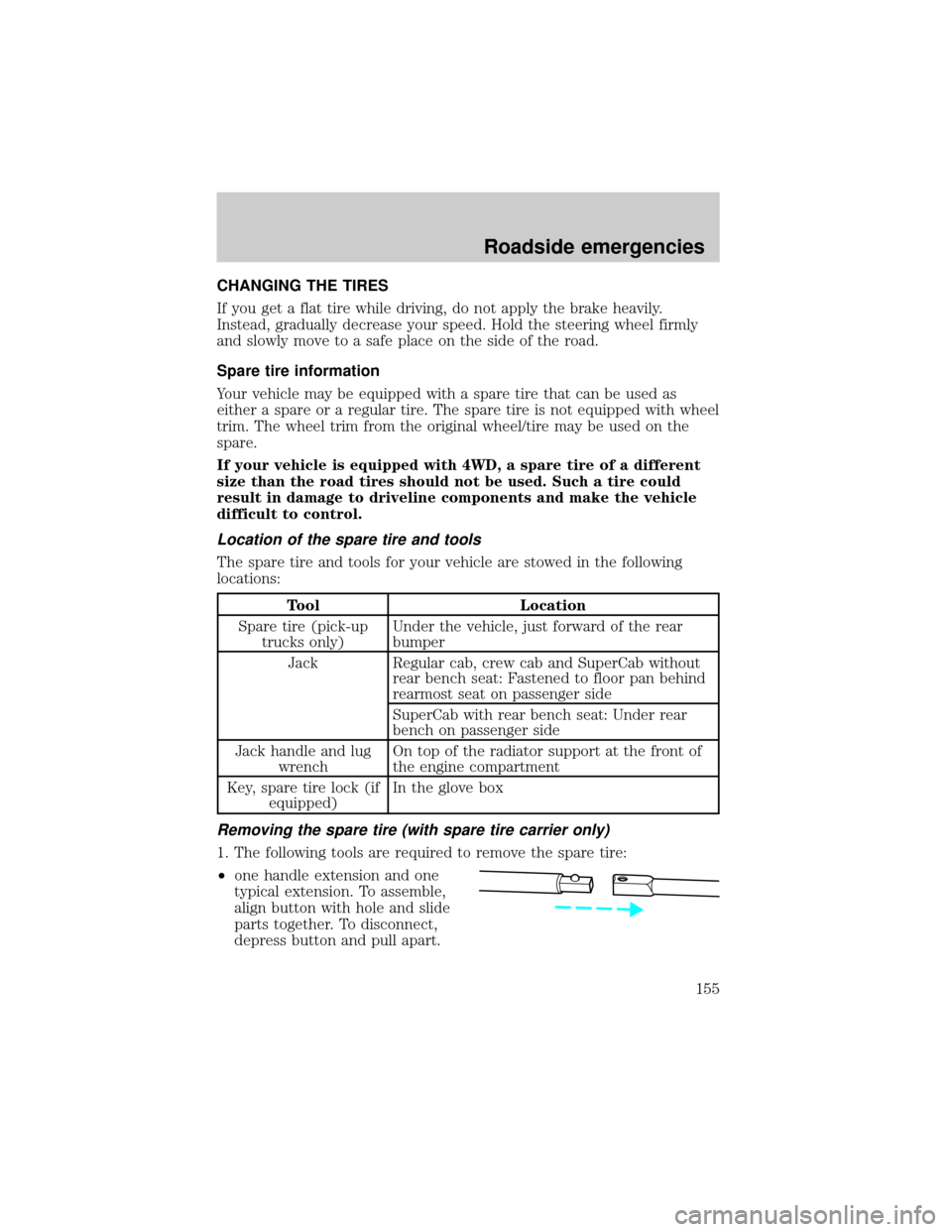
Check the power steering fluid.
Refer to the Scheduled Maintenance
Guide for the service interval
schedules. If adding fluid is
necessary, use only MERCONtAT F.
Check the fluid level when it is at ambient temperature, 20É ± 80É F
(-7É ± 25É C):
1. Check the fluid level on the dipstick. It should be between the arrows
in the FULL COLD range. Do not add fluid if the level is within this
range.
2. If the fluid level is low, start the engine.
3. While the engine idles, turn the steering wheel left and right several
times.
4. Turn the engine off.
FULL COLD
Maintenance and care
188
Page 220 of 256
Cleaning the exterior lamps
Wash with the same detergent as the exterior of your vehicle. If
necessary, use a tar remover such as Ford Extra Strength Tar and Road
Oil Remover (B7A-19520±AA).
To avoid scratching the lamps, do not use a dry paper towel, chemical
solvents or abrasive cleaners.
Cleaning the wiper blades, windshield and rear window
If the wiper blades do not wipe properly, clean the wiper blade rubber
element with undiluted windshield washer solution or a mild detergent.
To avoid damaging the blades, do not use fuel, kerosene, paint thinner or
other solvents.
If the wiper still does not wipe properly, this could be caused by
substances on the windshield or rear window such as tree sap and some
hot wax treatments used by commercial car washes. Clean the outside of
the windshield or rear window with a non-abrasive cleaner such as Ford
Ultra-Clear Spray Glass Cleaner, (E4AZ-19C507±AA), available from your
Ford Dealer.Do notuse abrasive cleansers on glass as they may cause
scratches. The windshield or rear window is clean if beads do not form
when you rinse it with water. The windshield, rear window and wiper
blades should be cleaned on a regular basis, and blades or rubber
elements replaced when worn.
Cleaning the instrument panel
Clean with a damp cloth, then dry with a dry cloth.
Avoid cleaner or polish that increases the gloss of the upper portion of
the instrument panel. The dull finish in this area helps protect the driver
from undesirable windshield reflection.
Do not use chemical solvents or strong detergents when cleaning
the steering wheel or instrument panel to avoid contamination of
the air bag system.
Cleaning the instrument cluster lens
Clean with a damp cloth, then dry with a dry cloth.
Do not use household or glass cleaners as these may damage the lens.
Maintenance and care
220
Page 251 of 256

Snowplowing ............4,141,142,143
Spark plugs,
specifications ...............222,227,228
Special notice .............................3,5
ambulance conversions ..............4
diesel-powered vehicles .............3
four-wheel
drive vehicles ...................143,144
utility-type vehicles ....................3
Specification chart,
lubricants ............................225,227
Speed control ..............................56
Speedometer ...............................17
Starting your vehicle .........104,106
jump starting ..........................166
Steering wheel
tilting .........................................60
Tachometer .................................19
Tailgate ........................................71
Tires ......................155,197,198,199
changing ...........................155,158
checking the pressure ............199
replacing ..................................201
rotating ....................................199
snow tires and chains ............201
tire grades ...............................198
treadwear ................................198
Towing .......................................199
wrecker ....................................171
Traction-lok rear axle ...............112
Transfer case
fluid checking .........................192Transmission .............................114
fluid, checking and adding
(automatic) .............................189
fluid, checking and adding
(manual) .................................191
fluid, refill capacities ..............222
lubricant specifications ...225,227
manual operation ....................117
Transmission
control indicator light .................13
Trip odometer .............................18
Turn signal .............................14,56
Vehicle dimensions ...................228
Vehicle Identification
Number (VIN) ...........................233
Vehicle loading ..........................132
Ventilating your vehicle ...........108
Warning chimes ...........................16
Warning lights (see Lights) .......10
Washer fluid ..............................182
Water, Driving through .............134
Windows
power .........................................62
Windshield washer fluid
and wipers
checking and adding fluid .....182
checking and cleaning .....196,197
operation ...................................61
replacing wiper blades ...........197
Wrecker towing .........................171
Index
251