Page 117 of 224
Should you need to arrange roadside assistance for
yourself, Ford will reimburse a reasonable amount.
To obtain information about reimbursement, call
1-800-241-3673 in the United States for Ford or
Mercury vehicles; or if you own a Lincoln vehicle,
call 1±800±521±4140. Call 1±800±665±2006 in
Canada.
Roadside coverage beyond basic warranty
In the United States, you may purchase additional
roadside assistance coverage beyond this period
through the Ford Auto Club by contacting your Ford
or Lincoln Mercury dealer.
Similarly in Canada, you may purchase additional
coverage beyond the basic coverage period by
consulting the Ford Roadside Assistance Club
brochure or by calling 1±877±294±CLUB
(1±877±894±2582).
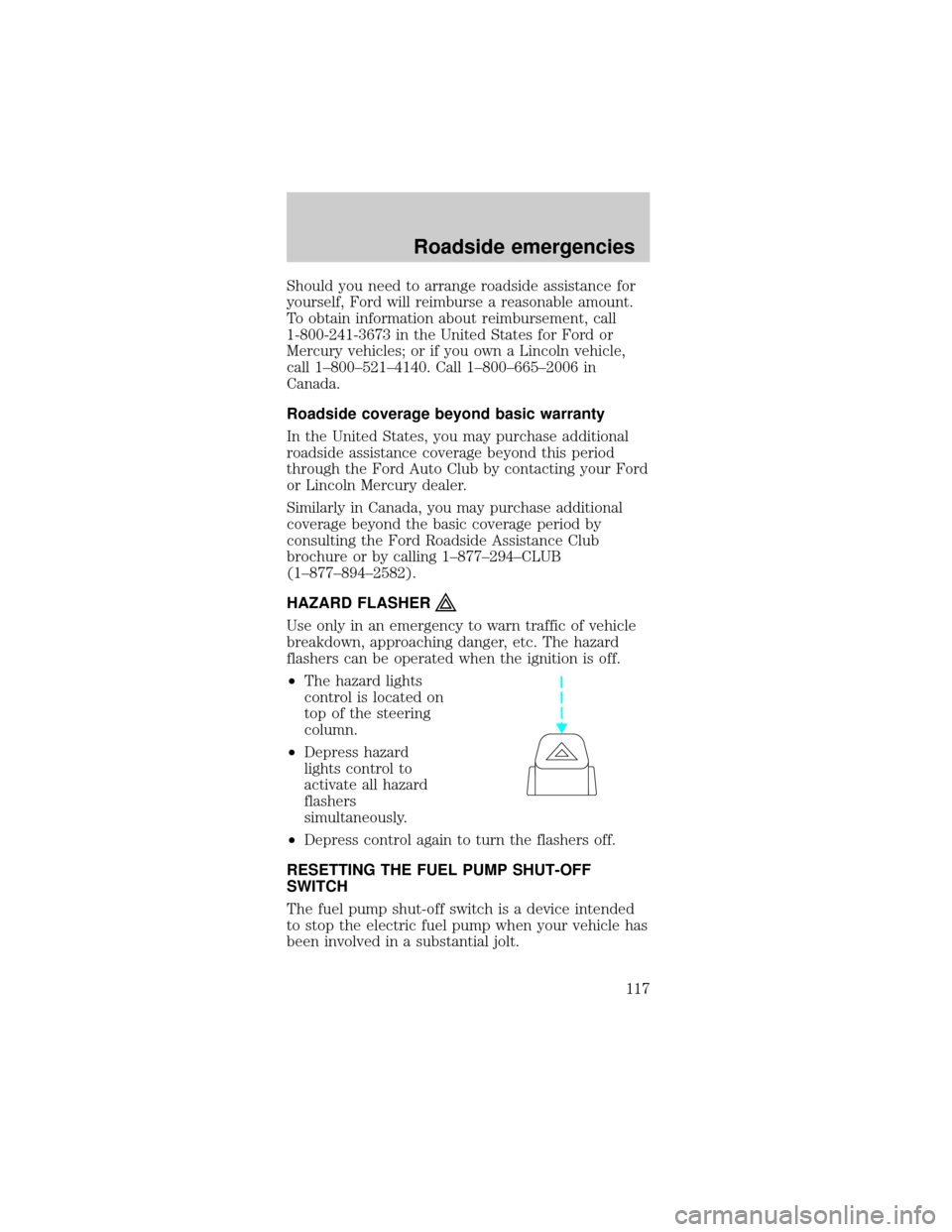
HAZARD FLASHER
Use only in an emergency to warn traffic of vehicle
breakdown, approaching danger, etc. The hazard
flashers can be operated when the ignition is off.
²The hazard lights
control is located on
top of the steering
column.
²Depress hazard
lights control to
activate all hazard
flashers
simultaneously.
²Depress control again to turn the flashers off.
RESETTING THE FUEL PUMP SHUT-OFF
SWITCH
The fuel pump shut-off switch is a device intended
to stop the electric fuel pump when your vehicle has
been involved in a substantial jolt.
Roadside emergencies
117
Page 118 of 224
After a collision, if the engine cranks but does not
start, the fuel pump shut-off switch may have been
activated.
The fuel pump shut-off
switch is located on
the left side of the
trunk behind the trunk
liner.
Use the following procedure to reset the fuel pump
shut-off switch.
1. Turn the ignition to the OFF position.
2. Check the fuel system for leaks.
3. If no fuel leak is apparent, reset the fuel pump
shut-off switch by pushing in on the reset button.
4. Turn the ignition to the ON position. Pause for a
few seconds and return the key to the OFF position.
5. Make a further check for leaks in the fuel system.
FUSES AND RELAYS
Fuses
If electrical
components in the
vehicle are not
working, a fuse may
have blown. Blown
fuses are identified by a broken wire within the fuse.
15
Roadside emergencies
118
Page 159 of 224

3. Run the engine until it reaches normal operating
temperature.
4. Allow the engine to idle for at least one minute.
5. Turn the A/C on and allow the engine to idle for
at least one minute.
6. Drive the vehicle to complete the relearning
process.
²The vehicle may need to be driven 16 km (10
miles) or more to relearn the idle and fuel trim
strategy.
²If you do not allow the engine to relearn its
idle trim, the idle quality of your vehicle may
be adversely affected until the idle trim is
eventually relearned.
If the battery has been disconnected or a new
battery has been installed, the clock and the preset
radio stations must be reset once the battery is
reconnected.
²Always dispose of
automotive batteries
in a responsible
manner. Follow your
local authorized
standards for
disposal. Call your
local authorized
recycling center to find out more about recycling
automotive batteries.
WINDSHIELD WIPER BLADES
Check the wiper blades at least twice a year or when
they seem less effective. Substances such as tree sap
and some hot wax treatments used by commercial
car washes reduce the effectiveness of wiper blades.
Checking the wiper blades
If the wiper blades do not wipe properly, clean both
the windshield and wiper blades using undiluted
LEAD
RETURN
RECYCLE
Maintenance and care
159
Page 177 of 224

Please consult your ªWarranty Guideº for complete
emission warranty information.
Readiness for Inspection/Maintenance (I/M)
testing
In some localities, it may be a legal requirement to
pass an I/M test of the on-board diagnostics system.
If your ªCheck Engine/Service Engine Soonº light is
on, refer to the description in theWarning Lights
and Chimessection of theInstrumentation
chapter. Your vehicle may not pass the I/M test with
the ªCheck Engine/Service Engine Soonº light on.
If the vehicle's powertrain system or its battery has
just been serviced, the on-board diagnostics system
is reset to a ªnot ready for I/M testº condition. To
ready the on-board diagnostics system for I/M
testing, a minimum of 30 minutes of city and
highway driving is necessary as described below:
²First, at least 10 minutes of driving on an
expressway or highway.
²Next, at least 20 minutes driving in stop-and-go,
city-type traffic with at least four idle periods.
Allow the vehicle to sit for at least eight hours
without starting the engine. Then, start the engine
and complete the above driving cycle. The engine
must warm up to its normal operating temperature.
Once started, do not turn off the engine until the
above driving cycle is complete.
BULBS
Replacing exterior bulbs
Check the operation of the following lamps
frequently:
²Headlamps
²Tail lamps
²Brakelamps
²High-mount brakelamp
Maintenance and care
177
Page:
< prev 1-8 9-16 17-24
