Page 184 of 280
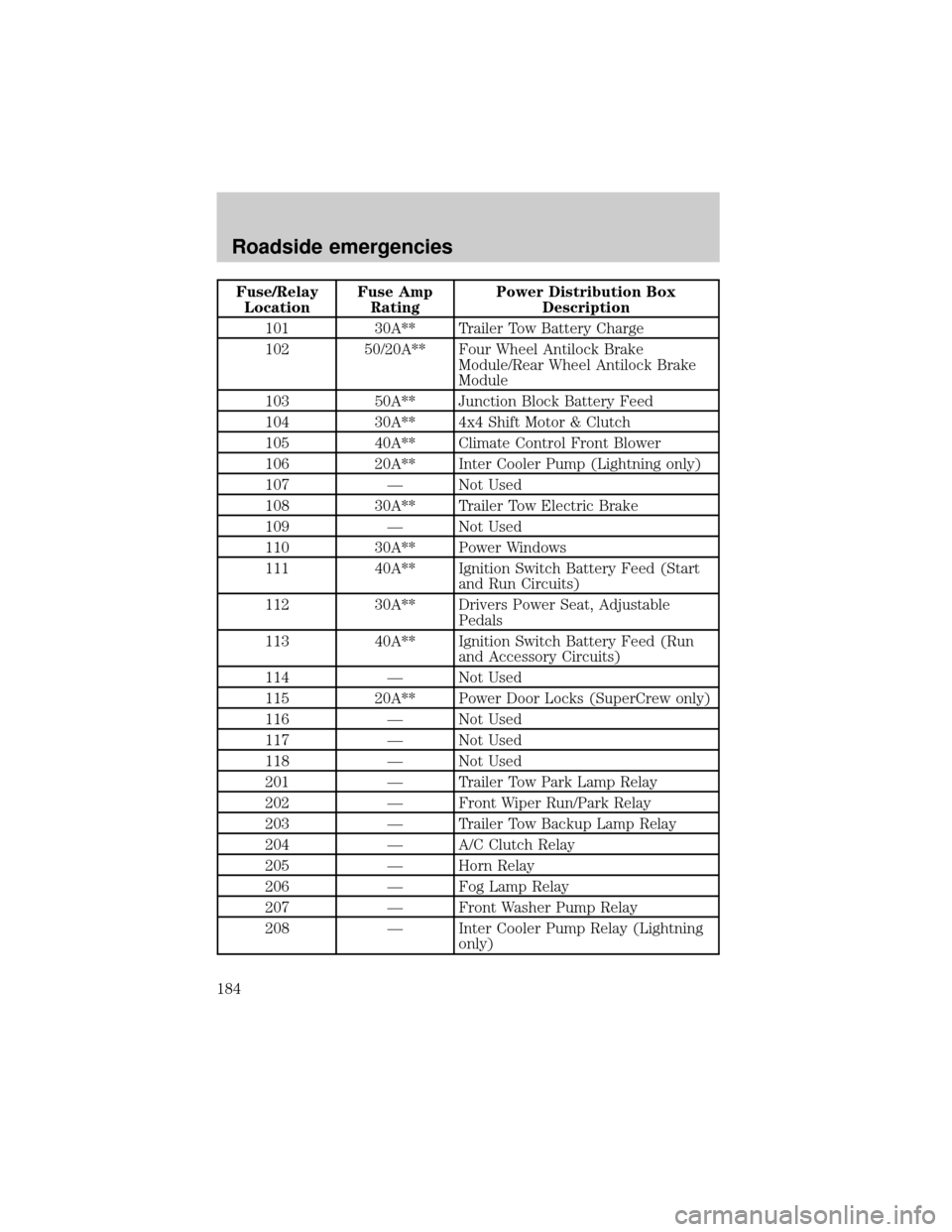
Fuse/Relay
LocationFuse Amp
RatingPower Distribution Box
Description
101 30A** Trailer Tow Battery Charge
102 50/20A** Four Wheel Antilock Brake
Module/Rear Wheel Antilock Brake
Module
103 50A** Junction Block Battery Feed
104 30A** 4x4 Shift Motor & Clutch
105 40A** Climate Control Front Blower
106 20A** Inter Cooler Pump (Lightning only)
107 Ð Not Used
108 30A** Trailer Tow Electric Brake
109 Ð Not Used
110 30A** Power Windows
111 40A** Ignition Switch Battery Feed (Start
and Run Circuits)
112 30A** Drivers Power Seat, Adjustable
Pedals
113 40A** Ignition Switch Battery Feed (Run
and Accessory Circuits)
114 Ð Not Used
115 20A** Power Door Locks (SuperCrew only)
116 Ð Not Used
117 Ð Not Used
118 Ð Not Used
201 Ð Trailer Tow Park Lamp Relay
202 Ð Front Wiper Run/Park Relay
203 Ð Trailer Tow Backup Lamp Relay
204 Ð A/C Clutch Relay
205 Ð Horn Relay
206 Ð Fog Lamp Relay
207 Ð Front Washer Pump Relay
208 Ð Inter Cooler Pump Relay (Lightning
only)
Roadside emergencies
184
Page 223 of 280
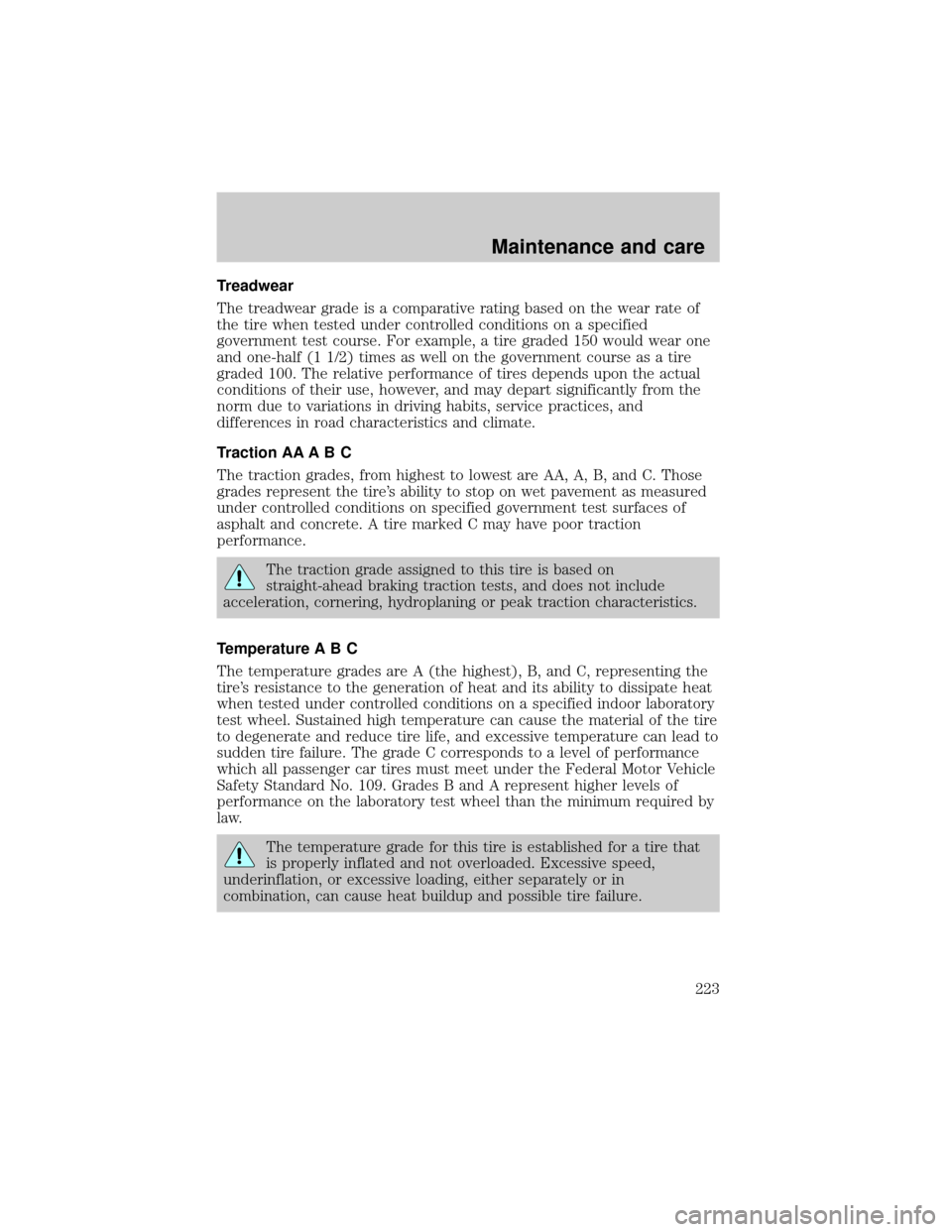
Treadwear
The treadwear grade is a comparative rating based on the wear rate of
the tire when tested under controlled conditions on a specified
government test course. For example, a tire graded 150 would wear one
and one-half (1 1/2) times as well on the government course as a tire
graded 100. The relative performance of tires depends upon the actual
conditions of their use, however, and may depart significantly from the
norm due to variations in driving habits, service practices, and
differences in road characteristics and climate.
Traction AA A B C
The traction grades, from highest to lowest are AA, A, B, and C. Those
grades represent the tire's ability to stop on wet pavement as measured
under controlled conditions on specified government test surfaces of
asphalt and concrete. A tire marked C may have poor traction
performance.
The traction grade assigned to this tire is based on
straight-ahead braking traction tests, and does not include
acceleration, cornering, hydroplaning or peak traction characteristics.
Temperature A B C
The temperature grades are A (the highest), B, and C, representing the
tire's resistance to the generation of heat and its ability to dissipate heat
when tested under controlled conditions on a specified indoor laboratory
test wheel. Sustained high temperature can cause the material of the tire
to degenerate and reduce tire life, and excessive temperature can lead to
sudden tire failure. The grade C corresponds to a level of performance
which all passenger car tires must meet under the Federal Motor Vehicle
Safety Standard No. 109. Grades B and A represent higher levels of
performance on the laboratory test wheel than the minimum required by
law.
The temperature grade for this tire is established for a tire that
is properly inflated and not overloaded. Excessive speed,
underinflation, or excessive loading, either separately or in
combination, can cause heat buildup and possible tire failure.
Maintenance and care
223
Page 226 of 280
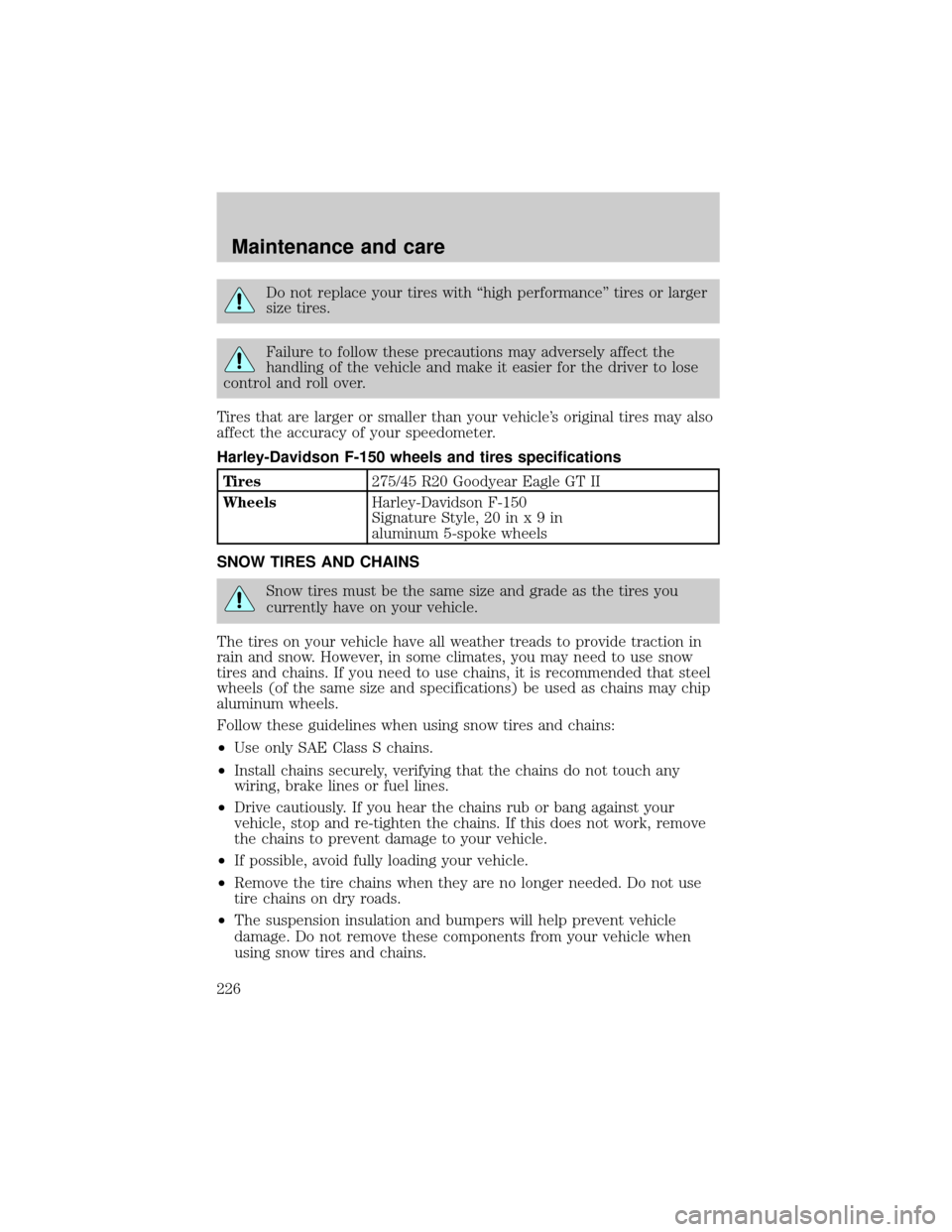
Do not replace your tires with ªhigh performanceº tires or larger
size tires.
Failure to follow these precautions may adversely affect the
handling of the vehicle and make it easier for the driver to lose
control and roll over.
Tires that are larger or smaller than your vehicle's original tires may also
affect the accuracy of your speedometer.
Harley-Davidson F-150 wheels and tires specifications
Tires275/45 R20 Goodyear Eagle GT II
WheelsHarley-Davidson F-150
Signature Style, 20 inx9in
aluminum 5-spoke wheels
SNOW TIRES AND CHAINS
Snow tires must be the same size and grade as the tires you
currently have on your vehicle.
The tires on your vehicle have all weather treads to provide traction in
rain and snow. However, in some climates, you may need to use snow
tires and chains. If you need to use chains, it is recommended that steel
wheels (of the same size and specifications) be used as chains may chip
aluminum wheels.
Follow these guidelines when using snow tires and chains:
²Use only SAE Class S chains.
²Install chains securely, verifying that the chains do not touch any
wiring, brake lines or fuel lines.
²Drive cautiously. If you hear the chains rub or bang against your
vehicle, stop and re-tighten the chains. If this does not work, remove
the chains to prevent damage to your vehicle.
²If possible, avoid fully loading your vehicle.
²Remove the tire chains when they are no longer needed. Do not use
tire chains on dry roads.
²The suspension insulation and bumpers will help prevent vehicle
damage. Do not remove these components from your vehicle when
using snow tires and chains.
Maintenance and care
226
Page 274 of 280

Cleaning your vehicle ...............242
engine compartment ..............243
exterior ............................243, 246
exterior lamps .........................244
instrument cluster lens ..........245
instrument panel ....................245
interior .....................................245
plastic parts ............................244
safety belts ..............................245
washing ....................................242
waxing .....................................242
wheels ......................................243
wiper blades ............................244
Climate control (see Air
conditioning or Heating) ............60
Clock ..........................28, 34, 45, 54
Clutch
fluid ..........................................204
operation while driving ..........147
recommended shift speeds ....149
Compass, electronic ....................75
calibration .................................77
set zone adjustment .................76
Console
overhead ....................................73
Controls
power seat .................................99
Coolant
checking and adding ..............206
refill capacities ................210, 248
specifications ..................251, 253
Cruise control
(see Speed control) ....................67
Customer Assistance ................175
Ford accessories for your
vehicle .....................................266
Ford Extended
Service Plan ............................259Getting assistance outside
the U.S. and Canada ..............265
Getting roadside assistance ...175
Getting the
service you need ....................259
Ordering additional
owner's literature ...................270
The Dispute
Settlement Board ...................262
Utilizing the Mediation/
Arbitration Program ...............265
D
Daytime running lamps
(see Lamps) ................................20
Dipstick
automatic
transmission fluid ...................213
engine oil .................................200
Doors
door ajar warning .....................15
lubricant specifications ..........251
Driveline universal joint
and slip yoke .............................218
Driving under special
conditions ..........................158±159
mud ..........................................158
sand .........................................158
snow and ice ...........................159
through water .................158, 162
E
Emergencies, roadside
jump-starting ..........................190
Emission control system ..........235
Engine ........................................253
Index
274