2000 FORD ESCORT window
[x] Cancel search: windowPage 115 of 200
The high-current fuses are coded as follows.
Fuse/Relay
LocationFuse Amp
RatingPower Distribution Box Description
FUEL INJ. 30A* Air Bags, Engine Controls, Generator
DEFOG 30A* Rear Window Defrost
MAIN 100A* Charging System, BTN, Cooling Fan, Fuel
Pump, OBD-II, ABS Fuses, Ignition Switch,
Headlamps
BTN 40A* Hazard
ABS 60A* ABS Main Relay
COOLING
FA N40A* Constant Control Relay Module
OBD-II 10A** Data Link Connector (DLC), Instrument
Cluster
FUEL
PUMP20A** Engine Controls
HEAD RH 10A** Headlamps
HEAD LH 10A** Headlamps
* Fuse Link Cartridge ** Fuse
Relays
Relays are located in the power distribution box and should be replaced
by qualified technicians.
CHANGING THE TIRES
If you get a flat tire while driving, do not apply the brake heavily.
Instead, gradually decrease your speed. Hold the steering wheel firmly
and slowly move to a safe place on the side of the road.
Temporary spare tire information
The temporary spare tire for your vehicle is labeled as such. It is smaller
than a regular tire and is designed for emergency use only.
If you use the temporary spare tire continuously or do not follow
these precautions, the tire could fail, causing you to lose control
of the vehicle, possibly injuring yourself or others.
Roadside emergencies
115
Page 161 of 200
²Fuel economy may decrease with lower temperatures during the first
12±16 km (8±10 miles) of driving.
²Driving on flat terrain offers improved fuel economy as compared to
driving on hilly terrain.
²Transmissions give their best fuel economy when operated in the top
cruise gear and with steady pressure on the gas pedal.
²Close windows for high speed driving.
EPA window sticker
Every new vehicle should have the EPA window sticker. Contact your
dealer if the window sticker is not supplied with your vehicle. The EPA
window sticker should be your guide for the fuel economy comparisons
with other vehicles.
It is important to note the box in the lower left corner of the window
sticker. These numbers represent the Range of L/100 km (MPG)
expected on the vehicle under optimum conditions. Your fuel economy
may vary depending upon the method of operation and conditions.
EMISSION CONTROL SYSTEM
Your vehicle is equipped with various emission control components and a
catalytic converter which will enable your vehicle to comply with
applicable exhaust emission standards. To make sure that the catalytic
converter and other emission control components continue to work
properly:
²Use only the specified fuel listed.
²Avoid running out of fuel.
²Do not turn off the ignition while your vehicle is moving, especially at
high speeds.
²Have the items listed in your Scheduled Maintenance Guide performed
according to the specified schedule.
The scheduled maintenance items listed in the Scheduled Maintenance
Guide are essential to the life and performance of your vehicle and to its
emissions system.
If other than Ford, Motorcraft or Ford-authorized parts are used for
maintenance replacements or for service of components affecting
emission control, such non-Ford parts should be equivalent to genuine
Ford Motor Company parts in performance and durability.
Maintenance and care
161
Page 169 of 200
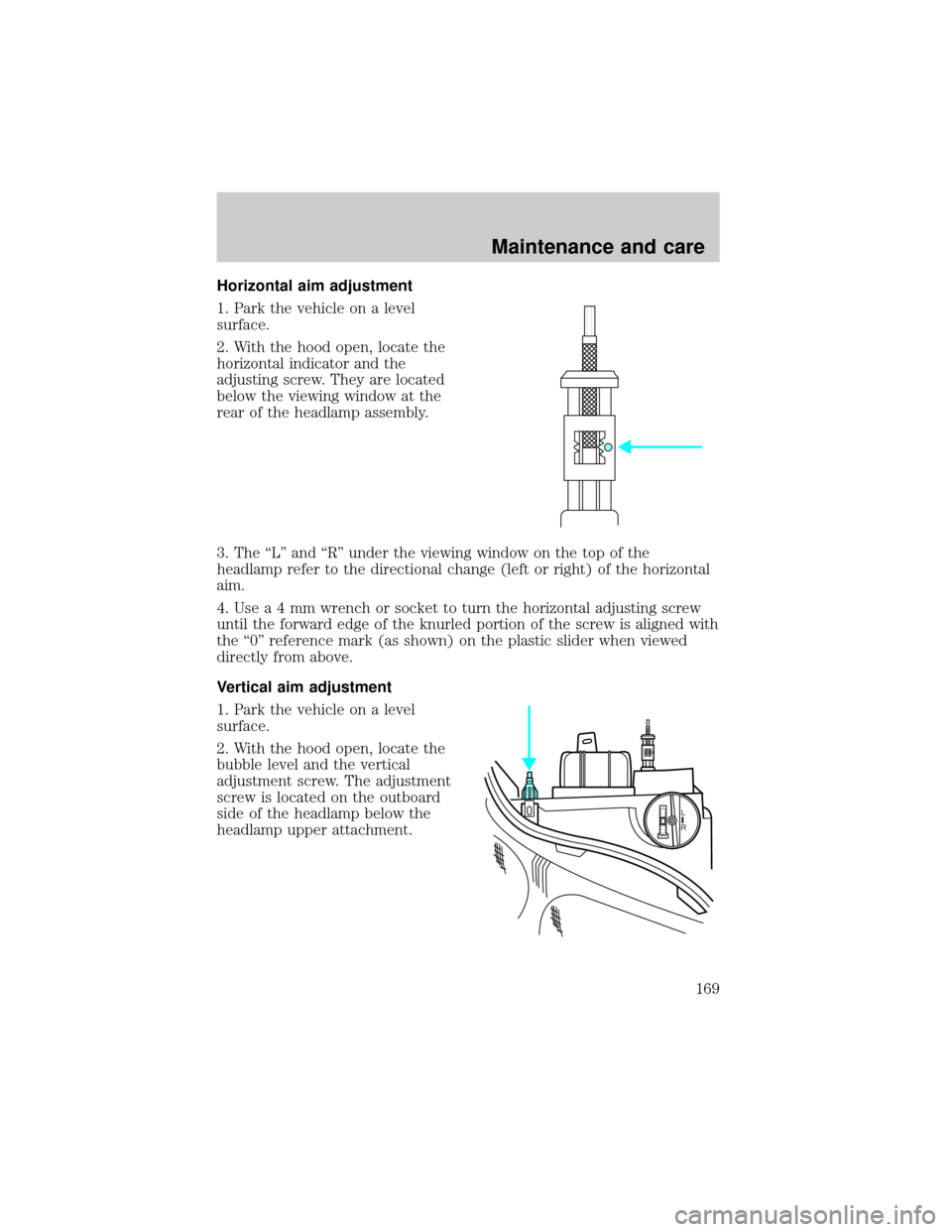
Horizontal aim adjustment
1. Park the vehicle on a level
surface.
2. With the hood open, locate the
horizontal indicator and the
adjusting screw. They are located
below the viewing window at the
rear of the headlamp assembly.
3. The ªLº and ªRº under the viewing window on the top of the
headlamp refer to the directional change (left or right) of the horizontal
aim.
4.Usea4mmwrench or socket to turn the horizontal adjusting screw
until the forward edge of the knurled portion of the screw is aligned with
the ª0º reference mark (as shown) on the plastic slider when viewed
directly from above.
Vertical aim adjustment
1. Park the vehicle on a level
surface.
2. With the hood open, locate the
bubble level and the vertical
adjustment screw. The adjustment
screw is located on the outboard
side of the headlamp below the
headlamp upper attachment.
L
R
UP
DN
Maintenance and care
169
Page 172 of 200

Underbody
Flush the complete underside of vehicle frequently. Keep body drain
holes unplugged. Inspect for road damage.
Cleaning mirrors
Do not clean your mirrors with a dry cloth or abrasive materials. Use a
soft cloth and mild detergent and water. Be careful when removing ice
from outside mirrors because you may damage the reflective surface.
Cleaning the exterior lamps
Wash with the same detergent as the exterior of your vehicle. If
necessary, use a tar remover such as Ford Extra Strength Tar and Road
Oil Remover (B7A-19520±AA).
To avoid scratching the lamps, do not use a dry paper towel, chemical
solvents or abrasive cleaners.
Cleaning the wiper blades, windshield and rear window
If the wiper blades do not wipe properly, clean the wiper blade rubber
element with undiluted windshield washer solution or a mild detergent.
To avoid damaging the blades, do not use fuel, kerosene, paint thinner or
other solvents.
If the wiper still does not wipe properly, this could be caused by
substances on the windshield or rear window such as tree sap and some
hot wax treatments used by commercial car washes. Clean the outside of
the windshield or rear window with a non-abrasive cleaner such as Ford
Ultra-Clear Spray Glass Cleaner, (E4AZ-19C507±AA), available from your
Ford Dealer.Do notuse abrasive cleansers on glass as they may cause
scratches. The windshield or rear window is clean if beads do not form
when you rinse it with water. The windshield, rear window and wiper
blades should be cleaned on a regular basis, and blades or rubber
elements replaced when worn.
Cleaning the engine
Engines are more efficient when they are clean because grease and dirt
buildup keep the engine warmer than normal. When washing:
²Take care when using a power washer to clean the engine. The high
pressure fluid could penetrate the sealed parts and cause damage.
²Do not spray with cold water to avoid cracking the engine block or
other engine components.
Maintenance and care
172
Page 174 of 200
Do not use chemical solvents or strong detergents when cleaning
the seat mounted side air bag. Such products could contaminate
the side air bag system and affect performance of the side air bag in a
collision.
Woodtone trim
Wipe stains with a soft cloth and a multi-purpose cleaning solution.
Inside windows
Use Ultra-Clear Spray Glass Cleaner (E4AZ-19C507±AA) for the inside
windows if they become fogged.
Cleaning and maintaining the safety belts
Clean the safety belts with a mild soap solution recommended for
cleaning upholstery or carpets. Do not bleach or dye the belts, because
these actions may weaken the belt webbing.
Check the safety belt system periodically to make sure there are no
nicks, wear or cuts. If your vehicle has been involved in an accident,
refer to theSafety belt maintenancesection in theSeating and safety
restraintschapter.
Cleaning leather seats (if equipped)
To clean, simply use a soft cloth dampened with water and a mild soap.
Wipe the leather again with a damp cloth to remove soap residue. Dry
with a soft cloth. For tougher soiling concerns, Ford recommends using
the Deluxe Leather Care Kit F8AZ-19G253±AA, which is available from
your Ford Dealer. This mild cleaner and special pad, cleans the leather
and maintains its natural beauty. Follow the instructions on the cleaner
label. Regular cleaning of your leather upholstery helps maintain its
resiliency and color.
Do not use household cleaning products, alcohol solutions,
solvents or cleaners intended for rubber, vinyl or plastics.
Cleaning the interior fabric
Remove dust and loose dirt with a whisk broom or a vacuum cleaner.
Remove fresh spots immediately. Do not use household or glass cleaners.
These agents can stain and discolor the fabric. Use a mild soap and
water solution if necessary.
Maintenance and care
174
Page 194 of 200

Air bag supplemental
restraint system ..........................72
and child safety seats ..............74
description ................................72
disposal ......................................76
driver air bag ............................74
indicator light ......................10,76
operation ...................................74
passenger air bag .....................74
Air cleaner filter ................148,175
Air conditioning ..........................36
Antifreeze
(see Engine coolant) ................137
Anti-lock brake system
(see Brakes) ...........................89,90
Anti-theft system ...................57,58
arming the system ....................58
disarming
a triggered system ...............58,59
disarming an
untriggered system ...................58
warning light .............................11
Audio system (see Radio) .........18
Automatic transaxle ...................92
driving with ...............................94
fluid, adding ............................143
fluid, checking ........................143
fluid, refill capacities ..............175
fluid, specification ..................177
Axle
lubricant specifications ..........176
Battery .......................................146
acid, treating emergencies .....146
charging
system warning light ................11
jumping a disabled battery ....119
maintenance-free ....................146
replacement, specifications ...175
servicing ..................................146
Belt minder .................................68
Brakes ..........................................89
anti-lock ................................89,90anti-lock brake system (ABS)
warning light ........................11,90
brake warning light ..................10
fluid, checking and adding ....135
fluid, refill capacities ..............175
fluid, specifications ..........176,177
lubricant specifications ...176,177
parking ......................................90
shift interlock ............................92
Break-in period .............................3
Capacities for refilling fluids ....175
Certification Label ....................180
Child safety restraints ................77
child safety belts ......................77
Child safety seats ........................78
attaching with tether straps ....82
in front seat ..............................79
in rear seat ................................79
Cleaning your vehicle ...............170
engine compartment ..............172
exterior .............................171,172
exterior lamps .........................172
instrument panel ....................173
instrument panel lens ............173
interior ..............................173,174
mirrors .....................................172
plastic parts ............................171
safety belts ..............................174
washing ....................................170
waxing .....................................171
wheels ......................................171
windows ..................................174
wiper blades ............................172
woodtone trim ........................174
Climate control (see Air
conditioning or Heating) ............36
Clock .......................................24,32
Clutch
fluid ..........................................136
operation while driving ............97
recommended shift speeds ......99
Index
194
Page 195 of 200

Coolant
checking and adding ..............137
refill capacities .................141,175
specifications ...................176,177
Cruise control
(see Speed control) ....................43
Customer Assistance ................105
Ford accessories
for your vehicle ......................189
Ford Extended
Service Plan ............................182
Getting assistance outside
the U.S. and Canada ..............188
Getting roadside assistance ...105
Getting the
service you need ....................182
Ordering additional
owner's literature ...................192
The Dispute
Settlement Board ...................185
Utilizing the Mediation/
Arbitration Program ...............188
Daytime running lamps
(see Lamps) ................................41
Defrost
rear window ..............................40
Dipstick
automati
c transmission fluid ................143
engine oil .................................132
Doors
lubricant specifications ..........176
Driving under special
conditions
through water .........................104
Emergencies, roadside
jump-starting ..........................119
Emission control system ..........161
Engine .................................177,178
check engine/
service engine soon light ...........9
cleaning ...................................172coolant .....................................137
idle speed control ...................146
lubrication
specifications ...................176,177
refill capacities ........................175
service points ...................130,131
starting after a collision .........106
Engine block heater ...................87
Engine oil ..................................132
checking and adding ..............132
dipstick ....................................132
filter, specifications .........134,175
recommendations ...................134
refill capacities ........................175
specifications ...................176,177
Exhaust fumes ............................88
Floor mats ...................................52
Fluid capacities .........................175
Foglamps .....................................42
Fuel ............................................153
calculating fuel economy .......158
cap ...........................................155
capacity ...................................175
choosing the right fuel ...........156
comparisons with EPA fuel
economy estimates .................161
detergent in fuel .....................157
filling your
vehicle with fuel .......153,155,158
filter, specifications .........158,175
fuel pump shut-off switch .....106
gauge .........................................13
improving fuel economy ........158
low fuel warning light ................8
octane rating .............156,177,178
quality ......................................157
running out of fuel .................157
safety information relating to
automotive fuels .....................153
Fuses ...................................108,110
Gas cap (see Fuel cap) ............155
Index
195
Page 198 of 200

fluid, checking and adding
(manual) .................................145
lubricant specifications ..........176
Trip odometer .............................14
Trunk ...........................................52
remote release .....................17,55
Turn signal .............................11,43
Vehicle dimensions ...................178
Vehicle Identification Number
(VIN) ..........................................181
Vehicle loading ..........................100
Ventilating your vehicle .............88
Warning chimes ...........................12Warning lights (see Lights) .........8
Washer fluid ..............................136
Water, Driving through .............104
Windows
power .........................................51
Windshield washer fluid and
wipers
checking and adding fluid .....136
checking and cleaning ............149
operation ...................................48
replacing wiper blades ...........149
Wrecker towing .........................124
Index
198