Refer toCleaning and maintaining the safety beltsin the
Maintenance and caresection.
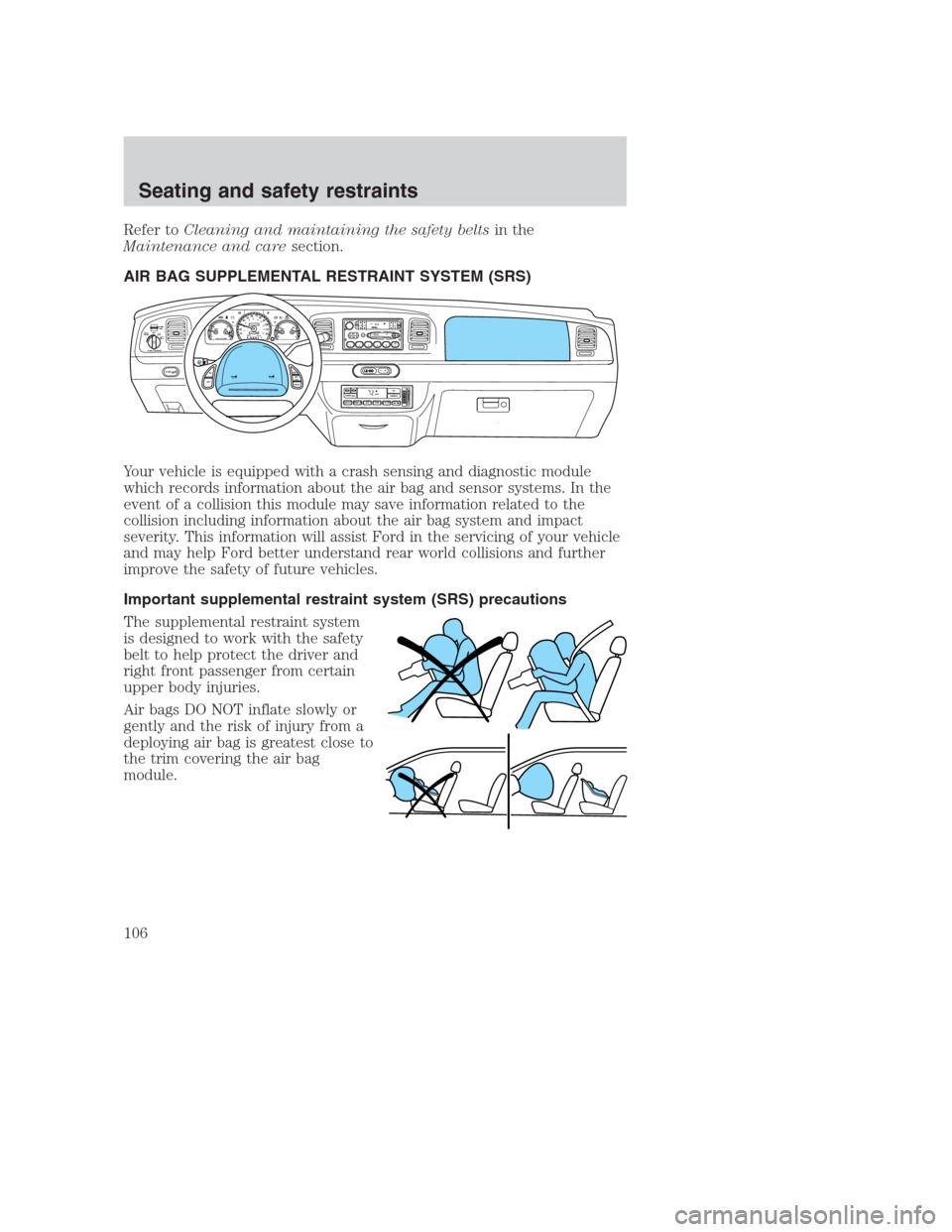
AIR BAG SUPPLEMENTAL RESTRAINT SYSTEM (SRS)
Your vehicle is equipped with a crash sensing and diagnostic module
which records information about the air bag and sensor systems. In the
event of a collision this module may save information related to the
collision including information about the air bag system and impact
severity. This information will assist Ford in the servicing of your vehicle
and may help Ford better understand rear world collisions and further
improve the safety of future vehicles.
Important supplemental restraint system (SRS) precautions
The supplemental restraint system
is designed to work with the safety
belt to help protect the driver and
right front passenger from certain
upper body injuries.
Air bags DO NOT inflate slowly or
gently and the risk of injury from a
deploying air bag is greatest close to
the trim covering the air bag
module.
E
CHECK
ENGINEAIR
SUSPOD
OFF
BRAKE
TEMP OIL VOLTS FUEL
MPH km/h10 203040506070
80
90
10 0
11 0
12 020 406080100
120
140
160
180
200H H
L C F H
L< FUEL FILL DOOR
N
O
R
M
A
/
CV
E
N
TF
L
O
O
RF
L
R
•
D
E
FD
E
FH
I
L
OM
A
X
A
/
CO
U
T
S
ID
E
T
E
M
PA
U
T
O
M
A
T
I
C O
F
FFA
UTO
R
E
W
S
ID
E1
-2 F
FS
C
A
NE
JB
A
S
ST
R
E
BB
A
LF
A
D
EV
O
L
- P
U
S
H
O
NS
E
E
K
T
U
N
E123456fwD
O
L
B
Y
B
N
RF
M
1S
TC
DC
L
K A
M
F
M
T
A
P
E
A
M
S
R.DEF.
AUTO
LAMP0FFPANEL
DIM
PUSH INTERIOR
HM
P R N D 2 110:35
HI
LO
F
OFFONRSM
SET
ACC
COAST
Seating and safety restraints
106
TRACTION CONTROL�(IF EQUIPPED)
Your vehicle may be equipped with the optional Traction Control�
system. This system helps you maintain the stability and steerability of
your vehicle. It is especially useful on slippery and/or hilly road surfaces.
The system operates by detecting and controlling wheel spin. The system
borrows many of the electronic and mechanical elements already present
in the anti-lock braking system (ABS).
Wheel-speed sensors allow excess rear wheel spin to be detected by the
Traction Control�portion of the ABS computer. Any excessive wheel
spin is controlled by automatically applying and releasing the rear brakes
in conjunction with engine torque reductions. Engine torque reduction is
realized via the fully electronic spark and fuel injection systems. This
process is very sensitive to driving conditions and very fast acting. The
rear wheels “search” for optimum traction several times a second and
adjustments are made accordingly.
The Traction Control�system will allow your vehicle to make better use
of available traction on slippery surfaces. The system is a driver aid
which makes your vehicle easier to handle primarily on snow and ice
covered roads.
During Traction Control�operation you may hear an electric motor type
of sound coming from the engine compartment and the engine will not
“rev-up” when you push further on the accelerator. This is normal
system behavior.
If you should become stuck in snow or ice or on a very slippery road
surface, try switching the Traction Control�system off. This may allow
excess wheel spin to “dig” the vehicle out and enable a successful
“rocking” maneuver.
If the Traction Control�system is cycled excessively, the brake portion
of the system will shut down to prevent the rear brakes from
overheating. A limited Traction Control�function using only engine
torque reduction will still control wheels from over-spinning. When the
rear brakes have cooled down, the system will again function normally.
Anti-lock braking is not affected by this condition and will function
normally during the cool down period.
The traction control indicator
flashes during a Traction Control�
system event.
TRAC
CNTL
Driving
125