Page 95 of 248
Seating and safety restraints
95 Children and safety belts
Children who are too large for child
safety seats (as specified by the
child safety seat manufacturer)
should always wear safety belts.
Follow all the important safety
restraints and air bag precautions
that apply to adult passengers in
your vehicle.
If the shoulder belt portion of a
combination lap and shoulder belt
can be positioned so it does not
cross or rest in front of the child’s
face or neck, the child should wear
the lap and shoulder belt. Moving
the child closer to the center of the
vehicle may help provide a good
shoulder belt fit.
If the shoulder belt cannot be
properly positioned:
• move the child to one of the
seats with a lap belt only (if
equipped),
OR
• if the child is the appropriate
size, restrain the child in a safety
seat.
14CSSen 17.6.99 11:00 Uhr Seite 95
Page 96 of 248
Seating and safety restraints
96To improve the fit of lap and
shoulder belts on children who
have outgrown child safety seats,
Ford recommends use of a belt-
positioning booster seat that is
labelled as conforming to all federal
motor vehicle safety standards.
Belt-positioning booster seats raise
the child and provide a shorter,
firmer seating posture and better
fit of lap and shoulder belts on the
child. A belt-positioning booster
seat should be used if the shoulder
belt rests in front of the child’s face
or neck, or if the lap belt does not
fit snugly on both thighs, or if the
thighs are too short to let the child
sit all the way back on the seat
cushion when the lower legs hang
over the edge of the seat cushion.
You may wish to discuss the special
needs of your child with your
pediatrician.
14CSSen 17.6.99 11:00 Uhr Seite 96
Page 97 of 248
Seating and safety restraints
97 Built-in child safety seat
(if equipped)
The rear seat may include a built-in
child seat. This child seat conforms
to all federal and local motor
vehicle safety standards. Read the
labels located on the child seat
cushion and shoulder belt for
information on the built-in child
seat.
Use the built-in child seat only if
the child is at least one year old,
weighs 10-27 kg (22-60 lbs) and
the child’s shoulders fit below the
shoulder harness slots on the built-
in child seat.
Children not meeting these
requirements should be secured in
an aftermarket seat. Refer to Child
safety seatsin this chapter. Built-in child seats
All built-in child restraints,
including seats, buckles,
retractors, seat latches, interlocks,
and attaching hardware should be
inspected by a qualified dealer
technician after any collision.
14CSSen 17.6.99 11:00 Uhr Seite 97
Page 98 of 248
Seating and safety restraints
98
Child seat interlock safety
feature
The interlock ensures that a child
is not placed in the integrated child
seat when the folding seatback is
not securely latched.
It prevents the seatback from being
unlatched while the child seat is in
use. When the child seat is
deployed, the seatback cannot be
released.
Built-in child seat retractors
The belts on built-in child seats are
equipped with a retractor. The
retractor will automatically snug
the belts around the child. If the
belts do not remain snug, take the
vehicle to your dealer or a qualified
technician for child seat repair. The
belts will not remain snug during a
collision if the retractor is not
functioning properly.
14CSSen 7/2/99 9:04 AM Page 98
Page 102 of 248
Seating and safety restraints
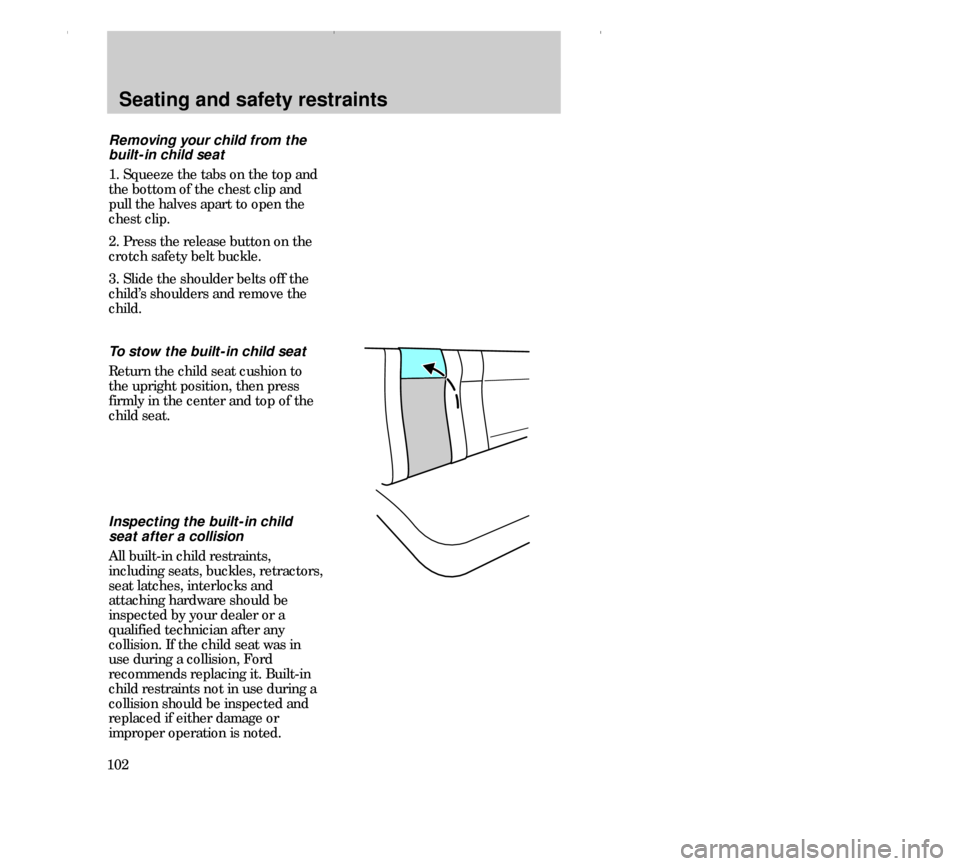
102To stow the built-in child seat
Return the child seat cushion to
the upright position, then press
firmly in the center and top of the
child seat. Removing your child from the
built-in child seat
1. Squeeze the tabs on the top and
the bottom of the chest clip and
pull the halves apart to open the
chest clip.
2. Press the release button on the
crotch safety belt buckle.
3. Slide the shoulder belts off the
child’s shoulders and remove the
child.
Inspecting the built-in child
seat after a collision
All built-in child restraints,
including seats, buckles, retractors,
seat latches, interlocks and
attaching hardware should be
inspected by your dealer or a
qualified technician after any
collision. If the child seat was in
use during a collision, Ford
recommends replacing it. Built-in
child restraints not in use during a
collision should be inspected and
replaced if either damage or
improper operation is noted.
14CSSen 17.6.99 11:00 Uhr Seite 102
Page 103 of 248

Seating and safety restraints
103
Carefully follow all of the
manufacturer’s instructions
included with the safety seat you
put in your vehicle. If you do not
install and use the safety seat
properly, the child may be injured
in a sudden stop or collision.
Ford recommends the use of a
child safety seat having a top tether
strap. Install the child safety seat in
a seating position which is capable
of providing a tether anchorage.
For more information on top tether
straps see Child safety seat tether
belt anchorin this chapter.
When installing a child safety seat:
• Use the correct safety belt
buckle for that seating postion.
• Make sure the tongue is securely
fastened in the buckle.
• Keep the buckle release button
pointing up and away from the
safety seat, with the tongue
between the child seat and the
release button, to prevent
accidental unbuckling.
• Put the safety belt in the
automatic locking mode. Refer to
Using automatic locking modein
this chapter. Child safety seats
14CSSen 17.6.99 11:00 Uhr Seite 103
Page 104 of 248

Seating and safety restraints
104Child safety seat tether belt
anchor
All vehicles include a tether
anchorage hardware kit for use
with child safety seats. Some
manufacturers make child safety
seats with a tether strap that goes
over the back of the vehicle seat
and attaches to an anchoring point
behind the vehicle seat.
Attachment holes (at each rear
seating position) have been
provided in your vehicle to attach
the anchorage hardware, if
required. Additional kits can be
obtained at no charge from any
authorized Ford dealer.
(Installations instructions are
included in the kit.)
2. Pull down on the shoulder belt
and then grasp the shoulder belt
and lap belt together. Installing child safety seats in
combination lap and shoulder
belt seat positions
1. Position the child safety seat in a
seat with a combination lap and
shoulder belt.
When using forward-facing
child seats move the
passenger seat as far back from
the instrument panel as possible.
Never secure rear-facing infant
seats in the front seat.
14CSSen 17.6.99 11:00 Uhr Seite 104
Page 133 of 248
Driving
133
It is extremly dangerous to
ride in a cargo area, inside or
outside of a vehicle. In a collision,
people riding in these areas are
more likely to be seriously injured
or killed. Do not allow people to
ride in any area of your vehicle
that is not equipped with seats
and safety belts. Be sure everyone
in your vehicle is in a seat and
using a safety belt properly.
Driving with a heavy load
The total weight of the vehicle plus
the total weight of passengers and
cargo should never exceed the
GVWR.
The weight that the vehicle carries
over the front and rear axles
should never exceed the GAWR for
the respective axle.
The weight limits of your vehicle’s
tires affect the GVWR and GAWR
limitations. Using tires with higher
weight limits than the original tires
will not increase the GVWR or
GAWR of your vehicle; using tires
with lower weight limits may lower
the GVWR or GAWR of your
vehicle.
22CDren 17.6.99 11:09 Uhr Seite 133