Page 2 of 429
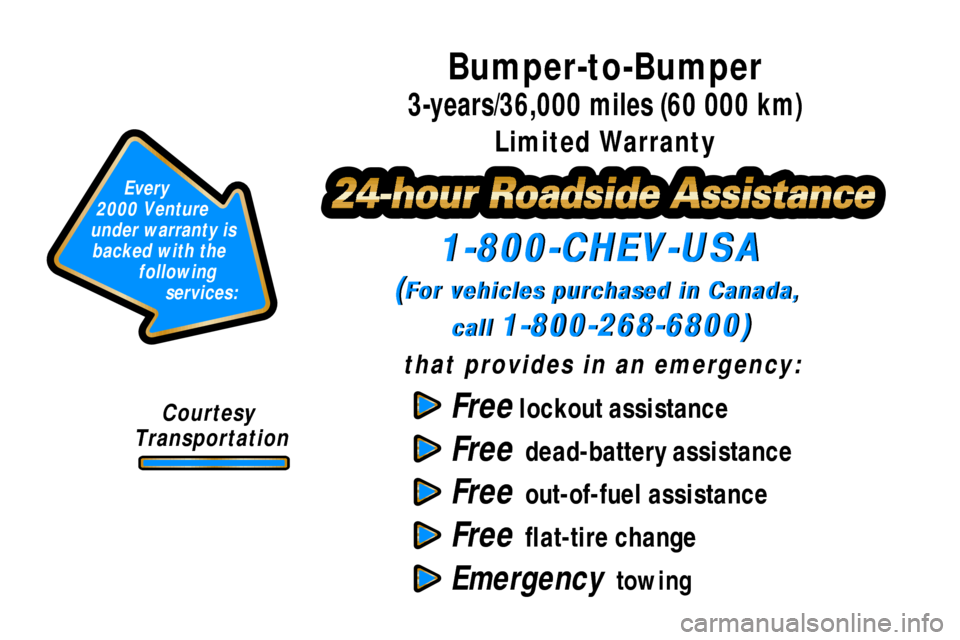
Free lockout assistance
Free dead-battery assistance
Free out-of-fuel assistance
Free flat-tire change
Emergency towing
1-800-CHEV-USA
(For vehicles purchased in Canada,
call
1-800-268-6800)
that provides in an emergency:
1-800-CHEV-USA
(For vehicles purchased in Canada,
call
1-800-268-6800)
Bumper-to-Bumper
3-years/36,000 miles (60 000 km)
Limited Warranty
Courtesy
Transportation
Every
2000 Venture
under warranty is
backed with the
following
services:
Page 6 of 429
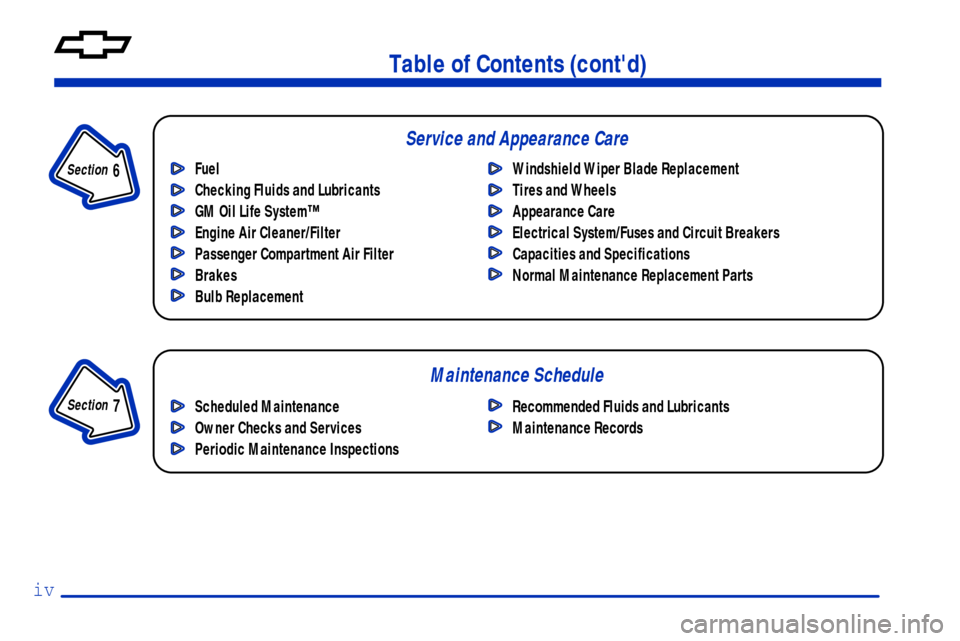
Table of Contents (cont'd)
Maintenance Schedule Service and Appearance Care
Section
7
Section
6
Scheduled Maintenance
Owner Checks and Services
Periodic Maintenance InspectionsRecommended Fluids and Lubricants
Maintenance Records Fuel
Checking Fluids and Lubricants
GM Oil Life System™
Engine Air Cleaner/Filter
Passenger Compartment Air Filter
Brakes
Bulb ReplacementWindshield Wiper Blade Replacement
Tires and Wheels
Appearance Care
Electrical System/Fuses and Circuit Breakers
Capacities and Specifications
Normal Maintenance Replacement Parts
iv
Page 11 of 429
ix
For example,
these symbols
are used on an
original battery:
CAUTION
POSSIBLE
INJURY
PROTECT
EYES BY
SHIELDING
CAUSTIC
BATTERY
ACID COULD
CAUSE
BURNS
AVOID
SPARKS OR
FLAMES
SPARK OR
FLAME
COULD
EXPLODE
BATTERY
These symbols
are important
for you and
your passengers
whenever your
vehicle is
driven:
DOOR LOCK
UNLOCK
FASTEN
SEAT
BELTS
POWER
WINDOW
AIR BAG
These symbols
have to do with
your lamps:
MASTER
LIGHTING
SWITCH
TURN
SIGNALS
PARKING
LAMPS
HAZARD
WARNING
FLASHER
DAYTIME
RUNNING
LAMPS
FOG LAMPS
These symbols
are on some of
your controls:
WINDSHIELD
WIPER
WINDSHIELD
WASHER
WINDSHIELD
DEFROSTER
REAR
WINDOW
DEFOGGER
VENTILATING
FAN
These symbols
are used on
warning and
indicator lights:
ENGINE
COOLANT
TEMP
BATTERY
CHARGING
SYSTEM
BRAKE
COOLANT
ENGINE OIL
PRESSURE
ANTI-LOCK
BRAKES
Here are some
other symbols
you may see:
FUSE
LIGHTER
HORN
SPEAKER
FUEL
Vehicle Symbols
These are some of the symbols you may find on your vehicle.
Page 12 of 429
Service Station Guide
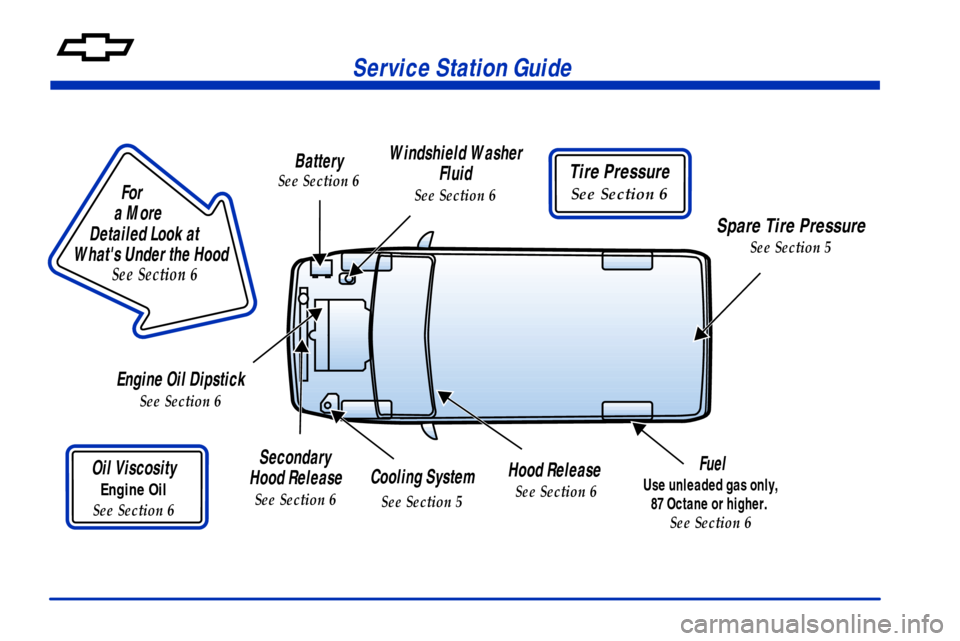
For
a More
Detailed Look at
What's Under the Hood
See Section 6
Battery
See Section 6
Windshield Washer
Fluid
See Section 6
Tire Pressure
See Section 6
Spare Tire Pressure
See Section 5
Fuel
Use unleaded gas only,
87 Octane or higher.
See Section 6
Hood Release
See Section 6Cooling System
See Section 5
Secondary
Hood Release
See Section 6
Oil Viscosity
Engine Oil
See Section 6
Engine Oil Dipstick
See Section 6
Page 128 of 429
2-24 Exiting Programming Mode
To exit programming mode, just turn the key from
ACCESSORY to OFF and put the BCM PRGRM fuse
back into the instrument panel fuse block.
After programming a feature, you can exit the
programming mode at anytime. Also, if your vehicle is
equipped with the content
-theft deterrent system,
remember to arm the system before exiting.
Sliding Door
To open the sliding door from outside the vehicle, pull
the handle out and then pull the door toward the rear. If
you slide the door all the way back, the door will rest in
a detent position. The door must overcome this detent
when closing.
To move the door forward, you must first pull the door
past the open detent position.
If your vehicle has a sliding door on the driver's side,
the door is designed to open only a little if the fuel door
is open. If this ever happens, don't try to force the
sliding door. Just close the driver's side sliding door.
Then when the fuel filler door is closed, the driver's side
sliding door can be opened normally.
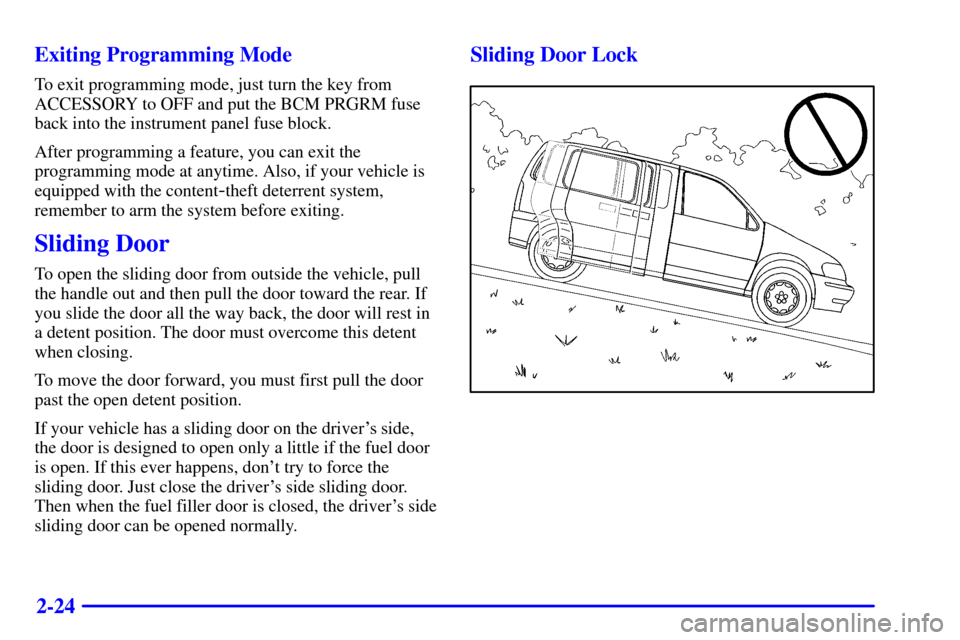
Sliding Door Lock
Page 138 of 429
2-34
Content Theft-Deterrent (Option)
If your vehicle has this option, it has a theft-deterrent
alarm system.
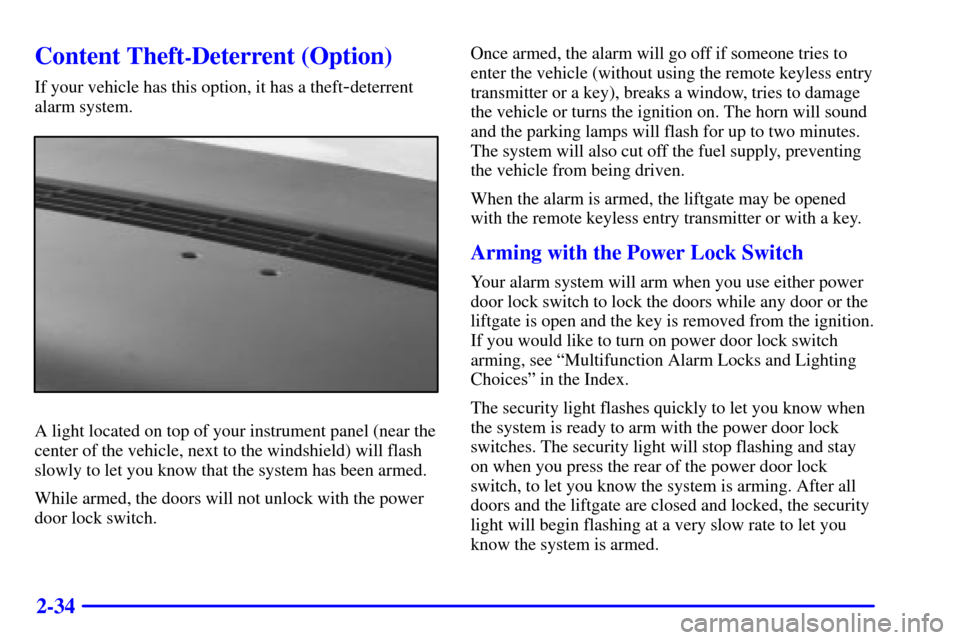
A light located on top of your instrument panel (near the
center of the vehicle, next to the windshield) will flash
slowly to let you know that the system has been armed.
While armed, the doors will not unlock with the power
door lock switch.Once armed, the alarm will go off if someone tries to
enter the vehicle (without using the remote keyless entry
transmitter or a key), breaks a window, tries to damage
the vehicle or turns the ignition on. The horn will sound
and the parking lamps will flash for up to two minutes.
The system will also cut off the fuel supply, preventing
the vehicle from being driven.
When the alarm is armed, the liftgate may be opened
with the remote keyless entry transmitter or with a key.
Arming with the Power Lock Switch
Your alarm system will arm when you use either power
door lock switch to lock the doors while any door or the
liftgate is open and the key is removed from the ignition.
If you would like to turn on power door lock switch
arming, see ªMultifunction Alarm Locks and Lighting
Choicesº in the Index.
The security light flashes quickly to let you know when
the system is ready to arm with the power door lock
switches. The security light will stop flashing and stay
on when you press the rear of the power door lock
switch, to let you know the system is arming. After all
doors and the liftgate are closed and locked, the security
light will begin flashing at a very slow rate to let you
know the system is armed.
Page 140 of 429

2-36
If you are still having trouble with nuisance alarms, you
can turn off the content theft
-deterrent system by
programming your content theft
-deterrent to Mode 3.
See ªMultifunction Alarm Locks and Lighting Choicesº
in the Index for more information. See your dealer or
qualified technician for service.
PASS-Key� III
Your vehicle is equipped
with the PASS
-Key III
(Personalized Automotive
Security System)
theft
-deterrent system.
PASS
-Key III is a passive
theft
-deterrent system. This
means you don't have to do
anything different to arm or
disarm the system. It works
when you insert or remove
the key from the ignition.
Your PASS
-Key III system operates on a radio
frequency subject to Federal Communications
Commission (FCC) Rules and with Industry Canada.This device complies with Part 15 of the FCC Rules.
Operation is subject to the following two conditions:
(1) this device may not cause harmful interference,
and (2) this device must accept any interference
received, including interference that may cause
undesired operation.
This device complies with RSS
-210 of Industry Canada.
Operation is subject to the following two conditions:
(1) this device may not cause interference, and
(2) this device must accept any interference received,
including interference that may cause undesired
operation of the device.
Changes or modifications to this system by other than an
authorized service facility could void authorization to
use this equipment.
PASS
-Key III uses a radio frequency transponder in the
key that matches a decoder in your vehicle.
When the PASS
-Key III system senses that someone is
using the wrong key, it shuts down the vehicle's starter
and fuel systems. The starter will not work and fuel will
stop being delivered to the engine. Anyone using a
trial
-and-error method to start the vehicle will be
discouraged because of the high number of electrical
key codes.
Page 145 of 429
2-41
NOTICE:
Your engine is designed to work with the
electronics in your vehicle. If you add electrical
parts or accessories, you could change the way
the engine operates. Before adding electrical
equipment, check with your dealer. If you don't,
your engine might not perform properly.
If you ever have to have your vehicle towed,
see the part of this manual that tells how to do it
without damaging your vehicle. See ªTowing
Your Vehicleº in the Index.
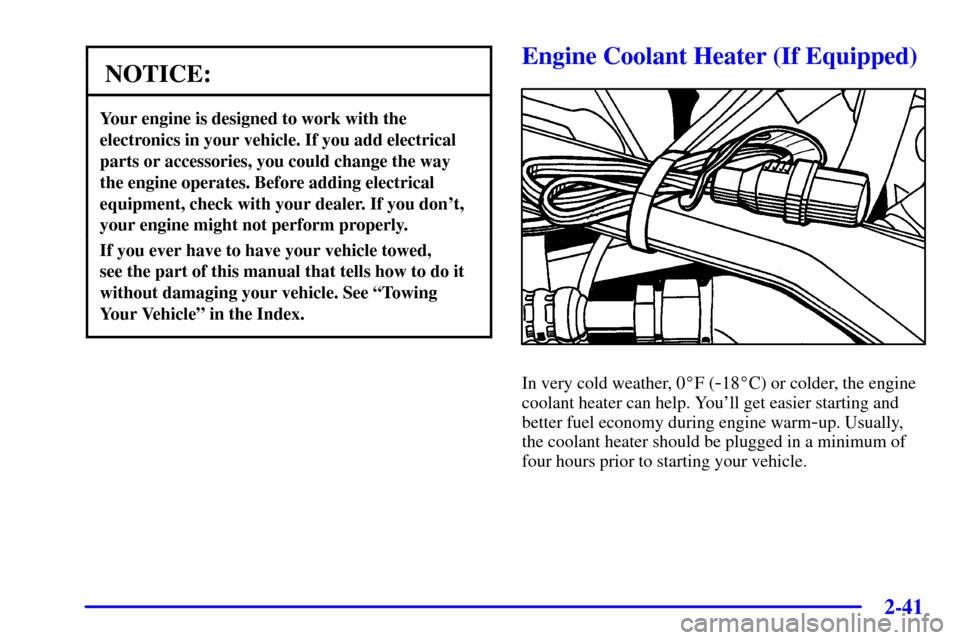
Engine Coolant Heater (If Equipped)
In very cold weather, 0�F (-18�C) or colder, the engine
coolant heater can help. You'll get easier starting and
better fuel economy during engine warm
-up. Usually,
the coolant heater should be plugged in a minimum of
four hours prior to starting your vehicle.