Page 349 of 429
6-25 How to Check Power Steering Fluid
Turn the key off, let the engine compartment cool down,
wipe the cap and the top of the reservoir clean, then
unscrew the cap and wipe the dipstick with a clean rag.
Replace the cap and completely tighten it. Then remove
the cap again and look at the fluid level on the dipstick.
When the engine compartment is hot, the level should be
at the ªHº mark. When it's cold, the level should be at
the ªCº mark. If the fluid is at the ADD mark, you
should add fluid.
What to Use
To determine what kind of fluid to use, see
ªRecommended Fluids and Lubricantsº in the Index.
Always use the proper fluid. Failure to use the proper
fluid can cause leaks and damage hoses and seals.
Windshield Washer Fluid
What to Use
When you need windshield washer fluid, be sure to read
the manufacturer's instructions before use. If you will be
operating your vehicle in an area where the temperature
may fall below freezing, use a fluid that has sufficient
protection against freezing.
Adding Washer Fluid
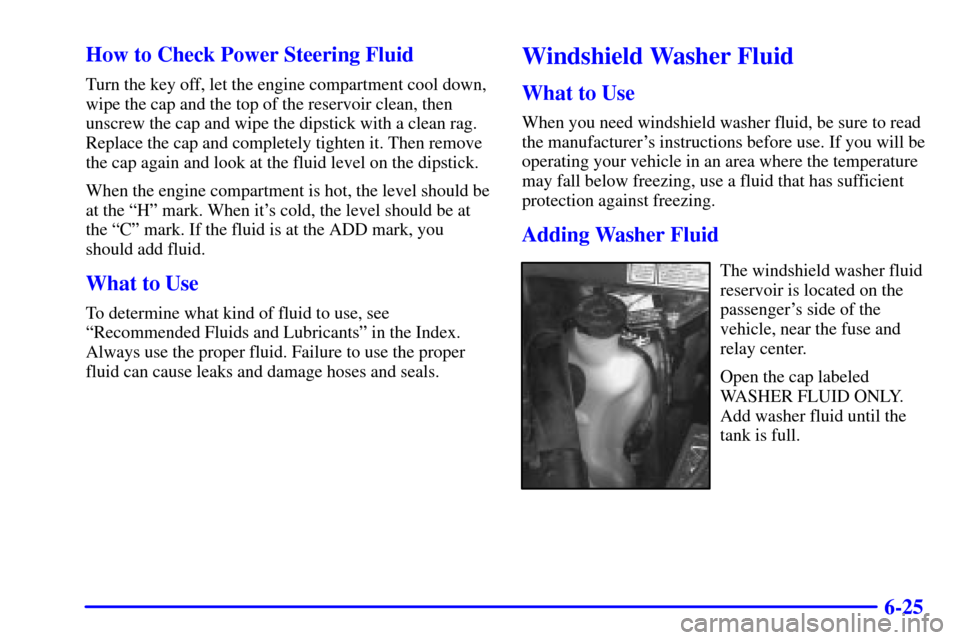
The windshield washer fluid
reservoir is located on the
passenger's side of the
vehicle, near the fuse and
relay center.
Open the cap labeled
WASHER FLUID ONLY.
Add washer fluid until the
tank is full.
Page 350 of 429
6-26
NOTICE:
�When using concentrated washer fluid,
follow the manufacturer's instructions for
adding water.
�Don't mix water with ready
-to-use washer
fluid. Water can cause the solution to freeze
and damage your washer fluid tank and
other parts of the washer system. Also,
water doesn't clean as well as washer fluid.
�Fill your washer fluid tank only
three
-quarters full when it's very cold.
This allows for expansion if freezing occurs,
which could damage the tank if it is
completely full.
�Don't use engine coolant (antifreeze) in
your windshield washer. It can damage
your washer system and paint.
Brakes
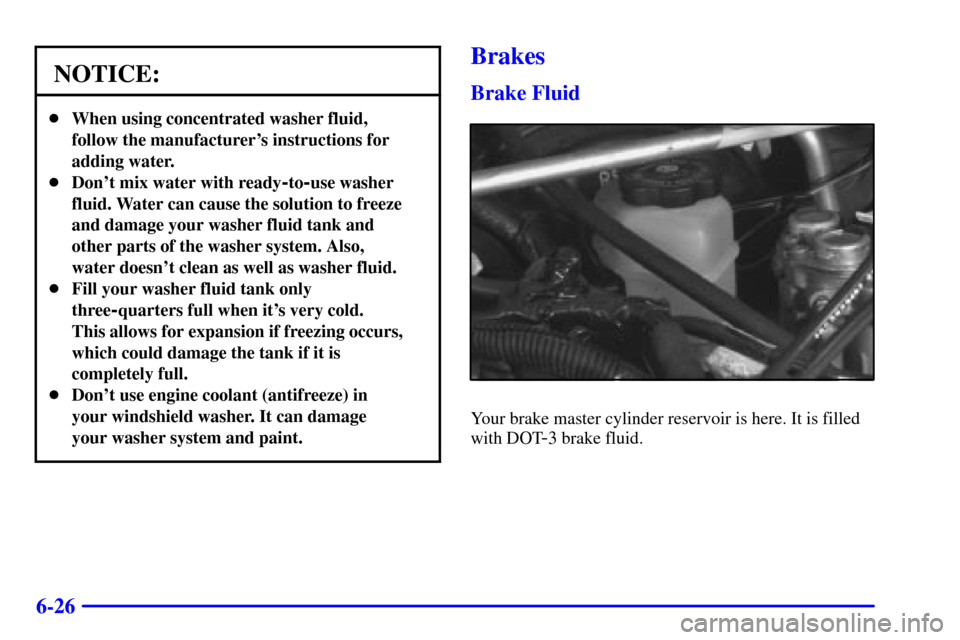
Brake Fluid
Your brake master cylinder reservoir is here. It is filled
with DOT
-3 brake fluid.
Page 351 of 429
6-27
There are only two reasons why the brake fluid level in the
reservoir might go down. The first is that the brake fluid
goes down to an acceptable level during normal brake
lining wear. When new linings are put in, the fluid level
goes back up. The other reason is that fluid is leaking out
of the brake system. If it is, you should have your brake
system fixed, since a leak means that sooner or later your
brakes won't work well, or won't work at all.
So, it isn't a good idea to ªtop offº your brake fluid.
Adding brake fluid won't correct a leak. If you add fluid
when your linings are worn, then you'll have too much
fluid when you get new brake linings. You should add
(or remove) brake fluid, as necessary, only when work is
done on the brake hydraulic system.
CAUTION:
If you have too much brake fluid, it can spill on the
engine. The fluid will burn if the engine is hot
enough. You or others could be burned, and your
vehicle could be damaged. Add brake fluid only
when work is done on the brake hydraulic system.
United States Canada
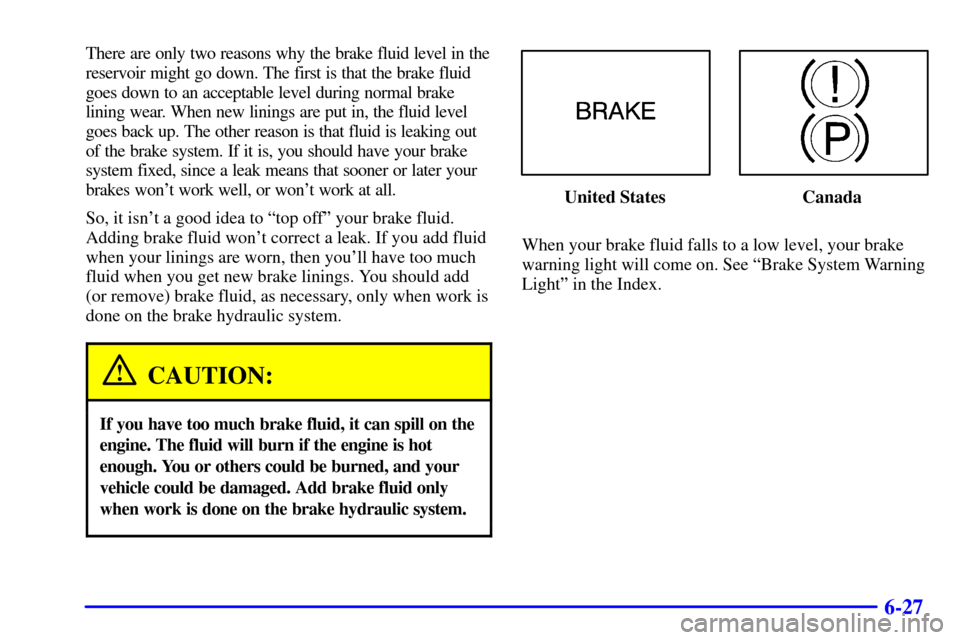
When your brake fluid falls to a low level, your brake
warning light will come on. See ªBrake System Warning
Lightº in the Index.
Page 352 of 429
6-28
What to Add
When you do need brake fluid, use only DOT
-3 brake
fluid. Refer to ªRecommended Fluids and Lubricantsº
in the Index. Use new brake fluid from a sealed
container only.
Always clean the brake fluid reservoir cap and the area
around the cap before removing it. This will help keep
dirt from entering the reservoir.
CAUTION:
With the wrong kind of fluid in your brake
system, your brakes may not work well, or they
may not even work at all. This could cause a
crash. Always use the proper brake fluid.
NOTICE:
�Using the wrong fluid can badly damage
brake system parts. For example, just a few
drops of mineral
-based oil, such as engine
oil, in your brake system can damage brake
system parts so badly that they'll have to be
replaced. Don't let someone put in the
wrong kind of fluid.
�If you spill brake fluid on your vehicle's
painted surfaces, the paint finish can be
damaged. Be careful not to spill brake fluid
on your vehicle. If you do, wash it off
immediately. See ªAppearance Careº in
the Index.
Brake Wear
Your vehicle has front disc brakes and rear drum brakes.
Disc brake pads have built
-in wear indicators that make a
high
-pitched warning sound when the brake pads are worn
and new pads are needed. The sound may come and go or
be heard all the time your vehicle is moving (except when
you are pushing on the brake pedal firmly).
Page 381 of 429
6-57
Vehicle Identification Number (VIN)
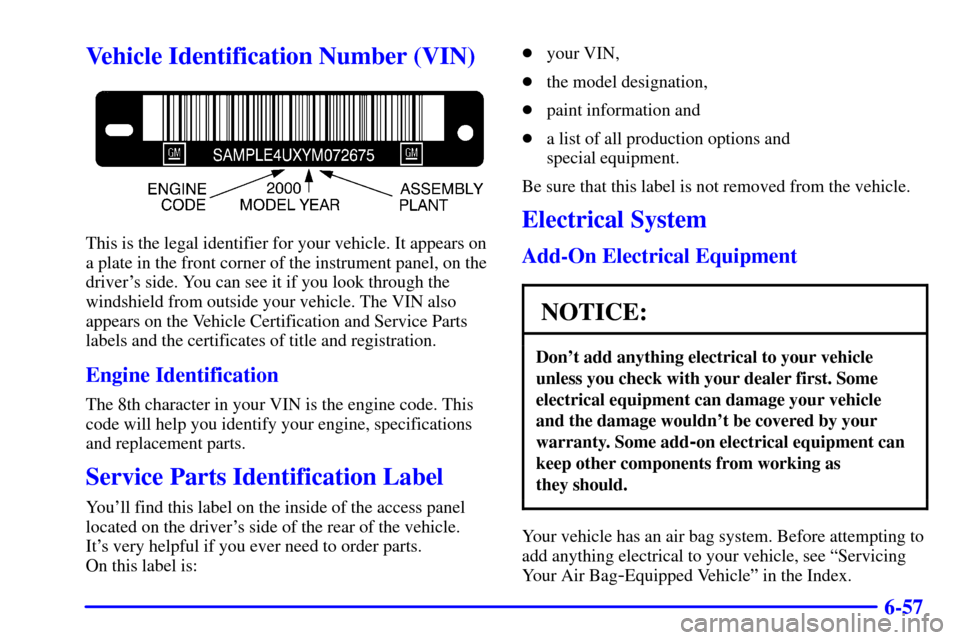
This is the legal identifier for your vehicle. It appears on
a plate in the front corner of the instrument panel, on the
driver's side. You can see it if you look through the
windshield from outside your vehicle. The VIN also
appears on the Vehicle Certification and Service Parts
labels and the certificates of title and registration.
Engine Identification
The 8th character in your VIN is the engine code. This
code will help you identify your engine, specifications
and replacement parts.
Service Parts Identification Label
You'll find this label on the inside of the access panel
located on the driver's side of the rear of the vehicle.
It's very helpful if you ever need to order parts.
On this label is:�your VIN,
�the model designation,
�paint information and
�a list of all production options and
special equipment.
Be sure that this label is not removed from the vehicle.
Electrical System
Add-On Electrical Equipment
NOTICE:
Don't add anything electrical to your vehicle
unless you check with your dealer first. Some
electrical equipment can damage your vehicle
and the damage wouldn't be covered by your
warranty. Some add
-on electrical equipment can
keep other components from working as
they should.
Your vehicle has an air bag system. Before attempting to
add anything electrical to your vehicle, see ªServicing
Your Air Bag
-Equipped Vehicleº in the Index.
Page 386 of 429
6-62
Underhood Fuse and Relay Center
This fuse and relay
center is located in the
engine compartment,
in front of the
windshield washer
fluid reservoir.
The fuses marked spare are available if a replacement
fuse is needed.
To remove the cover, turn the knob clockwise and lift up
on the remote positive (+) battery terminal cover.
Remove the cover.
Maxi Fuse Usage
1
-COOL FAN 2 Coolant Fans
2 Not Used
3
-HEADLAMPS Circuit Breakers: FRT HVAC HI
BLWR, and HEADLAMP Fuses
(Instrument Panel): HAZARD
and STOPLAMP
4
-BATT MAIN 2 Circuit Breaker: PWR
SEAT/PSD. Fuses (Instrument
Panel): ELC and RR DEFOG
Page 389 of 429
6-65
Replacement Bulbs
Headlamps 9004-HBI . . . . . . . . . . . . . . . . . . . . . . . . .
Front Turn Signal/
Parking Lamps 3157NA or 3157 NAK. . . . . . . . . .
Front Sidemarker Lamps 194. . . . . . . . . . . . . . . . . . .
Stop/Taillamps (Top) 3057. . . . . . . . . . . . . . . . . . . . .
Signal Lamps (2nd from Top) 3156. . . . . . . . . . . . . .
Back
-up Lamps (3rd from Top) 3156. . . . . . . . . . . . .
Taillamps (Bottom) 3057. . . . . . . . . . . . . . . . . . . . . .
Capacities and Specifications
The following approximate capacities are given in
English and metric conversions.
Please refer to ªRecommended Fluids and Lubricantsº
in the Index for more information.
Automatic Transaxle
Pan Removal and Replacement 8.0 quarts (7.5 L). . .
Complete Overhaul 10.0 quarts (9.5 L). . . . . . . . . . .
Cooling System
With A/C 9.6 quarts (9.1 L). . . . . . . . . . . . . . . . . . . .
With Rear Climate Control 11.9 quarts (11.3 L). . . . . Engine Crankcase
- Oil
and Filter Change4.5 quarts (4.25 L) . . . . . . . . . .
Fuel Capacity
Standard/Regular 19.8 gallons (75.0 L). . . . . . . . . . . .
Optional/Extended 25.0 gallons (94.0 L). . . . . . . . . . .
Refrigerant,
Air ConditioningSee Refrigerant . . . . . . . . . . . . . .
Label under the hood.
Tire Pressures, SizesSee Certification/Tire . . . . . . . .
label on the rear edge of the driver's door.
Wheel Nut Torque100 lb
-ft (140 N´m) . . . . . . . . . .
Windshield Washer Fluid1.0 gallon (0.37 L) . . . . .
All capacities are approximate. When adding, be sure to fill
to the appropriate level, as recommended in this manual.
Engine Specifications
Engine VIN Code E. . . . . . . . . . . . . . . . . . . . . . . . . . .
Engine Type V6. . . . . . . . . . . . . . . . . . . . . . . . . . . . . .
Firing Order 1
-2-3-4-5-6 . . . . . . . . . . . . . . . . . . . . . .
Horsepower 185. . . . . . . . . . . . . . . . . . . . . . . . . . . . .
Thermostat Temperature
Specification 195�F (91�C) . . . . . . . . . . . . . . . . . . .
Page 390 of 429
6-66
Normal Maintenance
Replacement Parts
Air Cleaner Filter AC Type A-1208C . . . . . . . . . . . . .
Battery Replacement CCA=600. . . . . . . . . . . . . . . . .
Engine Oil Filter PF47. . . . . . . . . . . . . . . . . . . . . . . .
Passenger Compartment Air Filter (2) 52482929. . . .
Radiator Pressure Cap RC27. . . . . . . . . . . . . . . . . . . .
Spark Plugs AC Type 41
-940 . . . . . . . . . . . . . . . . . . .
Gap: 0.060 inches (1.5 mm)
Windshield Wiper Blades
Length 24.0 inches (60.0 cm). . . . . . . . . . . . . . . . . .
Type Sheperd's Hook. . . . . . . . . . . . . . . . . . . . . . . . .
Wiper Blade (Backglass)
Length 16.0 inches (40.6 cm). . . . . . . . . . . . . . . . . .
Type Sheperd's Hook. . . . . . . . . . . . . . . . . . . . . . . . .
Vehicle Dimensions - Regular Wheel Base
Length 186.9 inches (474.6 cm). . . . . . . . . . . . . . . . .
Width 72.0 inches (183.0 cm). . . . . . . . . . . . . . . . . . .
Height 67.4 inches (171.2 cm). . . . . . . . . . . . . . . . . . .
Wheelbase 112.0 inches. . . . . . . . . . . . . . . . . . . . . . .
(284.5 cm)
Front Tread Width 61.5 inches (156.2 cm). . . . . . . .
Rear Tread Width 63.3 inches (160.8 cm). . . . . . . .
Vehicle Dimensions - Extended Wheel Base
Length 200.9 inches (510.2 cm). . . . . . . . . . . . . . . . .
Width 72.0 inches (183.0 cm). . . . . . . . . . . . . . . . . . .
Height 68.1 inches (172.9 cm). . . . . . . . . . . . . . . . . . .
Wheelbase 120.0 inches. . . . . . . . . . . . . . . . . . . . . . .
(304.7 cm)
Front Tread Width 61.5 inches (156.2 cm). . . . . . . .
Rear Tread Width 63.3 inches (160.8 cm). . . . . . . .